Altitude training is an appealing idea: mountain surroundings, a deliberate preparation block and possible physiological adaptation. Yet it is not a simple performance switch. The altitude and duration of your stay, training location and personal health together shape what happens, and a camp’s name cannot guarantee the result.
First distinguish the goal. Are you preparing for a race at altitude, trying to improve a result at lower elevation or exercising during a mountain holiday? These three situations require different planning. The travel experience may be valuable in itself, but it is not the same as a controlled training intervention.
What changes with altitude?
At greater altitude, atmospheric pressure falls, reducing the partial pressure of inhaled oxygen. This creates a different situation for the body from running at lower elevation. It does not mean all oxygen simply disappears from mountain air.
The CDC Yellow Book chapter on altitude describes the time needed for acclimatisation and the problem of ascending too quickly. Initial acclimatisation does not happen in one session and is not identical to every later, longer-term change.
Other aspects of the mountain environment also influence performance: temperature, wind, route, ground and travel fatigue. Do not automatically reduce the explanation for a slower first run to one mechanism.
Three frequently discussed training models
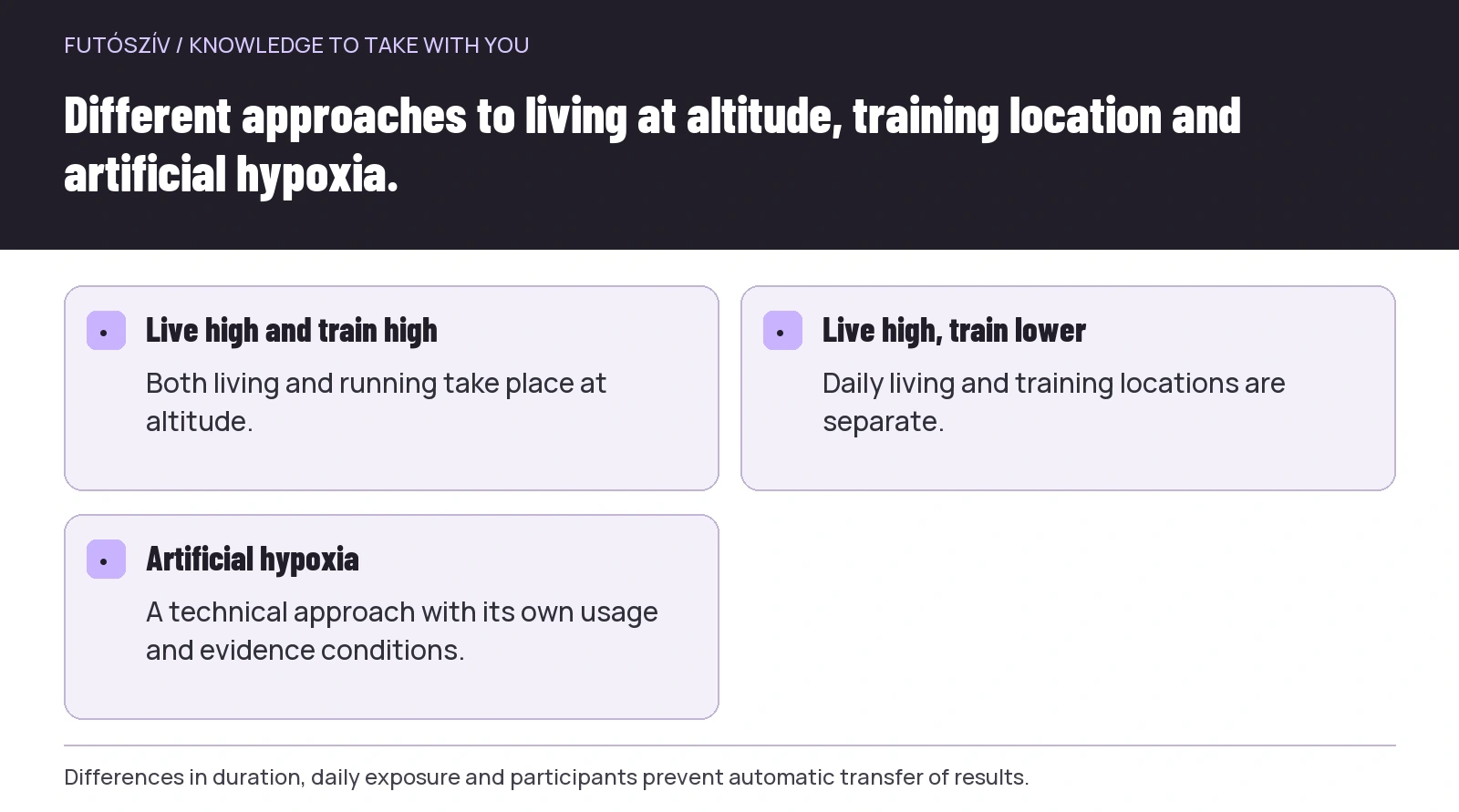
Living and training at altitude concentrates the day in one environment. The live-high, train-low concept separates the environment for living from that for faster work. Artificially reduced oxygen availability can provide another technical approach.
The names can cover many differences. Hours spent in the environment, sleeping altitude, where and how intensely you train, and the block’s duration all matter. It is therefore unhelpful to expect the same result from a short mountain visit as from a research protocol lasting several weeks.
Look at the full description rather than the model’s label. The word altitude in an offer does not by itself identify the research supporting the programme or the arrangements for monitoring health and training.
What did a classic running experiment show?
A randomised study involving thirty-nine competitive runners compared different living and training altitudes. Under the study’s conditions, the group living high and training lower improved over five thousand metres. The protocol was part of a supervised preparation process lasting several weeks.
This is an important finding, but not a personal time promise. Participants’ training status, the preparatory phase, camp and measurement procedure all belong to it. A recreational runner’s shorter trip cannot be calculated from the group’s average change.
The practical question is what transfers to your circumstances. A camp’s value may come from a calmer schedule, shared training or routes suited to your goal. Name these separately from altitude’s physiological effect.
 Enlarge diagram
Text version of the illustration
- Live high and train high
- Both living and running take place at altitude.
- Live high, train lower
- Daily living and training locations are separate.
- Artificial hypoxia
- A technical approach with its own usage and evidence conditions.
Why also examine results that did not improve?
In a double-blind, placebo-controlled study endurance cyclists spent a specified amount of time in rooms with normal air or reduced oxygen. The four-week protocol studied did not improve performance or the main physiological measures reported.
This does not simply refute every natural-altitude camp: it involved a different sport, technical approach and conditions. It does show that a method’s name is no performance guarantee and one positive study does not settle every question.
When reading, look for both the desired outcome and what was actually measured. A lack of favourable change is useful information, not a reason to dismiss the research. Realistic expectations draw on several kinds of primary findings.
Do not turn the first days into a fitness examination
The aim of running after arrival should not be to hold your home pace at any cost. Adapt to the new environment and your condition after travelling. More restrained movement, a shorter route and opportunities to rest are substantive planning elements.
The CDC’s altitude-travel guidance emphasises mild exercise and gradual acclimatisation during the initial period. Do not interpret this as an exemption for people with good endurance. Good running fitness does not prove every workload is manageable at the new altitude.
If travelling with a group, agree opportunities for individual adjustment beforehand. The pace and daily programme of the person acclimatising best are not automatically instructions for everyone. Enjoying the group does not require pretending to respond identically.
Include sleeping altitude in the plan too
The highest point reached during the day and overnight altitude are different data. Both need to be known when planning. A shorter excursion from valley accommodation differs from moving to higher accommodation.
Do not ask the camp organiser only for running distances. Find out where you sleep, how quickly you ascend, whether an easier programme exists and how you can reach lower ground. Accommodation and transport are part of the whole plan here.
A flexible itinerary may be worth more than densely packed days. If every day depends on reaching another compulsory high point, there is little room to adapt to individual condition. A programme booked in advance does not override a necessary health decision.
Which symptoms mean you should stop ascending?
The CDC information for travellers states that with symptoms of altitude illness, you should not ascend further while symptoms persist. If headache, nausea, dizziness or unusual fatigue develops after a recent ascent, do not use a hard run to decide whether you are well.
A symptom is not an automatic diagnosis, but it takes priority over completing the training plan. Seek appropriate medical help and do not remain alone while your condition worsens. Describe symptoms together with the recent altitude history.
Confusion, impaired coordination, severe breathlessness or other significant illness is urgent. Continuing activity and reaching the planned summit are not solutions. Do not delay asking for help because you have previously visited a similar altitude.
With worsening symptoms, a way down is crucial
The 2024 Wilderness Medical Society guideline emphasises descent in managing severe altitude illness. Handling the particular situation requires appropriate assistance; somebody seriously unwell should not descend alone.
This is precisely why you should know the options for seeking help and descending beforehand. Where is road access, who can help, and how will you communicate with network limitations? These can be relevant beyond expeditions when running a remote high-mountain route.
A number from a portable device is not decisive on its own. An apparently reassuring oxygen saturation reading or watch display does not justify ignoring serious symptoms. A professional must assess the clinical situation, and access to help takes priority.
 Enlarge diagram
Text version of the illustration
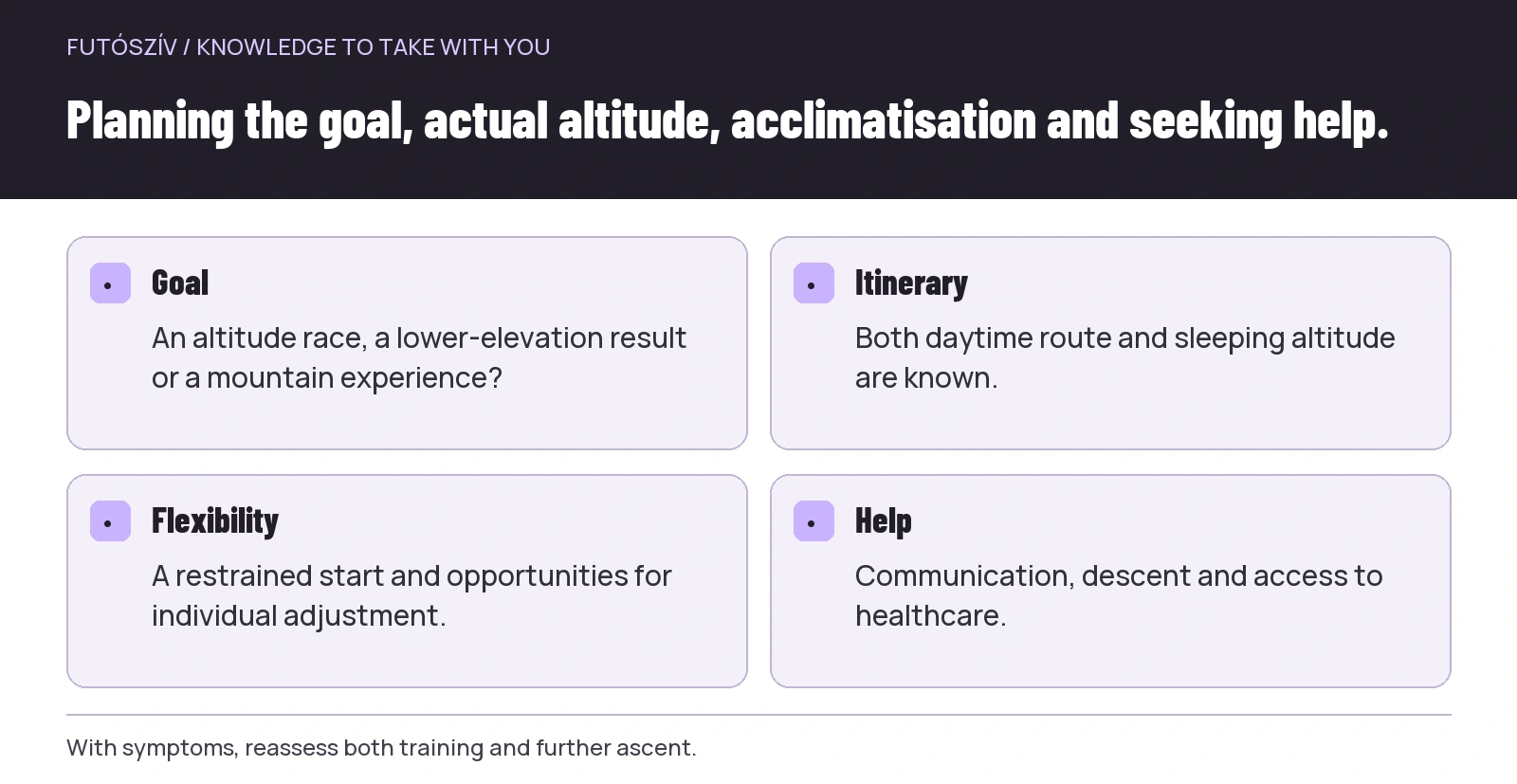
- Goal
- An altitude race, a lower-elevation result or a mountain experience?
- Itinerary
- Both daytime route and sleeping altitude are known.
- Flexibility
- A restrained start and opportunities for individual adjustment.
- Help
- Communication, descent and access to healthcare.
Discuss relevant health history before travelling
Heart or lung disease, breathing problems during sleep, previous altitude illness, pregnancy or another relevant condition may require personal medical advice. The CDC travel page specifically addresses the role of a pre-travel health discussion.
Bring actual route and accommodation altitudes, ascent rate and the type of activity planned to the discussion. “I am going on a mountain holiday” is less precise than a day-by-day itinerary. Individual risk can be considered against the actual situation.
Do not choose medication or preventive treatment from a running article. Need, contraindications and dosage are personal healthcare questions. Professional help planned beforehand is more useful than guessing on location.
How should you regulate training?
Adapt the daily task to local conditions and acclimatisation. Keep an easy day genuinely restrained; assess the possibility of faster work within the whole programme. Your pace chart from home is not a binding contract in the mountains.
Record route character, altitude, duration and perceived effort. If running on different terrain every day, average pace alone is not a useful comparison. Elevation gain and ground can alter the session just as altitude can.
Do not turn the camp into collecting workload in every free hour. Travel, hiking and other activities also require time and energy. Do not immediately fill the value of extra recovery opportunities with another workout.
What about meals and equipment?
Ensure your usual meals and supplies appropriate to the workload are workable. In an unfamiliar place, shops, schedules and kitchen access may need separate planning. There is no need to add an unusual diet to the new environment’s uncertainty.
Do not start taking iron or another supplement merely because an altitude camp is mentioned. Personal need can be established through appropriate assessment and professional evaluation. A general performance promise does not replace this.
For an artificial-hypoxia device, separately examine the provider’s supervision, usage conditions and actual evidence. Results from a natural mountain environment may not transfer to equipment operating on another principle.
Returning home is not automatically a record day
Performance after a camp is also affected by travel, workload and recovery. Do not expect an exactly specified improvement on a particular day regardless of all circumstances. Individual experience and professional planning can help time a race.
Evaluate using a task under comparable conditions and your pre-camp baseline. One good run is enjoyable, but does not separate the effects of altitude, rest, company and overall training. Acknowledging uncertainty improves the precision of your next decision.
An altitude programme makes sense when it provides a clear goal, appropriate preparation and a plan that can be adjusted safely. It may be an important tool for some athletes, but is not a requirement for every runner’s progress.
Sources
- Living high-training low: effect of moderate-altitude acclimatization with low-altitude training on performance.
- Live high-train low using normobaric hypoxia: a double-blinded, placebo-controlled study.
- CDC Yellow Book: High-Altitude Travel and Altitude Illness.
- CDC: Travel to High Altitudes.
- WMS Clinical Practice Guidelines: Acute Altitude Illness, 2024 Update.
How Futószív articles are prepared: our editorial guidelines.