
Your running partners complete the same loop but describe it differently. It feels hard throughout for you today while someone else calls it easy. That is not necessarily measurement error or weak willpower: external task and internal effort are different information. RPE, rating of perceived exertion, gives a simple language for recording your own experience usefully.
It is not mind-reading, medical assessment or an injury-prediction system. It helps when you ask consistently and interpret the number alongside circumstances. One hard-feeling day cannot establish the cause of fatigue or predict the next race result.
What does RPE mean?
The abbreviation refers to subjective assessment of exertion. Breathing, muscular work and general effort can all contribute to the sensation. The aim is not guessing a device’s number but describing how you experience the work.
Gunnar Borg’s foundational work discusses ways to quantify perceived exertion. Several scales exist, with different starting and ending points. If a coach or app requests RPE, first clarify the scale and exact question used.
Your own zero-to-ten diary scale can provide a simple reference, but do not automatically call it an officially validated Borg scale. Original methods have appropriate usage instructions. The point here is consistent personal assessment, not adding a famous name to a spreadsheet.
During and after training, you ask different questions
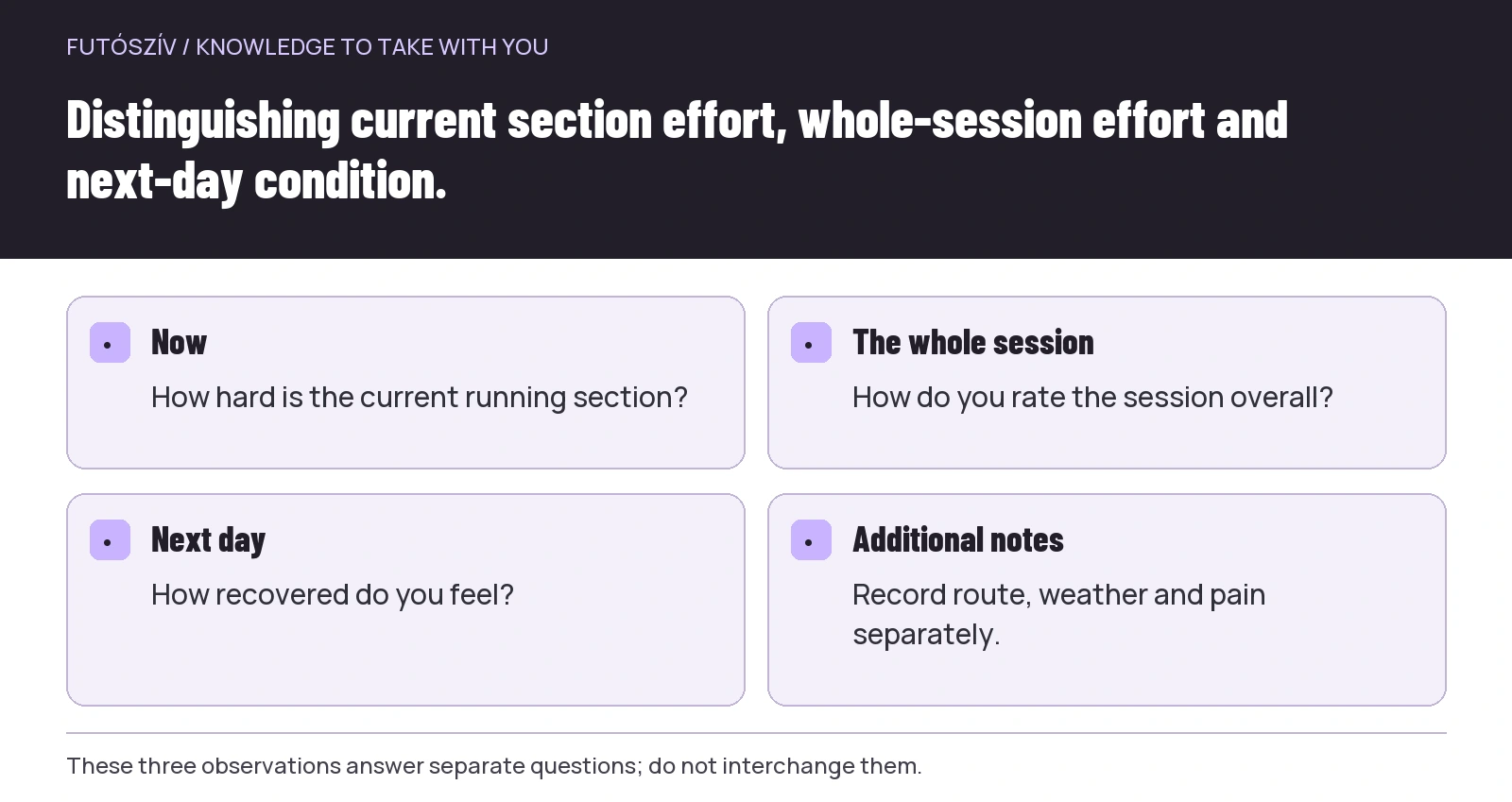
While running, you can rate the current section: for example, how hard the ongoing tempo effort feels. Rating the whole session can also include warm-up, rests and finishing. The numbers therefore need not match.
Session-RPE uses the overall impression to monitor load. The method by Foster and colleagues combines this rating with duration. Consistent questioning and timing matter in the protocol; answering in the final second of the hardest interval differs from reviewing the whole session.
Next-day condition is a third question. Training may feel pleasant while leaving substantial fatigue tomorrow, or you may feel fine after a hard outing. Do not automatically infer recovery from yesterday’s RPE.
First, give numbers a shared meaning
With a personal zero-to-ten diary, consider what very easy, comfortable, moderately hard and near-maximal mean. Associate these with your experience rather than others’ expectations. You need not regularly test the top of the scale to assess easier days.
For the first weeks, add a few words: “four, because breathing stayed comfortable but I worked on hills” contains more than a four alone. With experience, numbers can acquire more consistent personal meanings.
RPE is not an exam requiring the coach’s expected answer. An intended easy loop feeling hard today is exactly the information to record honestly. A better-looking number helps the next decision less.
 Enlarge diagram
Text version of the illustration
- Now
- How hard is the current running section?
- The whole session
- How do you rate the session overall?
- Next day
- How recovered do you feel?
- Additional notes
- Record route, weather and pain separately.
What might a useful diary entry look like?
Include a short session description, duration and overall sensation. For example: “40 minutes in a flat park, 4/10 on my own scale, warm afternoon”. Add unusual lack of sleep or next-day symptoms if relevant. Every run need not become a long report.
Define time measurement within your system. Does it include warm-up and cool-down? How are stops handled? A method is comparable with itself when you measure the same thing next week. Changing data collection can distort apparent precision.
Record sensation before viewing the app’s training assessment. This reduces adapting your experience to an algorithmic label already provided. You can examine both forms of feedback together afterwards.
Minutes multiplied by sensation: what is it for?
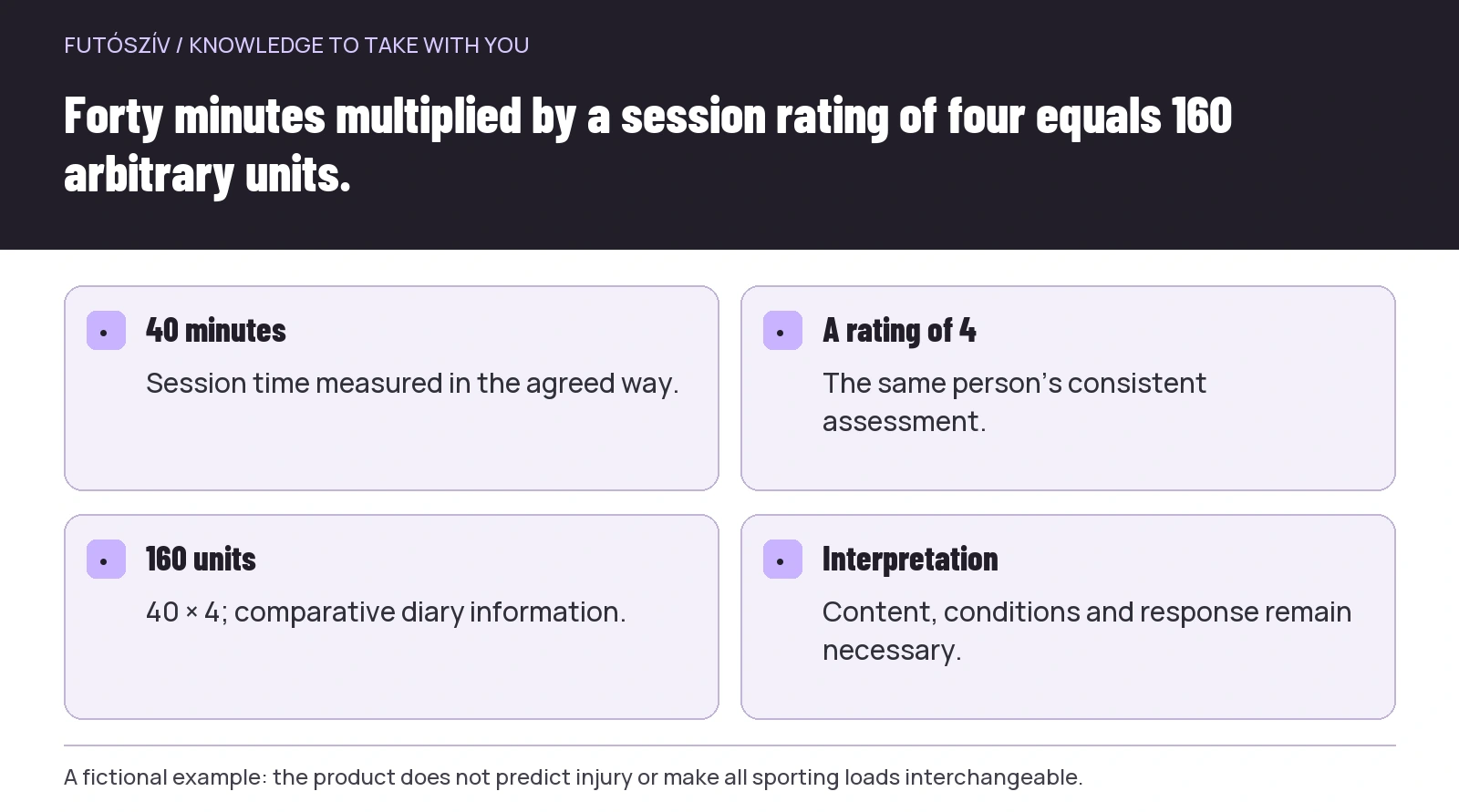
As an illustration, a forty-minute session rated four produces 160 arbitrary units. Twenty minutes rated eight mathematically yields the same product. This does not mean identical effects on muscles, tendons or next-day performance.
The product is a comparison tool simplifying reality, not replacing session content. Short intense running, a long easy loop and strength work can pose different mechanical and physiological demands even with similar numbers.
A study following seven runners compared several load-monitoring methods, including session-RPE. Such research helps assess methods but its small sample and modelling limitations prevent treating it as a prediction system for every runner. Diary data should improve understanding.
Why might today’s value be higher?
At the same pace, heat, wind, route, sleep and accumulated fatigue can change sensations. Everyday stress and motivation can influence the experience too. The session-RPE review discusses several such factors.
Do not infer the cause from one high number. Add circumstances and look for recurrence. Repeatedly unusual difficulty on familiar easy runs suggests reviewing weekly load and recovery. Persistent changes or accompanying symptoms may also require healthcare help.
An unusually low value also merits curiosity. Perhaps you answered a different question, omitted the hardest section from the rating or simply had a good day. Use the method with curiosity rather than constant suspicion.
Heart rate and RPE: when they disagree
Displayed heart rate may be low while running feels hard, or the reverse. First check measurement conditions: did the sensor work and are zones calculated from suitable values? Then consider surroundings and today’s condition.
The signals are not enemies. One comes from physiological measurement or estimation, the other from your experience. Neither explains every situation. Together they often provide more information than automatically declaring one wrong at each discrepancy.
Known illness or heart-rate-affecting medication makes personal advice particularly important. RPE does not permit ignoring professionally specified limits. It can form part of the agreed plan.
 Enlarge diagram
Text version of the illustration
- 40 minutes
- Session time measured in the agreed way.
- A rating of 4
- The same person’s consistent assessment.
- 160 units
- 40 × 4; comparative diary information.
- Interpretation
- Content, conditions and response remain necessary.
Do not score one another in a group session
One person recording three and another six for the same run does not create a ranking. Fitness, experience and daily condition differ. Your scale is primarily comparable with your own earlier data under the same question.
As a coach, allow a private, independent answer before group discussion. Others’ responses and an expectation to “be tough” can distort ratings. The goal is feedback to shape the next outing.
As a partner, you need not convince someone a loop could not have been hard. Ask what was demanding instead. Hills, breathing, tired legs or heat may emerge as the defining experience.
Effort and pain need separate lines
Do not hide potentially injury-related symptoms within RPE. A run can be easy overall while your knee or shin hurts. Observe pain location, character and change separately. A high effort number does not prove injury either.
For worsening, sharp or gait-changing pain, do not seek permission to continue through a diary method. Stop and seek appropriate assessment if needed. Chest symptoms, feeling faint or unusually severe breathlessness are not simple scoring tasks either.
Separate fields improve communication: “effort was four, but left-heel pain increased towards the end” is more precise than saying the session went badly.
How to learn its use over two weeks
Choose one clear question for the whole session and record time and sensation in the same diary. Add a one-sentence explanation for the first few outings. An elaborate load graph need not follow immediately.
At the second week’s end, find three examples: genuinely easy, moderately demanding and hard. What differed: duration, intensity, route or daily condition? Answers help build the scale from your own experience.
Then discuss the data with your coach or identify one planning change. A run after demanding work might be shorter, or a long loop moved to a cooler time. Measurement succeeds when it supports a sensible next step.
When simpler is better
If scoring creates anxiety or every session needs justification through another number, simplify. “Easy, moderate, hard” can also serve a personal diary. Not every runner needs a load product and weekly summary.
The appropriate method fits its purpose. Race preparation with a coach may justify detailed tracking; recreational running for enjoyment may need only brief observations. Understanding your own demands is the goal.
Sources and checking
This article cites Borg’s foundational work, the original session-RPE method paper, a methodological review and a comparison study involving runners. Calculations and diary models are editorial examples. Sensation ratings are neither diagnoses nor individual healthcare clearance for exercise. Sources checked: 18 November 2026.
How Futószív articles are prepared: our editorial guidelines.