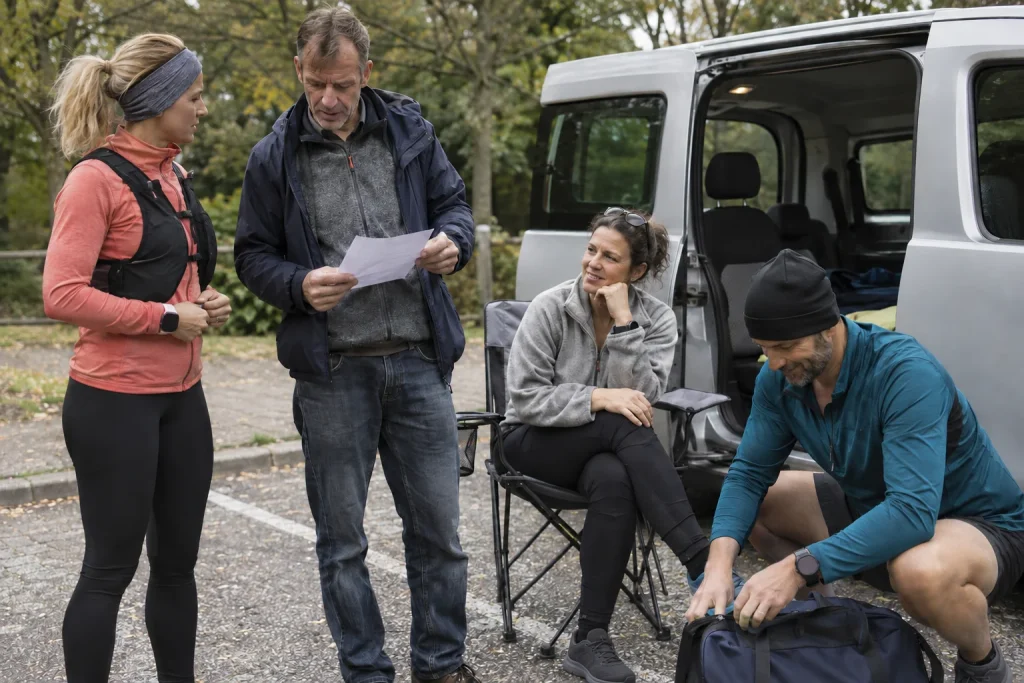
A long-distance team relay offers a distinctive experience: running, waiting, travelling, cheering and starting again. Your total allocated kilometres cannot fully describe the task. Two seemingly short legs may be separated by prolonged driving, little rest or nighttime waiting, and the second start comes from a different situation.
Good preparation therefore needs team organisation alongside running. Who prepares when, who drives, who updates the schedule and what happens if someone cannot continue? Clarify these calmly beforehand. During the race, short, clear agreements help more than a captain keeping everything in their head.
First make sure you mean the same goal
Some enter for a shared experience, others want a time result, and for someone else it may be a first event. Unless you say so, you can judge the same situation differently. A slower leg may be acceptable experience to one person and unexpected disappointment to another.
Agree what counts as success, how fixed the intended pace is and how to handle variation. The goal must not override individual condition or safety. Team spirit does not mean nobody may report difficulty.
Give non-running roles space in the joint plan too. Driving, navigation, bag handling and communication are real work. If these quietly fall on one person, apparently equal running distances can conceal very different loads.
Begin with official handover arrangements
Not every event allows changes in the same places or manner. Your race’s current rules define category, team size, timing equipment, support and any changes. Do not automatically treat habits from earlier years or other events as valid.
The official NN Ultrabalaton team page , for example, provides separate information about team entry and associated tasks. This is a specific organiser source, not a general relay rulebook. Check your category and current details directly with the organiser.
The captain should briefly summarise key points, but everyone should know the rules relevant to their task. “The others will tell me” seems convenient until you must decide in another car or without phone contact.
Allocate more than kilometres
Alongside distance, elevation, surface, expected weather, time of day and time since the previous start shape a leg’s difficulty. Two people can therefore have different tasks despite equal total distances. Plan allocation with these factors included.
Ask for honest information about current running routines, not just someone’s best-ever pace. A runner training less now may not have an appropriate basis for several legs in their old result. Night or technical sections may need separate experience too.
Make leg allocation transparent and adjustable within the rules. Do not automatically place every unexpected extra on the strongest runner. Discuss the backup plan beforehand too, so changes do not trigger personal bargaining.
Repeated starts create a separate situation
If running several legs, the later start is not another completely fresh race day. Previous running, travel and waiting together shape your condition. Reflect this in pace plans and expectations.
A study of a multi-day trail relay involving twenty participants followed this distinctive repeated-load situation through measures including muscle sensations and physiological indicators. The event was more extreme than many weekend team relays; its findings cannot be transferred unchanged to every relay participant.
The useful practical question is what precedes your restart. You need not deliberately create complete exhaustion or sleep deprivation in preparation. A manageable trial can teach organisation between two starts and familiar routines too.
 Enlarge diagram
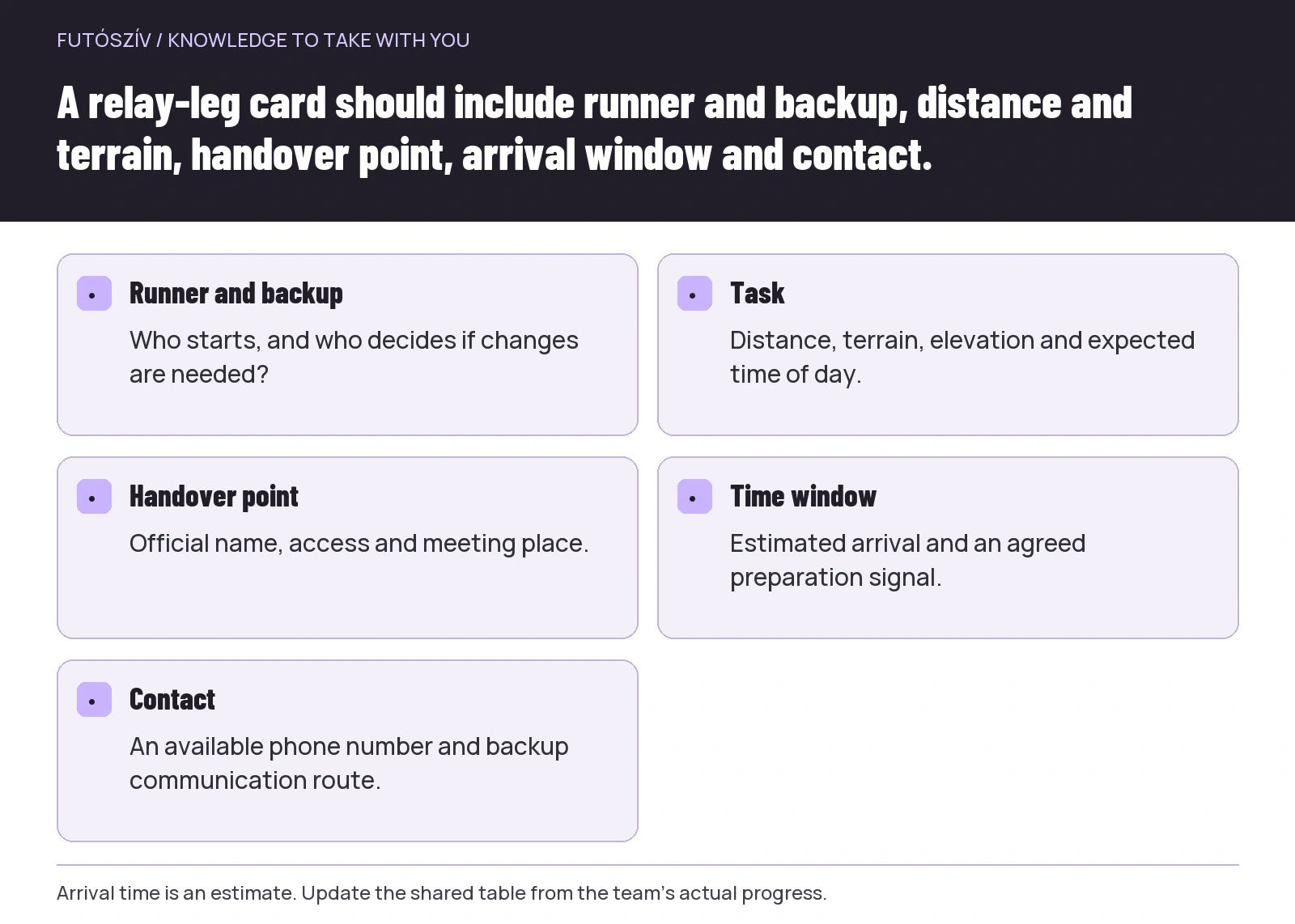
Text version of the illustration
- Runner and backup
- Who starts, and who decides if changes are needed?
- Task
- Distance, terrain, elevation and expected time of day.
- Handover point
- Official name, access and meeting place.
- Time window
- Estimated arrival and an agreed preparation signal.
- Contact
- An available phone number and backup communication route.
Treat estimated arrival as a range
A spreadsheet can calculate every runner’s arrival to the second. Reality changes with the course, weather and traffic. Do not tie the whole team’s operation to a single minute; allow margin and an agreed preparation signal.
Include leg name, runner, handover point, expected time window and contact in the table. Update from actual progress, but do not have everyone working separately in differing copies. Assign responsibility and clearly identify the latest version.
The runner’s estimate should be realistic. Excessively optimistic timing affects not only the result but the next person’s eating, preparation and vehicle arrival. Treat margin as an organisational tool, not weakness.
Reaching the handover point is a route in its own right
The runner’s route and vehicle access can differ. Review official parking and handover information beforehand, including walking access. A point being close on the map does not mean you can step straight from the car into the handover zone.
The driver should not handle group messages and detailed navigation discussions while moving. Have another passenger help or stop somewhere safe to organise information. Getting the next runner there on time does not justify risky driving.
Follow organiser instructions in the handover area. Do not stand in runners’ way or begin arranging bags at the narrowest point. An agreed meeting place can prevent much rushing.
Driving needs its own rest plan
For a long relay or one continuing into night, driving is not a leftover task. Decide beforehand who drives, in what condition, and where rest or a change of driver is possible. Do not automatically give the next long journey to someone who has just finished running.
The NHTSA information on drowsy driving emphasises sufficient sleep and recommends stopping safely when drowsy. Coffee or another stimulant does not remove the need for sleep and is not a reliable plan for driving through the night exhausted.
Organise the post-finish journey home beforehand too. The race ending does not mean transport tasks have ended. Without an appropriately rested driver, choose another solution; arrival time at home matters less than safety.
Have a personal routine between runs
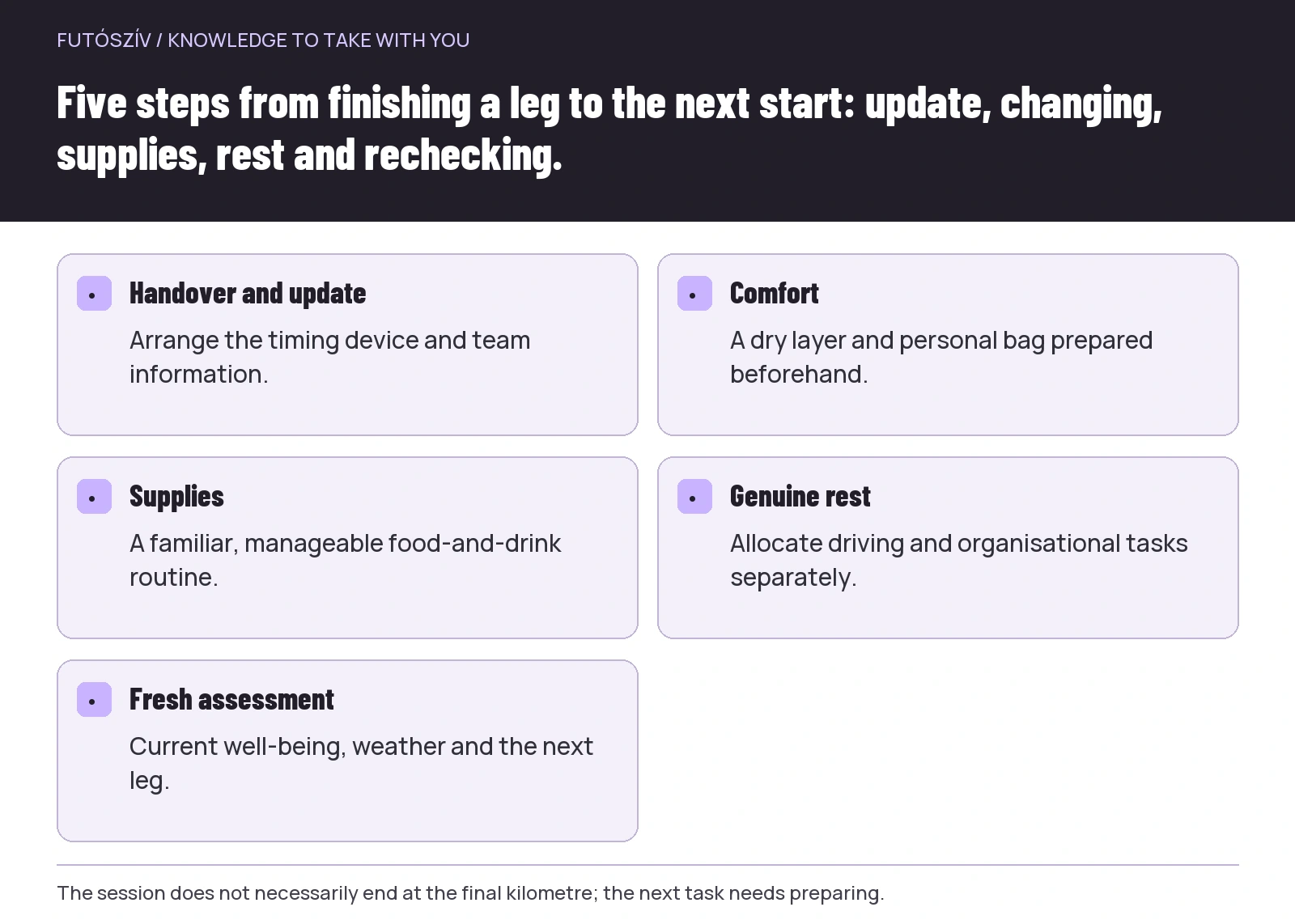
After handover, arrange transfer of the timing device and update the team, then attend to your own comfort. A dry layer, accessible personal bag and familiar supplies can prevent searching for everything just before the next start.
The time until your next leg may vary. Do not tie meals and preparation to a rigid ideal timetable. Begin with familiar, manageable solutions and organise the day from actual waiting time. An appropriate professional can help with individual nutrition questions.
Do not automatically spend the entire interval standing to cheer, organising or searching for others’ equipment if you will run again. Helping matters, but share it. Time intended for rest becomes rest only if the opportunity actually remains.
Begin the next start with a fresh assessment
Consider elapsed time, current well-being and changes to weather or the leg. The plan for your first morning run may not describe an evening restart. Allow a few calm minutes to settle before beginning.
Do not try to cram familiar, situation-appropriate pre-start movement into the last second. If the incoming runner beats the estimate, organisational margin can help. Preparation includes avoiding a sudden, rushed start.
Report new symptoms or concerning illness. Feeling responsible to the team should not prevent seeking help. The American College of Cardiology information says exercise-related chest symptoms, dizziness or feeling close to fainting, for example, may require professional discussion before continuing.
 Enlarge diagram
Text version of the illustration
- Handover and update
- Arrange the timing device and team information.
- Comfort
- A dry layer and personal bag prepared beforehand.
- Supplies
- A familiar, manageable food-and-drink routine.
- Genuine rest
- Allocate driving and organisational tasks separately.
- Fresh assessment
- Current well-being, weather and the next leg.
Know how to use equipment in darkness too
For an expected night leg, prepare compulsory and recommended items according to current event requirements. Try the headlamp, visibility equipment and phone access beforehand. Unopened equipment is not a working routine.
Leave attention for route management too. Do not assume the crowd or runner ahead always provides the correct direction. In uncertainty, clarify the official route and organiser-help arrangements somewhere safe.
You can practise moving in darkness in a manageable, well-organised session. Deliberate sleep deprivation is unnecessary for learning how the light and clothing work. Skill and exhaustion are separate questions.
A backup plan should be more than one name
Agree what happens if someone is late, cannot find the point, has a phone failure or cannot take the next leg. Know the decision process within the rules. Not every change is necessarily permitted; check beforehand.
Contact details should not exist only in one phone running out of power. Provide simple backup access to key information and make sure everyone knows whom to call. Keep communication short because complex systems easily fall apart during a race.
A health situation is a separate branch: appropriate assistance and notifying the organiser take priority. The affected runner need not rescue the team’s result alone. A good backup plan specifically reduces pressure.
What should you practise together?
A short joint trial without maximal pace as its goal may help. Allocate roles, organise personal bags, try timing signals and meeting arrangements. It can quickly reveal missing information.
Fit running tasks to individual backgrounds. Every member need not do identical training because they belong to one team. The joint programme aims at cooperation, not forced uniformity between different running levels.
After the trial, choose one process to improve: a more precise signal, better bag arrangement or a more realistic arrival window. A small organisational change can prevent much unnecessary rushing during the race.
Review team operation after finishing too
Alongside total time, examine how tasks were distributed, whether rest was available and when information was incomplete. Do not look only for the slower leg. Organising travel and waiting shaped the experience too.
Let everyone discuss their own load. Someone who ran less may have done more background work; a fast runner may still have found a later restart difficult. These experiences can improve the next allocation.
A good relay experience does not come from a flawless spreadsheet. It comes from people knowing their tasks, being able to report changes and a plan retaining flexibility. The many separate starts can then become a genuinely shared run.
Sources
- NN Ultrabalaton official team information – event-specific information, always alongside current race rules.
- NHTSA: Drowsy Driving – drowsiness and safe driving decisions.
- Oxidative stress, inflammation, and muscle soreness in an 894-km relay trail run – a small-sample study of a multi-day trail relay.
- American College of Cardiology: warning signs during sport.
How Futószív articles are prepared: our editorial guidelines.