
A coach opens an uploaded run and sees time, distance, curves and laps. They may not know you detoured around a closure, waited longer before the third section or had unusable data for part of the run. A few precise accompanying sentences therefore add real information. Every run need not become a long report, nor should you solve the whole session for the coach beforehand. A useful note makes intention, actual execution, relevant circumstances and your question traceable. This article builds a simple sustainable workflow for that.
Arrange the shared channel first
Agree where the main recording belongs and where its note can be read. It may be a training platform, shared log or another agreed solution, but context should not scatter across many interfaces. A public run title and a professional note for a coach may serve different purposes. The Polar coaching-notes guide separately explains access to coach and athlete comments attached to sessions, for example. Check which field your coach sees and who else can access it.
Notifications are not automatic or subject to identical conditions in every service. The TrainingPeaks coach-notification description sets out specific access and settings requirements. Do not assume every note immediately arrives and is read. Agree how often the log is reviewed, where to raise a separate question and what calls for more urgent discussion. The digital system supports the agreed collaboration rather than replacing its framework.
Name the task in one sentence
“Running” or “went well” gives little link to the plan. You need not copy the whole description already on the platform, but identify the task and any modification. For example: “Today’s planned easy loop was completed; the route became hillier than usual.” This is context, not excuse-making. If the recording attached to the wrong day or you performed another plan element, state that immediately. The coach then does not evaluate the graph against an incorrectly assumed task.
If the plan’s meaning was uncertain, distinguish what you read from what you did. For example: “I understood the notation as a time-based section, so started the programme that way; please let us clarify before next time.” Recording numbers alone do not reveal this misunderstanding. The purpose is a clear next step. You need not rewrite the story afterwards as though everything followed the plan. Describing actual execution supplies useful feedback for collaboration.
Describe execution, not just the final result
Behind average pace lie sections, recoveries and possible interruptions. If the task unfolded differently, identify when, where and what changed. “It did not work” is too broad for analysis. “After the third selected part I continued by another route because of a closure, so later laps cover different sections” is more precise. Avoid unnecessarily repeating every table number; add what the recording cannot reliably show.
Timing is particularly useful when reading curves. If you roughly know the time or lap number, give appropriate precision. Do not invent a second-exact time for something only vaguely remembered. “Around the twentieth minute” or “before the third manual lap” may work. An apparently precise but uncertain number can guide less well than an honest approximation. The coach can interpret recording and sentence together when uncertainty is clear too.
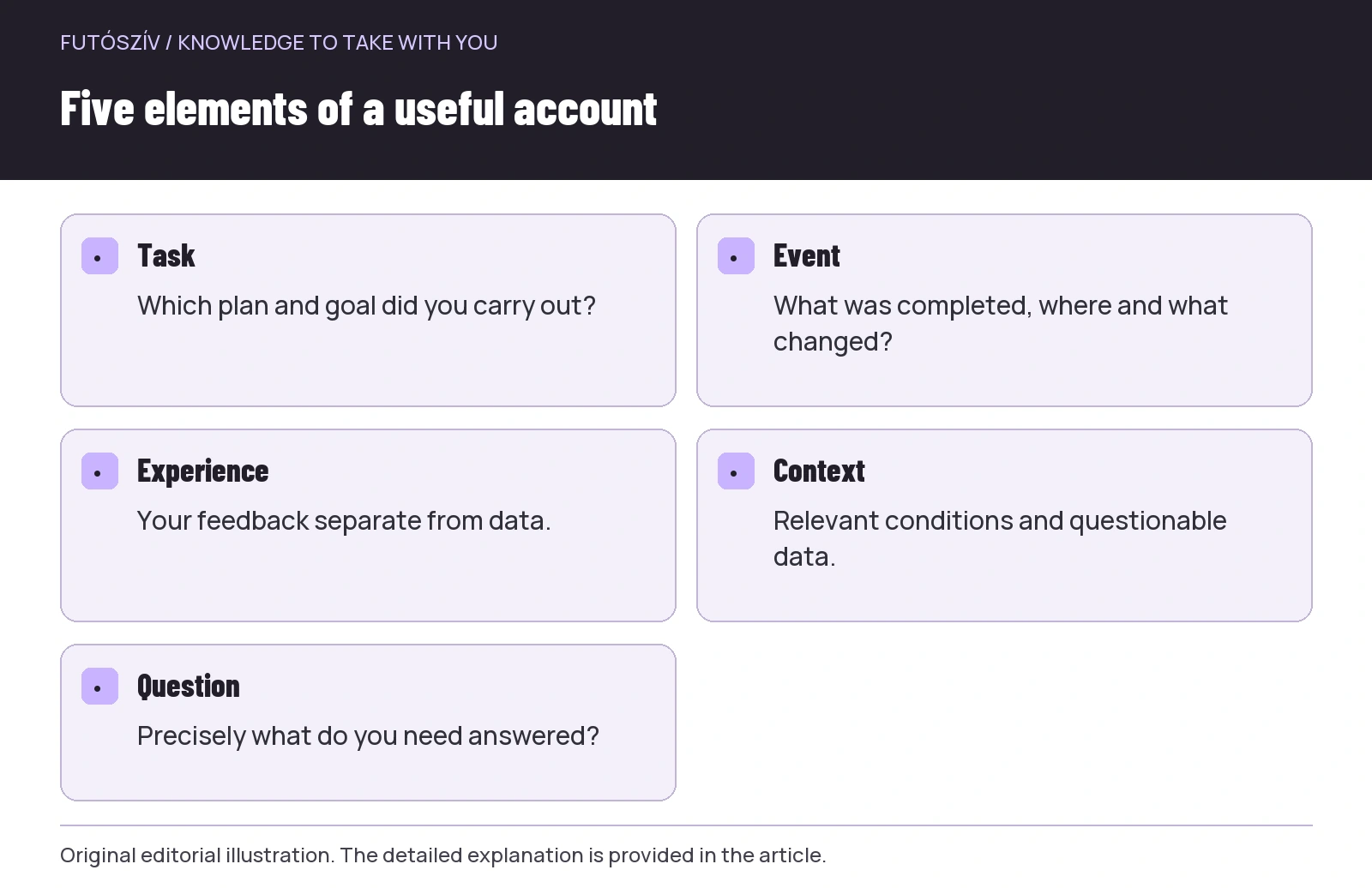 Enlarge diagram
Text version of the illustration
- Task
- Which plan and goal did you carry out?
- Event
- What was completed, where and what changed?
- Experience
- Your feedback separate from data.
- Context
- Relevant conditions and questionable data.
- Question
- Precisely what do you need answered?
Do not lose personal experience among the numbers
Experienced difficulty, manageability and impressions are separate information. If sharing a scale, agree its meaning and use it consistently. Without one, a short specific sentence can help: “the task still felt manageable at the end” or “maintaining rhythm needed more attention in the final part”. These describe, not diagnose physiology. Do not copy your feelings back from a watch score. Experience arising separately from data is precisely what the note adds.
Instead of a general mood label, identify what the impression concerns. A route may be enjoyable even when a task was technically uncertain, and equipment may be uncomfortable after an orderly session. Preserve both in separate sentences. Every difference need not immediately receive a cause. “It felt unusually hard; I do not know why” is honest useful feedback. Clarifying that question may be the joint analysis’s purpose, rather than expecting a ready explanation from you.
Add only relevant circumstances
Weather, ground, route, equipment or schedule can matter, but every run needs no complete life account. Select what genuinely informs the task or data. A windy return may matter to section paces, a muddy detour to distance and a long wait to total time. Do not use a circumstance as automatic proof of every discrepancy’s cause. A factual note is enough: this event happened and the associated part appears here.
Handle sensitive information through the appropriate agreed channel. Not every community comment suits health or private details. Check visibility, particularly with several coaches or a group interface. Polar’s coaching-notes information also identifies multi-coach access in its system. Do not assume a field name automatically means confidentiality. Choose the scope deliberately and provide only details necessary to the task.
| Part of a short account | A useful question to yourself | Example answer |
|---|---|---|
| Task | What was I meant to complete? | Today’s planned easy loop |
| Execution | What actually happened? | Completed the loop, changing route near the end |
| Experience | How did the task feel? | Manageable until the end |
| Conditions | What cannot reliably be seen from the file? | A short detour because of a closure |
| Data quality | Is a measurement section questionable? | The opening heart-rate section is incomplete |
| Question | What do I need answered? | Which route should I choose next time? |
Give data-quality issues a separate line
If part of heart rate, pace or route is questionable, do not label the whole workout faulty. Describe the channel, period and whether editing occurred. For example: “Data: heart rate in the first ten minutes is not reliably usable; original retained, unedited.” This differs from experienced difficulty. Do not merge them as “it must have felt odd because of the watch”. State a cause only with suitable grounds. Separating observation and explanation helps the coach too.
If manually correcting total distance or cropping a section, identify the operation and source. The final app number may not reveal a previous difference. Your note therefore traces the change too. The coach need not analyse every technical detail, but should know which data supports conclusions. If uncertain, retain the original and clarify shared practice before editing. Usability and traceability matter, not graph cosmetics.
Example for a run completed as planned
Illustrative example: “The planned easy run was completed on the usual loop. I felt no substantial change in manageability between the beginning and end. The return was windier, which should be considered with kilometre paces. I noticed no technical recording fault. I have no separate question now.” This is neither a real session report nor a professional rating. It works because it avoids repeating every number while preserving the task, experience and one interpretive circumstance.
Example of modified execution
Illustrative example: “I completed the first selected parts of today’s plan on the original route. Before the third, a closure required another path; later manual laps therefore cover different terrain. I retained the full recording and did not crop the detour. I rated perceived difficulty for the whole outing. Question: for the next similar task, should I keep this alternative or choose another place?” The example names a specific decision point and related question. It does not falsely claim identical performance from changed laps.
If modifying because part of the plan was unclear, state that reason. If another circumstance prompted it, name that with necessary detail. Do not retrospectively seek the “right” explanation that sounds best to the coach. An honest execution account underpins collaboration. Evaluating the change belongs to shared work, but data must first follow what happened. A log is not a certificate that every plan was completed unchanged every day.
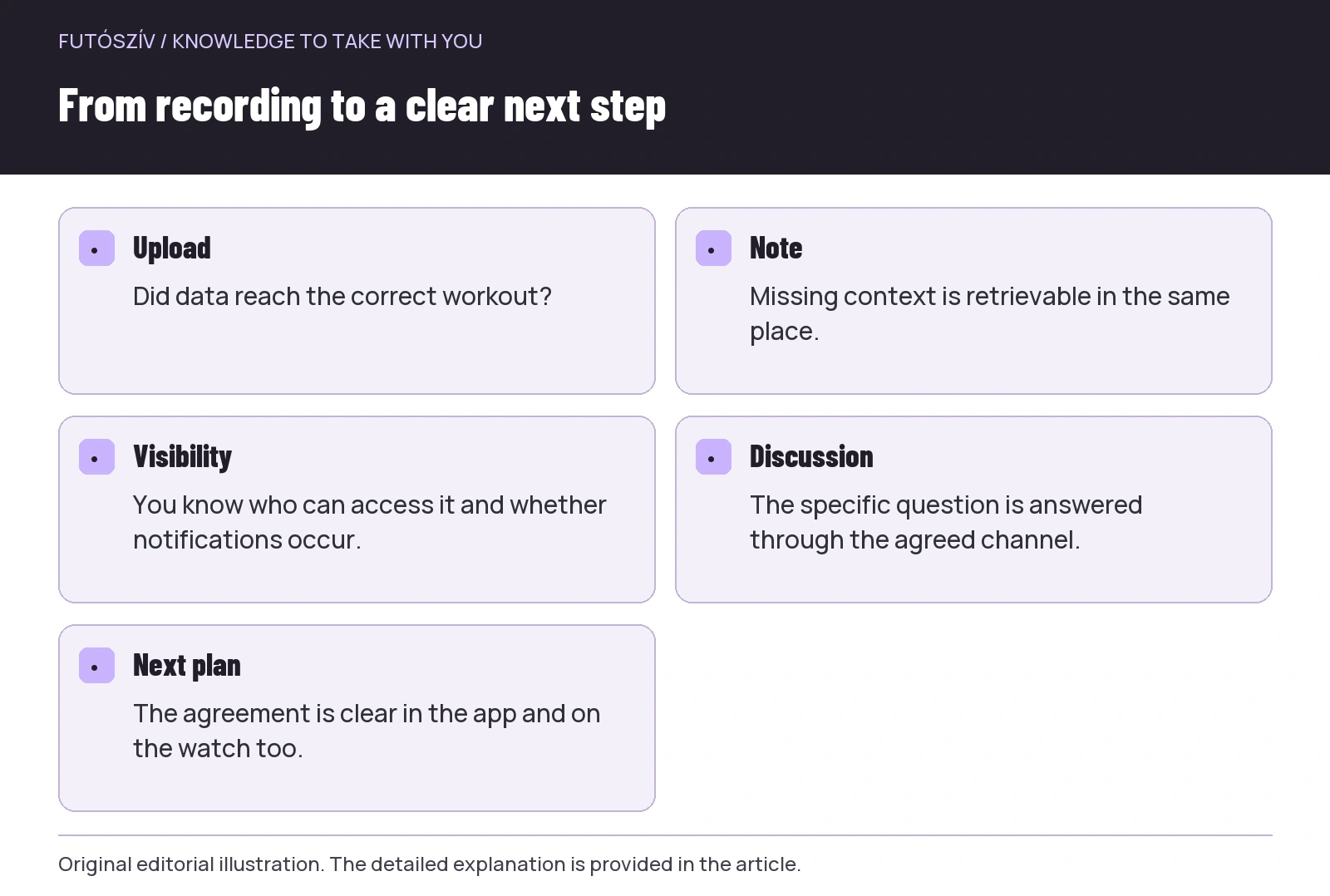 Enlarge diagram
Text version of the illustration
- Upload
- Did data reach the correct workout?
- Note
- Missing context is retrievable in the same place.
- Visibility
- You know who can access it and whether notifications occur.
- Discussion
- The specific question is answered through the agreed channel.
- Next plan
- The agreement is clear in the app and on the watch too.
Example of technical uncertainty
Illustrative example: “I completed the task, but the watch reported a short connection loss midway through the second section. A gap appears in pace there; I do not know its exact duration. Route and total time remain, with no manual correction. In my experience, that part felt similarly manageable to the others. Question: should we exclude this section from detailed pace comparison?” The example clearly separates execution, recording, uncertainty and a specific analytical question.
Attach a screenshot or file only if necessary and required by the shared workflow. Show the questionable period and axes, not an unintelligible crop. Original files may contain more personal information, so check recipient and channel. You need not copy every app notification to the coach. Select the relevant technical detail; handle a product-support fault separately from a training question. The two tasks may need different answers.
Make the question answerable
Instead of “what do you think?”, name where you need help: interpreting the next task, route choice or data comparability. Avoid piling many unrelated questions into one note if they hide the important decision. Clearly flag uncertainty affecting the next session through the agreed channel and in time. A sentence beside an uploaded activity may not be an instant-response messaging system. Agree response times and the method for more urgent discussion beforehand.
For health symptoms, a log note does not replace appropriate care or direct clarification with a professional. Do not assume a coach will certainly recognise every problem from a graph. Watch data and shared text may supplement information within their limits. Handle personal details through the right channel to the extent necessary. The examples here show communication structure, not health-decision protocols. Clarifying professional roles and availability belongs to good collaboration.
A weekly summary differs from a workout note
A note for one session should preserve that event’s context. A weekly summary can highlight recurring questions, substantial changes from the plan and known constraints ahead. Do not paste the same long text onto every run. If a sensor fault recurs, identify exact periods on individual recordings and summarise the recurring issue and separate technical action in the weekly line. The summary then provides overview while details remain retrievable.
Keep the coach’s answer connected to the appropriate session or question within the shared system’s options. If an agreement concerns the next outing, make its place in the actual plan clear too. A change left in comments but not synchronised to the watch can easily cause misunderstanding. The TrainingPeaks getting-started guide also presents activity-related feedback and platform use as separate workflow elements. Clarify the connection between plan, note and device programme in your own system.
A useful account can take two minutes
After the run, when you have calm time, check the upload and write in the agreed place. Use this short order: task, actual execution, personal experience, relevant conditions or data quality, then a specific question if any. Each line need not be a long paragraph. Consistency and clarity matter more than length. If updating later, flag new information, particularly after editing the recording too. Retrievability grows from a brief everyday habit rather than rare retrospective recollection.
A useful note does not perform the coach’s work; it supplies context missing from the recording. Numbers describe recorded events while sentences add intention and experience. A shared channel, understood visibility and clear question put information in the right place. If the account makes clear what you intended, what happened and what you need answered, you have supported meaningful joint analysis. A good log is therefore precise, consistent and suited to your workflow, rather than merely long.
Sources and further reading
- Polar – How to Add Coaching Notes
- TrainingPeaks – Coach Workout Notifications
- TrainingPeaks – Ultimate Get Started Guide
How Futószív articles are prepared: our editorial guidelines.