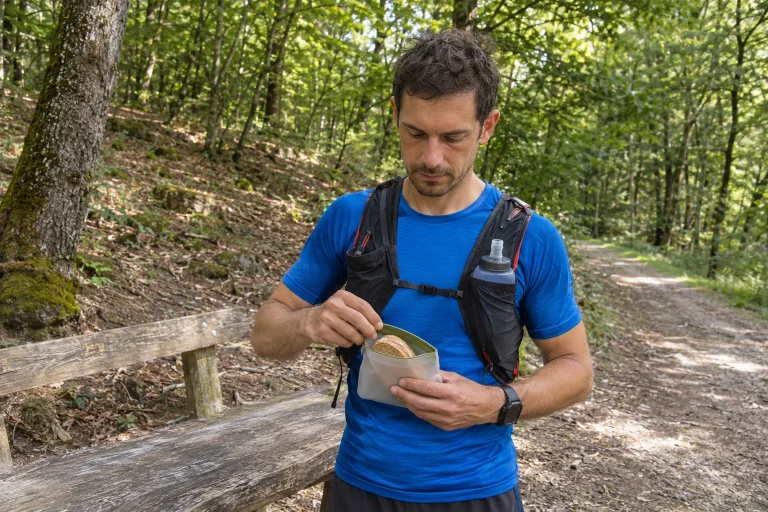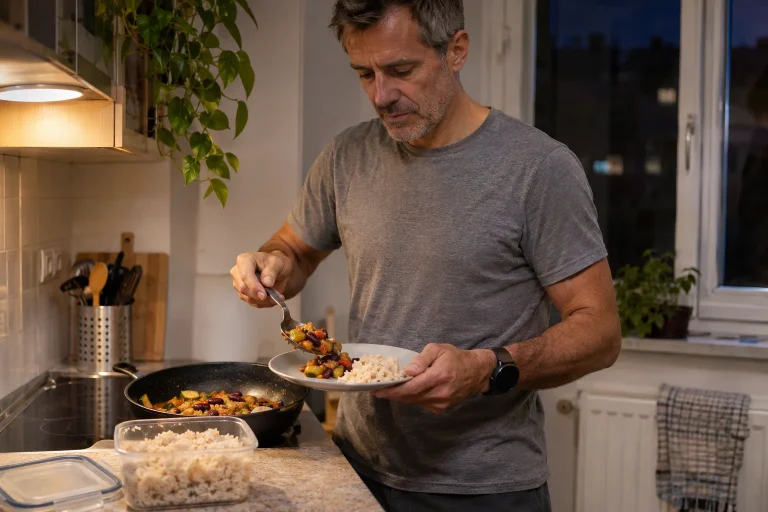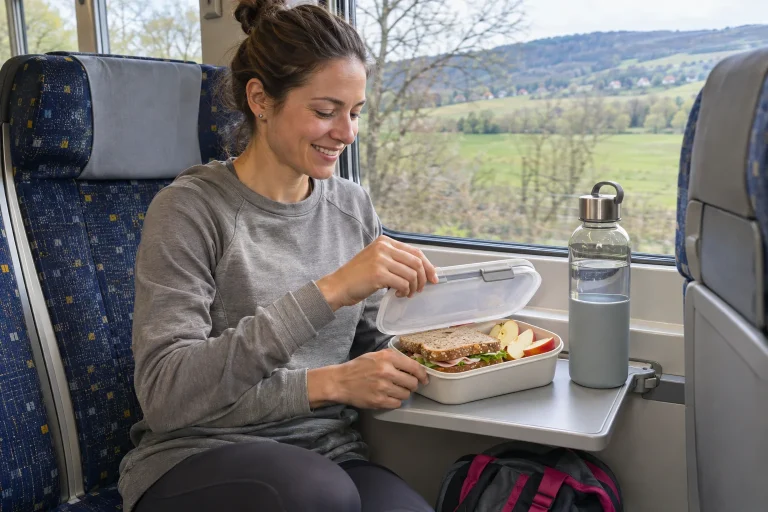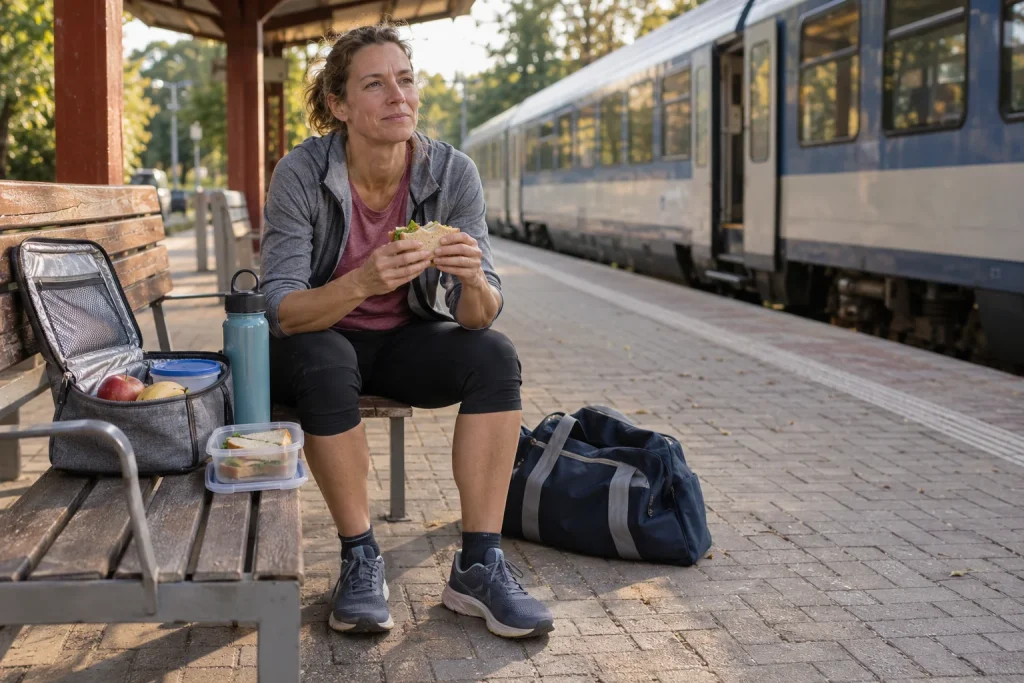
The day can continue for hours after the race finish line. Bag collection, changing, an awards ceremony, reaching the car park and a long journey home may follow, although advance attention focused almost entirely on running. The return therefore needs its own food, drink and rest plan. It is not enough to assume something will remain in the race pack and everyone will be ready to leave at the originally entered time after finishing.
This article provides a framework for travel organisation and nutritional access. It is not a personal recovery diet, fluid or electrolyte dosing guide, or fitness-to-drive assessment. Personal needs, health and safe transport require separate evaluation. Rearranging a food pack does not resolve illness or feeling unwell. The examples are fictional situations, not actual post-race exercise assessments or our own product tests.
Treat the post-finish period as a programme of its own
Record expected tasks between finishing the run and actually departing. Leaving the finish area, collecting a bag or reaching a more distant shower can take time. The first meal opportunity should not appear only at the end of a return trip lasting several hours. Arrange access to the food and drink your personal plan needs during this intermediate stage too. The post-run programme is a real part of the day, not empty space between two more important times.
The British Dietetic Association’s sports-nutrition overview addresses food after training and competition as part of the whole individual plan. Rapid recovery can matter particularly for repeated efforts close together. For your own return journey, therefore, do not start with a general ‘everyone must eat this immediately’ list. Arrange genuinely accessible meals for your appropriate personal needs rather than copying an online portion.
Keep the return-journey pack separate and identifiable
If you bring your own food and drink for travelling home, do not mix it with supplies used during the run. Label the pack’s role and know where it will remain in appropriate condition during the race. Food left in a running belt, a bag in storage and a container in a parked car have different handling histories. Leftovers merely existing does not establish suitability for your eating plan or appropriate storage.
Know the separate return pack’s contents, relevant time and storage conditions too. Retain labels and ingredient information, especially if someone else prepares or transports it. A companion should understand what they are handing over and which personal supplies remain untouched. ‘I brought you something’ can be kind, but without knowing individual dietary requirements and actual condition, it is not a complete meal solution.
Know the full journey of food set aside that morning
The Food Standards Agency’s hot-weather guide also explains the roles of a suitable cool bag, ice packs and shaded placement, emphasising keeping chilled food cold. Meet the particular product’s instructions throughout the race day. A morning journey in an air-conditioned car does not automatically provide suitable storage for several hours parked afterwards. Assess those as separate stages.
If you cannot ensure appropriate handling during the race, do not base the return journey on that food. Find another clarified option beforehand, such as a suitable local meal or personal supplies whose specific requirements can actually be met. The food’s name and a ‘for the journey home’ label do not create a new storage duration. Do not try to make uncertain leftovers appropriate by quickly eating them merely because they are conveniently in the car.
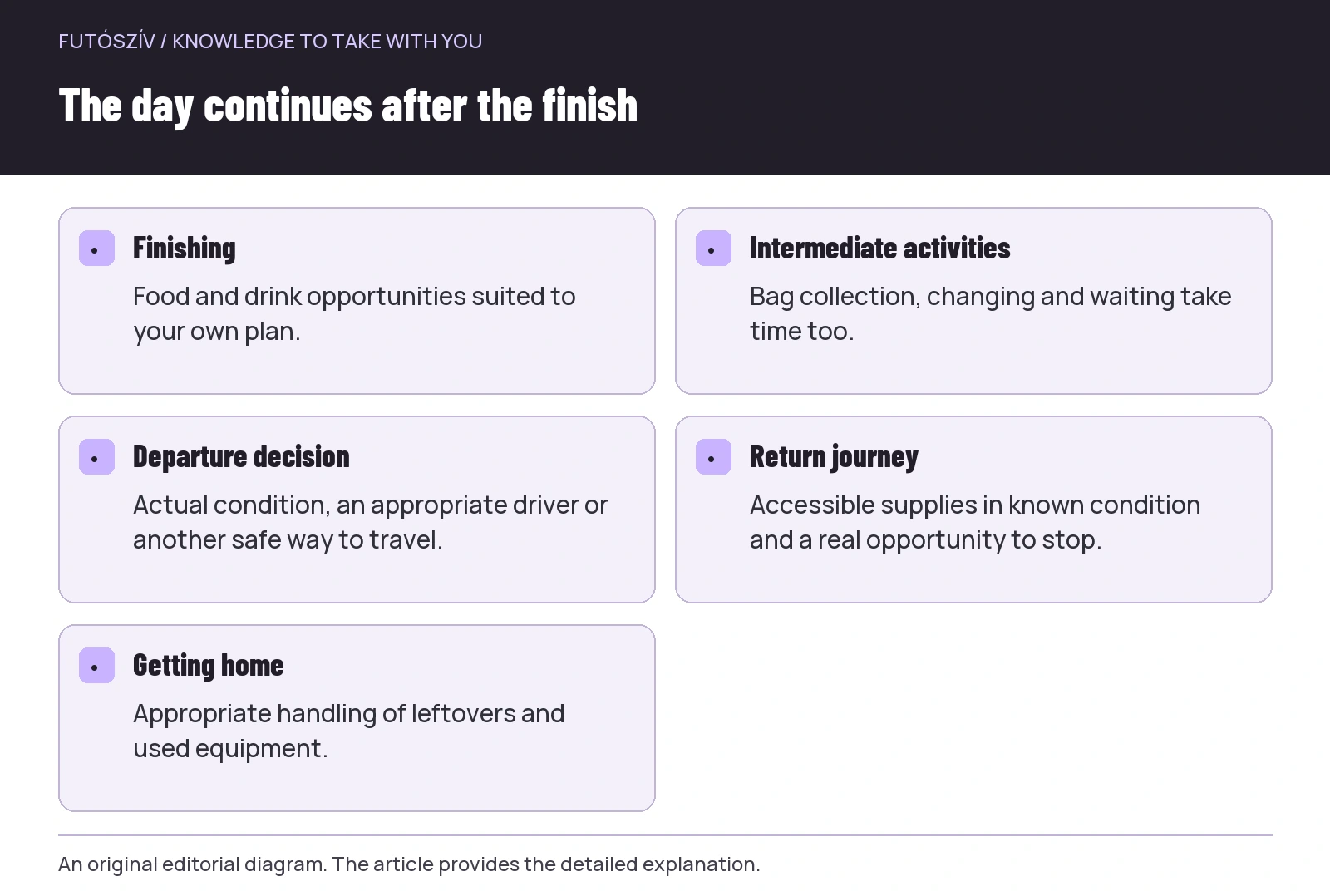 Enlarge diagram
Text version of the diagram
- Finishing
- Food and drink opportunities suited to your own plan.
- Intermediate activities
- Bag collection, changing and waiting take time too.
- Departure decision
- Actual condition, an appropriate driver or another safe way to travel.
- Return journey
- Accessible supplies in known condition and a real opportunity to stop.
- Getting home
- Appropriate handling of leftovers and used equipment.
Check local meals for a specific time
If relying on a restaurant or shop after finishing, check current opening hours and actual access. A delayed awards ceremony or bag collection can change the arrival time originally planned. Leave flexibility and appropriate backup in your plan. Use the menu to check ingredients important to you and ask about the particular dish on site if necessary. Do not assume race catering or a finisher’s pack is a personalised solution either.
The meal location and departing vehicle’s route should fit together too. Redirecting the entire group to a distant place with difficult parking may not be sensible. The plan can be simpler: an appropriately arranged meal near the finish, followed by orderly bag collection and travel. Your choice depends on your circumstances, but necessary eating should not become the original programme’s final task squeezed out by everything else.
Keep fluids accessible and needs individual
Access drinks needed for the return under your personal plan both at the finish and en route. Do not bury a bottle beneath all the luggage in the boot if you will need it at an appropriate stop. Clarify refill or purchasing options beforehand and follow the particular drink’s storage instructions. Neither journey length nor a bottle’s nominal capacity alone determines individual fluid needs.
Do not try to make up every earlier assumed shortfall at one return-journey stop by guessing. Appropriate replacement is personal, especially with a medical condition or symptoms. This article gives no rapid-rehydration recipe and does not treat the amount missing from a bottle as a laboratory measurement. The practical task is to have clearly identifiable, safely handled and genuinely accessible drinks for carrying out your own necessary plan.
Arrange the driver’s role before the race
If the runner intends to drive home, do not simply declare that settled on the outward journey. Post-race fatigue and how the day actually unfolds can change the situation. Have another workable transport option or suitable rest plan available to switch to if needed. Finishing a race does not establish fitness to drive, and well-intentioned confidence does not settle the conditions for a long journey.
According to the NHTSA information on drowsy driving, adequate sleep is fundamental, while coffee and energy drinks alone do not reliably protect against the consequences of sleepiness. If you are drowsy, do not continue driving to preserve the original arrival plan. Stop somewhere safe and arrange appropriate rest or another fit driver. Consuming food or a drink does not become a certificate of fitness.
Make departure time genuinely changeable
A previously stated ‘we must leave at three’ deadline can easily create pressure at the expense of eating, rest or organising bags properly. Treat the schedule as a target to revisit in light of actual conditions, not an unconditional obligation. If necessary conditions are absent, change departure or the travel method. A later arrival can be communicated; a precise message cannot compensate for missed rest or unsafe driving.
If accommodation or another mode of transport might be needed, investigate options beforehand. A backup is more usable when fewer new questions need solving while tired. You do not automatically need another booking for every trip, but know the next step and whose responsibility it is if things change. A shared plan helps when companions also accept that actual conditions can override an optimistic home-arrival estimate.
| Question before departure | Resolved state | If it is not yet resolved |
|---|---|---|
| Can you access your own meal? | Known, suitable food and a real opportunity to eat | Arrange the meal or access rather than automatically postponing it until the journey ends. |
| Is the drink accessible? | Identifiable supplies suited to the personal plan | Appropriate purchase or refill, including storage |
| Who is driving? | A driver fit in their actual condition and a workable journey | Stop, arrange suitable rest or another safe option |
| Is the leftovers’ condition known? | A traceable history and subsequent handling | Do not automatically treat them as food for the journey home. |
| Can the programme change? | Companions know the next step if delayed. | Agree the details before leaving. |
A stop should be more than quick shopping
Plan a lawful, safely usable stop where necessary eating and hygiene conditions can be met. Handling food, handwashing, utensils and arranging waste can also take time. Access should not require opening packs or reaching into the back seat while driving. Parking the vehicle appropriately and dealing with your own task are separate steps. A passenger can help prepare an identified pack but should not guess individual requirements.
Rest should also have an actual role for driving. We give no universal interval or guarantee from a short break: condition and requirements for safe continuation decide. If the driver remains sleepy after stopping, do not calculate necessary rest backwards from the schedule. Changing the journey may be the next step. A coffee cup, loud conversation or loud music does not replace adequately rested driving.
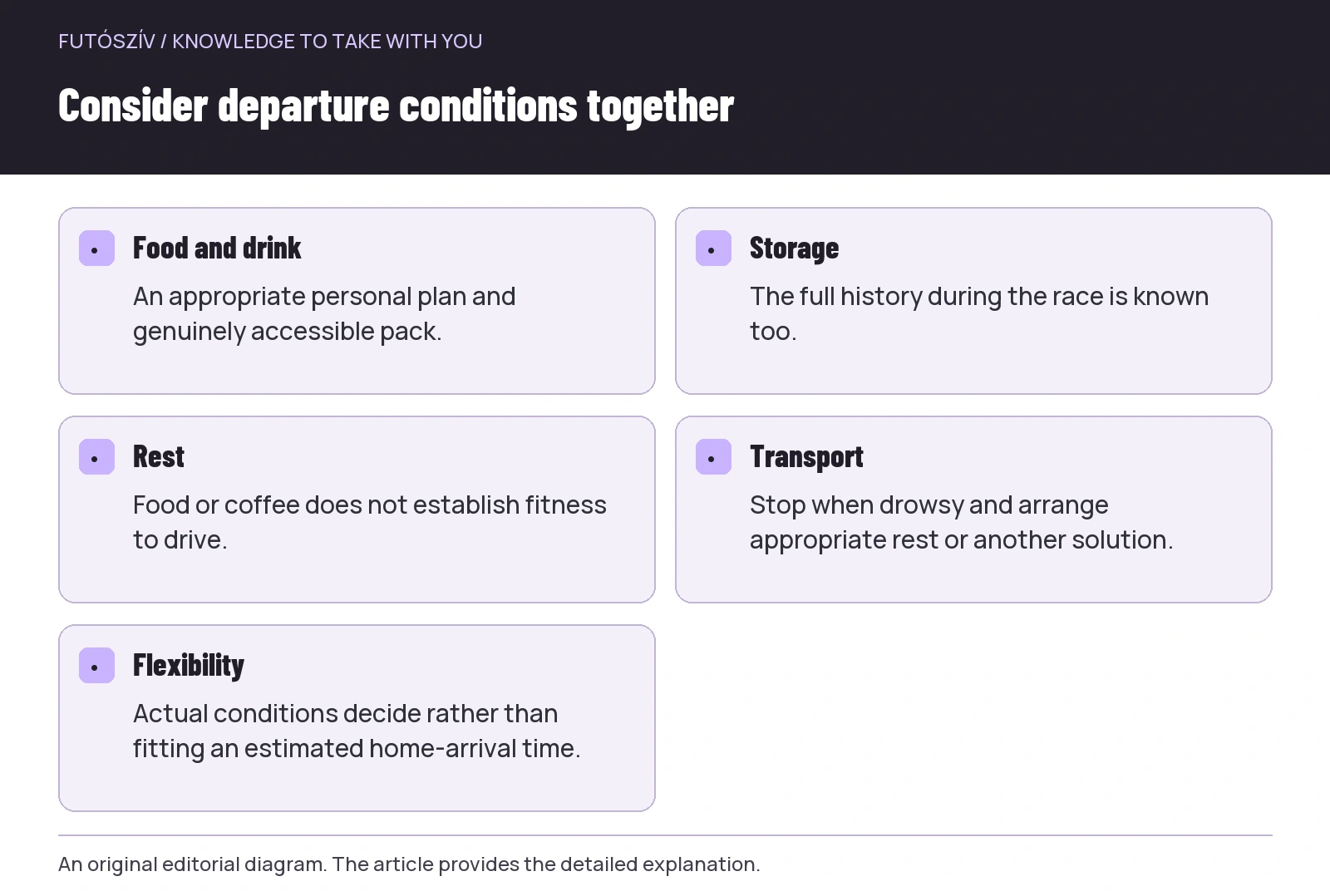 Enlarge diagram
Text version of the diagram
- Food and drink
- An appropriate personal plan and genuinely accessible pack.
- Storage
- The full history during the race is known too.
- Rest
- Food or coffee does not establish fitness to drive.
- Transport
- Stop when drowsy and arrange appropriate rest or another solution.
- Flexibility
- Actual conditions decide rather than fitting an estimated home-arrival time.
As a passenger, keep your own access too
On a train, bus or other journey, do not leave your personal food pack in someone else’s luggage if you might lose them in the boarding crowd. Know when there is real time and space to eat and how to pack leftovers before changing. Vehicle air conditioning is not general food refrigeration. Maintain necessary storage throughout travel and waiting. If relying on onboard food, check the current service on that particular departure.
A tight connection should not become the only meal opportunity. A later service or longer wait can change the programme, so have an appropriately manageable alternative. If your personal plan needs companion help arranged beforehand, make the meeting and pack handover specific too. Simplifying the return must not leave necessary access dependent on uncertain onboard food or an unavailable companion.
Group members may finish in different conditions
Everyone may not finish the race at the same time or be ready for the same next task. Arrange shared eating and departure so an earlier finisher’s suitable access does not remain unresolved while waiting for others. The pack lead should know which food or bottle belongs to whose personal plan. Do not arbitrarily adjust food-safety conditions to the latest finisher’s new arrival time.
A shared decision should allow for someone needing more rest or different help too. They do not need to make their condition fit the others’ mood. Make the agreement concrete: who waits where, when you discuss it again and what changes departure? Clear roles also reduce unnecessary calls and searches for food packs. Calmer organisation supports individual needs being met rather than centrally monitoring them.
Eating does not resolve every post-finish symptom
If you feel unwell or develop an unusual, concerning condition, do not first assume a particular food or electrolyte must be missing. Seek appropriate help, including event medical staff if needed, and do not travel onwards merely because you have collected your bag. This article does not diagnose or suggest home treatment trials. Adapt the long-journey plan to the current health situation too.
Your food diary and bottle level can later support discussion with an appropriate professional, but they are not an independent examination. Do not use them to invent an urgent deficit that you try to correct with a large dose in the car park. Food, drink and rest arranged in advance are practical supports, not answers to every symptom. Accessing appropriate help belongs to the day just as much as reaching bag storage and the car park.
Close the pack’s story when you get home
Deal with appropriately preserved food in known condition according to its own instructions, and clean and dry used equipment separately. Do not automatically save uncertain leftovers for tomorrow. Note where the return journey lacked a real meal opportunity, whom you should have reached earlier or why the departure plan became too rigid. Targeted changes can address those issues next time.
A long journey home after a race is well considered when food and drink suited to the personal plan, appropriate handling, accessible rest and genuinely changeable transport remain available after finishing. Completing the run does not settle the rest of the day’s tasks by itself. A separate return plan lets the homeward stage consist of clear, appropriate decisions too.
Sources and further reading
- British Dietetic Association: Sport and exercise
- Food Standards Agency: Food safety in a heatwave – advice for consumers
- NHTSA: Drowsy Driving
How Futószív articles are prepared: our editorial guidelines.