
You do not have to pass a test of how you feel before the start
The start is approaching. Around you, people are stretching, chatting and looking at their phones. Meanwhile, you are checking whether you feel calm enough. If calming down becomes another compulsory task, waiting can turn into yet another performance situation. A more useful aim may be knowing your next simple task even while excitement is still present.
A pre-race routine can provide a framework for this. It does not remove every uncertainty, replace clinical support or guarantee a good result. It is a tried sequence that makes room for preparation, attention and the possibility of adjustment. Adapt the details to your own sporting situation and, when necessary, with professional support.
Pressure does not affect everyone in the same way
ESSA’s 2026 position statement on competitive pressure explains that pressure can both help and hinder performance; the sport and situation matter when choosing a support strategy. A pre-performance routine is one of several possible tools. This does not mean every runner should use the same phrase, movement or exercise.
Georgia State’s counselling centre also describes developing a personal, repeatable routine for athletes. You can take the idea of a framework from its examples without copying someone else’s entire sequence. Preparing for a longer road race, a short track race and an unpredictable trail event can involve different needs. Your own system is useful when it organises the tasks you actually face.
Separate questions you can resolve from uncertainty that remains open
Questions you can resolve include where to find the correct start area, when to hand in your bag and what the official timetable says. These require verified information. Open uncertainties include how the field will develop, how the second half of the distance will feel or whether everything will go to plan. More browsing in the evening may not provide a definitive answer to these.
Your sheet could have two columns: what still needs doing and what you cannot decide now. Turn the first into concrete tasks, without turning the second into an endless checklist. A routine is not intended to eliminate every unknown. It helps keep the manageable part from becoming mixed with constant speculation about questions that remain open.
Choose a recognisable starting point
Your routine might begin when you arrive at the race centre or finish the warm-up you agreed beforehand. Choose a point that will be easy to recognise at the actual event. You do not need to fix everything to the minute, especially if the timetable at the venue may change. The starting point should make things clearer, rather than create another rigid deadline.
Follow that point with just a few familiar steps. If the list is too long, waiting becomes a memory task instead. Write it so that a quick glance is enough. If you work with a coach, agree which elements belong to physical preparation and which to your personal attention routine; the two should not give conflicting instructions.
 Enlarge diagram
Text version of the illustration
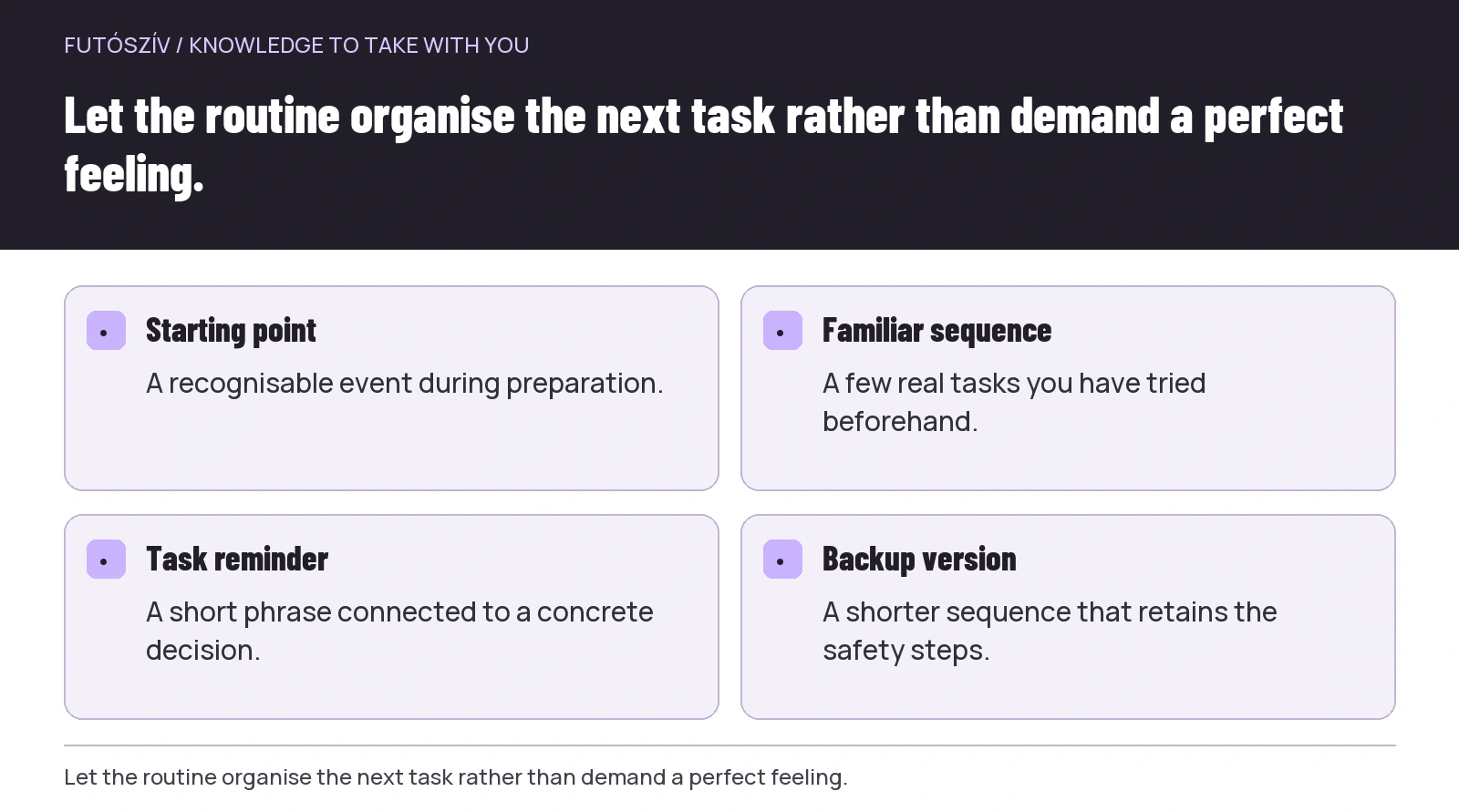
- Starting point
- A recognisable event during preparation.
- Familiar sequence
- A few real tasks you have tried beforehand.
- Task reminder
- A short phrase connected to a concrete decision.
- Backup version
- A shorter sequence that retains the safety steps.
Make the first step an actual action
“Do not worry” is a difficult instruction to carry out. Checking that you are heading to the correct start area, putting away unnecessary belongings or finding the agreed meeting point is more concrete. These are organisational tasks belonging to the race situation, rather than psychotherapy techniques. Once you have done them, you can actually establish that they are complete.
Distinguish a necessary check from repeatedly checking the same thing. If you have already read the timetable update and there is no new information, reopening it every ten minutes may not be necessary. Your routine can specify when you will last check official announcements and where you can hear about changes at the venue. This retains the information gathering needed for safety.
Choose a short reminder connected to a task
A brief phrase can be useful when you know which concrete decision it refers to. For example, “my own plan” might remind you not to follow the pace of the first runner passing you automatically. “One section” could help you recall that you are focusing on the next agreed task rather than the whole race. These are editorial examples, not mental prescriptions that apply to everyone.
The phrase must not override a physical warning. Instructions such as “keep going at any cost” are not appropriate safety principles. If a new, severe or alarming symptom appears, stopping and seeking help matter more than any reminder chosen beforehand. Mental preparation should support sound decisions rather than suppress warning signs.
Do not try an attention exercise for the first time at the start
If you want to use breathing, imagery or another attention exercise, become familiar with it in calmer circumstances first. You do not have to learn a new technique immediately before the start because others are using it. There is no need to force an exercise that feels unpleasant or makes you feel worse. If you have an individual mental health concern, discuss appropriate use with a professional.
Practice may also show that a brief quiet period, a familiar task or a matter-of-fact conversation with your coach works better for you. An impressive-looking method is not the point. Look for a tool that is feasible in the actual race environment and does not require perfect silence, complete separation or lots of new equipment.
Prepare a shorter version too
Delayed transport, a relocated start or an unexpected queue can disrupt your original sequence. If your routine can work only in flawless circumstances, it becomes a source of uncertainty itself. Prepare a shorter version: check information affecting safety, complete the necessary preparation agreed beforehand and use a single task reminder. The other elements can be optional additions.
A shorter version does not authorise you to drop organiser requirements or health-related limits. The aim is to make your personal ritual more flexible, rather than squeeze important tasks into an unsafe timeframe. If the situation means that starting safely or within the rules is no longer possible, treat that as a separate decision. A routine should not force you to start regardless of circumstances.
Discuss your pre-race needs with the people around you
You may enjoy talking before the start, or prefer a brief, quiet preparation period. You can tell your running companions or supporter beforehand. For example, you might ask not to spend the final period discussing new target times or other people’s training. A clear request is easier to follow than expecting those around you to guess what you need.
As a group leader, allow for differences too. Shared encouragement is not equally useful for every participant. Make essential information accessible without requiring everyone to demonstrate their personal attention routine publicly. Pre-race support should help people prepare independently, rather than create a compulsory uniform mood.
 Enlarge diagram
Text version of the illustration
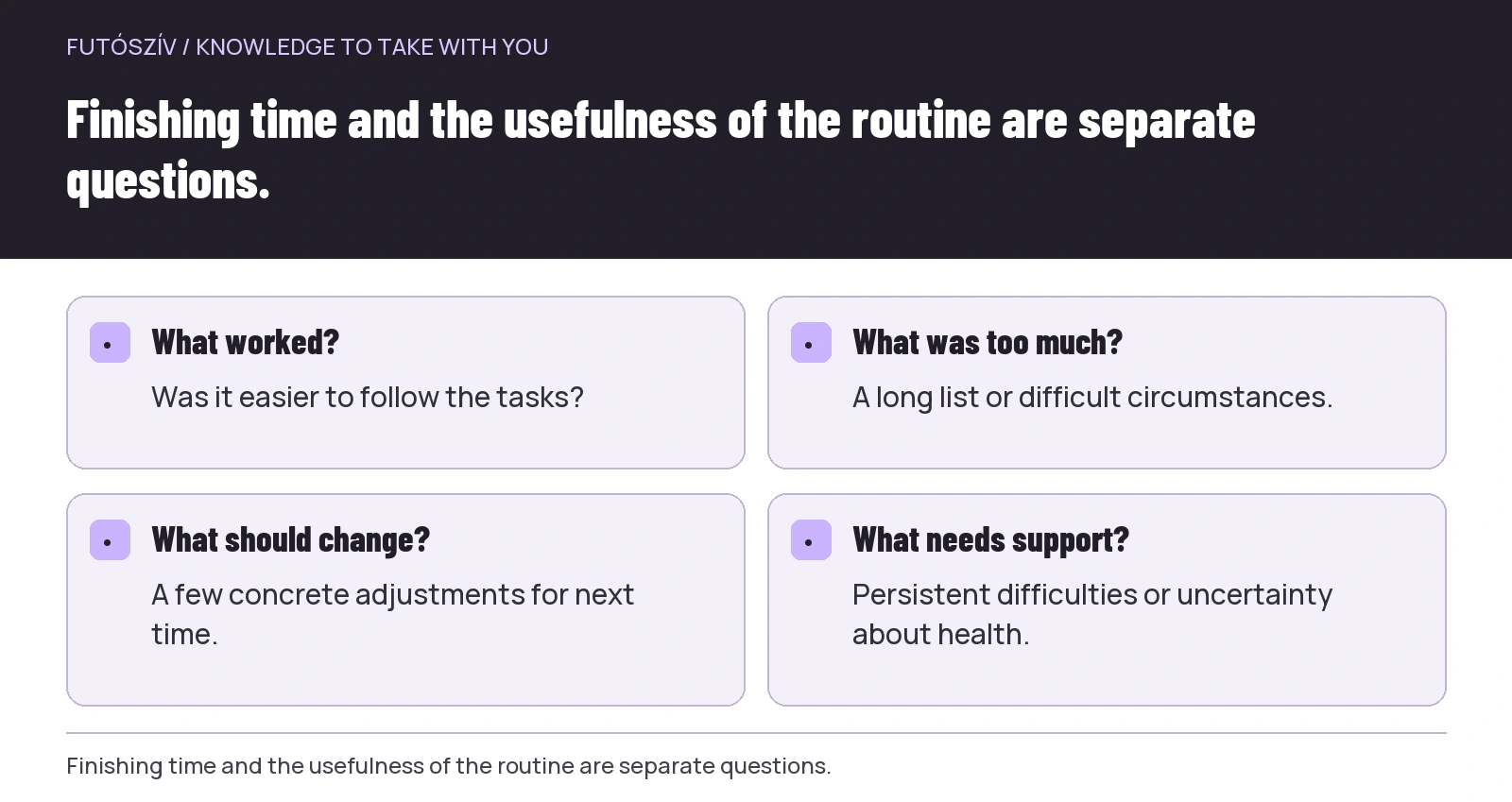
- What worked?
- Was it easier to follow the tasks?
- What was too much?
- A long list or difficult circumstances.
- What should change?
- A few concrete adjustments for next time.
- What needs support?
- Persistent difficulties or uncertainty about health.
Evaluate the result and the usefulness of the routine separately
A good finishing time does not prove that every part of the routine was necessary, and a harder race does not prove that the whole approach was pointless. The concrete questions are whether it helped you follow the tasks, what was difficult to carry out and where you needed to adjust. You can answer these independently of the result.
Write down no more than a few changes for next time. Rebuilding every detail after a single race will not give you enough experience of the same system. Equally, you do not have to retain an element that feels unpleasant, does not support safety or is impossible to complete. A routine is a tool you can adapt in light of experience using it.
Persistent anxiety may extend beyond the race
If worry makes sleeping, working or everyday activities impossible weeks beforehand, seek appropriate professional support. You do not have to regard this as an unavoidable price of racing. Sport psychology preparation and care for clinical anxiety can involve different tasks; a professional can help identify the support you need.
Do not automatically describe new chest pain, fainting or severe breathlessness as race nerves. Medical assistance at the venue, and emergency care when needed, take priority over starting. General information about pre-start tension cannot remotely establish how dangerous a specific physical symptom might be.
An example of a routine with two versions
In the full version, after arriving you check current organiser information, carry out the preparation agreed beforehand and briefly recall your task for the first section. The shorter version retains the same essentials when there is less opportunity for personal quiet time. It adds no new physical load and does not change health-related requirements or race rules.
After the next occasion, do not ask whether you were completely calm. Ask instead whether you knew what came next and whether an unexpected situation still left room for a sound decision. Your pre-start routine then becomes something other than a demand to force a perfect feeling. It is a familiar framework that makes room for your own plan and necessary flexibility alongside the excitement of racing.
A small-scale trial before the big event
You can also work through your personal sequence on a familiar, less important occasion. Choose the starting point, check whether the short list is clear and notice where you have to search or make decisions unnecessarily. This is not pressure-enhancing training or a clinical exercise. It is a simple trial to check whether the plan is manageable with your actual equipment and surroundings.
If a coach or sport psychology professional is helping, your experience can prompt a shared question: which part genuinely organises preparation, and which are you keeping merely out of habit? Keep the next version short and memorable. A good framework does not demand another performance immediately before the start; it helps you return to tasks you already know.
Sources and further reading
- ESSA 2026: Performance Under Pressure in Sport
- Georgia State Counseling Center: Pre-Competition Routines
- World Athletics: Five tips to help you deal with pre-competition nerves
How Futószív articles are prepared: our editorial guidelines.