A run can be attentive without having to be special
Sometimes, at the end of a familiar loop, you can barely remember where your thoughts went. Work, the next task and yesterday’s conversation filled the time. On other occasions, a few simple details stay with you: moving trees, a quiet stretch of path or how it felt to arrive. A mindfulness-related attention exercise can offer a chance to notice these things.
You do not have to turn running into a meditation achievement. You do not need an empty mind, uninterrupted calm or flawless concentration. This article describes brief, everyday opportunities for observation, with health and road-safety boundaries. It does not provide therapy or promise a faster race, guaranteed freedom from stress or a method suitable for everyone.
The idea is simpler than the promises built around it
The NHS describes mindfulness as paying greater attention to what is happening inside and outside us in the present moment. It is not about eliminating every thought. The mind wandering, and noticing that it has wandered, can be part of the experience. However, a general description does not make every exercise attempted during a run a clinically evaluated intervention.
The NCCIH information also describes differences in research findings and uncertainties about safety. It emphasises that mindfulness should not replace conventional healthcare. A short editorial attention exercise therefore does not imply a proven treatment effect. You can observe your experience without attaching a major health claim to it.
Start with an appropriate environment
A busy crossing, a technical trail or the edge of a crowded cycle path is not a good place to narrow your attention inwards. Awareness of traffic, the ground and people around you takes priority. For an attention exercise, choose a familiar place with clear visibility, where it will not distract you from an important safety task. If the situation changes, simply stop the exercise.
Keep your eyes open and avoid tasks that impair your awareness of your surroundings. This article does not recommend closing your eyes, holding your breath or shutting out the environment while running. The value of an exercise is not measured by how far you can detach yourself from the outside world. In the real situation of a run, attention needs to work alongside safe movement.
Try a moment while standing or walking
Before experimenting during a run, you can see what it is like to notice a few simple details while safely stopped or taking a quiet walk. For example, choose one distant and one nearby object, or notice where an environmental sound is coming from. You do not need an unusual experience or a sequence involving every sense.
This is not a test that grades your attention. If a task comes to mind, you can simply notice that your thoughts have moved elsewhere. There is no need to reprimand yourself. Afterwards, ask whether you found the exercise interesting, neutral or unpleasant. All three answers are useful information; you do not have to continue just because the method is popular.
 Enlarge diagram
Text version of the illustration
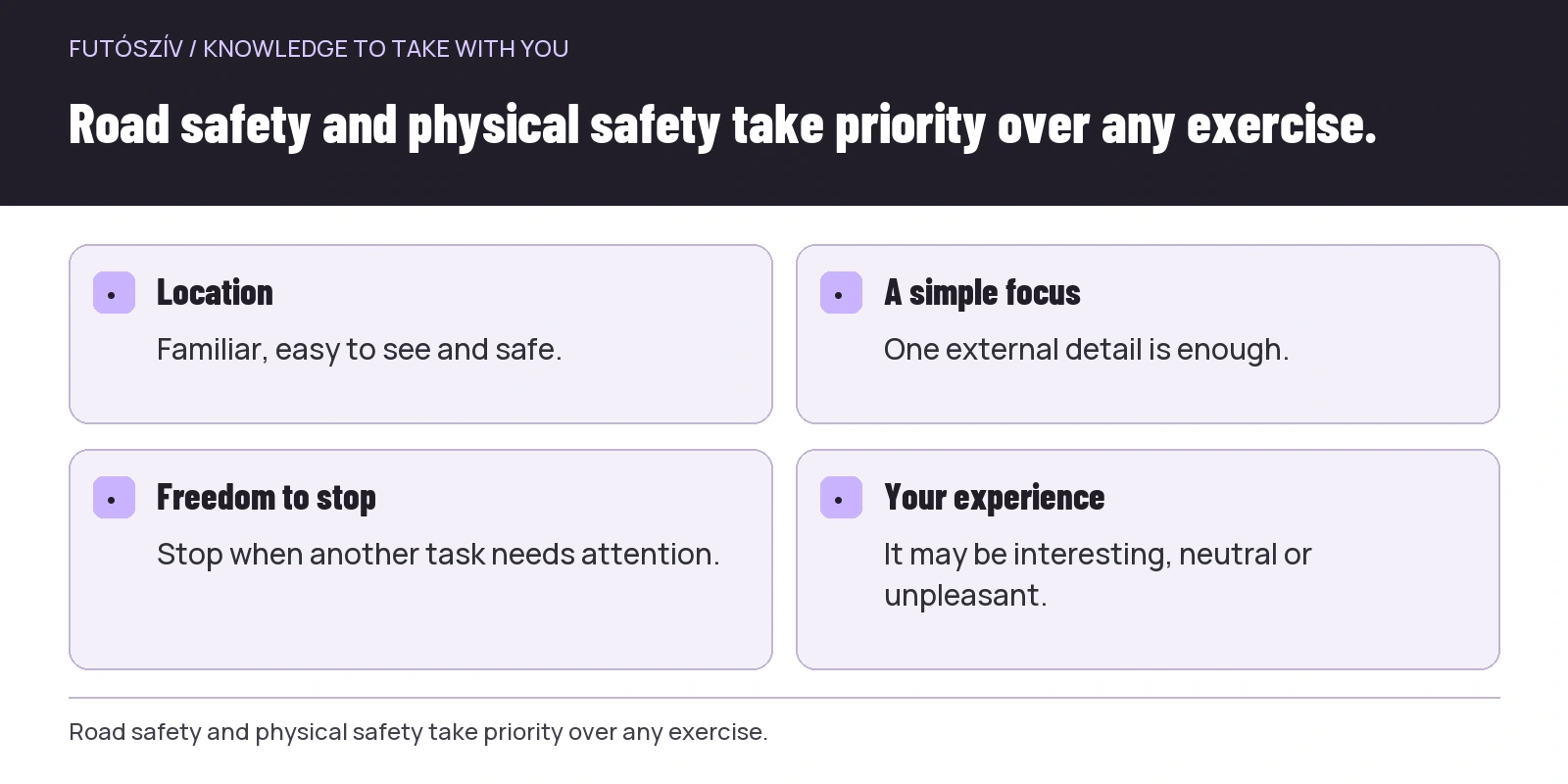
- Location
- Familiar, easy to see and safe.
- A simple focus
- One external detail is enough.
- Freedom to stop
- Stop when another task needs attention.
- Your experience
- It may be interesting, neutral or unpleasant.
External points of attention on an easy-to-follow stretch
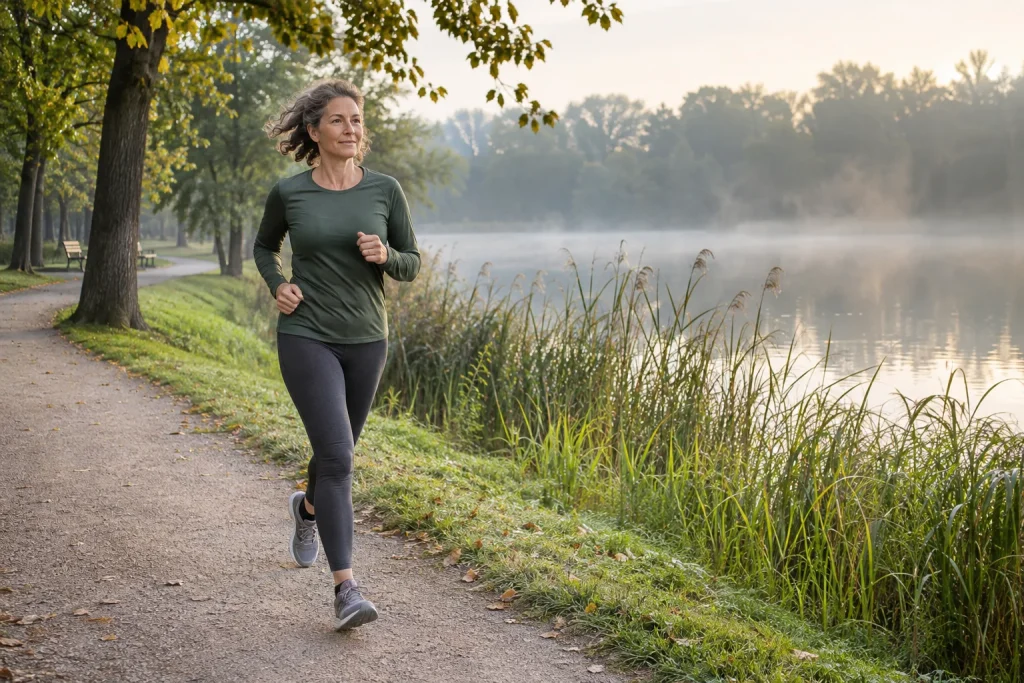
If the setting is safe and the activity suits you, notice changes in light, colours or sounds over a short stretch. For example, how does an open area of the park differ from the path under the trees? The task is not to count everything or produce an accurate report later. Noticing one detail is enough.
Do not start another compulsory sequence on your sports watch. The exercise can stay brief, optional to interrupt and unmeasured. If another runner approaches, the surface changes or you reach a junction, practical awareness of the environment takes precedence. Mindfulness should not require you to push important external signals into the background.
Observing bodily sensations is not a medical examination
You might notice where clothing touches your skin or how the air feels different in the shade. There is no need to check every heartbeat or step. Constant inward monitoring can feel unpleasant for some people, so you can choose an external focus instead or omit the exercise entirely.
Do not try to override new pain, feeling unwell or another concerning symptom simply by observing it. The appropriate decision is to stop the activity and seek healthcare as needed. Noticing a warning sign is not a failure of the attention exercise. Personal safety matters more than completing a chosen task or adapting to uncomfortable sensations at any cost.
You can name a thought without having to resolve it
While running, you may think that you ruined a previous race or that the next session is bound to be difficult. A brief description might be that planning, remembering or worrying is happening now. You do not need to prove or disprove the thought immediately. This is one possible form of personal observation, not a standalone psychotherapeutic procedure.
If an issue genuinely requires action, you can write it down later and deal with it in the appropriate place. A missing race number needs to be resolved with the organiser, while persistent anxiety may require professional support. Redirecting attention must not mean putting every problem aside for ever. Noticing a thought is different from neglecting a real task.
A neutral experience is a valid response too
You might try a brief observation and feel nothing particular. You may not become calmer or find the run easier. There is no need to look for a fault in yourself. Your personal toolkit may include methods that simply do not interest you or do not work for you. Not every popular exercise has to feature in every runner’s routine.
If you wish, try another, simpler focus on a different occasion. If you do not, choose a conversational run or let your thoughts move more freely. Movement can be experienced in many ways. The aim is not to produce a supposedly correct inner state, but to discover what fits your needs and environment.
If you feel worse, you do not have to persist
The NHS explicitly notes that mindfulness is not right for everyone and that some people feel worse when practising it. The NCCIH also reports possible negative experiences. If an exercise brings up intense anxiety, distressing memories or another unpleasant state, stop and seek appropriate professional support if needed.
Do not interpret this as a sign that you need to practise harder or longer to succeed. Particularly if you have an established mental health condition, discuss the method with the professional supporting your treatment. An editorial article cannot assess your personal history or select a therapeutic approach that is safe for you.
 Enlarge diagram
Text version of the illustration
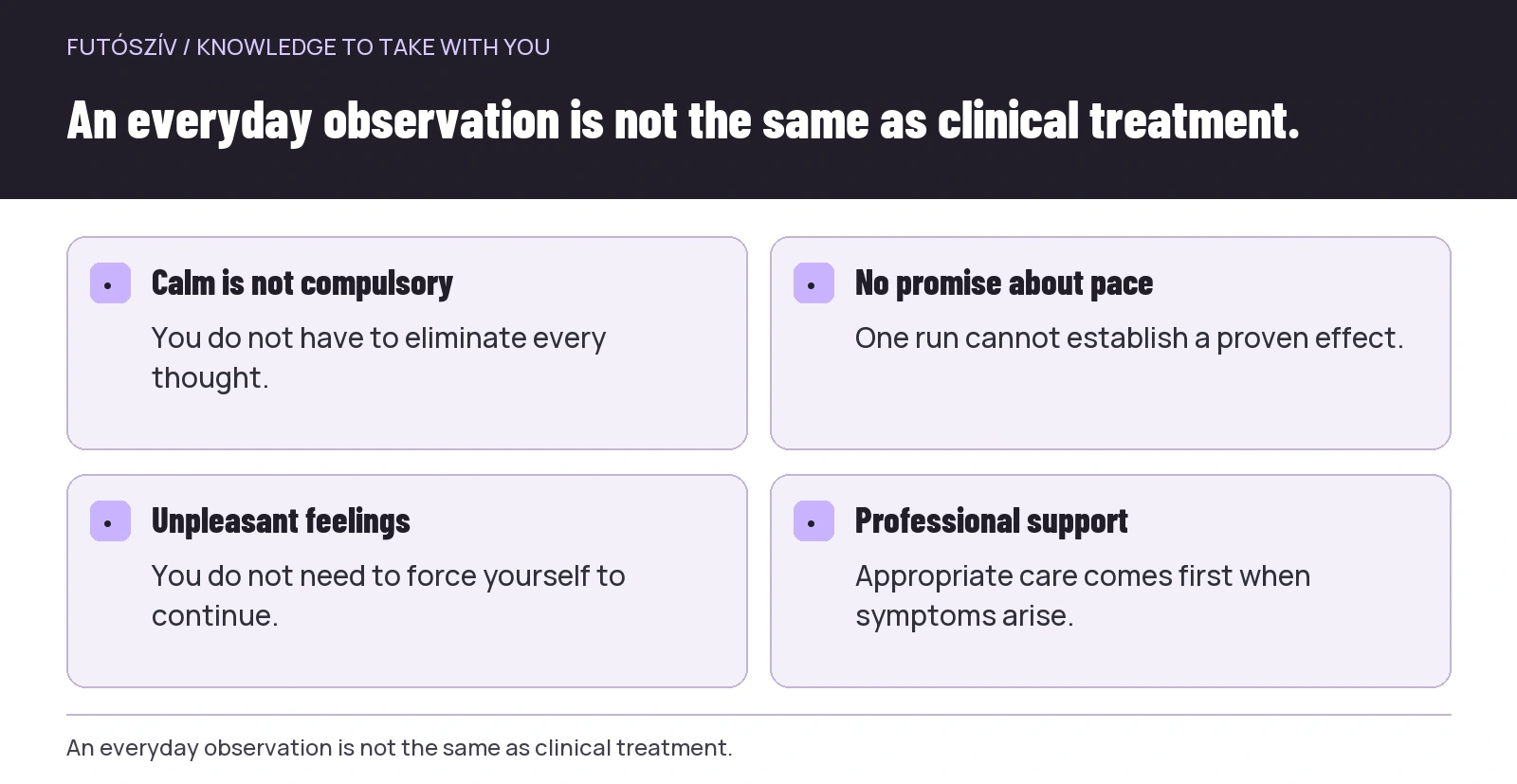
- Calm is not compulsory
- You do not have to eliminate every thought.
- No promise about pace
- One run cannot establish a proven effect.
- Unpleasant feelings
- You do not need to force yourself to continue.
- Professional support
- Appropriate care comes first when symptoms arise.
Keep the task optional in a group too
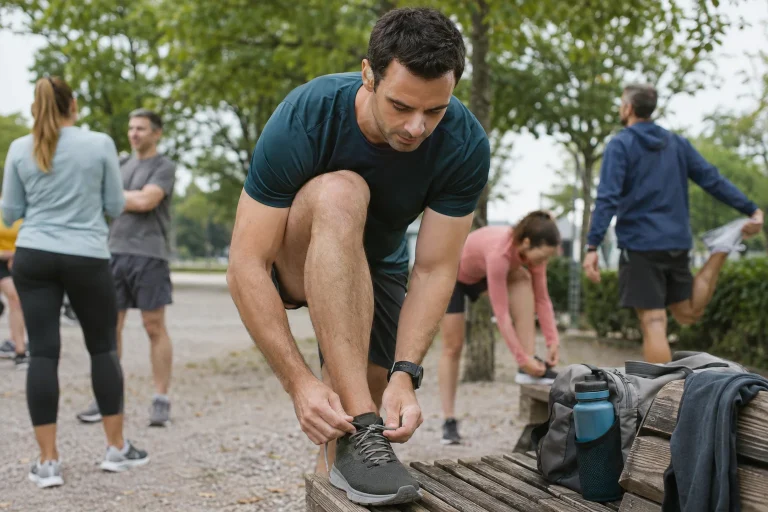
If you lead a running group and offer a short attention exercise, explain in advance what will happen and that people can opt out. Do not ask for public accounts of personal emotions or inner experiences. Participants have different histories and may not want to share them with the group. A general sports programme is not automatically a therapeutic setting.
Choosing the location, following traffic rules and setting the activity boundaries remain part of organising the session. If someone does not wish to take part in the attention task, make it clear how they can join the rest of the programme. Choice is only real if it does not bring mocking comments, an obligation to explain or exclusion from the group.
Do not look for an outcome solely in your pace
The brief exercises described here carry no performance promise. If your average pace changes later, that alone cannot reveal the exercise’s effect. The course, weather, daily routine and many other circumstances may also have changed. When evaluating your experience, stay with what you actually observed.
For example, ask whether the location was suitable, whether it was easy to stop and whether you would like to give your surroundings this brief attention again. This may be enough feedback for a freely chosen everyday experiment. Scientific assessment of clinical effects or sporting performance needs different evidence and a different professional framework from impressions of a single run.
An example: a few noticed details in a familiar park
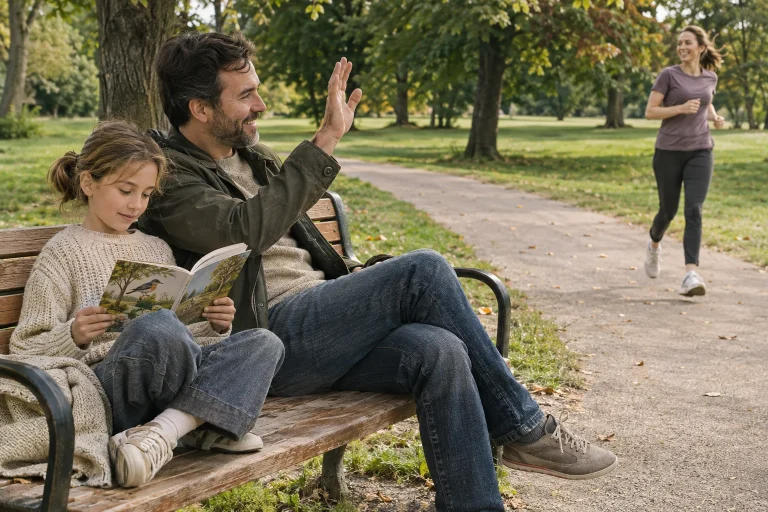
During a quiet stretch of walking, you notice that the wind moves a nearby bush differently from the branches of a taller tree. Meanwhile, you remember something you need to do tomorrow. You note to yourself that you are planning, then bring your attention back to the safe route. At the next junction, traffic takes priority and the brief exercise ends.
There is no special breakthrough or compulsory lesson in this story. There were simply a few noticed moments, followed by another task. If this suits you, it can occasionally accompany movement. If not, you can leave it out. Mindful attention remains a useful option when curiosity and safety are accompanied by freedom of choice.
A professional and a general wellbeing suggestion have different roles
If you are looking for a course or guided session, you can ask about the leader’s qualifications, the programme’s purpose, participation arrangements and how unpleasant experiences are handled. If you have health symptoms, do not choose treatment from the description of a general running programme. You can discuss possible complementary approaches with the professional involved in your care.
Brief environmental observation, regular meditation and clinical mindfulness-based treatment are not interchangeable terms. Research findings about one cannot automatically be transferred to another. Keeping these concepts distinct helps you place simple attention during a run in its proper context: an optional experience, without exaggerated promises or unnecessary self-testing.
Sources and further reading
- NHS: Mindfulness, reviewed August 2026
- NHS Every Mind Matters: What is mindfulness?
- NCCIH: Meditation and Mindfulness, Effectiveness and Safety
How Futószív articles are prepared: our editorial guidelines.