
Muscle pain going downstairs is not a diagnosis on its own
After new strengthening or an unusually downhill run, sitting, standing up and stairs may be harder the next day. This may be delayed-onset muscle soreness, commonly called DOMS. A similar sensation does not mean the same thing in every situation, however. Pain onset, location, progression, effects on movement and any accompanying symptoms matter together.
According to the American College of Sports Medicine information , DOMS often develops after unfamiliar muscle loading, typically starts with a delay and may be strongest one to three days after training. This differs from acute pain during movement. The time window is a reference point, rather than a rule classifying every later-starting pain as harmless.
This article does not aim to help you distinguish every injury from soreness with certainty at home. It helps you observe changes more usefully, avoid common misunderstandings and know when professional help is needed. Enduring pain does not, by itself, establish safe load capacity.
Why might it appear after a new session?
DOMS does not require a particularly long run. An exercise not performed for a long time, a new load format or movement different from the usual may be enough. Downhill running and slowly lowering a weight involve muscle lengthening under load. Such eccentric work is a particularly familiar trigger.
The ACSM material also rejects the popular explanation of accumulated lactic acid. Muscle pain the next day is not simply “acid left behind” that needs running out. The process is complex, so an oversimplified story can lead to oversimplified, sometimes harmful solutions.
Judge unfamiliarity against your own history. A long mountain descent can be a new stimulus even for a trained road runner, and substantial running mileage does not automatically make new leg strengthening familiar. Endurance from another sport likewise does not mean every muscle is prepared for the same load.
Four questions instead of merely scoring pain
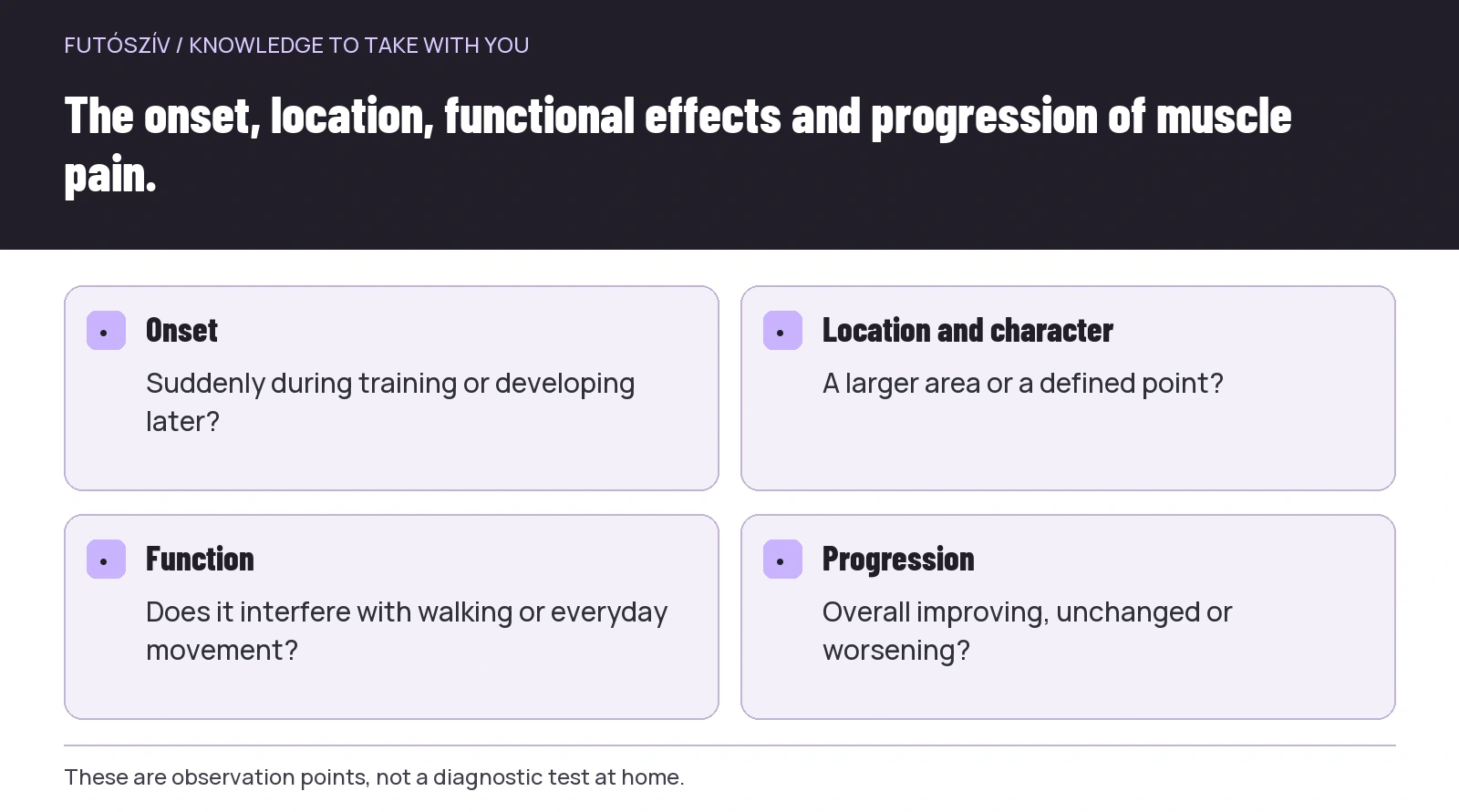
When did it begin? A sudden stabbing sensation at one point while running is a different history from feeling well in the evening and several muscle areas becoming sensitive the next day. Sudden onset does not name the injury, but should not be renamed ordinary soreness retrospectively simply because you trained the day before.
Where and how do you feel it? Stiffness across a larger muscle area differs from strong, well-localised point pain. Swelling, bruising, unusual weakness or altered sensation are important additions. Symptoms on both sides are not guaranteed reassurance either: both sides can hurt from a more serious loading problem.
What does it prevent, and how is it changing? Can you manage everyday movement, is walking worsening and is the condition improving overall? Function and trend matter alongside numbers. You do not need repeated painful movements to prove the situation; limitations already observed can be described.
 Enlarge diagram
Text version of the diagram
- Onset
- Suddenly during training or developing later?
- Location and character
- A larger area or a defined point?
- Function
- Does it interfere with walking or everyday movement?
- Progression
- Overall improving, unchanged or worsening?
Three histories, three different next steps
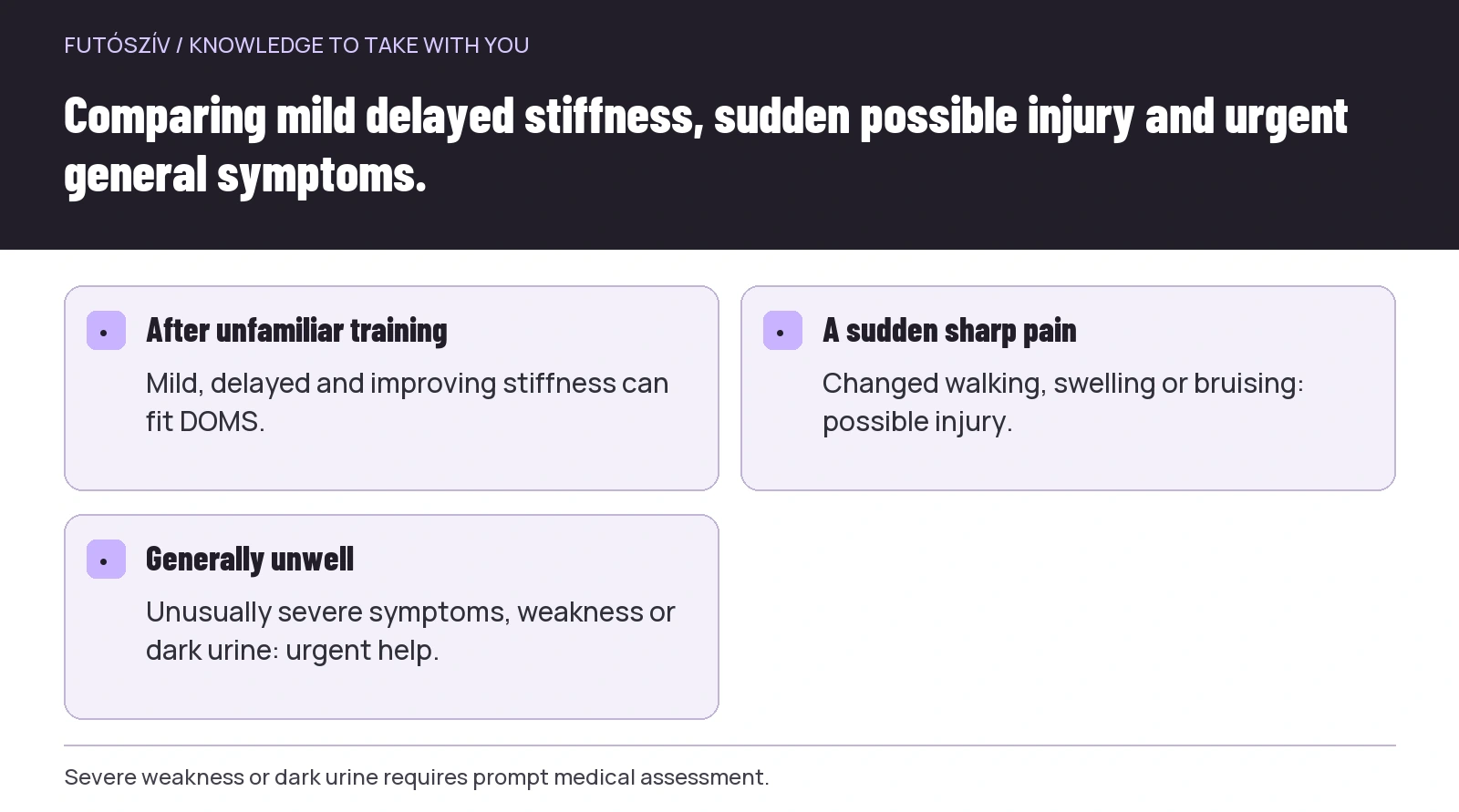
Stiffness after unfamiliar strengthening. The runner performed new exercises the previous day and several thigh muscles are sensitive next day. Symptoms did not begin with a sudden injury and generally ease over subsequent days. This can fit DOMS. It still makes sense to adapt load to actual movement rather than try to repeat the same hard session.
Sharp pain during running. The runner suddenly feels a pull while accelerating, their stride changes and swelling or bruising appears later. This history suggests possible injury and cannot be resolved by general soreness advice. Stop running and seek assessment appropriate to the condition’s severity.
Unusually severe muscle symptoms and feeling unwell. After a large or new load, the runner is strikingly weak, has severe pain and perhaps urine dark like tea or cola. This is an urgent medical question. The task is not to decide at home whether it “still counts as soreness”, but to obtain appropriate care quickly.
The rare but important exception: rhabdomyolysis
The CDC/NIOSH information lists muscle pain more severe than expected, dark urine and unusual weakness among warning symptoms of rhabdomyolysis, involving serious damage to muscle tissue. Symptoms can begin hours or days later. You do not need every sign present together before seeking help.
Seek immediate medical assessment if such symptoms arise, and emergency help for severe illness, confusion or collapse. Symptoms can resemble other conditions, and diagnosis requires medical examination. Apparently normal urine or temporary improvement is not a reliable home rule-out test.
The military clinical guideline on exertional rhabdomyolysis also places diagnosis and return within medical assessment. A military setting is not the same as a recreational runner’s, but the basic boundary is clear: severe muscle symptoms and general illness need more than a home recovery recipe. Do not delay care on the basis of first drinking more fluid and seeing what happens.
Possible injury: which signs should you not try to run through?
The NHS page on sprains and strains discusses worsening pain, major swelling or bruising and inability to bear weight as signs that may justify prompt help. Visible deformity, altered sensation or a cold or discoloured limb requires urgent care. Occurring after training does not reduce these signs’ significance.
If you cannot walk normally, do not change running technique to keep going. Do not turn a pain-related limp into a new “gentle” session. Temporary improvement as you warm up is no guarantee either: symptom relief and tissue load capacity are not the same question.
Persistent, recurring or unexplained symptoms are worth taking to a professional even without conspicuous swelling. This is particularly important if pain appears in the same place every run or limits you beyond training. You do not need to wait until a seemingly minor problem makes movement completely impossible.
If it really seems like mild soreness, what does cautious adaptation mean?
Do not force the next day’s programme around predetermined kilometres. If movement is stiff or uncertain, technically difficult terrain, major accelerations or another unfamiliar leg load are not ideal choices. Shorter, comfortable everyday movement differs substantially from hard sports training.
Choosing gentle, pleasant movement is not a compulsory “active recovery” performance. If an easy walk is comfortable, it may fit your day; if it increases symptoms, you need not prove through it that you recover properly. With uncertain, severe or non-improving symptoms, seek advice rather than testing more and more activities.
Sleep, regular eating and reviewing load are usually more important practical tasks than piling up treatments. Massage, foam rolling or cold application does not replace diagnosis. A method that is uncomfortable, provokes strong pain or loads an injured area does not become useful simply by being called recovery.
 Enlarge diagram
Text version of the diagram
- After unfamiliar training
- Mild, delayed and improving stiffness can fit DOMS.
- A sudden sharp pain
- Changed walking, swelling or bruising: possible injury.
- Generally unwell
- Unusually severe symptoms, weakness or dark urine: urgent help.
Do not confuse less pain with greater readiness
Feeling lighter legs one day is a welcome change, but not an automatic invitation to make up every missed session. First consider whether everyday movement and general condition are settling and whether injury signs are absent. If an injury or severe muscle damage was diagnosed, returning requires an individual professional plan.
Symptoms suppressed with painkillers are not a load test either. Discuss medication with a doctor or pharmacist where needed, but do not use it to get through a session you could not otherwise perform normally. A general soreness article cannot provide medication permission or dosage.
You do not need to seek the same degree of soreness at the next similar session. Adaptation and development cannot be measured by next-day pain quantity. ACSM likewise emphasises that pain is not necessary for training benefits. A programme leaving you comfortable moving the next day can be valuable too.
How to reduce surprises with a new training format
Introduce the new element recognisably. If you change strengthening, running shoes, route and intervals together, understanding a later symptom’s origin becomes harder. You need not avoid every novelty; choose a number of changes whose effects you can track in your own circumstances.
Do not wait until the last week before a race to try heavy leg exercises not done for a long time or unusually many descents. This is an uncertain way to gain confidence in your form. Introducing something new requires planning and subsequent adaptation time; an approaching start does not automatically speed the process.
You can tell the coach about the new programme: I have not done this before, it previously caused strong muscle pain, or I am currently facing several other loads too. You can then modify quantity and timing together. Gradual progression here is not a percentage prescribed for everyone, but a decision adapted to experience and response.
A useful short account when seeking help
List unfamiliar elements in previous days: a new exercise, major descent, race, heat or return after a long break. Add symptom onset, location, progression and the everyday movement it obstructs. Report general illness, unusual weakness or urine changes immediately if present.
The University of Maryland medical educational overview also shows the importance of distinguishing DOMS from more serious conditions. You do not need a ready-made diagnosis before examination. An accurate history helps more than trying to choose with certainty between soreness and injury.
Long-term enjoyment of running includes avoiding dramatising temporary sensations after unfamiliar load while also not trivialising warning signs. Both perspectives can coexist: reasonable observation in a mild, improving situation, and appropriate professional help when the history goes beyond it.
Sources and further reading
- American College of Sports Medicine: Delayed Onset Muscle Soreness
- NHS: Sprains and strains
- CDC/NIOSH: Signs and Symptoms of Rhabdomyolysis
- University of Maryland School of Medicine: Delayed Onset Muscle Soreness
- Clinical Practice Guideline for the Management of Exertional Rhabdomyolysis in Warfighters
How Futószív articles are prepared: our editorial guidelines.