In a small home, running kit tries to serve several tasks within the same few square metres. It comes home wet, waits for cleaning, dries and becomes ready to go again. If all of this happens in one basket, it soon becomes difficult to tell what is usable. A space-saving system therefore separates states first and only then finds containers for them.
You do not need a separate sports room or an impressive equipment wall. A small section of shelf, existing drying space, a designated shoe spot and a few simple labels can work. The aim is for your belongings not to obstruct use of the home, and for necessary items to be easy to reach before departure. Adapt the following steps to your own layout.
Trace its entire journey through the home
Think through the ten minutes after your last run. Where do you take off your shoes? Where do the phone, key, used socks and jacket go? Where is the next clean outfit? The movement of items often reveals where the system backs up. A larger box alone does not solve an undefined route for used clothing.
List the storage and drying options you actually have. Look beyond empty shelf space to what you can comfortably access. A high, hard-to-reach box may suit rarely used dry items, but is awkward for your daily key. Let frequency of use guide placement.
In a shared home, agree arrangements with others. Hallway, bathroom and drying space are not exclusively running areas. Explain which state would use space and for how long. “The shoes always stay here” and “they go back to the shelf after drying” are different agreements. Specific arrangements are easier to maintain and check.
Distinguish four states
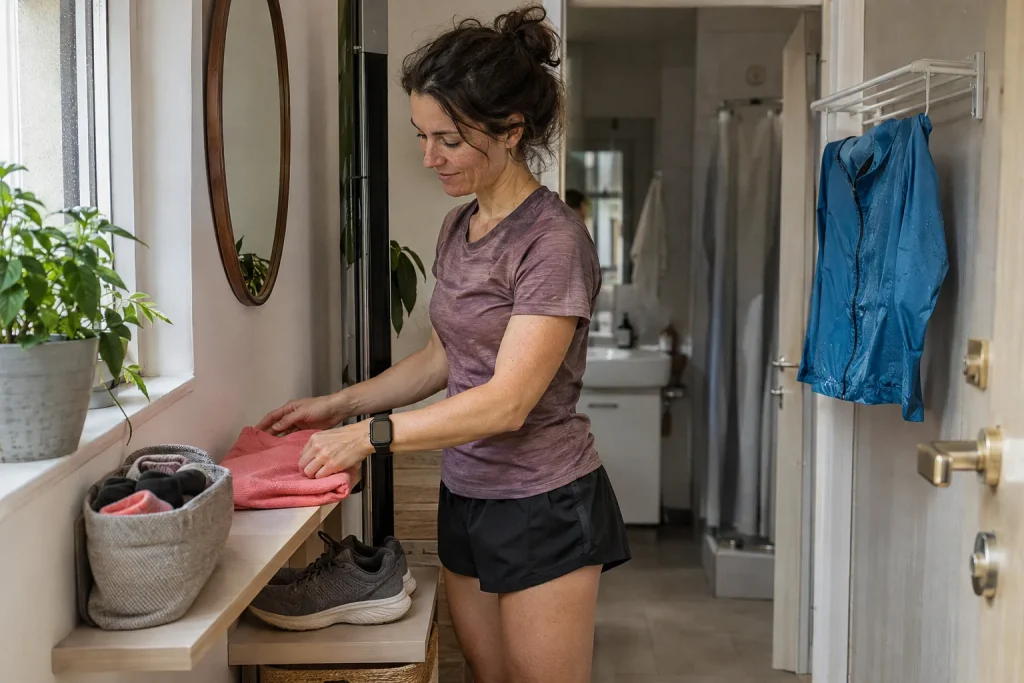
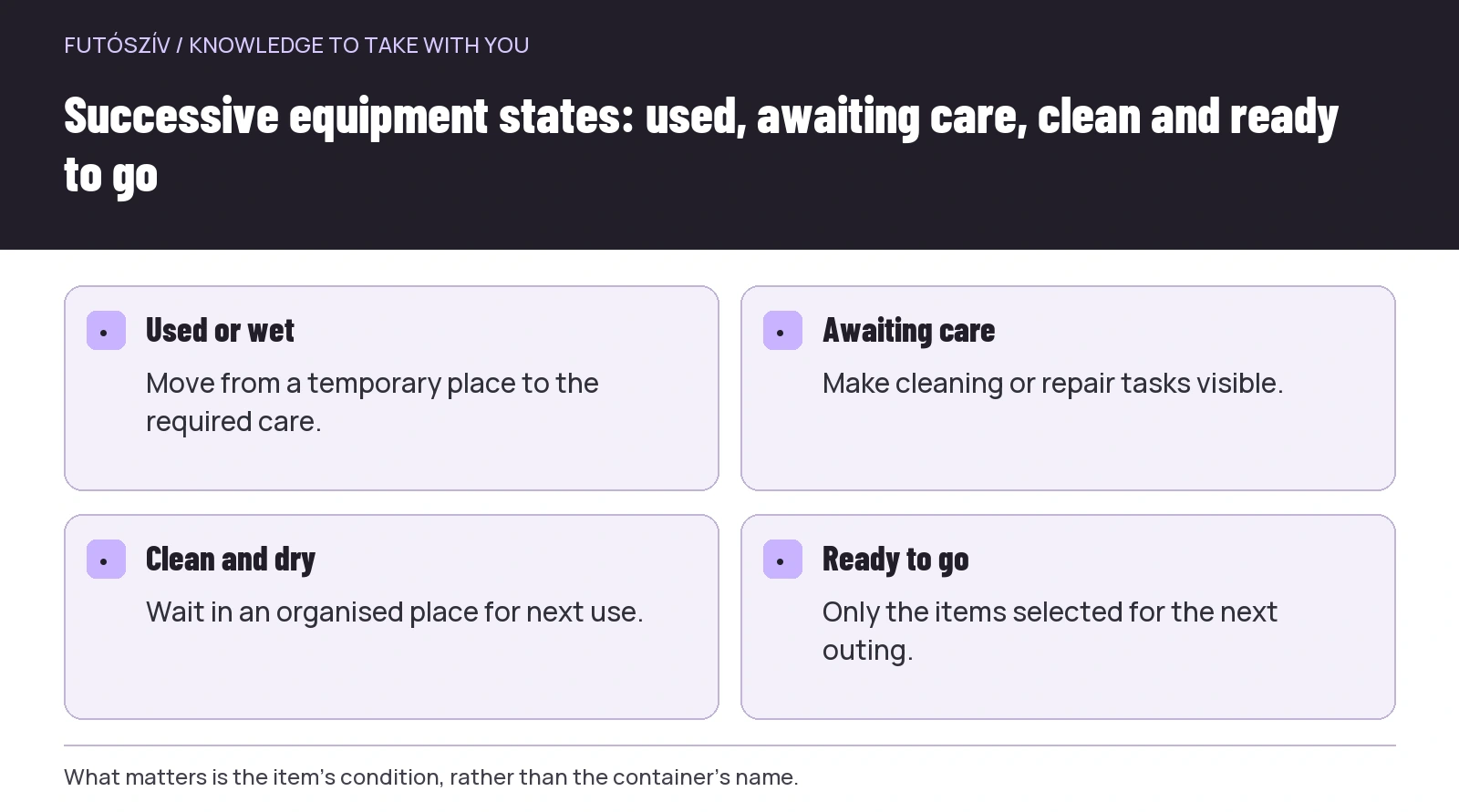
Used or wet. These items should not automatically join the clean supply. On arrival, give them a temporary place suited to the home, from which they move on to appropriate care. Do not confuse a closed transport bag with permanent storage. Unpacking after running is part of the system.
Awaiting cleaning or inspection. This may include muddy shoes, clothing needing care or an accessory requiring repair. Make the next step clear. If a repair-needed piece mixes with usable supplies, the problem may only appear as you leave. A simple label or separate small pouch may be enough to indicate the state.
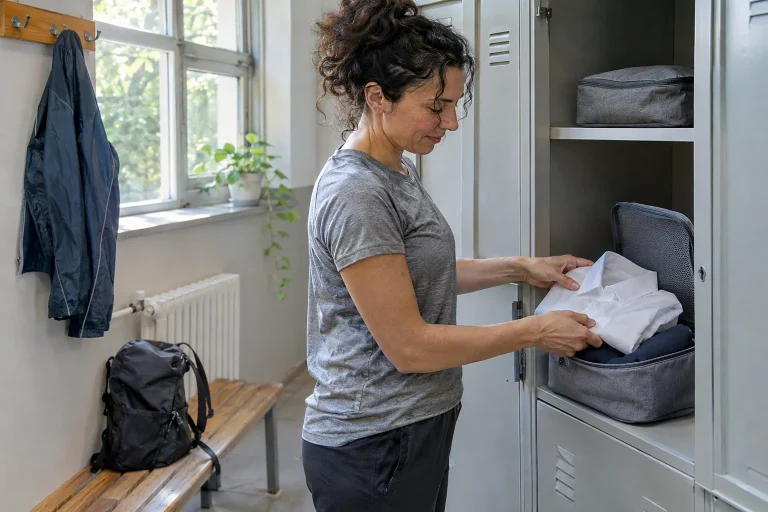
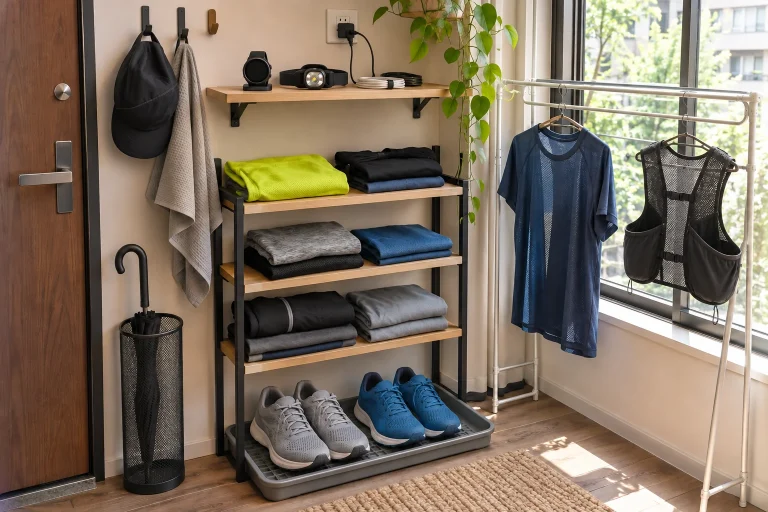
Clean and dry. This is the supply genuinely suitable for storage and ready for next use. The item and space determine whether it is folded or hung. Everything does not need to fit in the same form. A jacket, socks and a light have different shapes and frequencies of use.
Prepared for the next outing. This is the smallest, temporary group. Include only items chosen for the next programme. If all your clothes go here, preparation loses its meaning. A small area on a chair or shelf can be enough if it does not interfere with others’ use.
 Enlarge diagram
Text version of the diagram
- Used or wet
- Move from a temporary place to the required care.
- Awaiting care
- Make cleaning or repair tasks visible.
- Clean and dry
- Wait in an organised place for next use.
- Ready to go
- Only the items selected for the next outing.
Condition matters more than a storage label
| State | The space’s task | When does it move on? |
|---|---|---|
| Used, wet | Temporary placement and separation | When the required care begins |
| Awaiting care | Making the task visible | After cleaning or repair |
| Clean, dry | Organised storage | When choosing the next programme |
| Ready to go | Simplifying preparation | On the next outing |
The same shelf can serve different roles at different times if states do not mix. In a small space, this may be more practical than buying four large containers. However, genuinely appropriate provision is needed for wet items; lack of space does not change an item’s care requirements.
The GORE-TEX care page also emphasises checking manufacturer care instructions. Your storage system should support them. If a particular item has a different washing or drying procedure, note that separately. “All sports kit goes through the same process” sounds simple but combines too many different objects.
Give shoes their own route
After taking shoes off at the entrance, first check their condition. Muddy, rainy and dry outings may leave different tasks. Arrange the route towards clean parts of the home so that later dealing with shoes does not require taking over the entire hallway again. A permitted, easy-to-clean location can help.
For cleaning, your own model’s instructions matter. Nike’s official article on washing shoes , for example, describes hand cleaning and air drying instead of machine washing for its own shoes. This does not mean the same rule applies to every product from every brand. The lesson is that saving space is not a reason to automatically add shoes to the clothing wash process.
The designated drying spot should not obstruct opening a door or moving around. Return only appropriately cared-for, storage-ready shoes to the shelf. If you have several pairs, mark simply which are usable and which still need attention. Lack of space is often worsened by accumulation with no defined state, when nobody knows why a pair has been in the way for weeks.
Treat daily and seasonal supplies separately
Make currently used clothing easy to access. Clean, properly stored seasonal items not needed for months can go somewhere less convenient. Separation does not necessarily require new furniture: the front and back of the same shelf or two existing containers can serve different roles.
At seasonal changes, review what stays in daily use. A layer useful on a cooler evening may still have a place even when the season has a different name. Let actual use guide the decision. Something put away too early according to a calendar label only has to be retrieved again later.
Before storing, make a brief inventory. What is complete, what needs repair and which pieces do you not use? Do not pack faulty items away as though they were ready. At the first outing next season, an organised supply is much easier to retrieve than old unresolved tasks.
 Enlarge diagram
Text version of the diagram
- Real space
- Allow room for opening doors and lifting out the container too.
- Access
- You should not need to unpack everything for a daily item.
- Use
- Daily and seasonal items can have different locations.
- Drying
- This needs its own suitable provision.
- Shared space
- Agree the arrangement with other people using the home too.
Keep small accessories together, grouped by role
Lights, reflective accessories, belts, hats, phone straps and key holders easily scatter. A small section of drawer or an existing divided box can make them easier to see. You could organise by use: everyday, needed in darkness and rarely used. There is no need to wrap everything separately if that only creates more unpacking.
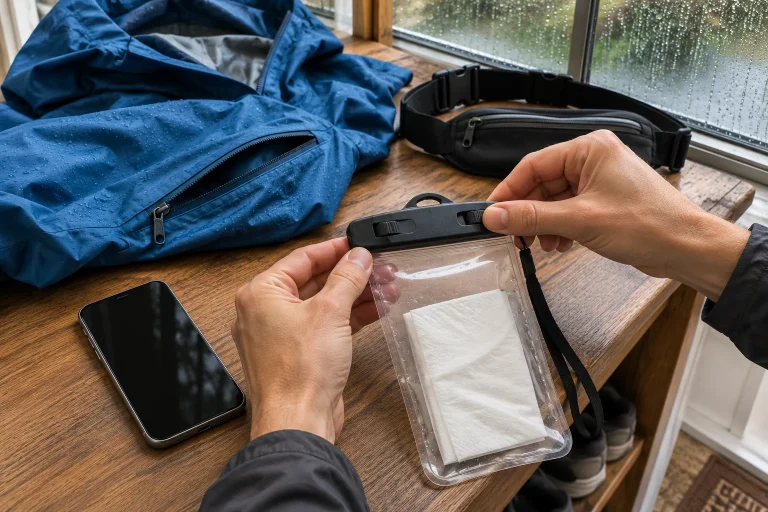
For electronics, charging and storage are separate states. Use conditions and accessories specified by the manufacturer for charging. Do not route a cable across a walkway. If the light regularly goes into the drawer uncharged, change the closing routine rather than the container’s size.
Consider the home’s other users when placing small parts and cords too. With small children or pets, access can require particular attention. Equipment is organised not because it occupies one impressive surface, but because it can be used appropriately and predictably within your own household.
Three small-home situations
A narrow hallway. Keeping passage clear is the first task here. Only a temporary shoe spot may remain at the entrance, while dry storage moves to another shelf area. Put the key in a permanent, accessible place, and move clothes directly towards the appropriate care state. The hallway does not have to serve every running task at once.
One shared clothes airer. Coordinate use with other laundry. Plan the quantity and care of your sports kit around this actual capacity. If every surface is regularly full, washing times and supply rotation matter more than another box. Drying items’ space needs do not disappear because no space has been designated.
A shared bedroom wardrobe. A clearly bounded shelf area may be enough for clean daily supplies. The outfit selected for next time gets a temporary spot, which it frees at departure. Used clothing does not return to the same place. The agreed boundary helps ensure the system does not displace others’ storage.
These are illustrative basic situations. In your home, choose the solution according to ventilation, access, furnishings and shared use. The examples aim to separate tasks, not recommend a particular piece of furniture or storage product.
Measure before buying storage
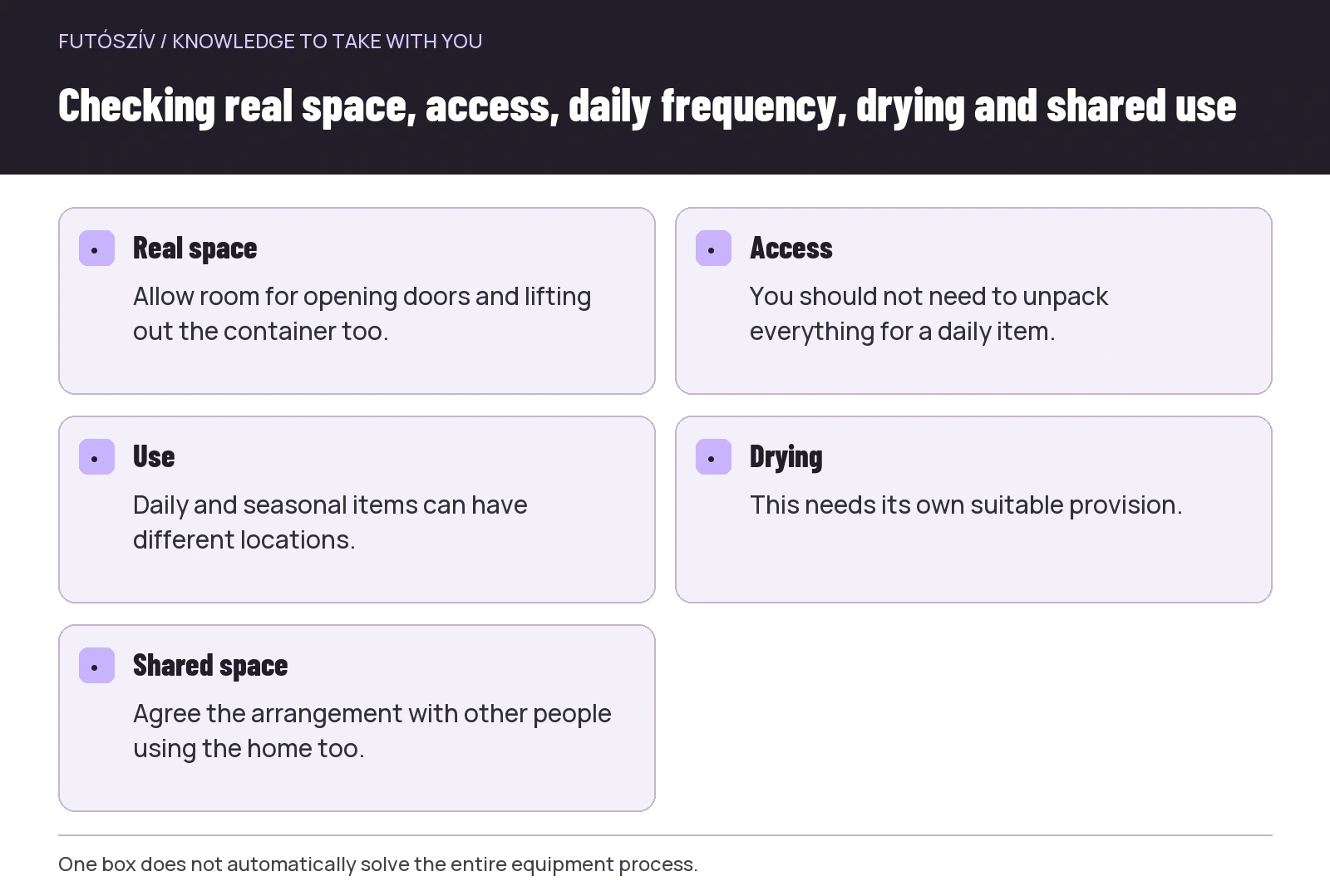
If the existing arrangement is insufficient, measure the actual space and the supply to be stored first. Door opening, shelf depth and lifting out the box all matter. A container that only just fits may be hard to use if its lid cannot open or you must move three other objects every time.
Try the size temporarily with an existing box or designated shelf section. A few days of use may reveal whether placement works. Put daily items where you actually retrieve them, rather than where they would look best in a room photograph. Organisation aims for function.
New storage does not increase drying capacity or repair a broken zip. If these are bottlenecks, solve them as separate tasks. Naming the problem precisely helps avoid buying a space-consuming object for a question requiring another kind of answer.
A brief weekly tidy-up with three questions
What remains in a temporary state? What has not returned to its own place? What is missing for the next outing? Review these three questions at a calm moment. An accessory left beside the airer for ages or clothing forgotten in a bag then gets a task before the next departure.
If something regularly ends up in the wrong place, consider whether its assigned route is too awkward. Perhaps returning the daily hat to a high box is difficult, the key holder is not near the door, or containers for usable and repair-needed items look too similar. Recurring disorder can also tell you about system design.
Change one detail, then observe whether use became simpler. In a small space, clarity often offers more than greater storage capacity. If you know what is clean, drying, awaiting care and prepared for next time, equipment no longer appears as one unmanageable pile. It has its own route and next step through the home.
How Futószív articles are prepared: our editorial guidelines.