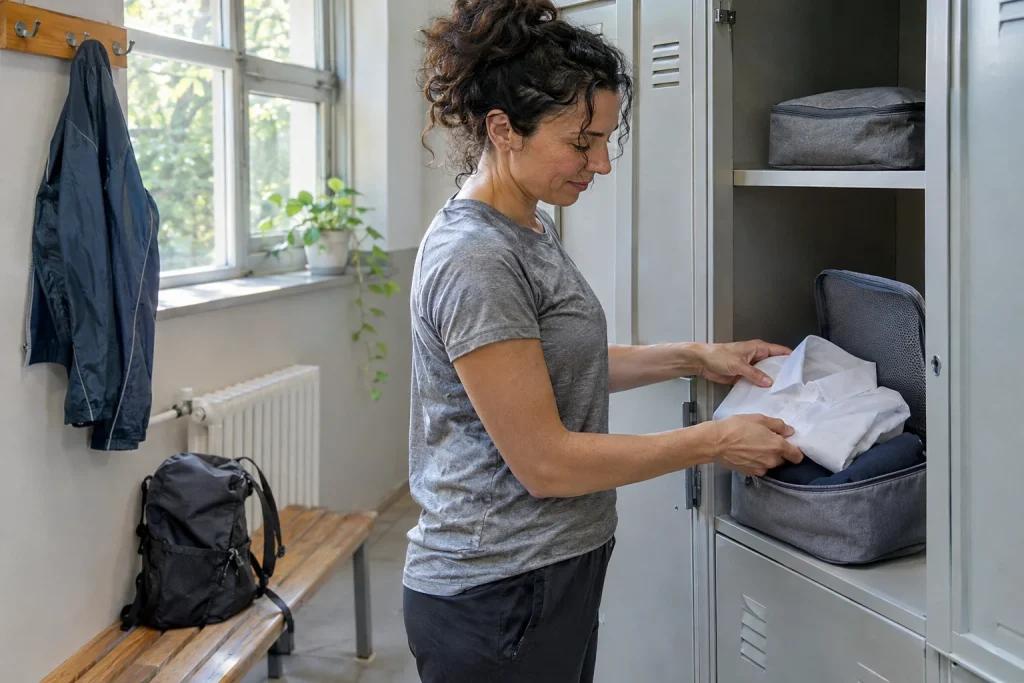
Running to work is comfortable when the next ten to twenty minutes after arrival are planned too. A well-chosen route is only one part of the system. You need to know where to change, where clean clothes stay, how used equipment gets home and what happens at the end of the day. Two work-clothing packs prepared in advance can help create a repeatable cycle.
In this guide, “two changes of clothes” means two clean outfits appropriate for your own workplace. One waits for the next arrival on foot, while the other serves as a replacement or backup. This is an organisational example, not a rule for every workplace. Uniform, occupational safety or hygiene requirements mean arranging the solution according to local rules.
Start your assessment at the destination
Before planning a single morning kilometre, check the conditions on arrival. Is there an accessible changing room and suitable washing facilities? When can you use them, do you need an access card, and where can you store your belongings? Assuming “there must be somewhere” can easily create a rushed first morning. Ask about the actual place and procedures.
If there is a shower, check access and what you need for your own use. Its existence does not prove it is free or open when you arrive. Towels, shower footwear, toiletries and handling wet items afterwards are tasks too. It is simpler to inspect the details on a calm day without running.
If suitable arrival facilities are unavailable, you could run home after work, combine a shorter section with transport or use another location. You do not have to force workplace facilities to fit a morning run. A sustainable format accommodates both movement and the requirements of starting work.
The Workplace Movement guide for leaders , made available by Sport England, also discusses workplace support for active commuting. In your own situation, the most important arrangement is often very concrete: which room you may use, where you may store clothing and who can give reliable information.
Put together two complete packs
A complete outfit means every necessary item is present. Top, bottoms, underwear, socks and any other pieces needed for work all count individually. If trousers are missing from one pack, it is not really a backup. Build the packs around your own dress requirements, rather than a generic picture of office work.
Pack A should be the clothes prepared for the next run arrival. Keep pack B for replacement or an unexpected situation when A cannot be used. As far as possible, do not gradually consume the backup for everyday clothing replacements without noting the gap. The system works when “complete” describes a real state.
Consider workplace footwear needs too. If you can keep a suitable pair there safely and according to local rules, it may reduce daily carrying. If not, transporting it needs a separate solution. Do not blur the roles of running shoes and footwear needed for work in a job with particular requirements.
Four states in the clothing cycle
| State | Where might the pack be? | What is the next step? |
|---|---|---|
| Clean and complete | In prepared storage | Ready for the next arrival |
| In use | Worn during the workday | A separate decision about taking it home at day’s end |
| Awaiting the journey home | In permitted, separate storage | Take it on the next suitable journey |
| Being washed or prepared | At home | Make it complete again and return it |
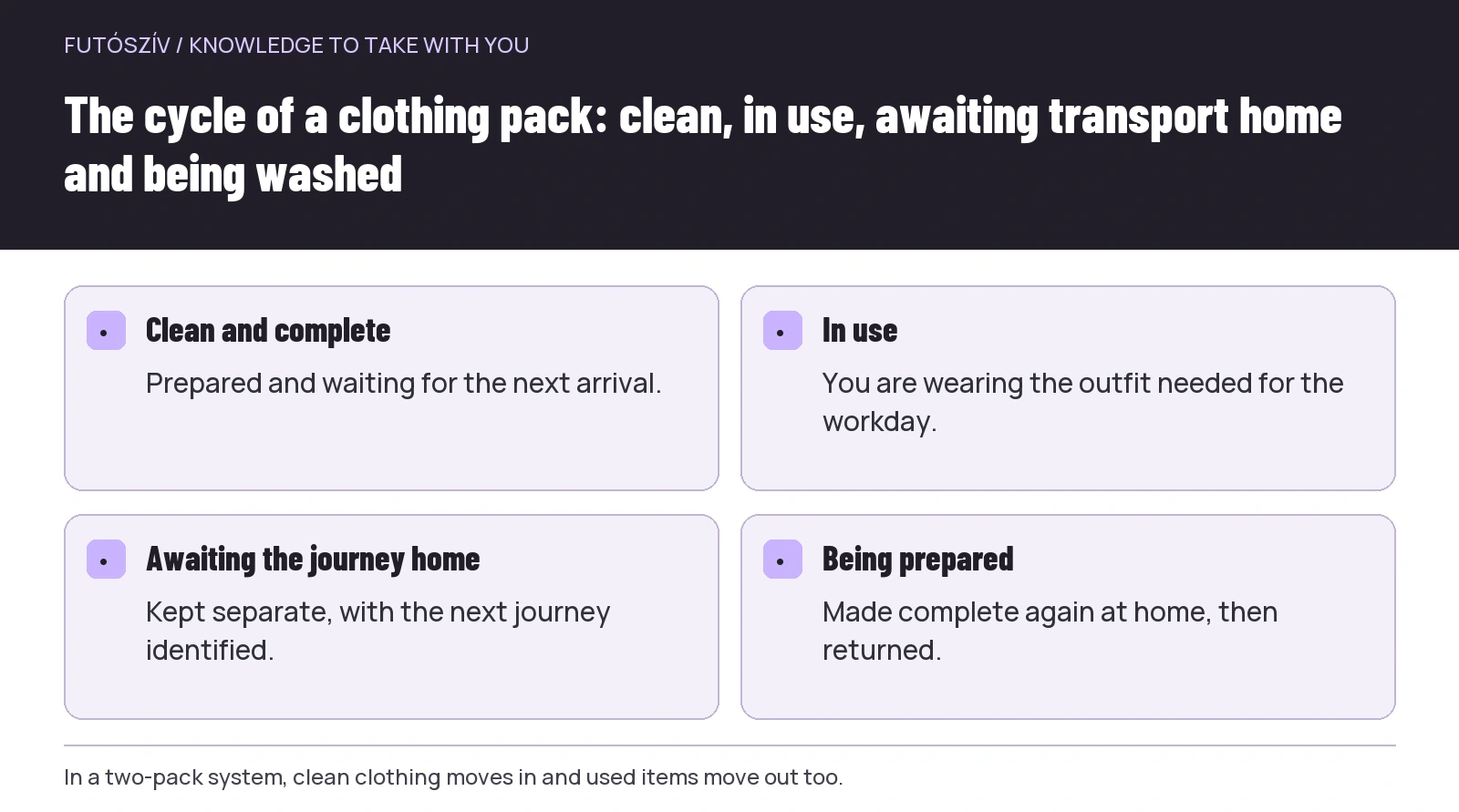
Two packs do not mean never carrying clothing again. They make when and what you carry more predictable. Clean packs move inwards and used items move outwards. If one direction is missed, usable supplies run out after a few occasions. Set a time for the exchange just as you do for the run.
 Enlarge diagram
Text version of the diagram
- Clean and complete
- Prepared and waiting for the next arrival.
- In use
- You are wearing the outfit needed for the workday.
- Awaiting the journey home
- Kept separate, with the next journey identified.
- Being prepared
- Made complete again at home, then returned.
An illustrative weekly example
Suppose a runner wants to run to work on Tuesday and run home after work on Thursday. On Monday, using their usual transport, they bring Tuesday’s pack A and check backup B. On Tuesday, they change after the run, separate used kit according to local facilities and take it home at the end of the day. On Thursday, they arrive before work with the necessary equipment, then leave after work according to the agreed plan.
In this example, every item of clothing does not need to return to the same state on the same day. What matters is the owner knowing exactly where each pack is and what is missing for the next outing. Running does not become a regular exercise in carrying shopping bags, because the larger exchange is planned for another day.
This is not a recommended training frequency, but a clothing-logistics example. Arrange your own running programme independently to suit your situation. Clothing transport and running can be different types of entries in your weekly calendar. Coordinating them organises preparation.
Make the first trial without a tight deadline
Choose a day with spare time after the expected arrival. Before an important meeting that starts immediately is not a good time to first test the building’s rear entrance, changing-room access and the entire changing process. The first outing aims to teach you the whole procedure. It provides real information for planning the following days.
The day before, check pack A item by item. Check your access card, necessary key and essential work items separately too. A missing card may have a bigger impact than an awkwardly packed top. Let the real conditions of starting work guide the order.
Walk through the route under other circumstances before your first run to work. The shortest driving route is not necessarily a suitable pedestrian route. Inspect crossings, the entry point and morning use. This leaves fewer new on-site tasks on the day you arrive running.
Plan the whole morning backwards
Start from the actual time work begins. How long do entering the building, washing, changing and preparing the day’s task take? Add the approach and your chosen running programme. Calculate departure backwards from this, with a realistic margin. Arriving at the gate is not the same as being in position ready to work.
On the first trial, do not try to beat your usual travel time at all costs. You are combining two different tasks: travel and exercise. The new solution may fit your day more comfortably, but you can evaluate this only from the total time. Recorded running time alone is a misleading comparison.
The NIDDK practical guide to starting physical activity also supports thinking through obstacles and solutions beforehand. For this programme, an obstacle might be the entrance opening time, clothing transport or a changing work start time. Breaking these into specific tasks makes it clearer which parts can be solved and which need another day.
Test how the load moves too
If using a backpack or belt, first try it with the contents you would actually carry. The comfort of an empty bag says little about its loaded state. After arranging it at home, a familiar section you can shorten can reveal where adjustments are needed. Your first run to work should not also be your first use of the equipment.
Bringing clothing packs in beforehand can reduce what you carry, but daily needs remain. Phone, keys, access card and personal needs still require planning. Transporting work electronics is subject to employer and manufacturer requirements. Not every item suits transport while running, and not every bag offers the same protection.
Consider storage of clothes and devices for rain too. The name “sports bag” does not automatically mean waterproof. If you cannot appropriately protect necessary items, modifying the run or route is an option. You do not have to solve the risk immediately with a new purchase if a simpler version of today’s outing exists.
 Enlarge diagram
Text version of the diagram
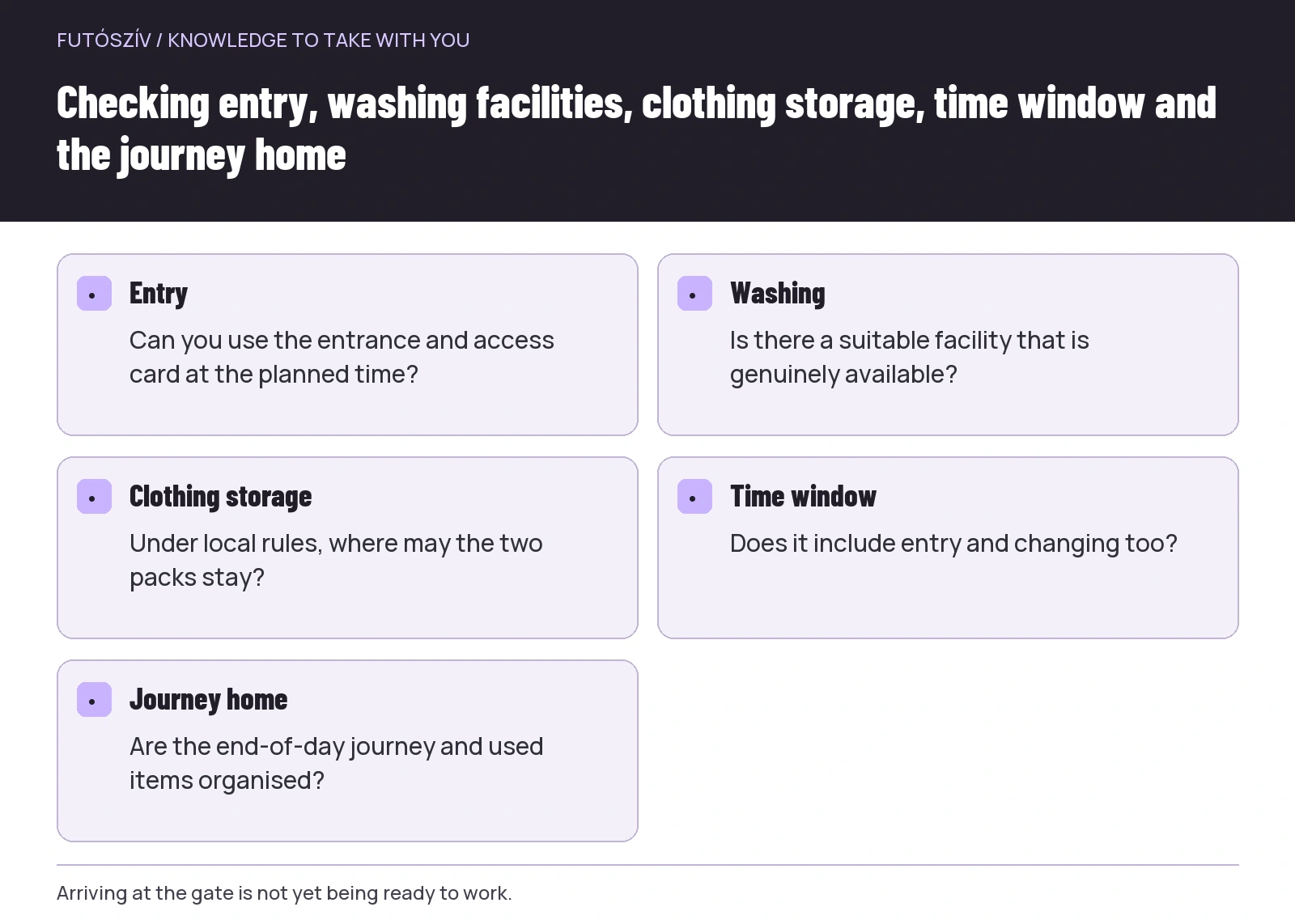
- Entry
- Can you use the entrance and access card at the planned time?
- Washing
- Is there a suitable facility that is genuinely available?
- Clothing storage
- Under local rules, where may the two packs stay?
- Time window
- Does it include entry and changing too?
- Journey home
- Are the end-of-day journey and used items organised?
Give the end-of-day journey its own plan
Running in during the morning does not mean you must also run home in the afternoon. Transport, walking, a prearranged lift or another solution may work. Choose according to your daily programme and the used items you need to carry. Planning the two directions separately leaves fewer hidden commitments.
If returning by public transport, check the ticket or pass required and current service conditions. As a Budapest example, the BKK BudapestGO page also presents real-time journey planning and service information. Elsewhere, start with the local provider’s current information. The particular service and fare product depend on the day and route.
If you run home after work, separately consider what happens to the work clothes you wore that day. Can they stay safely in a permitted location, or must you take them home? Do not leave in an item needed for tomorrow’s meeting simply from habit. The two-pack system follows home and workplace schedules together.
Wet and used items should be in a temporary state
Handle used equipment according to local arrangements and the items’ care instructions. In a shared changing room or office, do not automatically spread everything over places belonging to others or serving another purpose. Clarify beforehand whether drying is permitted anywhere. If not, the timing of taking items home and caring for them becomes especially important.
A closed pouch may help separate items during short transport, but does not mean the clothing has been dealt with. At home, take it out and handle it according to the care instructions. A forgotten pack can become another task and an unpleasant surprise later. Closing the day is therefore part of clothing logistics.
Separate clean packs A and B from used items or those awaiting transport home. A label or simple colour code may help, but only if you update the status consistently. A pack labelled long ago that has since become incomplete can give false confidence. A quick item-by-item check is worth more than the container’s name.
Three typical snags and how to fix them
Every top is at work, with none left at home. Set a regular exchange occasion and do not carry only inwards. The rotation aims to keep supplies needed for the next programme in both locations. Accumulating more clothes alone does not solve one-way movement.
One item is always missing from the backup. Note use of pack B and restore it to completeness on the next transport journey. If you regularly need the backup, check what is missing from planning pack A. A recurring gap is specific organisational information.
The morning programme regularly runs late. Measure stages separately: departure, travel, entry and changing. Choose a solution for the stage that overruns. It may mean preparing earlier, using another entrance or choosing another day. Rushing during the run is not a suitable correction for a miscalculated arrival process.
Simplify after two trials
Review which garments had a role and which stayed unnecessarily in storage. Make a short pack list for your own workplace. Let it record the arrangement that actually works, with the exchange day alongside it. This makes the next departure less of a memory test.
If one condition of the system is persistently unavailable, choose another format. Running home after work or a shorter section combined with transport can also be a well-organised outing. The aim is a solution where the next steps for clothing, work and travel are all clear. This can make running linked to commuting a repeatable everyday option.
How Futószív articles are prepared: our editorial guidelines.