
A run–walk approach can be a planned completion strategy, not just an unexpected stop on the course. At an event with a cut-off, however, both forms of movement contribute to total time. Running pace alone does not tell you whether the whole programme fits the race’s framework. Walking, stationary stops and checkpoint limits belong in the calculation too.
This guide helps interpret the timing of an approach already developed for your own circumstances and fit it to an event. It does not prescribe a run–walk ratio, pace or distance for everyone. Personal preparation and the programme should be clarified with an appropriate professional where necessary. A calculated finish within the cut-off does not automatically prove that the undertaking suits you.
Read the race’s timing rule first
Find the overall cut-off, its starting point and any intermediate limits. A start wave, net time or fixed time of day may create different calculation situations. Understand the precise wording. If unclear, ask the organiser for an answer applying to your own start and race category.
The Budapest Half Marathon frequently asked questions describe the cut-off and procedure involving the closing vehicle, for example. This is an event-specific framework, not a general rule for every race. For your own start, know what happens at the limit and how to report that you will not continue in the planned way.
Also check whether the chosen category permits your intended participation approach and under what conditions. The label “running race” does not justify definite conclusions about every detail. Route access and services may have time limits too. Fit your own plan to these actual conditions.
The run–walk approach is part of the whole programme
The London Marathon Events 2025 beginner marathon plan also uses predefined running and walking sections. This shows that such an approach can sit within a complete programme. Extracting one ratio cannot apply the specific plan to every runner. Develop a personal version around individual circumstances and the whole preparation.
For cut-off planning, start with your own familiar, tested approach. Do not choose a random online ratio the evening before the race because the arithmetic looks favourable. Feasibility requires experience of how the approach works in a programme suited to you. The mathematical model is only one time-frame check.
Distinguish planned walking from stationary stops. Walking covers distance; standing lets time pass without progress. Planned slowing at aid stations, toilets or waiting on the route appears differently in the overall plan. Precise terms make calculations simpler too.
 Enlarge diagram
Text version of the illustration
- Running section
- 1 km in 6 minutes in the calculation example.
- Walking section
- 0.5 km in another 6 minutes.
- Total
- 1.5 km in 12 minutes altogether.
- Overall average
- 12 ÷ 1.5 = 8 minutes per kilometre.
Why is simply averaging two paces misleading?
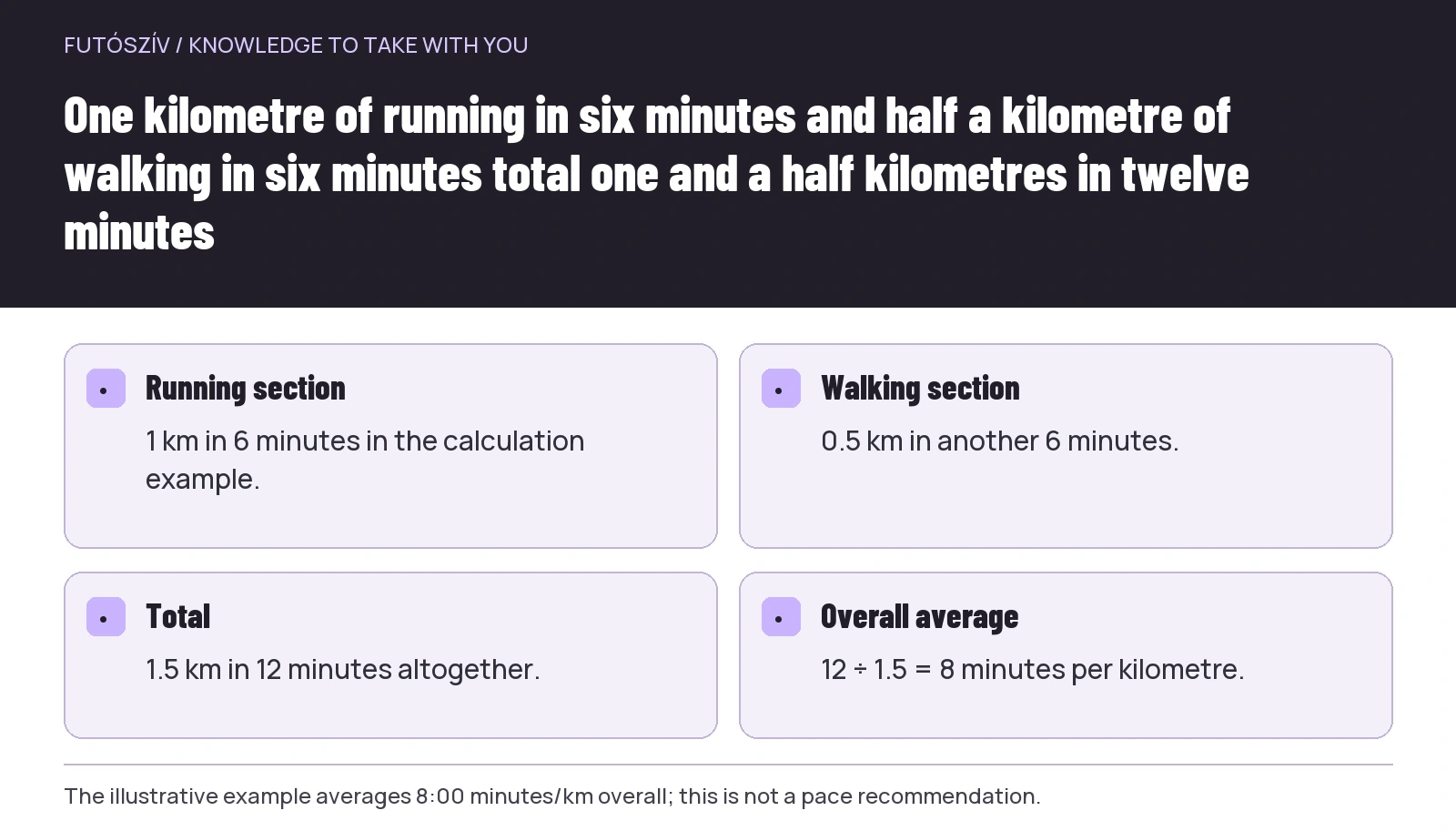
In an illustrative example, suppose one kilometre of running takes six minutes, followed by half a kilometre walking, also taking six. Running pace is 6:00 minutes/km and walking pace 12:00 minutes/km. The full one and a half kilometres takes twelve minutes, giving an overall average of 8:00 minutes/km. Simply averaging the two pace numbers gives nine minutes, which does not describe total progress here.
The difference arises because you cover unequal distances at the two paces. Compare total time with total distance. The numbers above serve only to illustrate arithmetic; they are not suggested personal speeds. With your own data, apply the same principle to the programme actually tested.
| Example section | Distance | Time |
|---|---|---|
| Running section | 1 km | 6 minutes |
| Walking section | 0.5 km | 6 minutes |
| Total | 1.5 km | 12 minutes |
| Overall average | 12 minutes divided by 1.5 kilometres | 8:00 minutes/km |
If using a time-based cycle, first determine distance covered in each part from the appropriate data, then add the parts. You do not need to calculate everything mentally on the course. During preparation, write your programme clearly and follow the decision points prepared beforehand on location.
A stationary stop creates a new total time
In another illustrative example, moving sections total ten kilometres and eighty minutes. Adding five minutes stopped makes total elapsed time eighty-five minutes. The average for the whole programme is therefore 8:30 minutes/km. The eight-minute movement average does not include the complete story.
Your device may display moving time and elapsed time with different settings. Compare the appropriate time type with the race’s limit. An apparently better personal recording due to auto pause does not alter the organiser’s limits. Clarify field meanings using the device instructions.
Stops need not automatically be called errors. They may be part of your needs and chosen programme. Planning simply needs to include their actual time requirements. This makes comparison between the full programme and race framework more precise.
Check intermediate points on separate lines
If the event publishes intermediate cut-offs, an estimate within the overall finish limit is insufficient by itself. Your planned progress to each point must fit its condition too. Terrain, elevation or route characteristics mean sections may not be completed at the same rate. Use an estimate appropriate to your circumstances.
You can make a table with official point, limit, personal estimate and open question fields. Label official information separately from your planned time. If the plan works at a point only through an uncertain assumption, clarify it. Do not discover after the start that an intermediate limit was omitted from consideration.
| Field | Role |
|---|---|
| Official point | Identifiable route location and distance |
| Time limit | The organiser’s precise current condition |
| Personal estimate | A plan based on a tested programme and the route |
| Discrepancy | Where is the fit tight or uncertain? |
| Next step | A question, adjustment or consideration of another event |
The table is not intended to force your personal pace to meet the limit at any cost. If your appropriate programme does not fit, another distance or event may be an option under the official arrangements. A cut-off is an organiser’s condition. It does not oblige you to attempt a completion your circumstances do not support.
Adapt transitions to walking to the surroundings too
Even a planned transition in a large field must consider others. Assess the situation before a narrow section, sharp turn or busy aid station. Signalling and predictable movement may help, but the route and staff instructions at that moment matter. Your timer’s sound does not override the environment.
If moving with companions, agree the approach before starting. Not everyone means the same thing by a short walk or easy run. Explain your specific familiar programme to each other. Shared completion works only if participants genuinely agree to the same framework.
When following a pacer, specifically ask whether the group plans walking or slowing. Execution can differ despite the same target time. You need not stick with a group unsuited to your personal approach. Keep your decision plan clear even when moving separately from the flag.
 Enlarge diagram
Text version of the illustration
- Timing rule
- Correct season, starting point and limits.
- Personal approach
- A programme already developed and tested.
- Elapsed time
- Walking and stationary stops both belong to the picture.
- Intermediate points
- Separate checks alongside the overall finish time.
- Closing out
- Known procedures for changes, reporting and returning.
Observe data and usability together in practice
During practice appropriate to your programme, examine how you follow the sections. Is the timer easy to operate, is the alert clear, and do you know what comes next if you miss a sound? You need not use every device at once. A simple, understood system may provide a better basis for racing.
If the app or watch handles cycles, know the total duration too. Alongside the order of movement types, ending the outing is a separate question. Repeating device alerts do not change your personal programme’s limits. Try settings at home and in familiar conditions, following your own instructions.
Note circumstances too: route, stops and execution of the task. One favourable short trial does not guarantee the full time for a longer race. Experience may contribute to your existing programme and professional evaluation where needed. Fitting within a time frame involves several pieces of information.
Decide what to do if the plan changes too
If progress unfolds differently, first examine your own situation and race conditions. You need not automatically recover time by dropping the walking section. Modifying a personal programme is a separate decision whose suitability cannot be shown by one number. Current circumstances and needs remain the basis.
Near the cut-off, follow organiser guidance. Know beforehand whom to notify of finishing or withdrawing and how to arrange your return. Checkpoints and services may not remain available indefinitely. Your full-day plan should include this possible ending too.
If health symptoms appear, appropriate help and individual decisions come first. Meeting the cut-off does not override that. A general online plan is not a diagnosis, and a predefined cycle does not oblige you to continue. Use the organisational framework within your real circumstances.
Three different outcomes from the same planning process
Your tested approach and official conditions may fit well. You then arrange the whole event programme and logistics too. An important detail about cut-off calculation may be missing; in that case, ask first. Or your manageable programme may not fit the framework, leading you to seek another option.
All three are useful planning outcomes. The goal is not to justify a preselected entry at any cost. It is understanding how the actual total time of running, walking and stops relates to race conditions. Describing both sides precisely leaves less guesswork in the decision.
Put five things on your own sheet
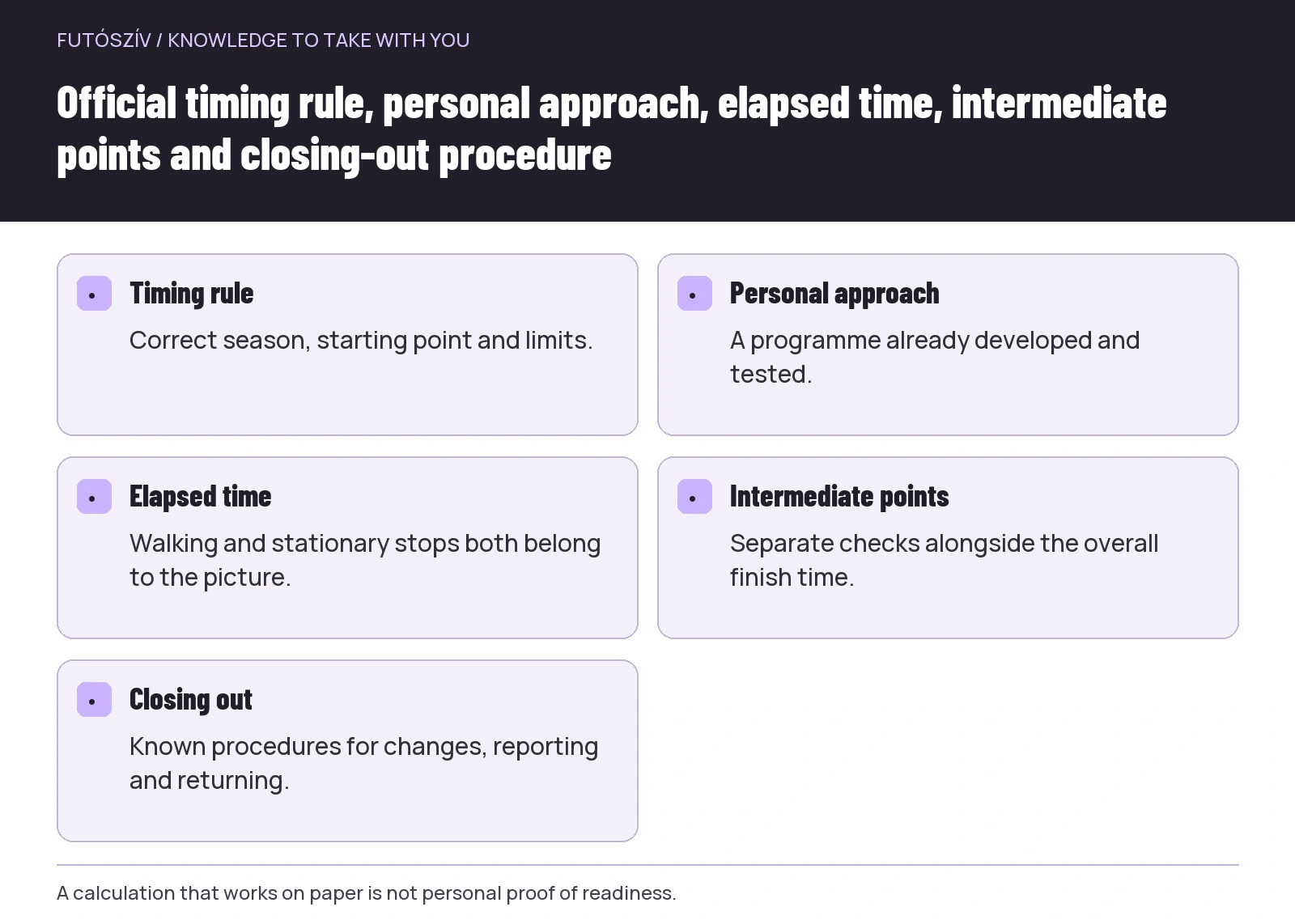
The timing rule for the appropriate event edition. Your tested completion approach. The meaning of total elapsed time. Intermediate checkpoints. Procedures for adjustment and closing out. Together these provide a traceable framework. The run–walk strategy can then appear as a deliberate personal programme while both race conditions and your individual circumstances remain visible.
How Futószív articles are prepared: our editorial guidelines.