
Planning a Budapest race weekend without a car involves more than one journey-planner search. You need to arrive in the city, reach accommodation or the next place with luggage, collect your number, reach your own race and finally travel home. These connections may involve different days, entrances and transport conditions.
A useful plan does not promise the fewest transfers in every circumstance, but makes the whole weekend clear. The Budapest section needs current BKK information, long-distance travel information from the relevant operator and race details from the organiser. The following method is our own practical aid, without specific accommodation bookings or unchecked service times.
Identify five places before searching routes
Record the actual city arrival point, accommodation or baggage-storage location, bib collection, your own start and the departure point after finishing. They are not necessarily the same place. The event centre’s address does not establish that every distance starts or finishes there either. Find the exact place for your own race.
Alongside the station or airport name, add the next connection. At a large station, travelling from the arriving vehicle to local transport can involve more than a transfer shown as one point on a map. Luggage and necessary access affect it too. Do not use your running pace to solve a tight connection.
Those five places can then form a simple weekend chain. If one remains unknown, do not treat travel built around it as final information. You can sketch around a provisional race date, but review when detailed locations and timing appear. A map crop from a previous year does not replace missing information.
Plan bib collection as a separate journey
Check which day, time window and conditions apply to collecting the pack. It can fit between arrival in the city and hotel check-in only when the actual timetable works. You may need to store luggage first or arrive earlier specifically for collection. The concrete option depends on event rules and provider conditions.
Prepare registration confirmation, identification or other necessary documents according to organiser information. Do not assume someone else can collect for you or the office stays open equally long for every distance on race day. These organiser-specific conditions can change your travel day too.
Search the local route to collection’s precise entrance, rather than only a general building or park name. Walking from the stop, queuing and travelling onwards are part of the task. The weekend is less tight when administration is not surrounded by three overlapping activities all assuming the most optimistic arrival.
 Enlarge diagram
Text version of the diagram
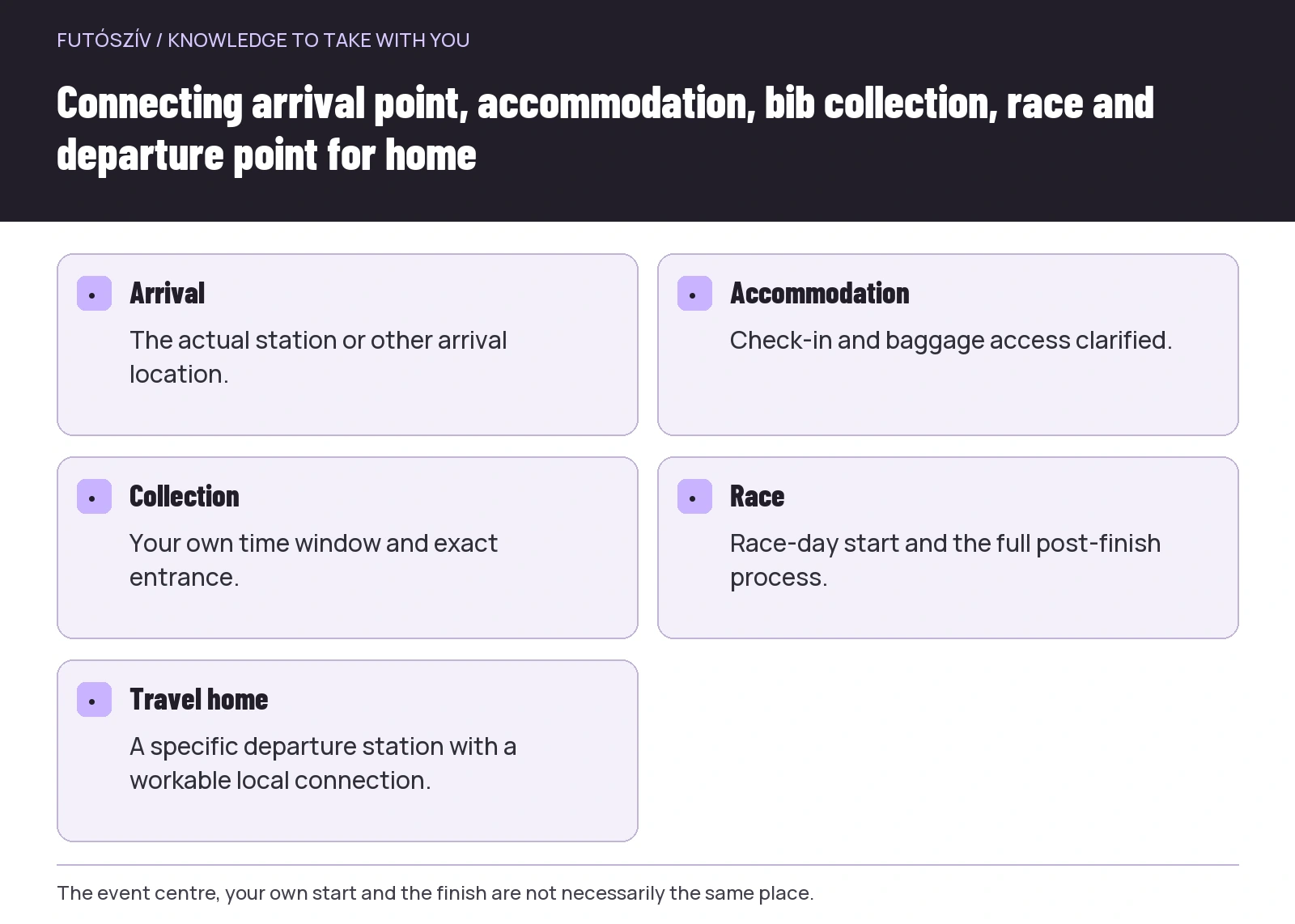
- Arrival
- The actual station or other arrival location.
- Accommodation
- Check-in and baggage access clarified.
- Collection
- Your own time window and exact entrance.
- Race
- Race-day start and the full post-finish process.
- Travel home
- A specific departure station with a workable local connection.
Assess accommodation through transport connections
Accommodation near the start sounds good, but the actual entrance, closures and checkout arrangements matter too. Collection may be elsewhere and the finish may release you on another side. Do not consider just one straight-line distance when choosing. Evaluate arrival, bib collection, start and travel-home connections together.
Ask the accommodation about your actual booking: when can you arrive, can luggage be stored before or after your stay and how long is the service accessible? Late checkout or separate baggage storage is not an automatic race-weekend accessory. If the plan depends on it, you need an answer clarified in writing rather than a general services list.
Consider breakfast timing against your own programme too, as an organisational question rather than dietary advice. With an early departure, normal service may be unusable. The accommodation can provide factual information. Coordinate the booking promise and personal needs separately; the accommodation’s name alone does not decide this.
Race-day transport is not necessarily a copy of Saturday’s journey
A connection easy to use on Saturday may differ on Sunday because of the event or another traffic change. Search for the actual race day and the time window when you will travel. Work backwards from the necessary arrival at the venue rather than your start time, including walking and personal tasks.
The official BKK page for planned transport changes collects published modifications, while BKK Info gives access to current transport information. These checks complement each other: the earlier outline needs the situation valid at departure alongside it. Read the organiser’s own travel announcements too.
Check the departure stop and transfers as well as the destination. A diversion may affect the service you have already walked to, and the familiar exit may change. A simpler alternative involving more walking is good only if it suits your needs and local access. Not every detour is automatically manageable.
Choose tickets for the actual journey and entitlement
Budapest and long-distance sections may have separate travel conditions. Check an existing ticket or pass for the specific route and service rather than interpreting its name as general permission. Know validation, presentation and any proof requirements too. A race number gives a travel discount only when explicitly and currently announced.
For arrival by air, for example, the official BKK information on the airport shuttle bus single ticket describes specific use conditions for the 100E. It does not imply the same ticket covers the whole city route or return journey. Check the current product and your own discount entitlement before travelling.
The official Budapest Pay&GO page likewise presents bank-card ticket purchasing with a defined scope of use. The technology’s name does not mean the same process is available on every city service. If choosing it, read the specific service, ticket and inspection description. Arrange independent access for family or team members travelling separately too.
Check the validity period for long-distance routes
When planning months ahead, ensure the timetable covers the race date. A search made in November may not provide the final connection for a spring weekend. The later timetable already published by the operator and current service changes together provide the basis. Here it is the actual travel date that matters, rather than the race distance.
The MÁV Group 2026–2027 domestic public-service timetable page publishes information tied to a specific validity period. At the 18 November 2026 check, this was particularly important for trips beyond the December timetable change. Later engineering works or operator changes require another check before departure.
Record the Budapest arrival and departure stations precisely. Do not assume the homeward journey leaves from the station you arrived at or that local connections are identical at all times. Check ticket conditions, reservations and changes for the actual product chosen. Flexibility is not a general property of every ticket.
 Enlarge diagram
Text version of the diagram
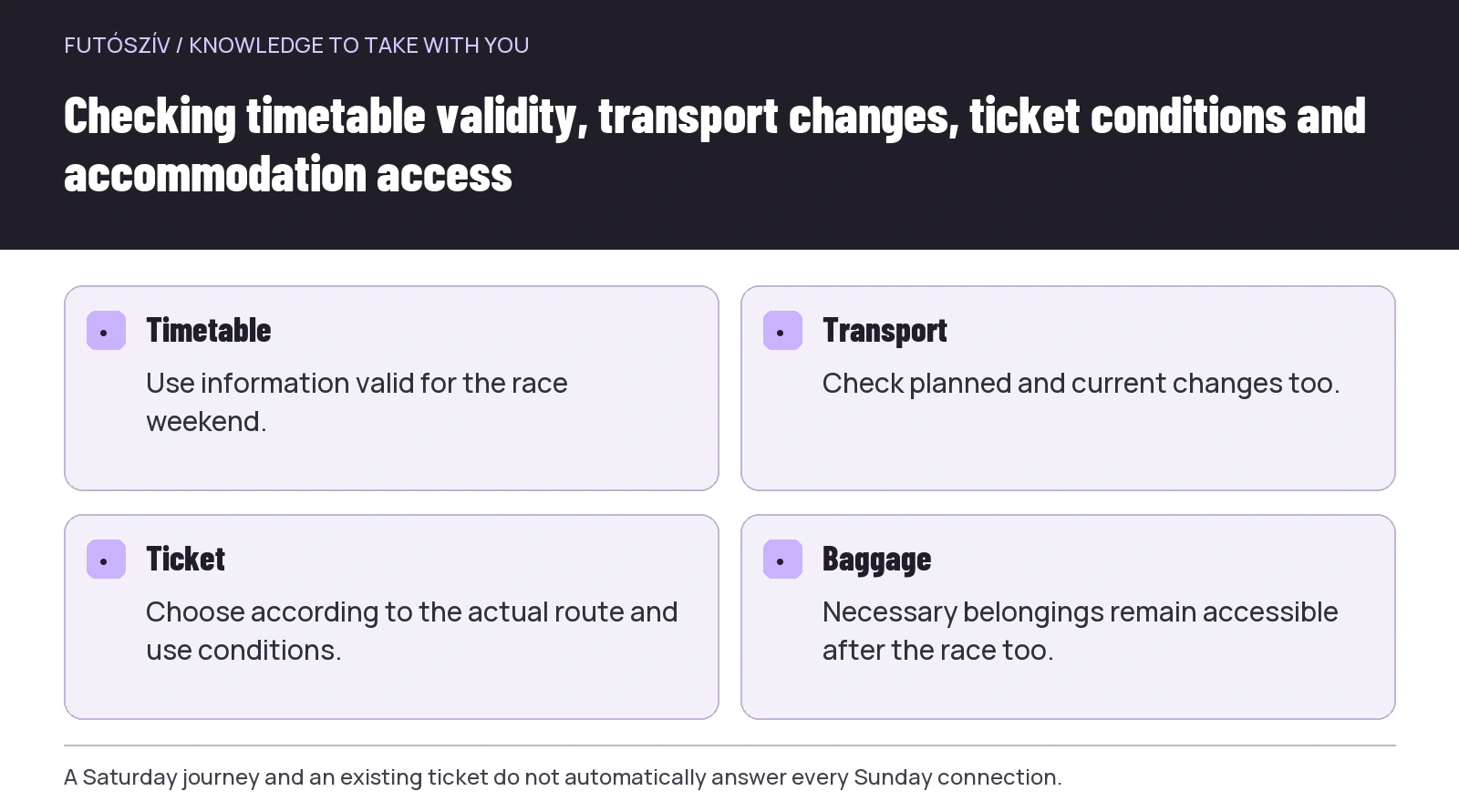
- Timetable
- Use information valid for the race weekend.
- Transport
- Check planned and current changes too.
- Ticket
- Choose according to the actual route and use conditions.
- Baggage
- Necessary belongings remain accessible after the race too.
Your own weekend connection sheet
The following table is a personal planning outline rather than a timetable. Fill actual places and times from checked information supplied by organiser, accommodation and transport providers. Do not replace necessary on-site time with one general number of spare minutes.
| Connection | What to check separately | What hidden task may be in between? |
|---|---|---|
| Arrival point → accommodation | Actual local route and arrival conditions | Moving luggage, entrance and check-in |
| Accommodation → bib collection | Your own time window and precise place | Walking, queue and necessary documents |
| Accommodation → your own start | Race-day transport and meeting arrangements | Closures, exit and baggage |
| Finish → baggage or accommodation | Participant exit and access | Collection, meeting and an opportunity to change |
| Departure point → travel home | Actual departure station and ticket conditions | Local travel, reaching the platform and connection |
The sheet also reveals where several tasks depend on one tight arrival. If collection, check-in and a shared dinner fit only through flawless minute-by-minute operation, simplify. Not every weekend opportunity needs including in the same trip.
An imagined example with earlier arrival
A runner arrives by train on Saturday, starts the chosen race on Sunday and wants to travel home afterwards. The situation is fictional, rather than a particular Budapest route. They check Saturday collection availability with the organiser and clarify luggage storage and Sunday checkout with accommodation.
Saturday’s plan resolves actual arrival and luggage first, followed by collection. They search a separate local journey for Sunday’s start on that day. Before going home, they count not only estimated running time but also exiting, reaching belongings and getting to the departure station. Time in between does not remain an unnamed empty space.
Now suppose the accommodation cannot store bags after checkout. The runner does not treat this as solved automatically, but seeks another genuinely accessible option under its conditions or changes the weekend. A good plan does not preserve the first idea at all costs; it finds real answers for indispensable connections.
Companions should have their own city plans too
If arriving with family or friends, do not assume everyone wants to wait between start and finish throughout the race. Their participation, meeting and travel home need plans too. Shared accommodation does not mean taking every route together all weekend. Separate activities, however, need their own access and coordination.
Someone leaving earlier should be able to reach their key, belongings and travel entitlement. The only phone or baggage identifier left with the runner should not hold others until an uncertain time. Make the shared meeting point specific and accessible to runner and spectators alike. Finish line and meeting should not be the same only in words.
Optional sightseeing should come from the weekend’s own time frame too. The day before or after racing need not be filled with a complete attraction list. Different interests are easier to manage when the end of the shared part and options to continue separately are clear beforehand. That does not make the race weekend less of a shared trip.
The final check should follow the date and the whole chain
Before departure, revisit current organiser information, long-distance travel, local transport changes and confirmed accommodation conditions. Carry changes through connected parts too. If collection moves, for example, changing the address alone is insufficient: the route there and later programme may change as well.
Keep important information retrievable in a format suited to your needs. Do not rely exclusively on an old screenshot when information can change, but do not leave finding basic details for the first time until the pre-start crowd either. Background sources and a short daily sheet can work together.
A well-organised Budapest race weekend without a car gives every important connection a real place and time from city arrival until travel home. The start is only one point in that chain. Precise collection arrangements, accommodation conditions, race-day transport and the whole finishing process together leave attention for the running programme you chose.
How Futószív articles are prepared: our editorial guidelines.