An enjoyable experience does not mean the same environment for everyone
A night-time, fancy-dress or music-filled run can be a special community experience. Yet the same amplified sound, flashing lights or unexpected spectacle may create difficulties for another participant. Describe the event’s atmosphere and conditions for taking part separately. Enthusiastic promotion needs specific information about what will happen on site alongside it.
More inclusive organisation does not assume that everyone has identical needs. Instead, it supports individual decisions, questions in advance and, where feasible, different ways to participate. This article offers organisational considerations, rather than an event-safety certificate or personalised medical advice. Health risks need assessment with an appropriate professional.
Describe the actual setting rather than relying on a label
The words ‘accessible’ or ‘recommended for everyone’ alone provide too little information for a participation decision. It is more useful to specify where music will be loud, which lighting effects to expect, how long crowded start-area waiting lasts and whether a quieter area exists. It also matters if a detail has not yet been finalised.
The National Autistic Society guidance on environments emphasises individual sensory differences and factors such as light, noise and crowds. This does not mean that every autistic person avoids the same things or needs the same solution. Precise descriptions are valuable because participants can assess the setting against their own needs.
Make information available before entry
Do not reveal special sound or lighting effects on the course only on a sheet inside the race pack. Information supporting a decision needs to be accessible before entry and updated with the final programme. If an important condition changes during organisation, communicate this where participants previously looked for information too.
Provide a short, clear summary and a more detailed venue description. The National Autistic Society material on accessible information also supports clear information in advance and maps or pictures that help people understand an environment. The editorial aim is to make important questions easy to find, rather than compress every detail into one long sentence.
Show more than the route on the map
Mark the start waiting area, stage, amplified-sound locations, toilets, exits and available quieter space. If a programme element can be bypassed, explain the route around it and how that fits race rules. The map should not promise access that the on-site team or safety plan does not allow.
Include a brief written description with the map. People do not all see or interpret colours and icons in the same way, and a small map on a mobile screen may be difficult to enlarge. Use an identifiable point and directions that can be followed rather than ‘the corner beside the stage’. Good map information matches on-site signs and staff explanations too.
 Enlarge diagram
Text version of the illustration
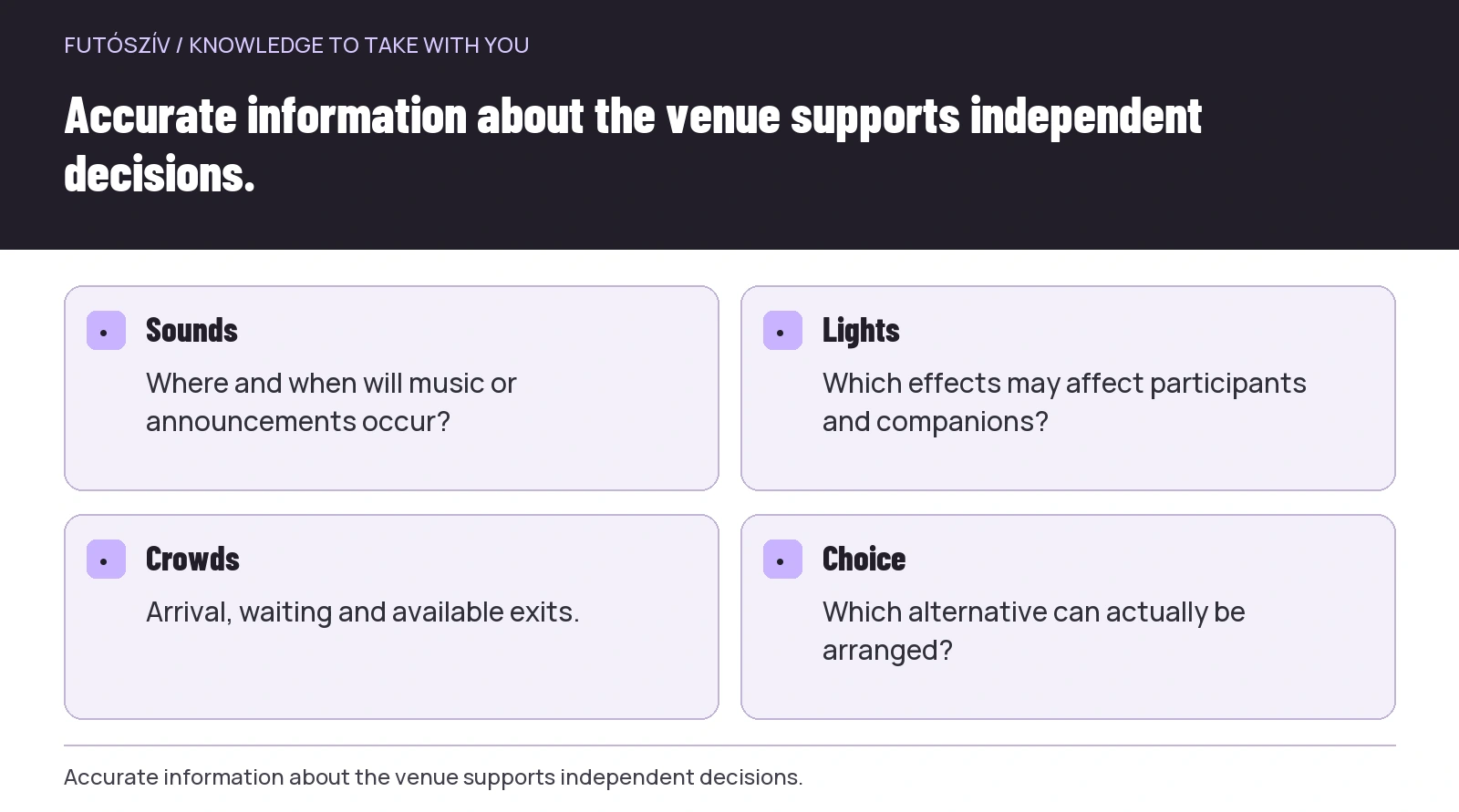
- Sounds
- Where and when will music or announcements occur?
- Lights
- Which effects may affect participants and companions?
- Crowds
- Arrival, waiting and available exits.
- Choice
- Which alternative can actually be arranged?
A quieter place needs to work in practice
A quieter area does not become usable simply by appearing in the programme. Check the actual noise, access, lighting and who can answer questions there. If it is directly beside a loudspeaker or repeated announcements, its name is misleading. Describe the venue’s limitations rather than promising complete silence.
The National Autistic Society mentions clearly marked calmer spaces away from the main crowds and noise. At a running event, implement this according to the venue’s characteristics and safety arrangements. It should not be treated as punishment or segregation: it is an optional space accessible to the participant and, where needed, their companion.
Communicate important messages through more than one channel
If a start time or gathering point changes, do not communicate it only through a loudspeaker. Provide accessible written or other suitable visual information too, and make sure staff know the current message. This can help a deaf or hard-of-hearing participant, a runner in a noisy area and someone who does not understand an announcement on first hearing.
Safety signalling requires separate professional planning. A quieter version of the programme must not mean participants miss important instructions. Organisers need to address accessibility, emergency communication and venue operations together. One visual sign or a quieter loudspeaker cannot resolve every situation.
Flashing lights are more than a matter of comfort
Epilepsy Action explains that certain visual stimuli, such as flashing lights or strong patterns, can trigger seizures in photosensitive epilepsy. Not everyone with epilepsy is photosensitive, and an event name cannot establish individual risk. Discuss health-related participation questions with the treating professional.
As organiser, do not promise general safety through a single warning sentence. Lighting requires professional risk assessment and discussion with the providers involved. This article gives no flashing frequency or universally safe setting. Clear advance information, reducing unnecessary risk and actual technical planning are each important tasks.
Personal protective equipment does not replace planning the environment
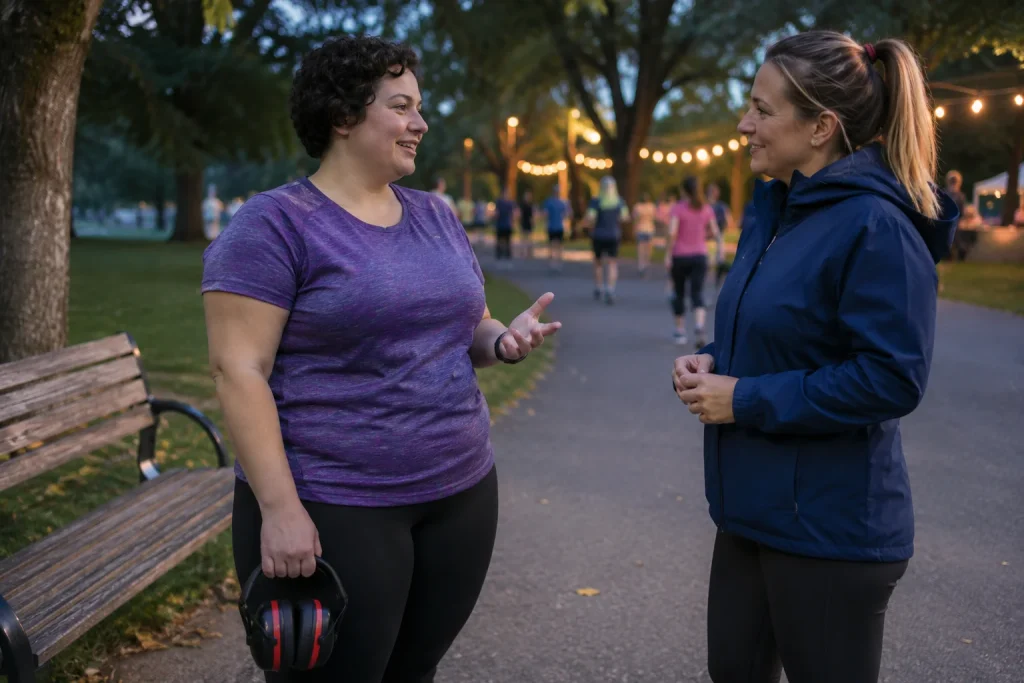
Participants may use sensory aids that suit them, but organisers cannot make these the sole solution to every problem. ‘Bring earplugs’ does not answer where written start information is available or which area can be chosen. Especially while running, a personal solution must not prevent awareness of traffic and safety signals.
Clarify event rules and individual health boundaries beforehand. A general article cannot choose suitable equipment for every participant. The question is what environment the organiser can provide and what information supports independent decisions about it. Individual adaptation is an option, rather than a complete transfer of organisational responsibility.
Personal discussions should not require unnecessary proof
Provide a designated, accessible channel for discussing participation needs. The person replying should know how the venue and programme actually work, rather than offer only general reassurance. Often the useful question is which condition or adjustment is needed, not a request for participants to publicly explain their diagnosis.
Handle personal data within an appropriate framework, with necessary information reaching only authorised people. This article does not prescribe a legal basis for processing or a proof requirement. Its organisational principle is respectful, understandable discussion directed at actual participation. An unresolved question does not need to be disguised as a settled answer.
 Enlarge diagram
Text version of the illustration
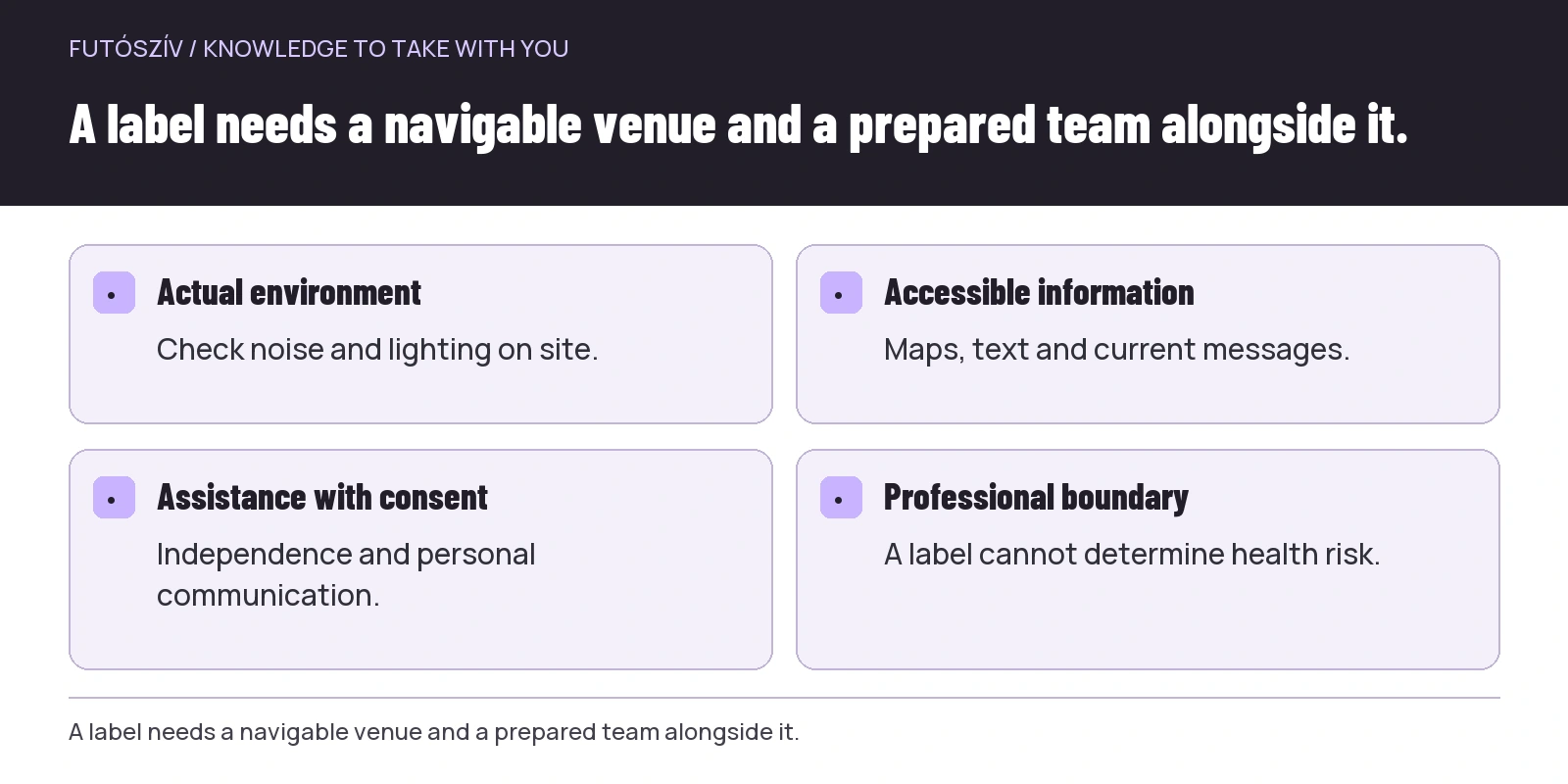
- Actual environment
- Check noise and lighting on site.
- Accessible information
- Maps, text and current messages.
- Assistance with consent
- Independence and personal communication.
- Professional boundary
- A label cannot determine health risk.
The on-site team should know what the event has promised
If the website promises earlier race-pack collection or a quieter waiting option, volunteers need to know too. Provide short, practical guidance on where to direct participants and whom to ask when uncertain. Personal assistance should not exist only in the head of one busy organiser.
Keep communication simple and do not demand immediate answers to complex questions. Ask clearly, allow time and provide written or another appropriate format when needed. Do not unexpectedly touch participants in the name of helping, or automatically speak to their companion instead of them. Independence and asking before helping are part of the programme’s operation.
Promotional material can help or hinder decisions too
Alongside an atmospheric video, provide a description that explains the venue and programme elements. If the promotional video itself contains strong flashing images, this should not become apparent only after playback begins. Web and video accessibility require separate checks; a warning for a live event cannot automatically be assumed appropriate for every digital asset.
The organiser’s imagery should show the actual event and identify material from a previous year. A new venue or changed lighting can mean an old video is no longer a sufficient basis for deciding. Enthusiastic marketing and precise information can coexist when each piece’s purpose and any unfinalised details are clear.
Participants can start with a few specific questions
Ask where and when amplified sound or lighting effects are expected, whether a calmer arrival time is available, what waiting involves and where help can be found. If an element can be bypassed, clarify how this fits your chosen race. These answers support your own decision more than the event’s general description as friendly.
If a health condition makes participation uncertain, the organiser can provide venue information, but individual medical decisions need an appropriate professional. You do not have to choose an event whose environment does not suit you. Fun runs can offer many types of experience; missing one event is not a judgement of your openness to community activities.
An example of a more precise event description
Alongside a general invitation to ‘special lights and a big party’, an organiser prepares a separate information sheet. It identifies the amplified start area, the location affected by lighting, an alternative that can be arranged, a quieter meeting point and a contact person. For unfinished details, it states when an update is expected. Participants then do not have to infer the actual setting from the promotional mood.
The description is checked through an on-site trial and feedback from affected participants. Anything that cannot be provided is stated clearly too. A more inclusive event is not one advertised as perfect, but one whose conditions can be understood and whose team can meaningfully discuss differing needs. The next event can then learn from real experience.
Sources and further reading
- National Autistic Society: Accessible environments
- National Autistic Society: Accessible information
- Epilepsy Action: Photosensitive epilepsy
How Futószív articles are prepared: our editorial guidelines.