First imagine the kind of day you want to experience
The medal is a conspicuous object in an event invitation. Its shape and colours are easy to compare, while the full experience consists of many smaller situations. What is the start area like, how long do you wait, what route do you follow, can you stay with your companion and how does the day end? If atmosphere matters to you, turn these into selection criteria.
You need not search for a single ideal running event for every occasion. Different programmes suit an evening with friends, a festive family day and a race prepared around a personal time goal. The aim is to connect the particular entry with your current expectations and preparation, rather than only the most striking promotional image.
Break atmosphere down into observable elements
A good atmosphere is a personal experience, but several aspects can be understood beforehand. The programme description may reveal time of day, course character, planned music or visual elements, distance structure and the audience the organiser addresses. Examine these separately rather than inferring every detail from one enthusiastic adjective.
| Experience question | What should you look for in the official description? | Your own decision point |
|---|---|---|
| Festive or ordinary? | Theme and actual programme | Do you want a costume or shared ritual? |
| Daytime or evening? | Start and full schedule | Does it fit your preparation and journey home? |
| Quieter or more spectacular? | Music, lighting and programme area | What environment would you like? |
| Individual or social? | Events, starting together and meeting opportunities | What should be the shared day’s main purpose? |
| New venue or familiar loop? | Course and technical information | How many new tasks are you taking on? |
The table does not rate programmes. A louder, spectacular event may appeal to one person while another seeks a simpler environment. Naming your own expectations makes the choice more precise.
A themed event is still a specific running task
A Santa-themed or other costume event can be playful, but distance, course and participation arrangements remain important. A costume does not automatically make the programme easy. Read the particular event description and seek an option fitting your preparation.
The official page for the PENNY Mikulásfutás 2.3-kilometre event presents a distance built around a festive experience for the event on 6 December 2026. This is a dated example, not a programme promise valid for every later edition. For a new entry, check the current year and event.
Your question may be how the theme connects to participation. Is the outfit compulsory or optional? Which events are offered? Where can accompanying people meet you? These details reveal the kind of day you are planning; the costumed promotional image adds atmosphere to that.
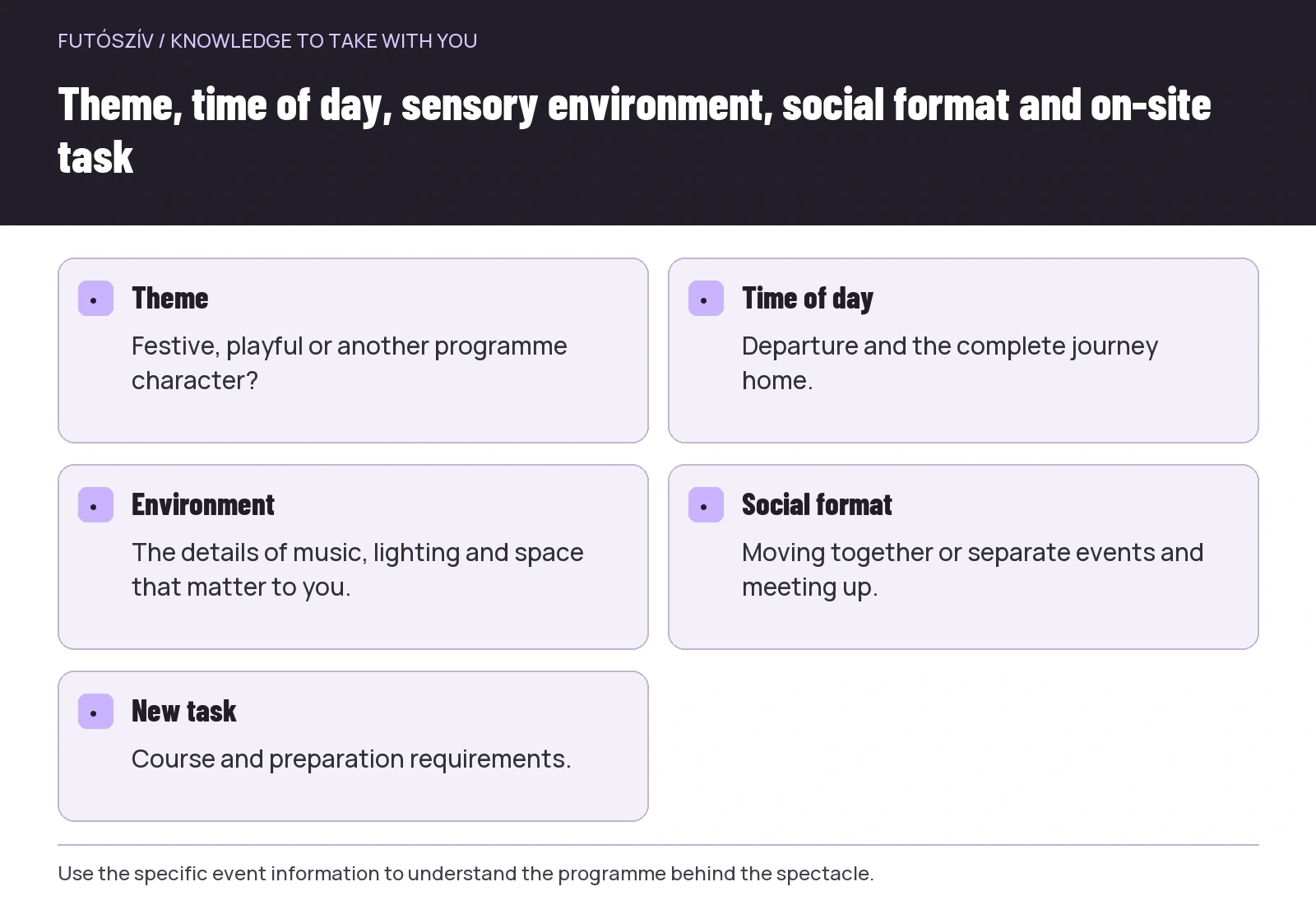 Enlarge diagram
Text version of the diagram
- Theme
- Festive, playful or another programme character?
- Time of day
- Departure and the complete journey home.
- Environment
- The details of music, lighting and space that matter to you.
- Social format
- Moving together or separate events and meeting up.
- New task
- Course and preparation requirements.
Understand the whole setting for a bright evening programme
The Sportoló Nemzet report on the 2026 LED’s Run describes the bright, musical community setting of the March 2026 event. The article is a report of a past event. It can help you understand the character of this programme format, not establish a start time, price or entry status for a new year.
Your own comfort and needs matter with visual elements too. If lighting, sound or the nature of the space is important for you, request specific information from the organiser. A short video does not continuously show the whole route and on-site environment.
An evening time also has travel and finishing implications. After crossing the finish, you collect belongings, meet companions and get home. Count these as parts of the full programme, rather than entering only the spectacular start time in your calendar.
An unusual location can bring a new task too
The official BBU Halloween Run 2026 page presents a programme whose routes, depending on the event, involve both above-ground areas and the cellar system. This is the example of the 7 November 2026 edition. Details of a later occasion require the new official event information.
Do not treat an underground, night-time or other unusual setting merely as a special photographic backdrop. Read about course character, equipment and experience needed, and the participation conditions stated by the organiser. If any circumstance raises a personal question, clarify it with the appropriate person before entering.
Nor does a short distance automatically become suitable for everyone. Space, surface, light and programme structure are separate considerations. Measure taking on the new setting against your circumstances, not the enthusiasm of the promotional copy.
Check which year the video comes from
A film showing an event’s atmosphere can give a useful first impression. Check the creator and year, then compare the images with the current programme. An earlier course, another venue or different event may not reflect present participation conditions.
The video shows selected moments. Less spectacular parts such as queueing, collecting belongings and getting home may be absent. Understand these from official information and your own organising plan. The film is a good introduction; the user guide to the full day comes from other sources.
Do not automatically infer your own suitability from people visible in the field. You do not know their backgrounds or chosen event from the footage. Your personal decision should rely on the event information, your experience and professional discussion where necessary.
For entering together, agree expectations first
A friend may look forward to the shared costume and photos while you also want a personal running goal. Both ideas can make sense without necessarily describing the same day. Discuss whether you will move together, choose separate events and when you will meet again.
One person’s commitment should not become another’s unstated obligation. Entering together does not automatically mean everyone wants the same distance or photography programme. The social experience works when choices and meeting points are understandable.
Consider shared travel arrangements too. With different events, collecting belongings, waiting and finishing may differ. Plan the whole day, not only how you will line up for the pre-start picture.
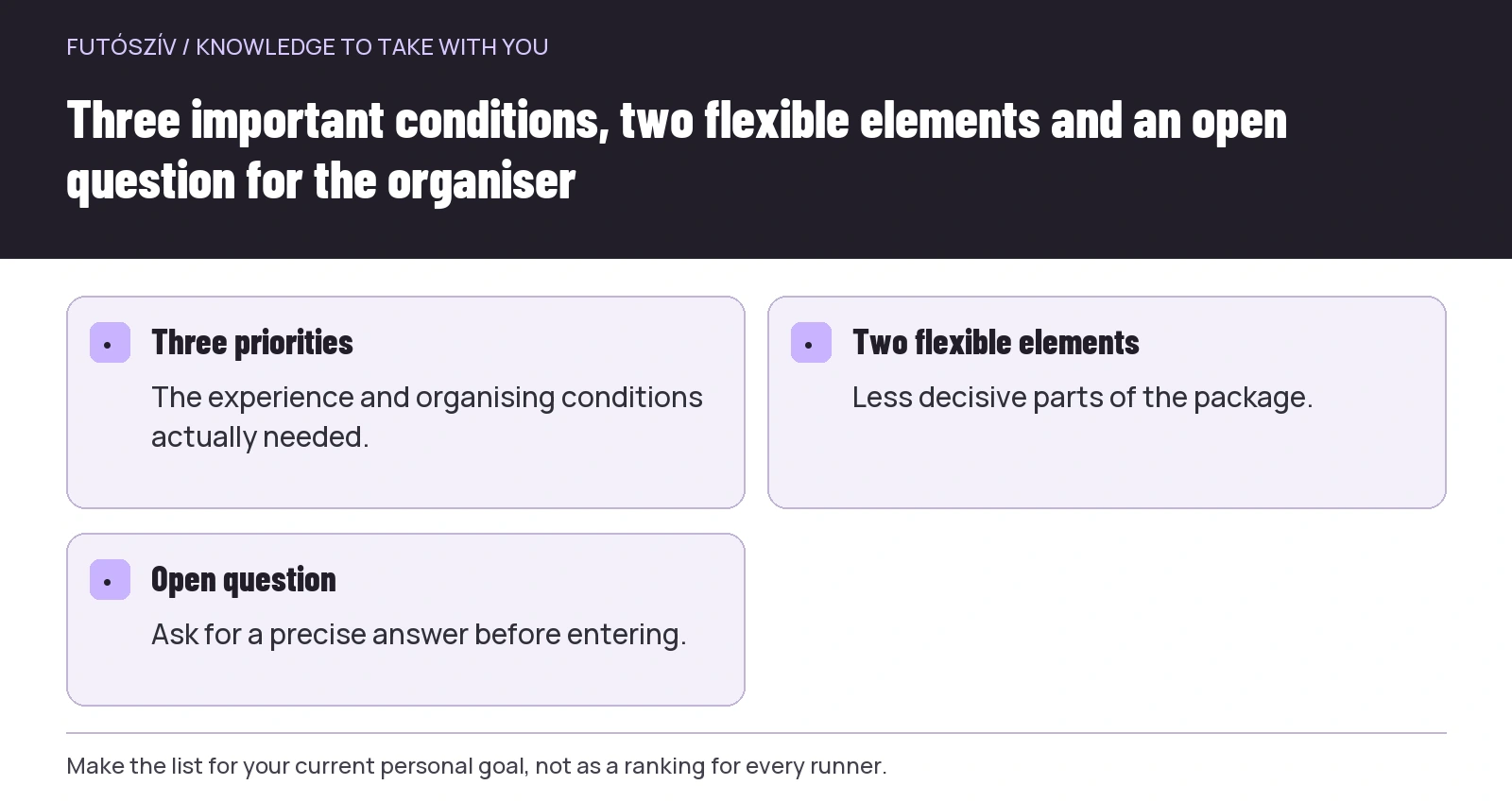 Enlarge diagram
Text version of the diagram
- Three priorities
- The experience and organising conditions actually needed.
- Two flexible elements
- Less decisive parts of the package.
- Open question
- Ask for a precise answer before entering.
Alongside the medal, read what entry actually includes
Package contents and participation services may differ by event, distance and entry period. Use the current official description to learn what your own entry includes. An item received in a previous year or an accessory visible in a picture is not automatically a current promise.
When comparing fees, also consider travel, necessary preparation and the whole time commitment. A cheaper entry at a more distant venue may mean a greater total cost. A more expensive package may not provide a service important to you now. The decision requires your own priorities.
Read cancellation, amendment and participant-transfer conditions before entering. These can differ between organisers. Choosing a programme for atmosphere still includes understanding the actual commitment, just as with a conventional road race.
An edited example of two friends making different choices
Two runners look for a shared autumn programme. One enjoys bright, musical surroundings; the other would prefer a daytime, less intense social occasion. They initially consider the same event because they like the medal. Detailed questions reveal different expectations of the experience.
Instead of one persuading the other, they make separate lists of important considerations. They find a shared occasion suitable for both, while the other programme remains an individual choice. Their friendship need not be proved through a single entry.
The example is fictional, not an actual event recommendation. The method is to clarify expectations. Instead of making a quick decision from an object, they compared the day’s actual format and only then chose.
Identify three important and two optional considerations
Write down three conditions that genuinely matter to you. These may include a short journey home, an appropriate event format or a social programme. Then name two elements where you are flexible. For example, medal shape or a separate extra activity may matter less than a route you understand.
The list is a personal decision tool, not a universal ranking. It helps prevent every striking new element in an invitation from rewriting your expectations. If an event fails one of the three basic conditions, an attractive package does not necessarily fill the gap.
Put an open question to the organiser specifically. Instead of asking “Will it be good for me?”, name what you need to know: which part of the event takes place in a particular setting, how starting together works or how the finish can be reached. You may receive a more usable answer.
Do not turn promotion into a personal promise
The organiser aims to present the event’s attractive aspects. Your experience, however, is shaped by conditions, personal goals and organising the whole day. A packed start photo does not prove you will experience the same atmosphere, just as a quieter report does not rule out a good shared day.
Alongside other participants’ accounts, always check the year and event. They may have attended a different distance, venue or set of conditions. Filter information relevant to your own choice rather than averaging every enthusiastic or negative opinion.
If there is not enough information about an important condition, postponing entry may be a reasonable next step. An atmosphere urging an immediate decision does not replace current event information. Commit personal time and money to a programme whose main framework you understand.
Keep the specific source of enjoyment for the next event
After participating, write down what created the atmosphere: starting together, the venue, meeting after the finish or a well-organised event. Also name what mattered less than expected. The next choice then involves more than lining up medals beside one another.
Keep a dated experience separate from the promise of a new event. Even the next edition of the same event can change, so fresh information is needed before a new entry. A previous good experience is a valuable starting point but does not replace current details.
A running event chosen for atmosphere suits you when you also understand the programme behind the spectacle. The medal can be a cherished keepsake, but the route, shared agreements and orderly organisation give the whole day personal meaning.
How Futószív articles are prepared: our editorial guidelines.