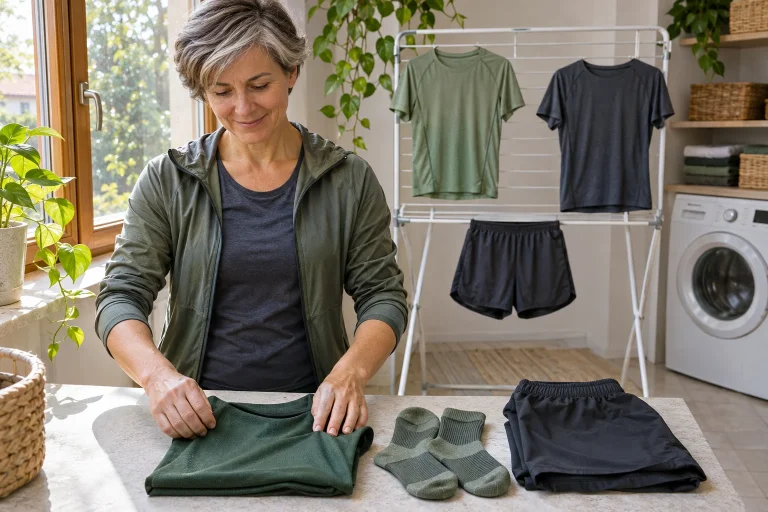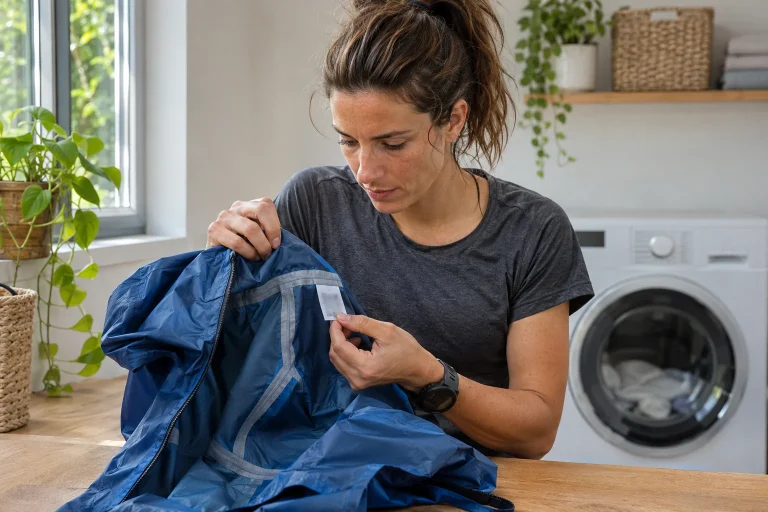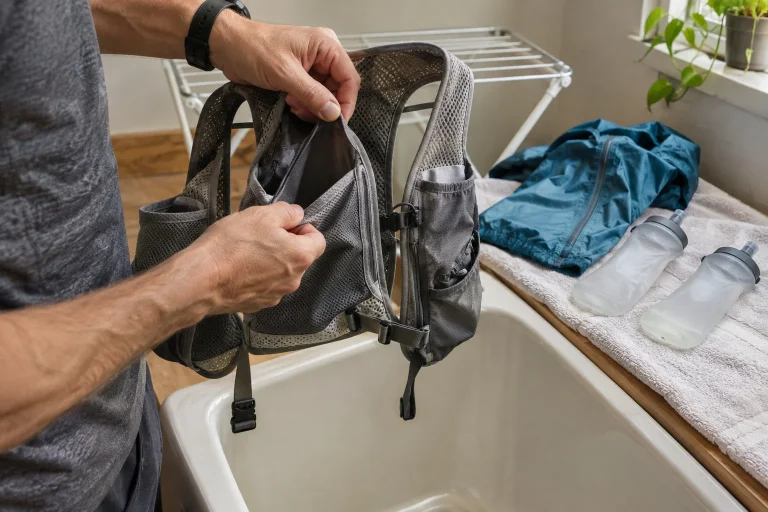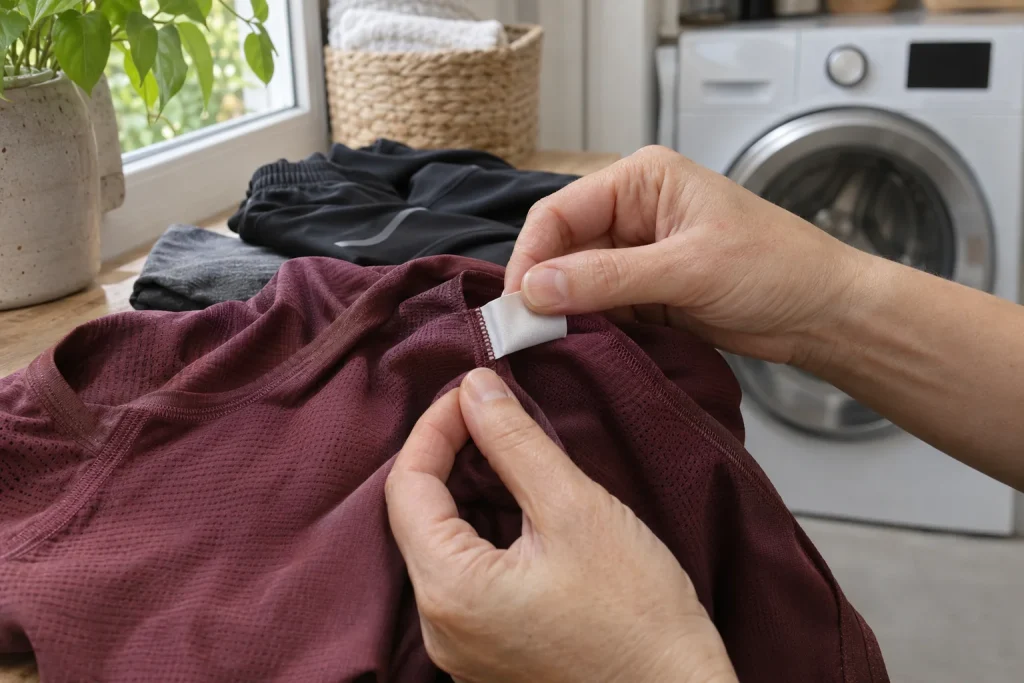
A running garment’s label is small and often hidden in an inner seam, yet it is the best starting point for care. Alongside a familiar temperature, separate symbols may indicate gentleness, drying, ironing and other processes. One number cannot therefore determine the entire washing and drying routine. This guide creates no new symbol system; it helps read the actual label on your own clothing and turn its information into practical household decisions. Rather than reproduce standard symbols, our illustrations show the reading and checking process.
First find the complete care information
Inspect both sides of the sewn-in label and any smaller attached leaves. Alongside size and composition, there may be a separate care section and additional text in several languages. A cut-off or faded label provides incomplete data; seek the exact model’s manufacturer instructions or a support response. Product name, part number and purchase date may help identify the garment. Do not copy care for an arbitrary similar top merely because it lists the same fibre.
Take a sharp photograph showing every symbol and additional sentence. Gently straighten a folded label rather than expecting camera magnification to separate overlapping marks. If photographing several garments, identify which each belongs to. An unidentified label image found later is less useful than one saved with a product name. A digital reminder is convenient for laundry, but interpret the full garment information and manufacturer guidance together.
The label concerns the particular assembly
Composition alone does not provide complete care instructions. Running clothing may include prints, stretch inserts, a membrane, zip, bonded hem or other additions that matter too. The label concerns the finished product, not merely one fibre’s general properties. Two similar polyester tops or wool-containing layers can carry different instructions. Online material information can offer useful background but does not override care for the specific item.
The Woolmark care-symbol explanation also emphasises checking the individual label on wool products: permitted washing and drying may differ between garments. Follow this principle across your running wardrobe. Do not decide from the material name that every item must be hand-washed or can be tumble-dried. The specific product’s information is decisive, and every new item’s label deserves an actual reading once.
Wash temperature is an upper limit; the bar means something else
According to the official GINETEX symbol explanation , temperature within the washing symbol shows the permitted maximum. Bars beneath it indicate gentler treatment, not another temperature or number of rinses. Temperature and mechanical treatment are separate information. Read the hand-washing and do-not-wash symbols as parts of the complete label too. A vigorous programme set to a lower temperature may still be inappropriate where mechanical action has other limits.
For your household decision, record two separate fields: maximum temperature and permitted process. Gentleness then does not disappear when you change only the machine’s temperature. A prohibition on washing does not mean you can freely soak the garment by hand; learn the suitable alternative from full manufacturer instructions. Do not use arbitrary vigorous rubbing or twisting during hand washing either. The method is as much part of gentle care as water temperature.
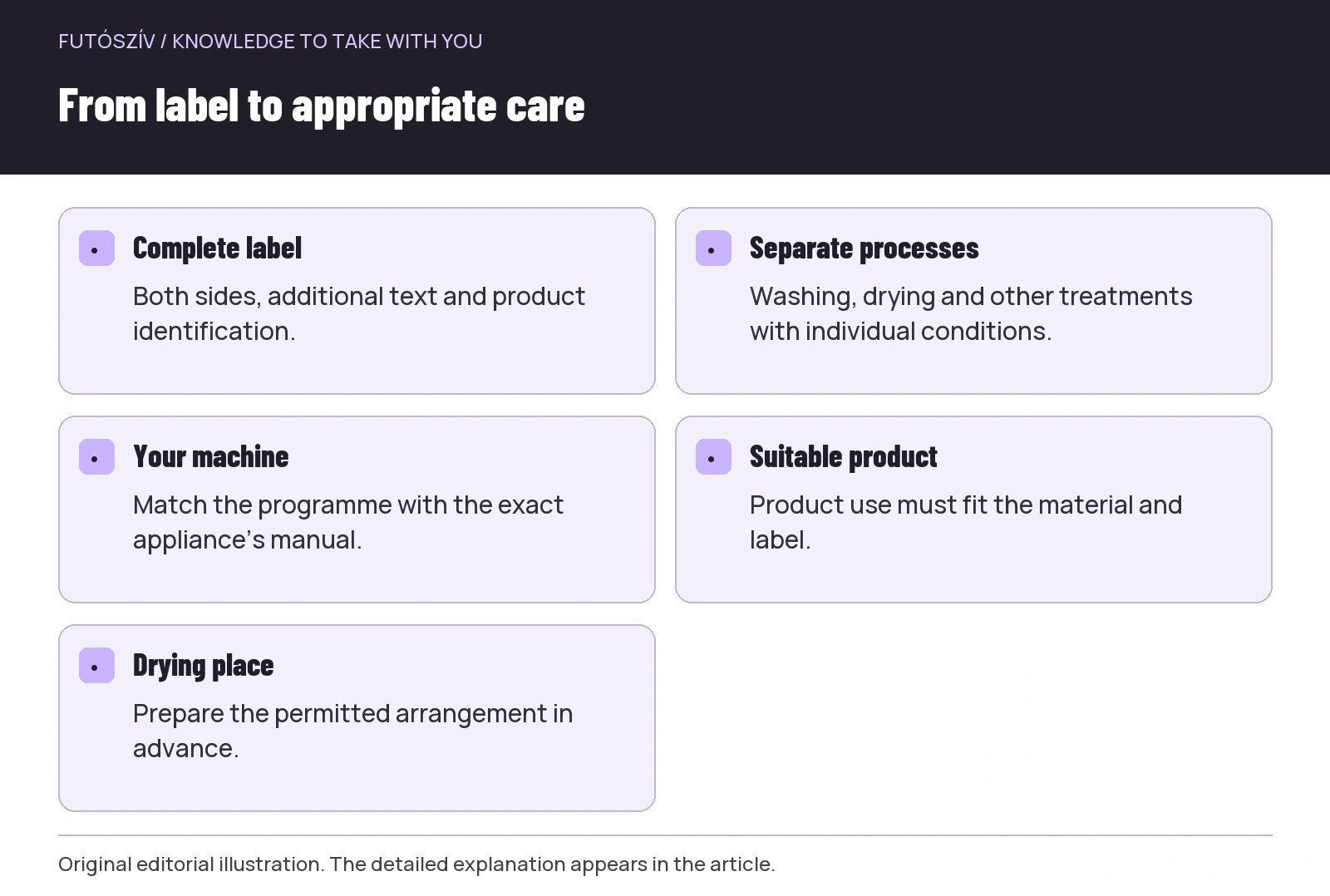 Enlarge diagram
Text version of the illustration
- Complete label
- Both sides, additional text and product identification.
- Separate processes
- Washing, drying and other treatments with individual conditions.
- Your machine
- Match the programme with the exact appliance’s manual.
- Suitable product
- Product use must fit the material and label.
- Drying place
- Prepare the permitted arrangement in advance.
The machine button and garment symbol come from different sources
An icon on a machine display may show its own programme, function or status. It does not necessarily mean the same as a similar drawing on a clothing label. The Bosch explanation of washing-machine symbols , for example, covers controls and operational indicators too. Consult the manual for your exact appliance model to learn what a programme does, its intended load and adjustable settings. The names “sports” or “delicate” alone are not permission issued for your garment.
Read the two documents together: the clothing states what is permitted; the machine explains how to carry it out appropriately. If a manufacturer requiring hand washing expressly prohibits machine treatment, a programme called “hand wash” does not automatically grant an exemption. If conditions are unclear, request manufacturer help with precise model details. Do not resolve uncertainty by guessing or remembering a previous machine’s programme. A similarly named function on a new appliance can differ.
| Where do you see it? | What do you learn? | What should supplement it? |
|---|---|---|
| Garment label | The product’s permitted care process. | Written instructions and precise manufacturer guidance. |
| Composition | The fibres listed. | The finished garment’s care requirements. |
| Washing-machine controls | The appliance’s own programme or status. | The exact appliance’s manual. |
| Detergent packaging | Use and dosing for that product. | Suitability for material and label. |
Plan drying before washing
The label’s drying section may specify a separate task after washing. Do not collapse tumble-drying and natural-drying symbols into one question of whether heating is allowed. Check the precise symbol’s meaning in the official explanation together with garment-maker additions. If tumble drying is prohibited, spinning in the washing machine and drying indoors still require separate interpretation: these are different operations. A tumble-drying prohibition restricts one method; it does not mean no care process exists.
In your notes, record more than “do not tumble dry”. If the product specifies flat, hanging or another natural-drying arrangement, note that too. You can then see beforehand whether a suitable place is needed. Hanging a delicate garment while heavy and wet differs from supporting it over a wide surface. You need not care for all running clothes identically; give the few items requiring special attention an easily recognisable routine.
Do not omit ironing and bleaching prohibitions
Ironing information is not decoration: appropriate temperature, permission and additional restrictions matter. Prints or bonded elements can make the garment’s own instructions particularly important. The bleaching symbol provides separate information too; do not substitute a lower-dose homemade version of a prohibited process. Stain removers do not all have identical compositions, so check the product’s description and garment suitability. Applying an unknown substance before a sports wash does not make it well-founded.
Professional cleaning information belongs to a different symbol group from home washing and drying. If using such a service, show the complete label and describe previous treatments too. Do not reduce all the symbols to one yes-or-no question. This article gives no chemical-cleaning recipe: recognise which operation a restriction concerns and do not apply it in place of, or alongside, another task without checking.
Why might you encounter a new or different detail?
Descriptions of care-symbol systems can evolve. The GINETEX announcement on ISO 3758:2023 , for example, introduces a detail for hand washing at ambient temperature among the changes. An old, brief online legend may therefore not cover every label. For an unfamiliar symbol, seek a current official source and the garment maker’s explanation. Do not regard an unusual detail as a printing error merely because previous clothing did not have it.
Differences may also reflect the label’s geographical market and written instructions alongside symbols. Recognising one symbol in an image is not the complete information. If using phone image recognition, treat it as a search aid: check the result against the actual symbol and whole label. A blurred bar, fold or partly hidden drawing can mislead. Calm manual checking is particularly useful for valuable or specialist-material equipment where incorrect care has larger consequences.
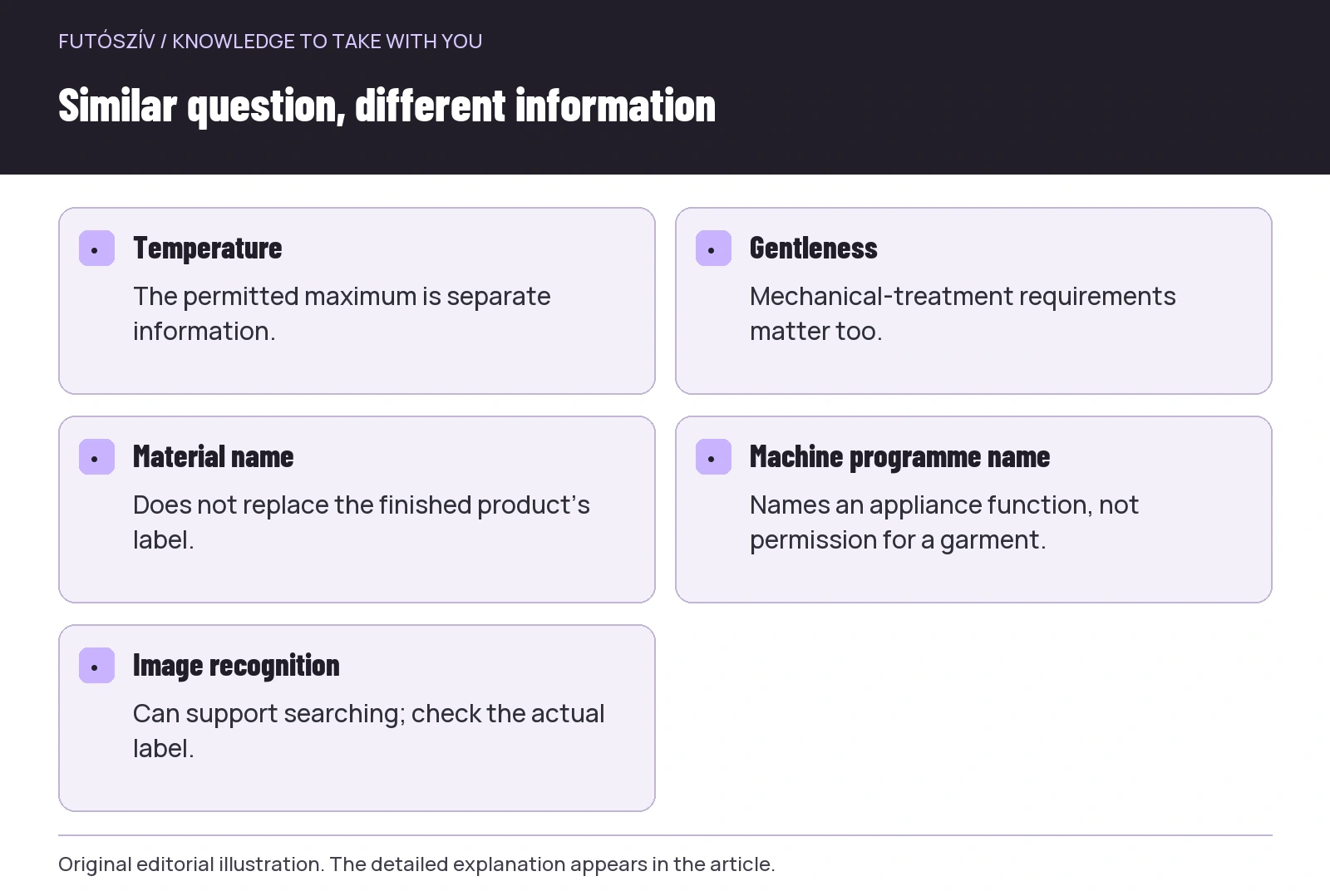 Enlarge diagram
Text version of the illustration
- Temperature
- The permitted maximum is separate information.
- Gentleness
- Mechanical-treatment requirements matter too.
- Material name
- Does not replace the finished product’s label.
- Machine programme name
- Names an appliance function, not permission for a garment.
- Image recognition
- Can support searching; check the actual label.
How should you group running clothes for washing?
Look beyond colour when sorting. Permitted temperature, mechanical action, product use and type of dirt all matter. Items can share a wash when the selected process is compatible with every garment’s instructions. Merely finding the lowest temperature is insufficient. A delicate mesh top alongside an item with hard, snagging hardware, for example, needs separate consideration. Account for your machine’s load and programme instructions as well as clothing labels.
You can make three simple groups: usual items that can share care, equipment needing a separate process and labels awaiting clarification. These are not permanent clothing categories but a decision sequence for that wash. Do not let the last group drift accidentally into the first. A particularly muddy item and an easily cleaned top may need different preparation too. The aim is a well-understood, traceable shared condition, not making all sports equipment disappear from the floor in one large load.
Three illustrative label-reading situations
In the first, two tops show the same temperature but one also has a symbol indicating gentler mechanical treatment. Despite matching temperatures, full instructions differ, so retain the second detail in programme selection. In the second, washing is allowed but tumble drying prohibited. A separate drying place is needed afterwards, rather than extending washing permission to drying. In the third, one part of the label is illegible: the known part does not authorise inventing missing information.
These are teaching examples, not instructions issued for actual products. Your garment’s complete label provides interpretation, and manufacturer additions may refine the task further. The examples reveal where information is lost: when the whole care process becomes one temperature, one yes-or-no answer or one programme name. Good notes instead preserve separate washing, drying and other restrictions. The next wash need not take longer, but requires less guesswork.
A brief information sheet for items difficult to remember
For an infrequently used membrane top or delicate running garment, a few lines suffice: product identification, label photograph, permitted wash process, drying and important prohibitions. Add a machine programme name only after checking the right appliance’s manual and confirming the setting suits the garment. Your note then does not preserve a misunderstanding for years. When starting a new machine or care product, review the relevant part: the garment’s label is unchanged but the tool used has changed.
The final goal is not reciting every symbol from memory. Useful knowledge means finding appropriate information, reading operations separately and applying them to your own equipment. Running-clothing care then becomes repeatable decisions: identification, reading the label, matching machine and product, then appropriate drying. A carefully saved label photograph and a few precise questions can be worth more than one washing rule believed to apply to every technical textile.
Sources and further reading
- GINETEX: Care symbols
- GINETEX: ISO 3758:2023 standard has been published
- Woolmark: Washing instruction symbols explained
- Bosch: Washing Machine Symbols
How Futószív articles are prepared: our editorial guidelines.