Many people either handle a membrane running jacket too cautiously or put it in the same wash as any T-shirt. Good care requires neither extreme: first identify the specific garment, then turn its instructions into a sequence you can follow. The membrane, outer fabric, seams and water-repellent treatment have different roles, so their care requirements must not be confused either. This article does not give one washing recipe for every jacket. It explains how to read and apply your own garment’s manufacturer guidance, when to check its condition and when to seek product-specific help.
Identification: the brand name is not enough
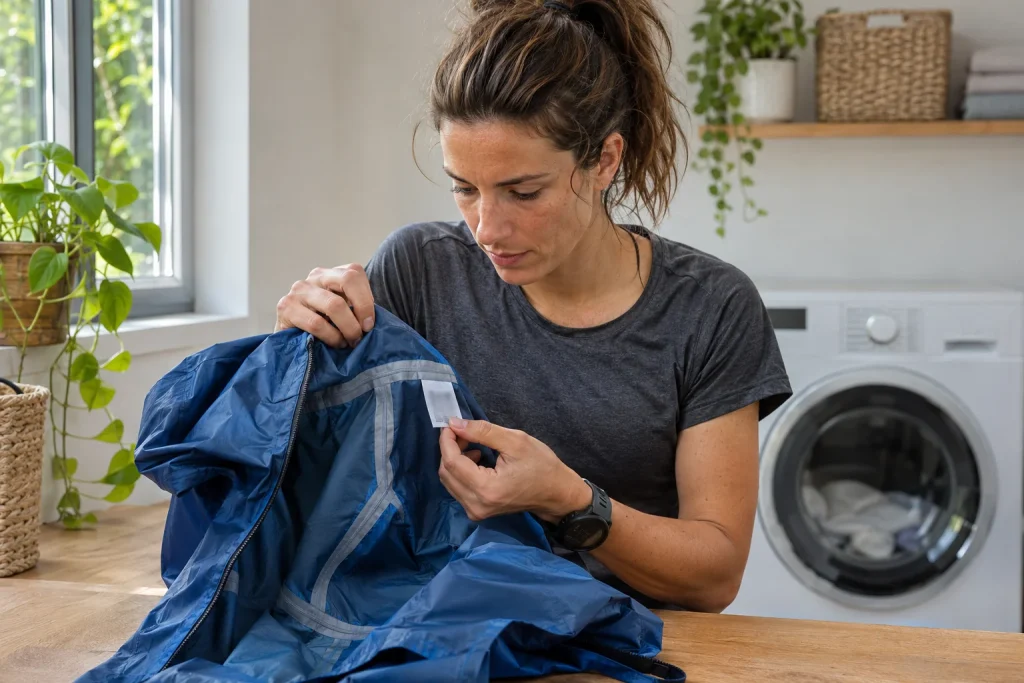
Find the jacket’s model name, care label and exact fabric-technology designation. A brand may offer several constructions and model years with different care requirements. A waterproof shell, a merely wind-resistant top and a garment with a special exposed membrane surface are not automatically the same product. Look for the manufacturer’s relevant model page and care document rather than relying on a short title left from an online shop. For an older purchase, purchase information or an internal code may help. Selecting the right instructions is the first substantive maintenance step.
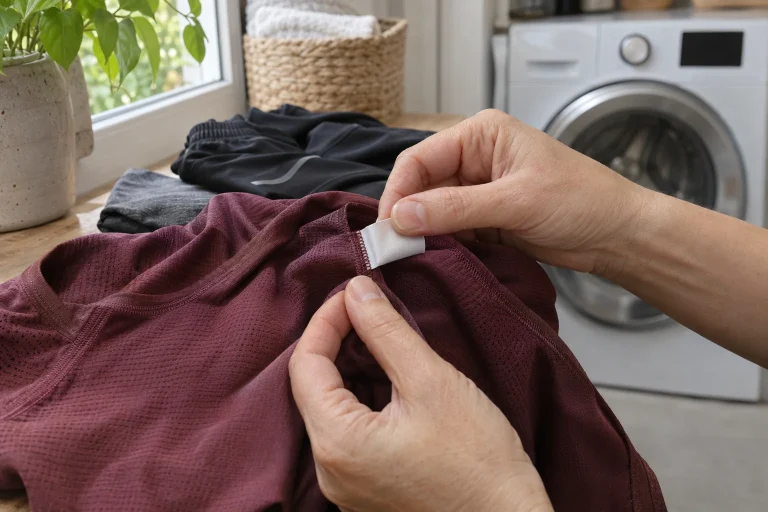
Photograph the label in good light, as small print is harder to look up once washing is under way. Check the separate washing, drying, ironing and bleaching symbols, along with any additional text. If two pieces of information seem contradictory, do not automatically choose the more convenient version. Identify which construction the general fabric-technology page or specific garment manufacturer’s instruction applies to, and ask for clarification if necessary. A jacket is not one uniform piece of material just because its main fabric is known: it can also contain zips, prints, bonded parts and other components.
The membrane and water repellency are different
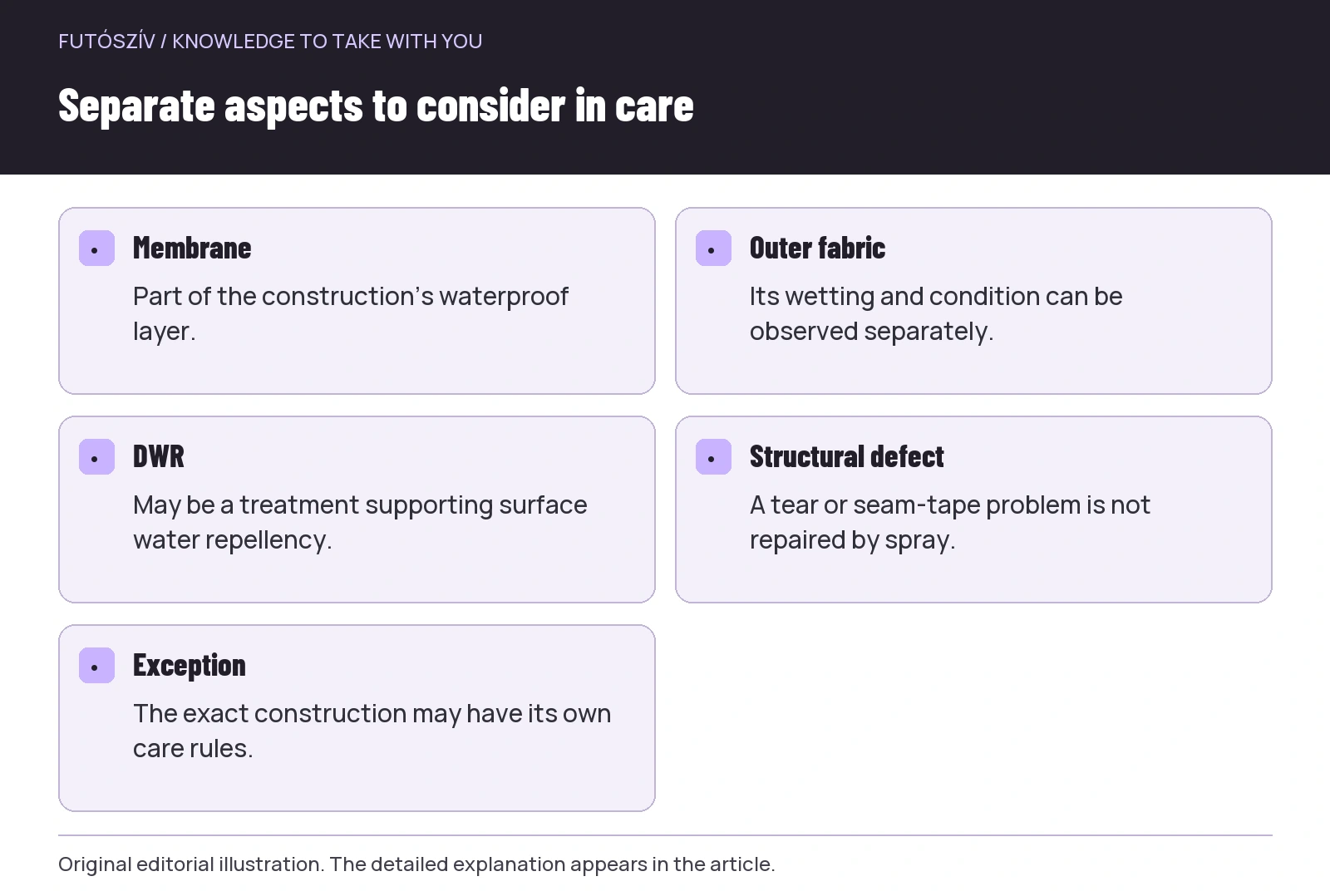
The GORE-TEX explanation of DWR distinguishes the membrane’s role from that of the water-repellent outer surface. DWR helps water bead and roll off the outside; it is not the laminate’s waterproof layer. Saturated outer fabric therefore does not, by itself, necessarily mean a punctured membrane. Equally, DWR treatment cannot automatically resolve a damaged seam or fabric defect. Identify your jacket’s problem precisely before buying another surface treatment.
After running, look at what actually happened: where the outside looks wet, which internal area is affected, and whether a zip or another entry point was open. You cannot always determine the origin of moisture inside at a glance. Do not claim definite leakage or definite condensation from assumption alone. When reporting a problem to the manufacturer, describe its location, circumstances and known condition. Precise observation helps separate cleaning, surface-treatment and repair questions. They are different tasks even when they concern the same jacket.
Turn the instructions into your own worksheet
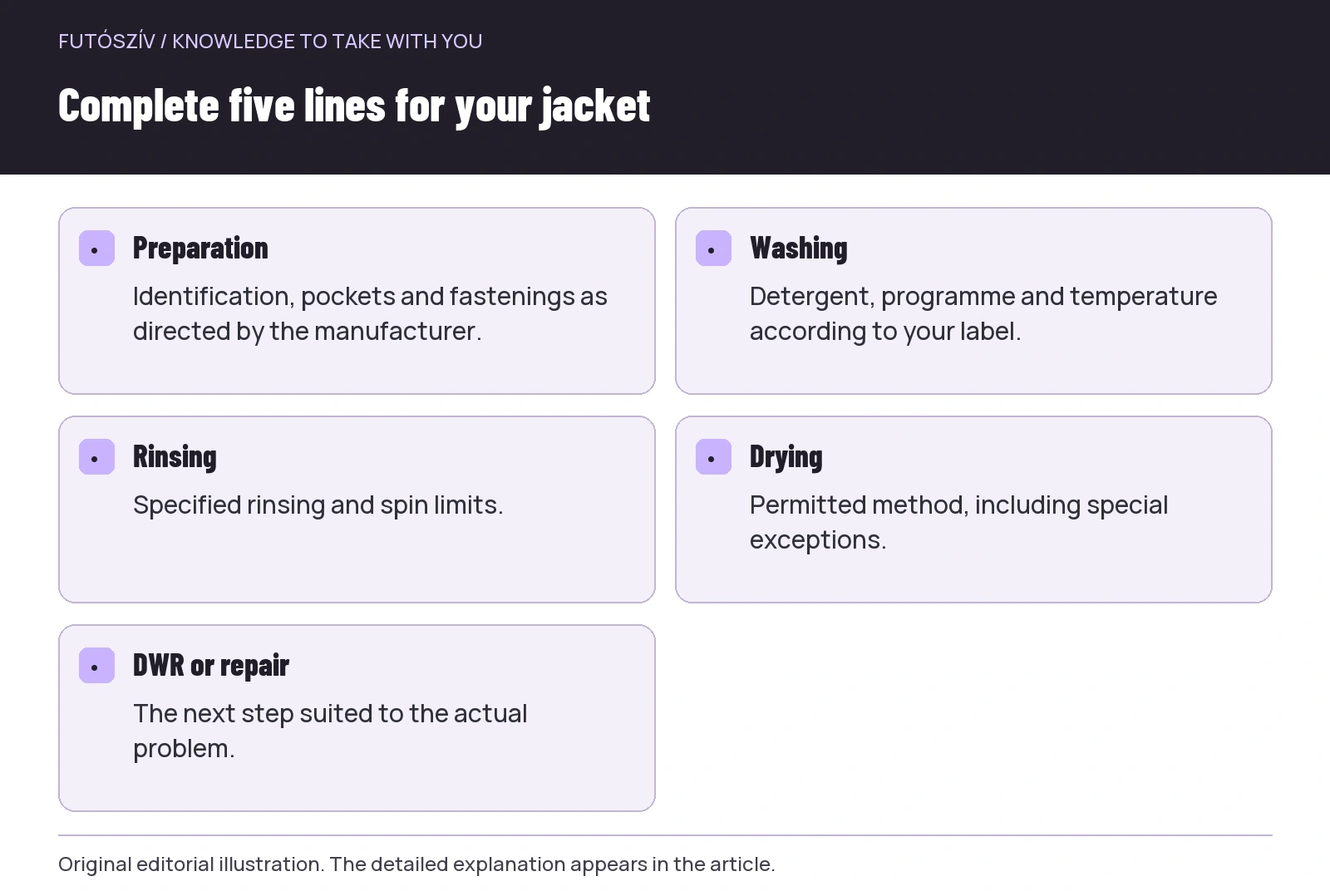
Write five lines: preparation, washing, rinsing and spinning, drying, and surface treatment if necessary. Briefly copy only the method permitted for your own product into each. Do not fill in temperature, programme or product based on another jacket. The GORE-TEX outerwear care page also gives steps subject to the garment manufacturer’s instructions and lists specific exceptions. The worksheet’s purpose is to prevent you from mixing several different online suggestions into one recipe on washing day.
You can add a check question to each line. For preparation: are pockets empty and fastenings arranged? For washing: are the selected detergent and programme suitable? For drying: is this method allowed for the entire garment construction? For surface treatment: is the product genuinely necessary and compatible? These are simple questions, but they make the process traceable. You need not keep a long record of every wash. Having the jacket’s important, easily forgotten details together is enough, so general advice does not override an exception for your own garment.
 Enlarge diagram
Text version of the illustration
- Membrane
- Part of the construction’s waterproof layer.
- Outer fabric
- Its wetting and condition can be observed separately.
- DWR
- May be a treatment supporting surface water repellency.
- Structural defect
- A tear or seam-tape problem is not repaired by spray.
- Exception
- The exact construction may have its own care rules.
Preparation: check hidden pockets too
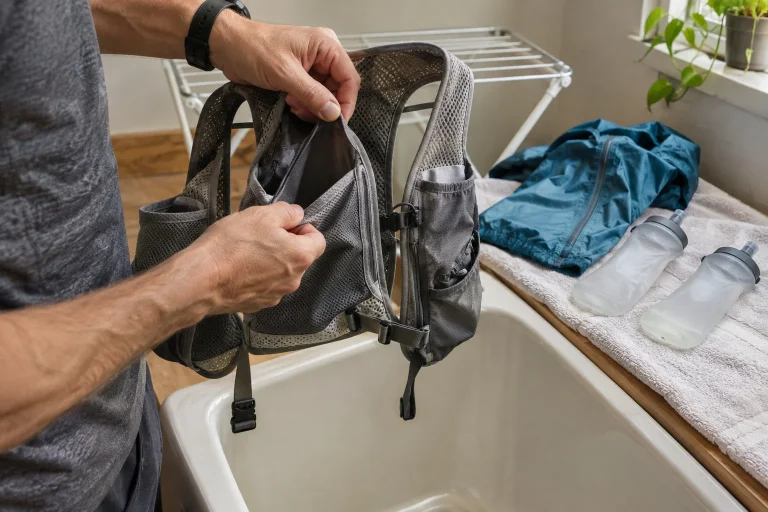
Remove keys, paper, packaging and all other accessories, then arrange zips, straps and tabs as the manufacturer directs. A small internal pocket is easy to miss, and an object left inside can create a new problem for both garment and machine. Inspect the jacket for damage: a tear, loose bonded edge, lifting seam tape or jammed zip should not receive its first attention during the wash. If you find such a problem, clarify the appropriate next step with the manufacturer first. Washing does not solve every structural issue.
Choose the rest of the load according to the instructions. Do not automatically put a delicate jacket alongside heavily muddy items or garments full of abrasive components. Cleaning needs and material limitations must be compatible. Residual additives in the machine drawer and automatic dosing may also warrant checking if the jacket’s instructions exclude certain products. Do not expect a “sports programme” name to guarantee full compatibility. Learn the programme’s operation from the machine manual, and the textile’s limits from the garment instructions.
Follow the full washing instructions
Besides temperature, instructions may specify detergent type, quantity, rinsing and mechanical action. Do not extract one number and fill in the rest from habit. For example, the general GORE-TEX page mentions liquid detergent and avoiding certain additives, but the specific instructions and exceptions for your own jacket are decisive. Fabric softener, stain remover and bleach are not universal sports-care products. If your garment excludes them, the hope of a nicer smell or stronger cleaning does not justify using them.
Do not arbitrarily increase detergent or soaking time. Treating a visible stain may also be product-specific, especially near coatings and bonded areas. Scrubbing and harsh chemicals can cause new damage unrelated to the original dirt. If a stubborn stain remains, ask the manufacturer for specific care advice. The aim is preserving usable material and function, not a like-new appearance at any cost. An aesthetic mark and a functional defect require separate evaluation; they do not always occur together.
| Step | What should you extract from the instructions? | Common mistaken shortcut |
|---|---|---|
| Identification | Exact model and construction | All membrane jackets are the same |
| Washing | Temperature, detergent, programme and load | Checking temperature alone is enough |
| Rinsing | The specified step and spin limits | More detergent must be better |
| Drying | Permitted method and care exception | A radiator quickly solves drying for every garment |
| DWR | Need, compatibility and activation | Spray fixes every leakage problem |
| Repair | The manufacturer’s process for fabric and seam defects | Iron every lifting part back into place at home |
Drying and heat treatment may have separate purposes
Some garment instructions specify a separate heat treatment after complete drying to reactivate surface water repellency. This is not general permission to apply any heat. The tumble dryer, iron, protective layer, steam and time all depend on the specific instructions. Special exceptions matter: for a durable-beading exposed surface such as GORE-TEX SHAKEDRY, the manufacturer specifies different care, without tumble drying or ironing on the linked page. You cannot override such an exception with the routine for a conventional fabric-faced jacket.
If you do not have the equipment specified in the instructions, do not improvise with a radiator, hairdryer or hot surface. Check whether the manufacturer provides a permitted alternative for the specific garment. If unclear, ask for help. A care step does not become safe because you use the wrong method briefly. Preserving a jacket also means recognising the limits of your home facilities. An appropriate external service or product-support answer may leave less uncertainty than a random experiment.
When should you consider a new DWR treatment?
First clean and care for the garment in your manufacturer’s sequence, then check outer water repellency as directed. DWR guidance discusses renewing surface treatment when necessary, but compatibility and exceptions still matter. Spray-on and wash-in products may not be usable in the same way on every garment. Read the conditions for both the jacket and chosen product. Do not combine separate steps from two products in the hope of a stronger result. The treatment should be precisely identified and traceable.
Keep the purpose of the check in perspective too. Beading water on the surface is an observation about the outside, not complete laboratory certification of waterproofness. Do not perform dangerous or excessive pressure tests on the garment at home. If you suspect a functional leakage problem, follow the manufacturer’s requested description and assessment process. Renewing DWR does not reattach seam tape or close a tear in the material. Understanding the distinction helps you seek the right solution for the right problem.
 Enlarge diagram
Text version of the illustration
- Preparation
- Identification, pockets and fastenings as directed by the manufacturer.
- Washing
- Detergent, programme and temperature according to your label.
- Rinsing
- Specified rinsing and spin limits.
- Drying
- Permitted method, including special exceptions.
- DWR or repair
- The next step suited to the actual problem.
Three common situations call for different next steps
First: the outer fabric no longer beads water, but you see no structural damage. Learning your garment’s care and surface-treatment sequence may be the next line of investigation. Second: seam tape is lifting or a tear is visible. That is a repair question, not merely a choice of detergent. Third: you notice internal moisture but its origin is unclear. Precise circumstances and product-specific assistance may be needed. Do not give all three situations the general label “not waterproof”, because they warrant different next actions.
The GORE-TEX description of repair services mentions zips, tears and loose seam tape among potential repairs, subject to individual assessment. This is an example tied to that service’s own availability, not automatically identical arrangements in every country. Ask your garment’s manufacturer about locally available options. The point is to enquire about repairability before gluing everything yourself or immediately replacing it. Damage location and material condition both matter to the assessment.
What should you tell the manufacturer when asking a question?
Provide the model, approximate purchase date and precise location of the issue. Take well-lit overview and close-up photographs, sharing personal information only as needed for the enquiry. Describe the care routine factually: programme, detergent and drying used, and when the problem appeared. Do not set out to prove that it must be a manufacturing defect or a damaged membrane. Concrete observations give the relevant specialist more useful reference points than a confident but unverified diagnosis of the garment.
If you have already applied a treatment, describe that too, even if you now have doubts about it. The history may matter to further cleaning or repair options. Do not apply another product merely to make the defect look better in a photograph. Prepare the item for the enquiry in the requested condition and manner. Your documentation also helps track what changed after each step later. A long letter is unnecessary: an identifiable item, precise issue, care history and specific question usually make a clearer start.
Storage: a running pack is not a permanent wardrobe
Once the jacket is completely dry and any necessary care is done, store it as the manufacturer directs. Packing into a small pocket can be a convenient transport feature, but it does not automatically mean prolonged storage damp and tightly compressed is ideal. Check pockets, hood, cuffs and thicker edges too. If one area is still damp, do not judge only by touching the large back panel. Use a clean storage place appropriate to the product. Being able to take it out quickly before the next run starts with properly finishing the previous outing.
Inspect a less frequently used jacket occasionally too, especially before an important run. Checking zip operation, adjusters and visible seams is not a performance test, but it reveals simple problems. Do not wait until the start area to discover a jammed hood adjuster or old packaging in a pocket. The equipment’s care sheet and a brief condition check may be enough for everyday routine. The aim is known usability, not inspecting the entire manufacturing construction every day.
A care system you can follow
Keep the exact instructions and five short process lines for your jacket. Treat cleaning, drying, necessary surface treatment and repair as separate tasks within permitted limits. Clarify an uncertain step rather than filling the gap with another product’s routine. Care then consists of concrete decision points: which item, what condition, which permitted treatment and what result. Before the next use, you can interpret your own experience within this framework too, without exaggerated promises.
The value of caring for a membrane running jacket lies in consistency and a method suited to the product. General fabric-technology knowledge helps explain the roles; the specific label and manufacturer guidance provide the actual actions. Outer water repellency, membrane and seam condition all belong to the garment but are not the same problem. Recognising them separately makes washing less of an uncertain experiment and helps you seek a more targeted solution when something goes wrong. A jacket you understand can then do its job on the next run.
Sources and further reading
- GORE-TEX – Durable Water Repellent
- GORE-TEX – Outerwear Care Instructions
- GORE-TEX – Repair Services
How Futószív articles are prepared: our editorial guidelines.