The shortest distance alone provides too little information when choosing a family running event. Who can enter, whether you can run with your child, where the course ends and how the family returns to a shared meeting point all matter. An age limit on the entry page is an organiser’s participation condition, not an individual answer about suitable activity for a child.
Start choosing from the actual family situation. How many people would go, who wants to run, who needs accompaniment and who would prefer watching? A clear morning can sometimes offer more than an all-day programme sending everyone in different directions. The method below helps read event information and venue details together; it gives no universal prescription for children’s training volume or medical suitability.
Listen to the child’s idea first
Briefly show what the event involves. The medal should not be the only visible detail: mention crowds, waiting for the start, travel and whether you want to run, walk or simply look around. You can offer choices: would they join a short event with you, first watch a similar occasion or choose another family activity this time?
Give the answer real consequences. If looking around is an accepted option, they should not discover on site that entry has already been paid and everyone expects them to start after all. A sibling’s enthusiasm is not shared consent either. Two children may need different programmes on the same day, which also need to fit adults’ supervision and time.
The Sport England summary on children and young people emphasises listening to individual needs and the importance of positive activity experiences. A simple principle for family planning follows: do not assess the programme only through adult eyes. The following questions are original planning suggestions, not the organisation’s event ratings.
Read the age limit as a complete sentence
The label “children’s event” does not define one standard age group. Check lower and upper limits, the date or year used to calculate age and whether different events have different conditions. Entry allowed from age six may mean something different when race-day age is counted than when age reached during that calendar year is used.
The official 2026 Miklósi Futónap event rules provide a clear example: they assign several short events to separate age groups and calculate age reached in the year concerned. This document concerns an event already held and illustrates reading rules; it does not replace entry conditions for the next edition. The point is not memorising an age limit but recognising that calculation method is part of the condition.
If a birthday makes classification unclear, send the organiser a specific question. Identify the event and edition and the age you would use; disclose only necessary personal information through the appropriate channel. Do not choose another age group based on an earlier year’s social comment. Check event rules and any updates even alongside a distance offered by the registration system.
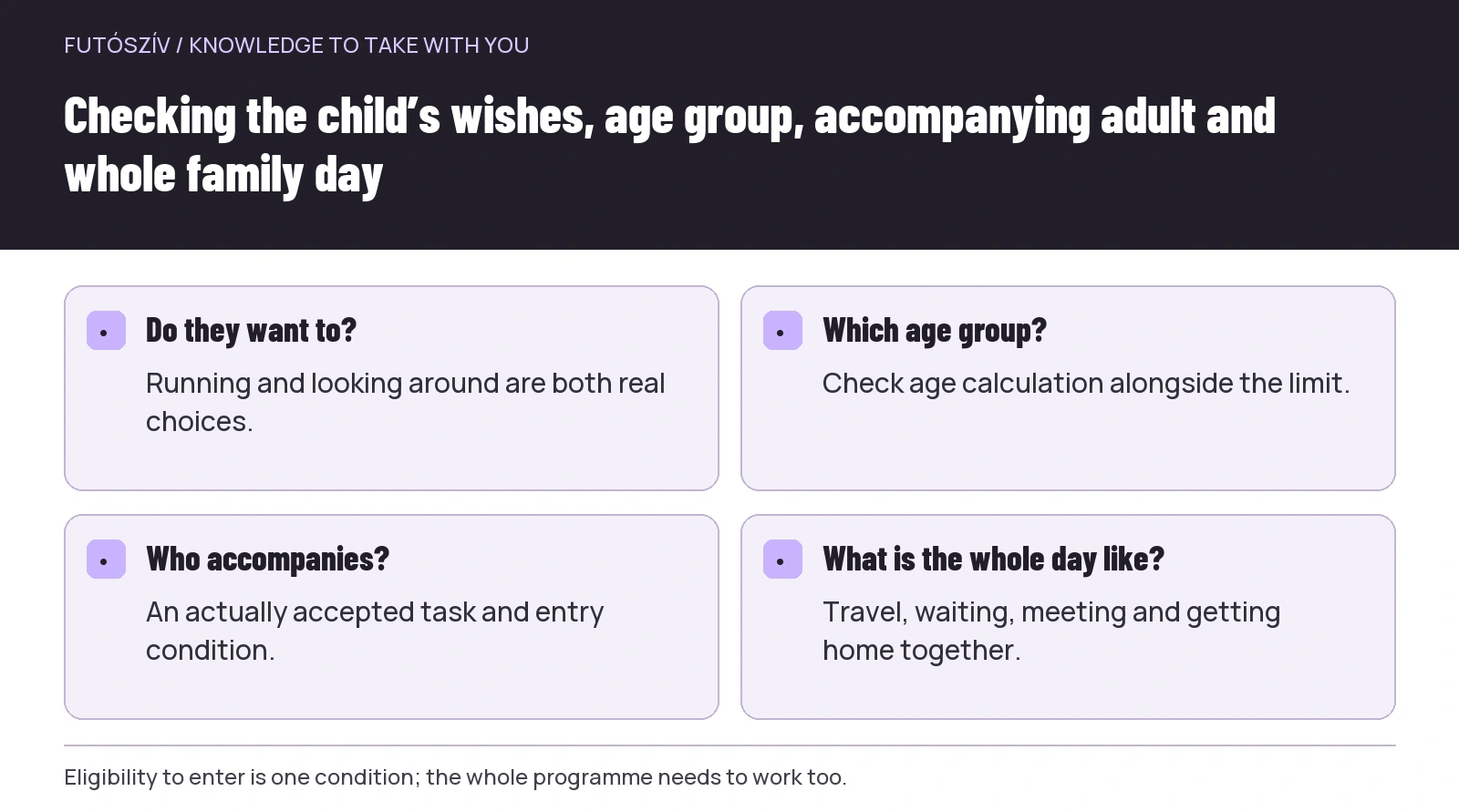 Enlarge diagram
Text version of the diagram
- Do they want to?
- Running and looking around are both real choices.
- Which age group?
- Check age calculation alongside the limit.
- Who accompanies?
- An actually accepted task and entry condition.
- What is the whole day like?
- Travel, waiting, meeting and getting home together.
The accompanying adult’s role is a separate condition
Separate three different questions: must the adult be present at the event, must they move with the child on the course and may they pass through the finish area together? The single phrase “parental accompaniment” does not always answer all three. Also ask separately whether the adult needs entry, a race number or other identification.
The official junior parkrun information , for example, separately addresses age group, a responsible adult’s presence on site and use of the finish funnel within its own overseas event system. This illustrates that being present and finishing together are not automatically identical. These rules cannot be transferred to a Hungarian event, and the page does not establish a junior parkrun venue in Hungary.
Assign family tasks clearly by name. An adult entering their own longer event cannot simultaneously collect a child at the short event’s finish. An acquaintance in the stands is a designated companion only if you have actually discussed it, they understand venue rules and have accepted the role. On-site helpers do not themselves replace family agreements.
Read the course map as a family route
Alongside distance, locate the start, finish, exit and point for meeting again. The same park can be simple for one shared short event and complicated for a day when start and finish are far apart. Check how far spectators need to walk, where lawful crossings are and which routes event closures affect.
Two points beside each other on a map may not have a direct connection. Barriers, fences, water or the running course may separate them. Do not assume an adult can quickly dash from start to finish. Find the actual walking connection and ask if the event drawing shows only the runners’ line.
Terrain and environment descriptions matter too. Paved or unpaved paths, stairs, narrow passages, a loud stage or an uncovered waiting place may create different family needs. Do not claim accessibility or pushchair access from a photo. Request information about the particular entrance and planned route if this is a condition of participation.
A brief comparison sheet may suffice
The table below is an original selection aid. It does not score children’s abilities or rank events. Complete it for two or three possibilities; leave question marks where reliable information is missing until answered.
| Consideration | What should you find in the event information? | Why does it matter for the family day? |
|---|---|---|
| Age group | Limit and calculation method | You choose the appropriate event |
| Accompanying adult | Presence, moving on the course, finish funnel | Adults’ tasks can be assigned beforehand |
| Event sequence | Start, assembly and collection time slots | Timing conflicts become visible |
| Start and finish | Exact location, spectator connection | Meeting can be planned |
| On-site conditions | Toilets, bag storage, access | Waiting becomes part of the plan too |
| Entry documents | Permission, deadline, collection | Missing paperwork can be avoided on site |
| Changes | Cancellation and official updates | You know where to check differences |
Missing information is not always a reason to exclude an event: detailed guidance may appear later. However, do not treat a condition necessary for participation as an automatic yes. If the accompanying adult’s entry requirements are uncertain, for example, clarify before payment rather than arguing in the start area.
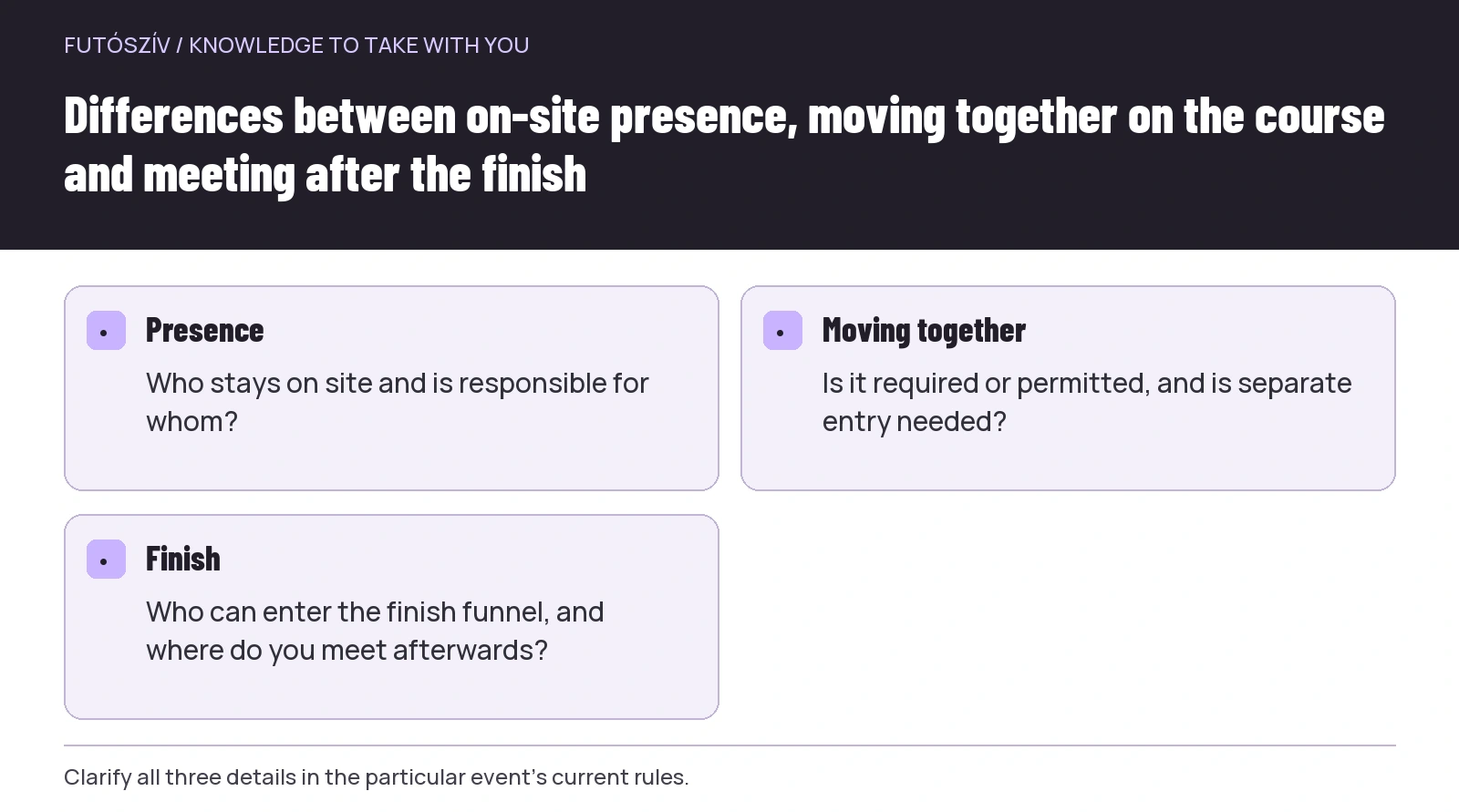 Enlarge diagram
Text version of the diagram
- Presence
- Who stays on site and is responsible for whom?
- Moving together
- Is it required or permitted, and is separate entry needed?
- Finish
- Who can enter the finish funnel, and where do you meet afterwards?
Check how much waiting comes with the entry
A ten- or twenty-minute event may sit within several hours at the venue if numbers must be collected early, another family member starts later or transport times are fixed. This is not necessarily bad, but works only when waiting is considered too. List arrival, administration, the event and actually leaving for home separately.
Do not base the plan on the most optimistic schedule. Walking from parking or a stop, queueing and finding the exit may take time too. Choose a time buffer according to location and family circumstances rather than copying a universal number of minutes. For a long gap, have a calm, accessible option requiring no further crossings of closures.
For siblings entering separate events, examine where adults will actually be throughout. Three overlapping tasks for one companion cannot be solved through more enthusiasm. Another event, another day or fewer entries may then be the workable decision. Family-programme success does not follow from the number of starters.
There may be costs beyond entry
Do not compare only the child’s discounted fee. Accompanying-adult entry, travel, parking, meals or a separate trip for advance number collection may add costs. Always examine the particular event’s current terms: “family” does not prove a shared discount, and a discounted price does not mean the programme suits every family member.
Separate necessary from optional items in the budget. Travel needed for basic participation differs from an event T-shirt or shared restaurant visit. If a gift shop, meal or several events are optional, say so beforehand. On-site decisions are then less likely to become unexpected comparisons between siblings.
Check documents too. The Fuss Neki organiser’s own declaration page requests a separate parental consent form for participants who are minors. This is an organiser-specific example of payment and administration needed to start not necessarily being identical. Use the current document for the event rather than assuming an unknown general template is accepted.
Comparing two imagined options
Imagine two fictional events. One is nearby; after the child and accompanying adult complete a shared event, the family meets in the same place, but few extra activities are offered. The other is a spectacular all-day event with several distances, but family members’ starts are far apart and no detailed spectator-access map is yet available. These are decision situations, not recommendations for existing races.
If the first occasion aims to introduce the race-number environment, the first option may need less coordination. If attending events already works well for the family and someone has accepted every task, the second may also be considered. Neither spectacle nor simplicity is good or bad in itself; their fit with the planned day matters.
Now change one condition: the child would prefer to stay looking around after the start, while the adult has a tight return journey. This is not necessarily a running-distance problem but a time-frame conflict. Seek a choice in which the previously agreed departure can be kept and the child understands it too. They should not discover the programme’s real end through hurried decisions on site.
What should you ask the organiser?
A good question identifies the event and distance being considered. For example: in the selected family event, what registration is needed for an adult moving with the child throughout, and where can they leave the finish together? If access matters, name the particular connection: you want the route from spectator entrance to the post-finish meeting point, not a general judgement of the venue.
Add the answer to the family plan with its date. An official response helps more when you can later identify which edition and detail it concerned. Use the designated customer-service channel instead of disclosing personal information under a public post. Contact aims to clarify a missing condition, not obtain acceptance of another event’s rules.
Finally, translate the decision into a simple programme for the child too: when you leave, who they will be with, what happens before and after the event and how to signal something is wrong. The chosen event becomes a real family programme when you fit not only within the entry system but understand and accept the whole day.
How Futószív articles are prepared: our editorial guidelines.