Several family members may start at one event yet experience very different days. One is already at the finish while another assembles; someone wants bag storage while someone else accompanies a child. A shared programme works when individual start times are joined by the tasks between them and who can actually carry them out.
This does not require a complicated organising app. A clear family schedule can show arrival, collection, accompaniment, meeting and getting home alongside each event. The aim is not to occupy every minute but to notice in time when one person would be needed in two places. The following method is an original practical planning suggestion, not an official programme for a particular race.
The start is only one time point
For each participant, first find four details: event day, number-collection conditions, required assembly or start-zone entry time and the start itself. If different events occur on different days, the shared weekend plan changes too. Do not assume from an event name that everyone starts at the same gate or can collect numbers in the same period.
The official 2026 Miklósi Futónap rules , for example, place short children’s events and longer-distance starts in sequence. This illustrates an event already held: it shows why events need examining on one timeline too. Always gather information for the next occasion from its current rules rather than copying the past start order linked here.
Write the check date and source at the foot of the family sheet. This later distinguishes a preliminary outline from a version updated using final participant information. If registration confirmation contains a different wave or time from the general programme, clarify the difference first. Promotional video does not replace information assigned to your race number.
Assign people to tasks
“Someone will go there” is not a rota. For every point requiring child accompaniment, number collection or handling belongings, name an adult who accepts it. Consider their own event and preparation time alongside it. Being theoretically at the venue is insufficient: they need to be genuinely available for the task then.
The running adult’s finish time is a planning estimate. A compulsory child collection cannot depend on it as though it were a scheduled arrival. After the finish line, reaching the meeting point, bag storage or another organiser process may still take time. If the next task is possible only with a tight finish, change the rota rather than trying to solve it through running pace.
The person accepting a task should receive necessary information and identification too. Accompanying-adult rules, meeting-point names and the designated contact should not be locked away on one runner’s phone. Equally, the family sheet should not unnecessarily become a publicly shared document containing personal information. The detailed version is for those who actually need it.
 Enlarge diagram
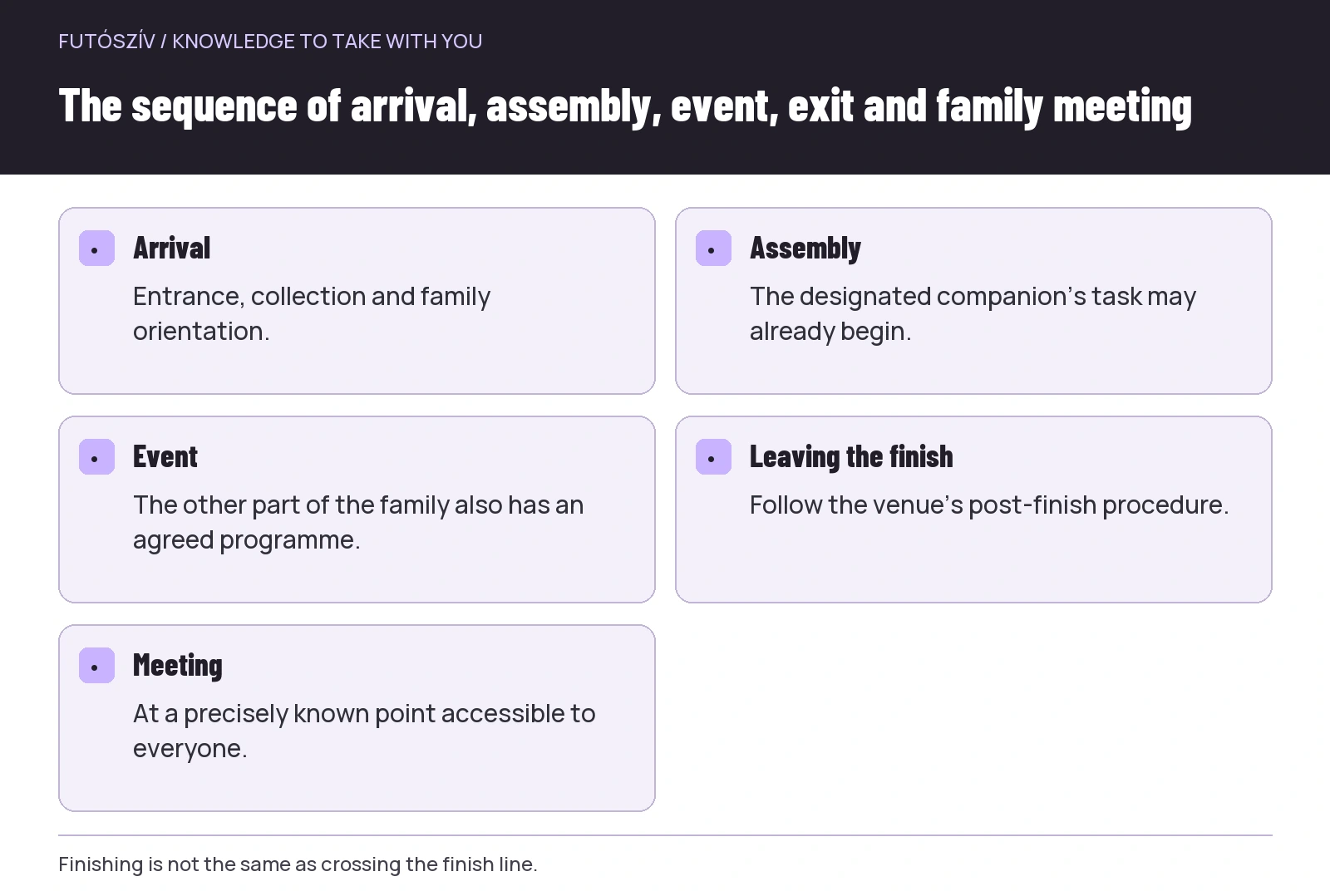
Text version of the diagram
- Arrival
- Entrance, collection and family orientation.
- Assembly
- The designated companion’s task may already begin.
- Event
- The other part of the family also has an agreed programme.
- Leaving the finish
- Follow the venue’s post-finish procedure.
- Meeting
- At a precisely known point accessible to everyone.
The companion and collecting adult may have different roles
Check whether the organiser permits handover to a different adult at all, and by which procedure. The person running with the child is not necessarily the one waiting for the whole family at the exit. If an official child-collection process exists, follow its rules; a jointly chosen bench or phone call does not replace required identification.
The official 2026 Mini London Marathon event guide illustrates this distinction well, describing separate collection points and entry identification within its own system. This is an overseas, past example; its wristband, race-number or access rules are not general Hungarian requirements. The lesson is to clarify roles and post-finish processes beforehand.
Even if a child remains with the adult accepting supervision, state when the agreement begins and ends. “They will be with you during the event” may be unclear if start-zone entry happens well before the start. Adults should confirm handovers with one another too; finding the next person on the rota should not be the child’s task.
An original sample day with two adults and two children
The schedule below is entirely fictional and illustrates organising. It is not an actual event programme or recommended exertion for children. The two children prepare for selected events permitted under the rules; their distances and ages are not part of the example. Adults are labelled A and B.
| Time period | Planned task | Adult A | Adult B |
|---|---|---|---|
| After arrival | Entrance, toilets, orientation | With the family | With the family |
| First child’s assembly | Go to the required place | Accompanies | Stays with the other child |
| First child’s finish | Official exit and meeting | According to event rules | Waits at the shared point |
| Second child’s event | Accompaniment and collection as required | Stays with the first child | Carries out the assigned task |
| Adult’s own assembly | Prepare for own event | Own task | Shared programme with both children |
| End of day | Agreed meeting and departure | Arrives after the full finishing process | Remains at an accessible shared point |
The table works only if finishing and handover actually conclude between the first two events. If adult A must go to their own zone before the second child starts, later rows shift. Use the example’s logic rather than treating its assumed sequence as a ready solution.
Try the harder version too: adult B also wants to enter another distance. Find a period that does not remove a necessary companion from the children. If none exists, outside help agreed beforehand or omitting an event may be realistic. One adult can care for family members only where actually present at a given time.
Put a real programme into gaps too
“We will wait until the next start” may describe very different situations. There may be a nearby calm seat, or prolonged standing at a crowded gate. Find which options spectators can access, how to reach toilets and whether re-entry to a zone is possible. A detour looking attractive on a map is not always usable in practice.
Do not schedule an excursion or shopping in a gap if reaching the next task requires a tight return. Movement between tasks consumes the day’s time just as travel does. If a stage activity is included, ask how fixed its start and end are; an uncertain show should not trap the companion needed for the next event.
Tell children which waiting period is short and what follows. They need not learn every time, but sequence helps: one event, then a shared break, then the other. If the order changes, those affected should hear too. Adults’ quick replanning is not automatically understandable to the rest of the family.
 Enlarge diagram
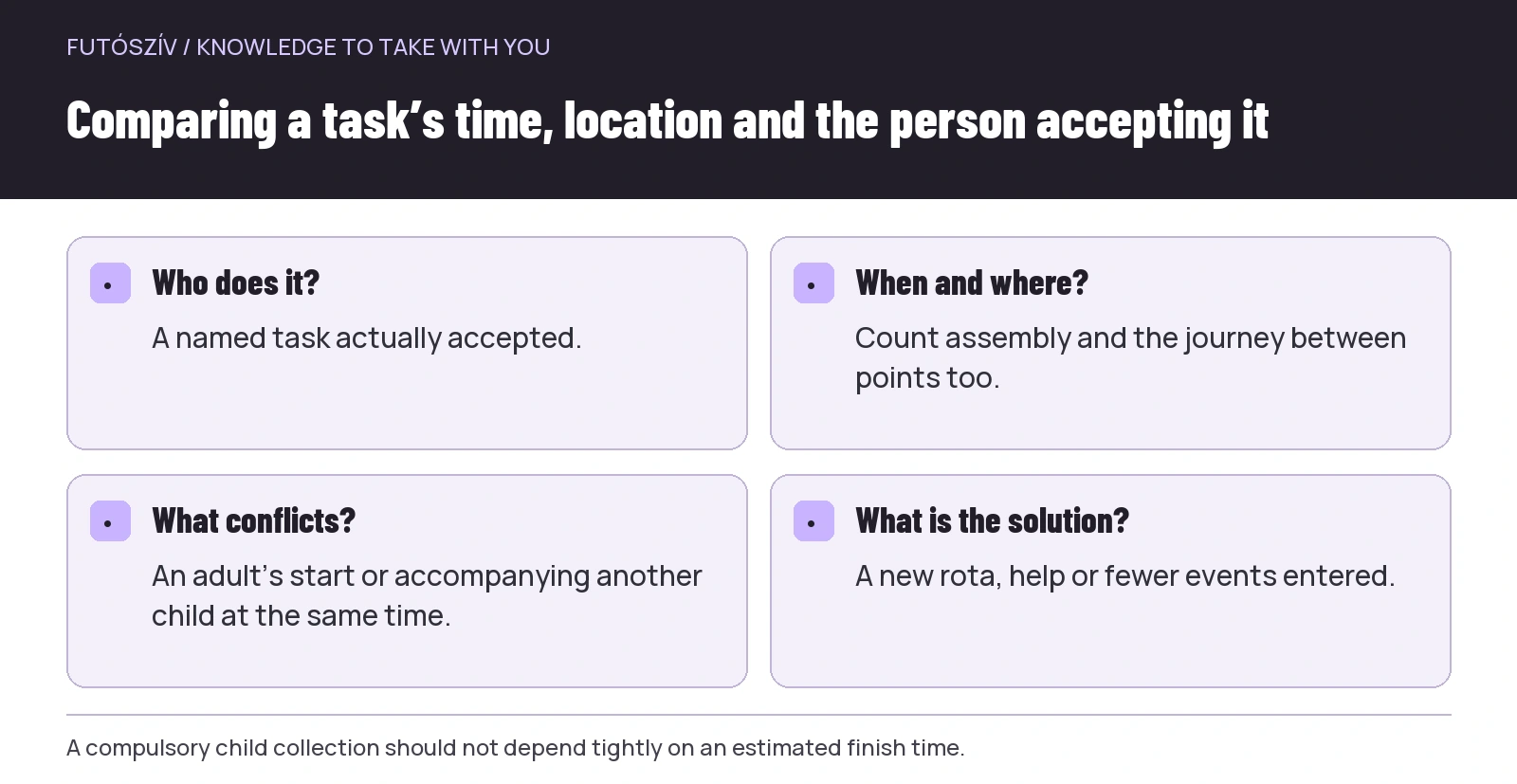
Text version of the diagram
- Who does it?
- A named task actually accepted.
- When and where?
- Count assembly and the journey between points too.
- What conflicts?
- An adult’s start or accompanying another child at the same time.
- What is the solution?
- A new rota, help or fewer events entered.
Follow the movement of bags too
Do not automatically check all family belongings into bag storage with the first runner’s bag. Items spectators or the adult staying with children may need should remain accessible. Bag-storage rules, hours and collection identification may differ by event; account for the particular service’s conditions in the family plan.
Separate the runner’s personal equipment, shared waiting supplies and items reserved for the end of the day by function. Someone staying with two children during another adult’s event should have realistically manageable luggage. Everything should not be in one large bag tied to the storage access of the person currently on the course.
Have a moment for redistribution too. A child’s number, clothing and belongings packed after their event should not disappear into another runner’s bag without anyone knowing. At day’s end, separately check bag storage, loaned items and documents taken for safekeeping are returned. This is an organising task, not part of the runner’s result.
The meeting point is not the finish line
The finish line is a good visual symbol but not necessarily a suitable family meeting point. There may be a closed runner corridor, several exits and a different spectator approach. Choose a point identifiable both on the event map and on site, lawfully accessible to spectators and the arriving runner. “At the big flag” is clear only if it truly means one well-defined point.
The official London Marathon spectator information recommends agreeing a meeting beforehand and warns against relying solely on phone contact in crowds. Its own event also uses a designated meeting area. For a Budapest or other Hungarian race, however, find that event’s designated area and current spectator map.
Have an understandable agreement if someone fails to arrive at the estimated time too. Do not consider a new location sent by phone accepted until the relevant adult confirms it. Children should not be tasked with searching for one another. If actual help is needed, use the organiser’s on-site procedure and appropriate emergency help where necessary, not a general online number of waiting minutes.
Getting there and returning need separate plans
The pre-start route may not suit departure for home. Closures, one-way spectator links, relocated stops or event duration may mean leaving by another exit. In Budapest, the official BKK journey-planning and traffic information provides a starting point for current services and planned changes. Elsewhere, check the local provider’s and organiser’s announcements.
Shared travel does not mean everyone must leave at the same time. If dividing the day in two from the outset, give the family members leaving earlier a working travel plan, necessary tickets and access to belongings. The later-running adult should not keep the only home or car key if others arrive there first. This is easier to arrange before departure than by phone at the finish.
Do not squeeze the journey home around one assumed finish time. With a fixed connection, include post-finish processes, meeting, bag collection and reaching the stop. If it fits only under very optimistic assumptions, seek another connection or a smaller programme. Family logistics are no reason to rush the runner.
A brief rehearsal the evening before
Read through the day as though everyone were already in position. The person staying with a child should describe where they wait, how to reach toilets and whom to ask questions. Runners should know where to find the others after the full finishing process. Check more than times: connections between tasks reveal gaps.
Then ask about three changes: what if an event changes, a child no longer wants to start or an adult returns later? You need not write a detailed novel for every case. Know which shared point remains valid, who decides family changes and which official channel provides event updates.
Keep the final sheet brief while checking thoroughly behind it. The aim is not a continuous organising meeting on site but everyone understanding the next few steps. Separate events can then make a shared day: performances differ, while attention to each other, meeting and finishing remain genuinely shared.
How Futószív articles are prepared: our editorial guidelines.