Finding running time as a father often involves more than putting on shoes. The shared day includes getting to nursery, shopping, evening plans, another adult’s own time and many small tasks absent from the calendar. A sustainable solution is not disappearing ever faster between responsibilities. It needs an agreement that tells everyone involved what happens while you are away and after you return.
This article addresses fathers, but does not assume every family has two parents or that caregiving automatically belongs to the mother. Single-parent, separated, shift-working and multigenerational families need different arrangements. The examples below are fictional practical situations. They offer tools for making sporting time visible, rather than family therapy or training-load advice.
Ask for the whole time window, not only the watch’s running time
A forty-minute run does not necessarily mean a forty-minute absence. Changing, getting out, returning, showering and genuinely rejoining the next family task may be included too. If only measured movement appears in the calendar, the remaining time comes from someone else’s invisible reserve. Plan from leaving the door to the next responsibility you can actually take on.
A fictional calculation: five minutes preparing, forty minutes running, five minutes of tasks on returning and fifteen minutes washing total sixty-five minutes. Travel adds another item if needed. These are not compulsory time standards; assess your own reality. The point is not to agree ‘half an hour of exercise’ while being unavailable for shared responsibilities for an hour and a half.
A precise sentence might be: ‘On Saturday I’d like personal sports time from eight until ten past nine. From ten past nine, I’ll get the children ready for the outing.’ This includes rejoining the family as well as leaving. The other person can see whether it really fits their plans. The time remains a proposal to discuss, rather than a settled fact.
Specific tasks sit behind running time
‘You’ll manage until then’ is a difficult instruction to hand over. Describe what actually falls within the chosen window: breakfast, dressing, a sibling’s activity, a pet, accepting a delivery or another task. You need not put the entire household into a spreadsheet. However, name the responsibilities for that occasion, particularly when the other person is attending to several things at once.
| Part of the time window | Question to clarify | A useful agreement |
|---|---|---|
| Before leaving | What needs preparing? | The running father sets out the things needed for that day’s shared outing. |
| While away | Who takes on which task? | The named adult is available and has accepted the role. |
| On returning | When are you available again? | Returning home and taking over the next task are listed separately. |
| If something changes | Whom do you tell, when and how? | Use an agreed channel; the new time is not automatically approved. |
The table does not prescribe the same person always doing the same thing. Its purpose is precisely to make the division of tasks a decision. Another family member’s childcare time is not an automatic reserve either. Ask for the favour within their boundaries and accept no as a valid answer.
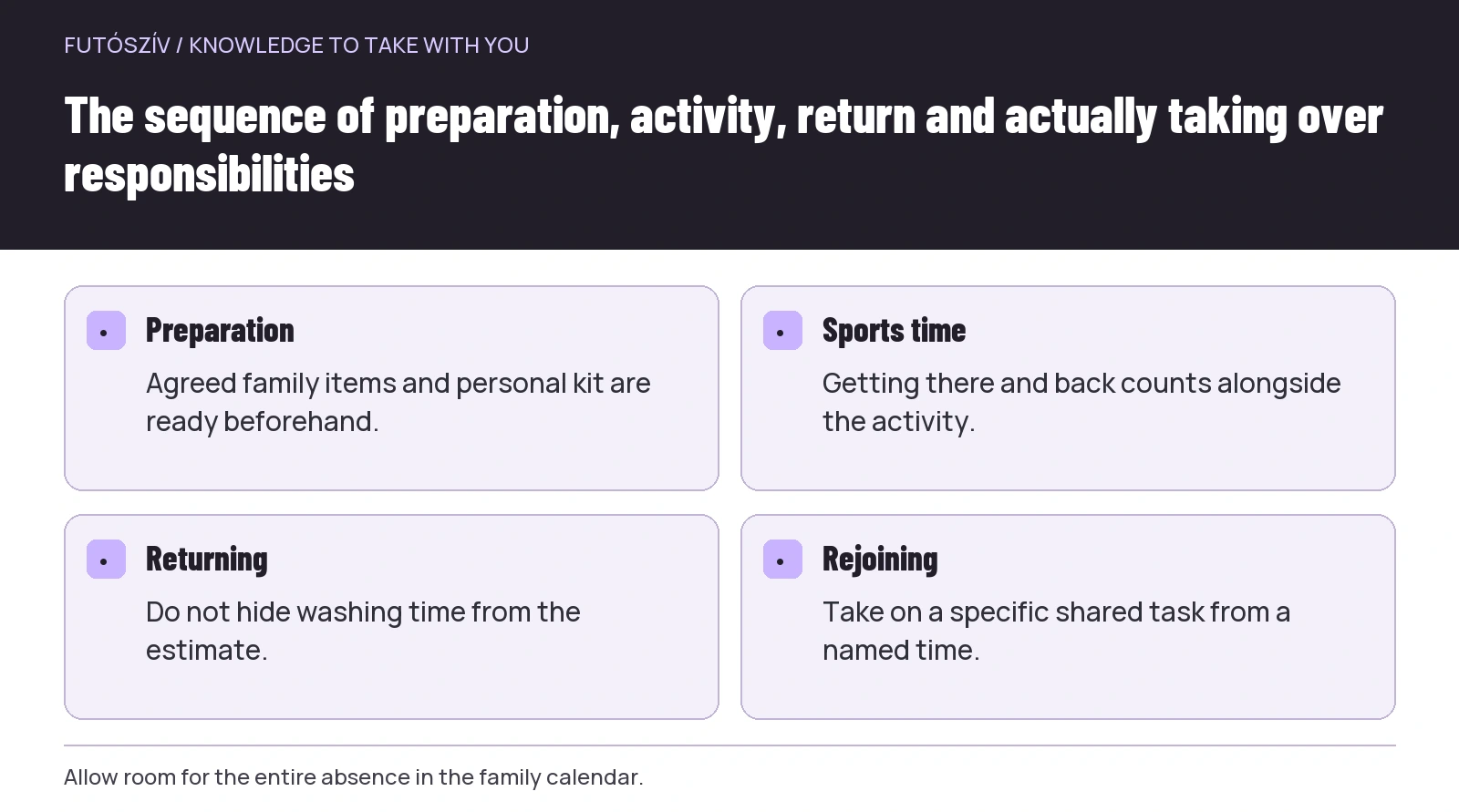 Enlarge diagram
Text version of the illustration
- Preparation
- Agreed family items and personal kit are ready beforehand.
- Sports time
- Getting there and back counts alongside the activity.
- Returning
- Do not hide washing time from the estimate.
- Rejoining
- Take on a specific shared task from a named time.
The other adult’s own time is a complete activity too
Running easily acquires a clear start, distance and event name, while the other person’s time remains ‘if we can fit it in’. Both can have calendar space even if the other person does not exercise. Meeting a friend, reading quietly or walking alone does not need kilometres to be valid. Your race deadline should not be the only organiser of shared free time.
Fairness does not necessarily mean minute-for-minute exchange every day. Working patterns, care needs and demands may differ. The difference should nevertheless be discussable and periodically reviewed. ‘Mine matters more right now’ should not become the explanation every week. If a major sporting event temporarily requires more arrangements, discuss its duration and how things will be balanced afterwards too.
A conversation opener might be: ‘I’d like these two time windows. Which of your own plans needs an equally dependable place?’ This is not offering a reward for supporting your running. Both people have needs within shared time. An agreement is meaningful when those needs are visible together.
Distinguish personal running from family activity
Playing in the park can be valuable family time, but may not provide the same experience as your own run. The reverse also applies: your training does not automatically become a good activity for a child simply because they are present. Name occasions separately so a family afternoon does not carry hidden expectations.
Sport England’s approach to families also treats shared activity as quality family time. This does not mean every family occasion should involve running or that a father’s personal sporting goal belongs to everyone. Consider participants’ interests and real circumstances when organising. Sport England: Children and young people
‘On Sunday we’ll choose a park game together’ and ‘On Sunday I’ll run my route and you can follow’ are different invitations. Both can be discussed, but family should not hide the individual goal in the second. When planning genuinely shared time, allow the child and other participants to shape it according to their possibilities too.
A child’s opinion is not decoration on a finished plan
Ask what they would like to do outdoors together, which familiar location they would choose or what they disliked last time. Do not place adult responsibility for the whole family timetable on them. Offer genuine, feasible choices. If something cannot fit now, explain why briefly and clearly.
The Play Their Way guidance on positive parenting culture emphasises listening to children about their own sporting experience. Here we use the principle that family movement is more than carrying out an adult’s idea. These questions are our examples: ‘What was good last time? What would you leave out? Which of the two games offered would you like?’ Play Their Way: Happy Place
A child choosing another game is not voting against their running father. Family connection does not require identical sporting interests. You can be an enthusiastic runner while your child chooses another movement or is more interested in a story that day. Arrange separate space for your running and build shared activities around shared participation.
With changing routines, make the discussion predictable
Shift work, parenting while living apart or unpredictable employment may prevent setting off at the same time every Tuesday. The discussion itself can be the constant: reviewing next week’s known commitments at an agreed time, for example. Do not wait until minutes before leaving to discover someone else has plans for that window.
Agree shorter and longer versions in advance too. This does not mean every missed session must be made up the next day. A shorter option helps when it genuinely fits without leaving a rush afterwards. If a family situation prevents either version, letting that occasion go is also an organisational decision.
As a parent living separately, respect the boundaries between your own time and agreed shared caregiving. A change to sporting plans should not automatically shift tasks to the other household. Specific legal or contact questions need individual professional assistance; this article does not interpret personal agreements. The practical principle is simple: only treat time as free when it has actually been agreed.
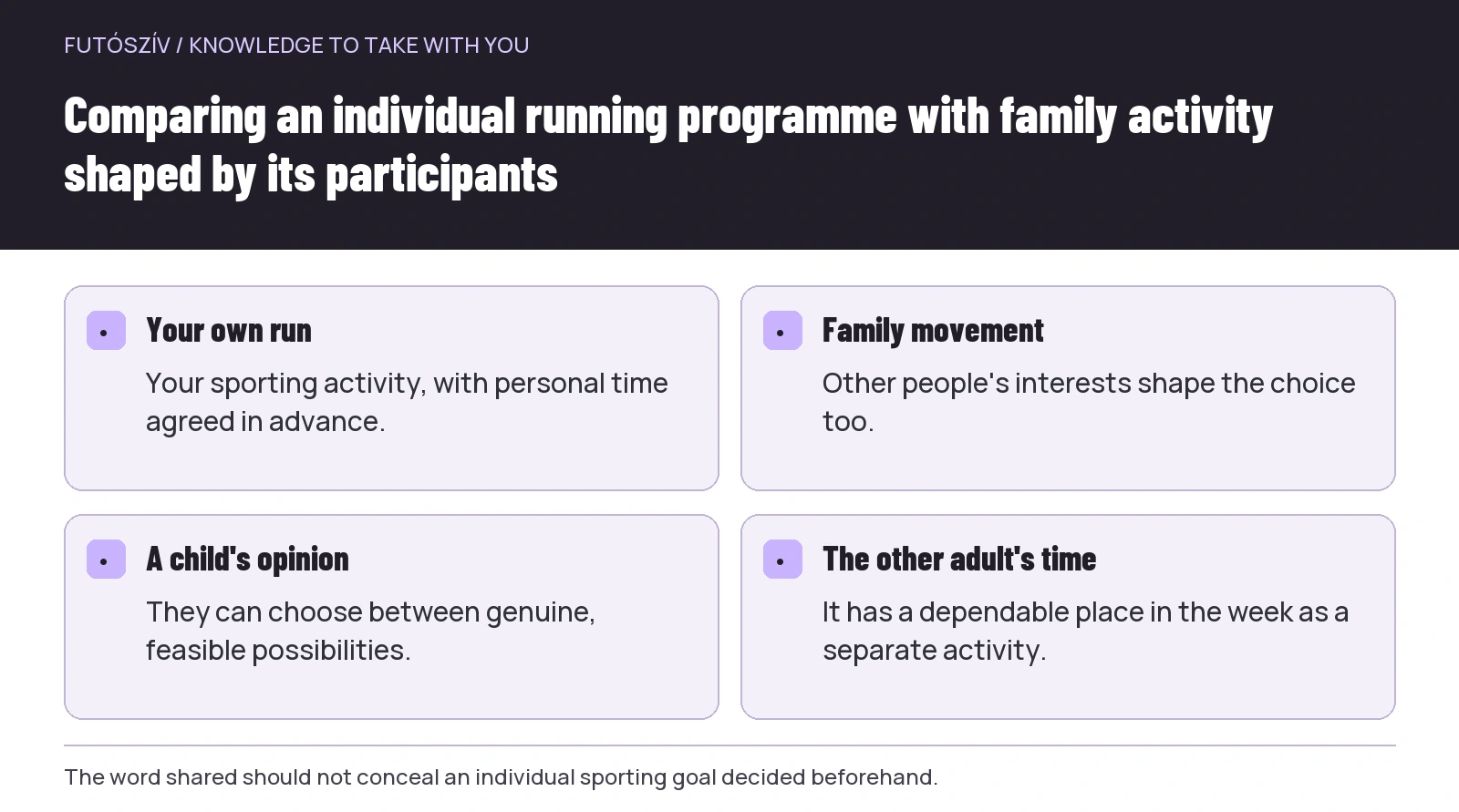 Enlarge diagram
Text version of the illustration
- Your own run
- Your sporting activity, with personal time agreed in advance.
- Family movement
- Other people’s interests shape the choice too.
- A child’s opinion
- They can choose between genuine, feasible possibilities.
- The other adult’s time
- It has a dependable place in the week as a separate activity.
Replanning a fictional Saturday
Imagine a family in which the father wants a morning run and another adult has their own activity starting at eleven. Initially, all that is said is ‘I’ll leave around nine for an hour’. This leaves several uncertainties: the exact departure, when the hour begins, who gets the child ready and when tasks can genuinely be handed over.
In the revised version, the father prepares his kit and the items he has agreed to organise for the shared outing the evening before. His personal window begins at eight fifty, and at ten he takes over the agreed family task. The other adult has time to prepare to leave. The times are fictional; this is not the right schedule for every family. The difference is naming uncertainties.
If something unexpected happens in the morning, the original plan need not be followed at any cost. They review whether a shorter option or another day works. A change is shared when everyone affected genuinely accepts it. ‘I’ll just get home later’ is not a solution if it makes the other person’s activity impossible.
A longer race project is a separate family commitment
Entering a race can change not only race day but travel, preparation, costs and the organisation of preceding weeks. Show these together before making commitments that affect others. Obtaining a race number does not automatically mean the family has taken over every associated responsibility.
Distinguish confirmed information from estimates. A published race date may be certain, while the exact return home or companion programme is not. If the family travels too, plan their activities separately: what each wants, how much waiting is manageable and when to spend time together. Cheering at the finish can be enjoyable, but is not automatically every family member’s duty.
Keep opportunities for review during a longer project. Work, a child’s routine or a helper’s availability can change. Earlier enthusiastic agreement is not unlimited authority for every later alteration. The project stays within shared boundaries when new circumstances are discussed too.
Returning is part of the agreement
After the run, do not end the session only in the app. Check which responsibility you accepted next and genuinely rejoin it. If you want to give a long account of the run, ask whether the moment suits. The work the other person has done and what the child wants to say deserve attention too.
Express thanks specifically: ‘Thank you for taking over this morning’s task. I’ll now organise the departure we agreed.’ This recognises actual help without permanently assigning the same role to the other person. Do not add the next time window as a retrospective extension of the current absence.
Occasionally review what worked in practice. Family life does not need a performance appraisal. A few specific questions suffice: was the time estimate accurate, whose personal plans were missed, and which task was unclear? Choose one change for a fixable detail and try it the following week.
The outline of a short agreement
Write one sentence covering the full window of personal sports time, another describing tasks taken on and handed over, and finally how changes will be communicated. Include the others’ personal time alongside it. The agreement need not be formal; it is enough that everyone understands the same thing and can revise it later.
As a father, running can fit the family week without every session becoming separate bargaining or an unspoken transfer of responsibilities. This needs precise commitments, genuine listening and adaptable boundaries, rather than a perfect routine. After well-organised personal time, you do more than arrive home: you know how to be present again for the next shared part of the day.
How Futószív articles are prepared: our editorial guidelines.