When organising a trail-running day in Királyrét, your departure for home is as much a part of the programme as the forest loop. If arriving by public transport, the local connection determines when you can set off, which route fits and where the day must end. A good plan does not rely on somehow getting down to the next service after the run.
This guide concerns preparing a self-organised daytime trail-running outing, not race regulations or a ready-made route. Local services were checked on 18 November 2026. The examples do not prescribe personal exercise demands and do not replace a current map, notices for the area or the timetable valid on your travel date.
A Királyrét day is really several connected journeys
First separate the intercity arrival, connection to Királyrét, forest programme and return journey. The Danube–Ipoly National Park’s access information for Hiúz Ház mentions both narrow-gauge railway and bus connections from Kismaros. This helps identify possibilities, but does not mean both are immediately available at any chosen date and time.
Write down the exact departure and arrival points for each leg. If changing transport in Kismaros, a transfer involves more than comparing two departure times. You must reach the right place and know when a connection actually exists. The name Királyrét alone is also insufficient to ensure everyone waits at the same place: specify a concrete meeting point.
The return requires an equally detailed chain. The journey from the end of the forest loop to the local departure point, waiting and the intercity connection together form the trip home. Someone who notes only the last train time can easily omit the connection needed before it. Thinking through the entire journey reveals where you have real choices.
Check the railway’s seasonal arrangements first
The Királyrét Forest Railway’s official timetable page showed no weekday services for the period from 1 November 2026 to 31 March 2027, but did show weekend and public-holiday services. This is an important local condition: you cannot build an itinerary for a winter Monday from the weekend railway timetable. Always check specific departures for your own date together with current notices.
Do not check only whether a suitable outward service appears in the timetable. You also need usable return departures and onward connections. Being able to reach Királyrét at a later hour does not mean you can subsequently return just as frequently or using the same option. Examine the two directions separately.
If you want to return using another service, verify it independently. A general description mentioning a bus is not a checked backup plan. Without the specific stop, day, departure and onward connection, it is only a possibility. A backup is usable when it is genuinely available in your circumstances.
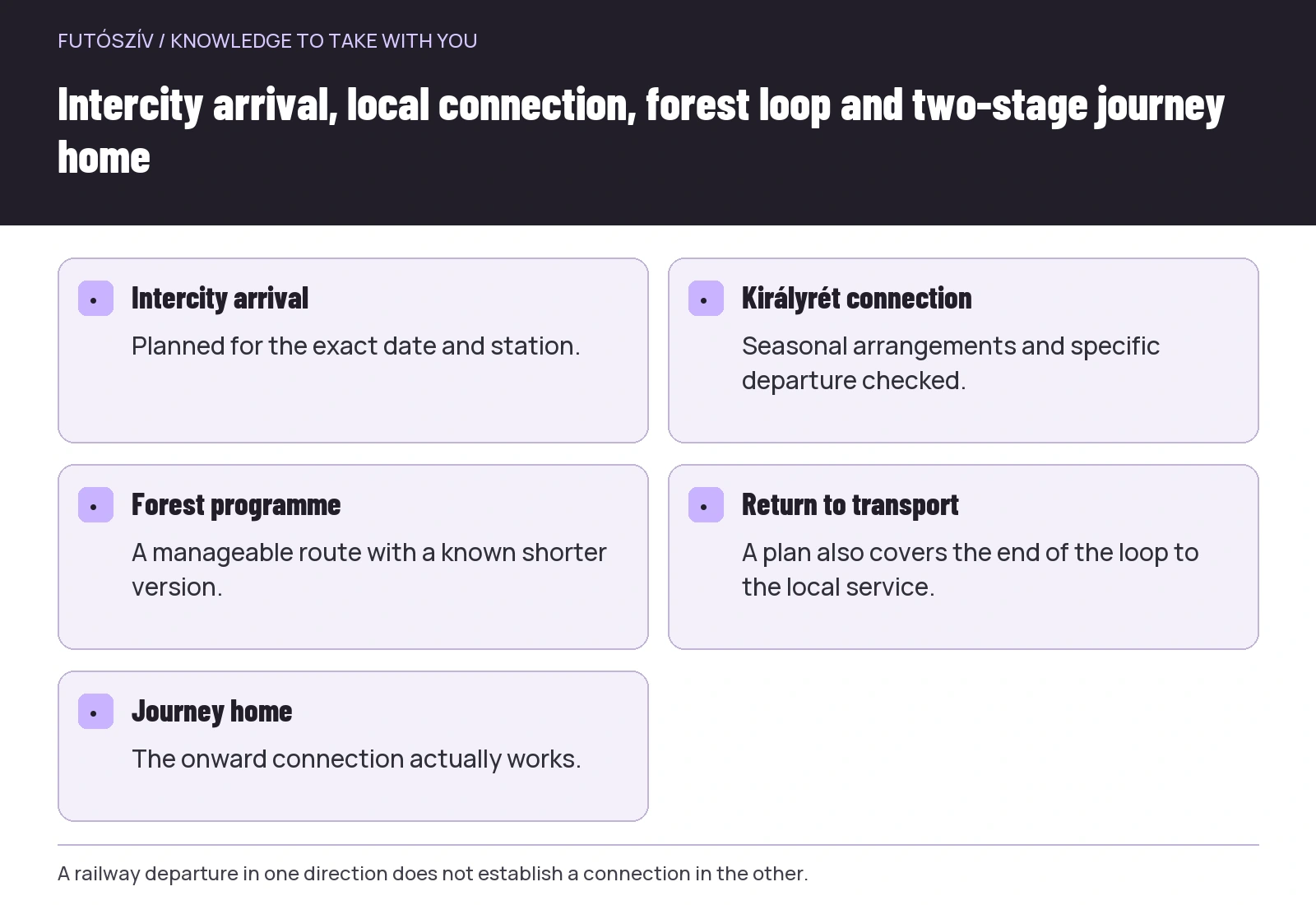 Enlarge diagram
Text version of the diagram
- Intercity arrival
- Planned for the exact date and station.
- Királyrét connection
- Seasonal arrangements and specific departure checked.
- Forest programme
- A manageable route with a known shorter version.
- Return to transport
- A plan also covers the end of the loop to the local service.
- Journey home
- The onward connection actually works.
Work backwards from the return departure to define the day
Choose a manageable connection home, then determine when the forest programme must finish. Leave room between them for finishing the loop, organising kit and reaching the departure point. There is no compulsory number of minutes for everyone: judge it according to your group, the nature of the route and the transport chain.
Transport contingency is not there to spend immediately on a later start at the beginning of the day. It is flexibility retained for uncertainties in the plan. If a delay getting there already uses it up, reassess the forest programme. Forcing the original full route unchanged while estimating an ever-faster return is not a good solution.
Two return options can help, but both must be checked. The first is your baseline choice. The second shows what is possible if the day requires a change. Do not call the timetable’s final row a backup if reaching it would require a forest return for which you have no adequate plan.
Do not choose the trail loop to fill every available minute perfectly
The route must fit the group’s experience and conditions that day. An attractive outline on a map does not answer questions about navigation points, surfaces or options to return. Review the chosen route together with official visiting conditions and recent restrictions. Do not bypass a closed section with an improvised, unfamiliar shortcut on arrival.
The Ipoly Erdő page on the Királyrét excursion centre is a useful local starting point for learning about the area. A location description, however, is not verification of your entire running route. For every part of the chosen loop, know how it connects to the next and where you can take a shorter version in a way considered beforehand.
A shorter version should mean more than fewer kilometres on a drawn line. It needs an identifiable decision point and a checked route back. If less time is available at the start of the day, selecting such a plan is easier than deciding en route where you might cut across the forest. Flexibility comes from planning, not unknown blank spaces on the map.
Shared boundaries hold a group’s day together
Among friends, travel-home needs can differ as well as speed and experience. Someone may need an earlier connection while another would stay longer. Discuss this before choosing the route. If the shared programme would threaten one person’s last available connection, do not treat a situation affecting the whole group as solely their problem.
State whether you will move together throughout or split into predetermined groups that can function independently. The promise that everyone waits for everyone is usable only if route and time allowance fit it. If splitting up, each group needs its own navigation and return plan. A route accessible on a single phone is insufficient for two groups moving independently.
Participants should know the decision points. Not everyone needs to perform the same organisational tasks, but they must understand the basics: where you start, how long the shared programme lasts, when you shorten it and where it ends. If a plan exists only in the organiser’s head, others struggle to signal changing needs in time.
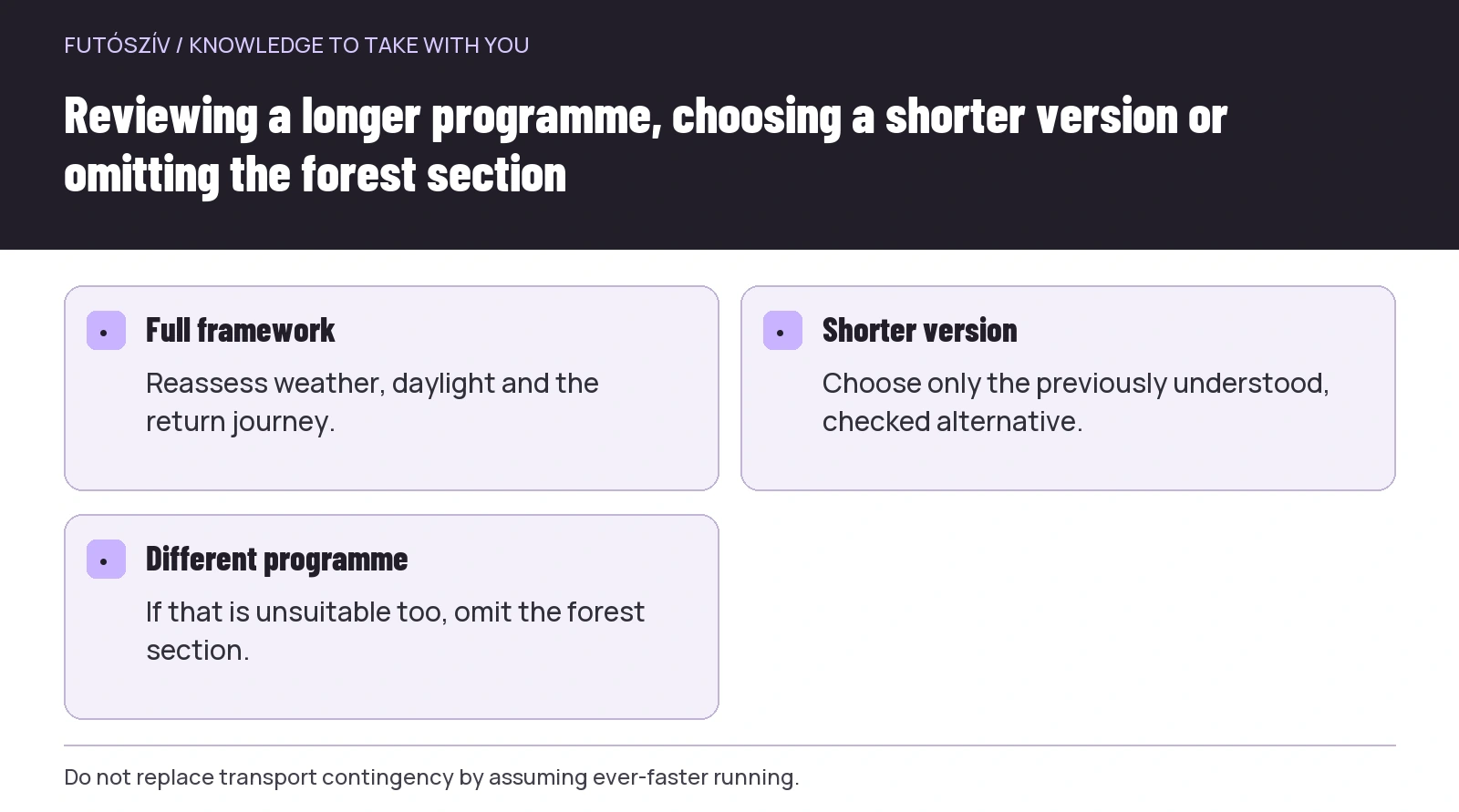 Enlarge diagram
Text version of the diagram
- Full framework
- Reassess weather, daylight and the return journey.
- Shorter version
- Choose only the previously understood, checked alternative.
- Different programme
- If that is unsuitable too, omit the forest section.
A fictional timeline: what can change if you arrive later?
Imagine a Saturday in Királyrét for which the group has prepared two forest options: a longer and a shorter one. Both lead to the same previously identified finishing point, and the trip home consists of connections checked for the travel date. This example identifies no actual route or service.
The outward connection changes, so the group would be able to start into the forest later than planned. The first question is not whether everyone can now run faster. Examine whether the longer version still fits your experience, weather, daylight window and return journey. If not, choosing the shorter version is consistent application of the plan.
If the shorter version cannot fit comfortably either, change the programme before setting off. You might choose another checked local walk or omit the forest section. Time spent on the shared journey does not oblige you to begin a programme that is no longer suitable at any cost. This decision is easier to state if you have accepted beforehand that the planned loop is conditional, not an obligation to complete it.
| What changed? | What should you check again? | What might the next decision be? |
|---|---|---|
| You arrive later | The full day’s framework and return connections. | Choose the shorter, prepared programme. |
| A designated section is unusable | The official restriction and the already known alternative. | A checked alternative or omitting the forest programme. |
| Someone must go home earlier | An independently workable return and group allocation. | A separately agreed programme if genuinely feasible. |
| A connection is unclear | The operator’s information for the specific date. | Find a verified solution instead of the uncertain connection. |
For accompanying activities, a recent notice matters more than old opening hours
If you planned a visitor attraction alongside running, check its current status separately. At the top of the official Hiúz Ház page in November 2026, a notice announced closure of the visitor centre and exhibition for renovation, with a stated timeframe until autumn 2027. General opening hours remained on the same page. In such a situation, the general schedule cannot justify promising an open exhibition.
This is a good example of why the whole page and recent notice must be read together. One part of a service may be suspended while other parts remain available by prior arrangement. For your own programme, ask about what you actually want to use. Do not treat a location’s name as simultaneously guaranteeing a waiting area, luggage storage and freely accessible indoor space.
Give non-running companions activities with known conditions too. If a building is closed, do not leave it in the plan as a convenient meeting or leisure option. The shared day becomes manageable for everyone when waiting and separate movements, as well as the running route, rest on verified information.
Transport questions associated with equipment
Consider what you will have with you throughout the day. Items needed for intercity travel, trail equipment and clothes you want to access on the return journey may be needed in different situations. For a self-organised outing, do not assume a bag-drop service that nobody has confirmed. If carrying everything, the chosen route together with your actual pack defines the real programme.
Prepare access to tickets, timetable information and maps separately. Check the validity of downloaded information too, because an old screenshot can mislead just as an old paper can. If several people need to navigate independently, do not put shared basic information only on one person’s phone. Copying information here serves usability, not unnecessary sharing of personal data.
A pre-departure check can be simple: can you access your route, identify the chosen return point and state the next step of the journey home? If only the organiser can answer, the others do not yet know the day well enough. A short shared review may prevent more misunderstandings than a long unread message.
A Királyrét planning sheet on one screen
A usable summary should include the date, arriving local connection, meeting point, chosen forest version and its shorter alternative. Add the planned return location, the checked chain of connections home and an explanation of decision boundaries. Keep sources and check times accessible too, so you know where to seek an updated answer if something changes.
At the end of the day, record a few factual observations: which transfer was comfortable, where local orientation took more work and whether the packing arrangement worked. These personal experiences help with later planning, but should not become general timetable claims. A successful Saturday connection does not mean it works identically on a winter weekday.
Transport contingency aims to preserve your choices. You can then adapt the forest day’s route to actual circumstances, and the return departure does not become a chase. Reaching Királyrét, completing a manageable programme there and travelling home in an orderly way are three parts of one connected plan.
How Futószív articles are prepared: our editorial guidelines.