Organising travel for a Lake Balaton relay team should not begin with the number of cars. First identify who has a task, when and where, then assign vehicles, drivers and luggage space. Reversing that order can leave the group attached to a plan that uses few cars on paper but tries to move too many people and too much equipment at once in reality.
This article offers a logistics method for an adult team of friends. It uses official 2027 NN Ultrabalaton team information as an example, checked on 18 November 2026. It does not provide complete race regulations, an assessment of fitness to drive or personalised running assignments. Conditions applying to your own team and vehicles need separate checks.
The team is not a group existing in just one place
The organiser’s team page identifies Balatonfüred as the centre for the event on 22–25 April 2027 and describes the larger team race as a 209-kilometre circuit. This creates a situation where team tasks are distributed over a long period and many locations. A shared entry does not mean everyone must be in the same car at every moment.
Write down the relay order and actual team tasks. Who is preparing to run, who is coming off their own leg, who drives and who has a task requiring presence in one place? Map transport needs alongside running assignments. One spreadsheet row containing only a runner’s name and kilometres is not enough for this.
Treat pre-event arrival, movements during the race and the journey home after finishing as three separate plans. The ideal passenger allocation on the outward journey may differ from that during the circuit. Not every suitcase brought from home necessarily needs to join every race-day vehicle movement either. Arrange the conditions for reorganising them beforehand, however.
Capacity is a real limit, not a negotiation
The current text of section 46 of the Hungarian Highway Code sets out basic conditions for carrying passengers; the driver counts when determining permitted numbers. When planning an adult team, start with the actual authorised seating of each vehicle. Even a short journey on the team’s behalf does not justify treating travel outside seats or overcrowded transport as a solution.
Luggage needs separate space. The same legislation’s provisions on positioning loads matter too: packing must not obstruct driving, and items must be secured. This is not a complete summary of the rules, but a planning principle that people and equipment capacity must be considered together. A seat cannot be assigned simultaneously to a passenger and a large bag.
Turn we fit into two separate questions: does every person have an appropriate place, and can every necessary item be positioned lawfully and usefully? Do not first test the car’s capacity with all the kit on departure morning. An actual packing trial reveals oversized shared items and anything inaccessible without unloading the bags.
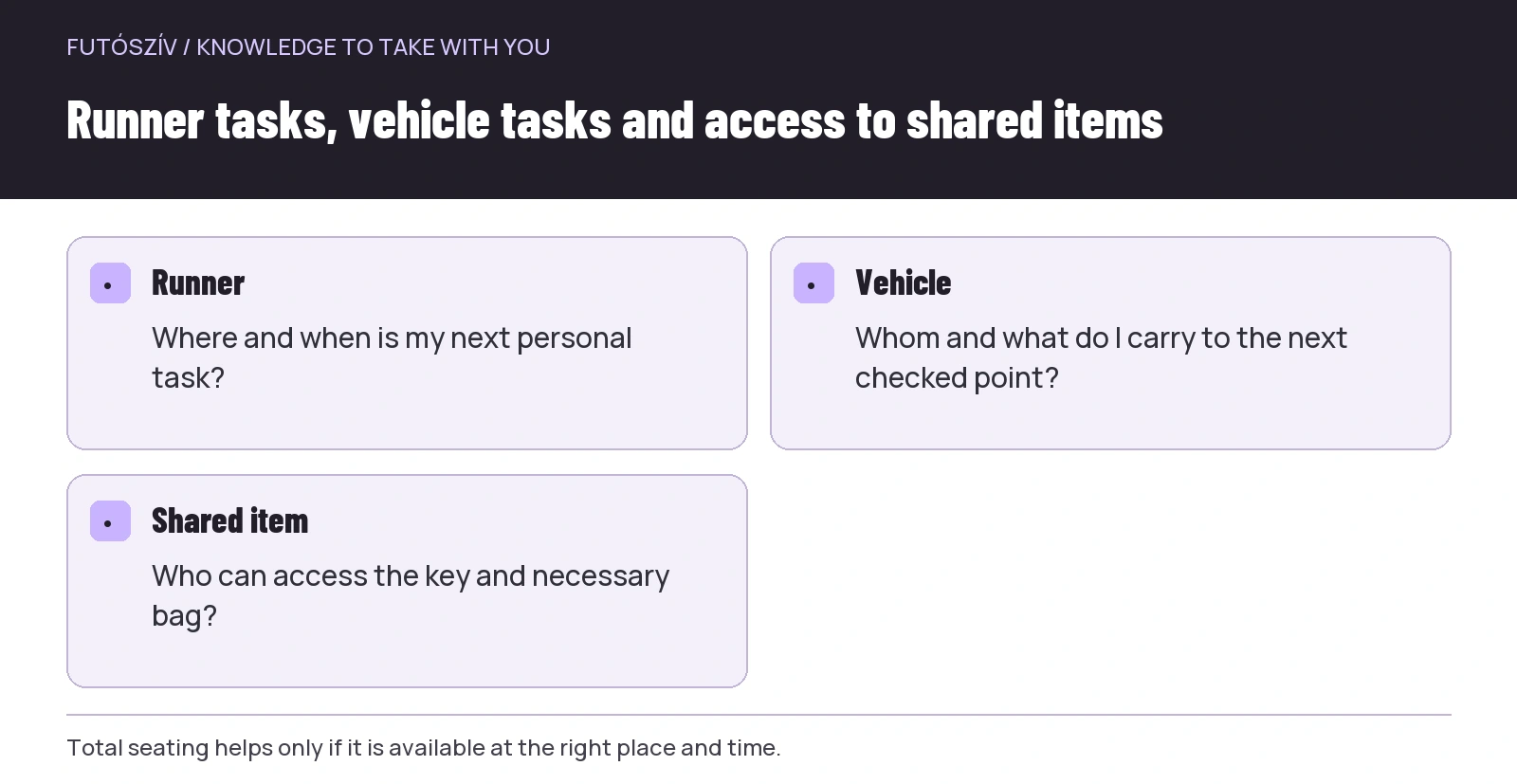 Enlarge diagram
Text version of the diagram
- Runner
- Where and when is my next personal task?
- Vehicle
- Whom and what do I carry to the next checked point?
- Shared item
- Who can access the key and necessary bag?
A support car is not a moving base travelling beside the runner
The Ultrabalaton team page specifically warns car-based supporters not to drive alongside runners on affected public-road sections. Build vehicle plans around lawfully accessible meeting and relay tasks, not continuous following of the course. Runner and car routes may differ.
At every selected point, access, stopping and walking to the actual relay location are separate questions. A road that appears close on a map may not allow entry, and an apparently empty area does not automatically become a car park. Follow organiser notices and on-site direction, checking point arrangements for your event year.
Do not assign every car a task at every relay point. If a point only needs one runner handing over and the next participant present, consider how many people actually need to travel there. Simplifying journeys comes from reducing tasks. Overcrowded cars and unnecessarily numerous vehicle movements are not the only two options.
Create vehicle groups from the tasks
Look for smaller groups whose members’ next tasks are compatible. Belonging to the same circle of friends or departing from the same home location does not necessarily make a good allocation during the race. If two people must simultaneously be at distant points, assigning them to the same car works only with a separate verified solution.
Within each group, clarify the next runner, the person handling navigation and communication, and the driver. Roles may change, but changes need an explicit agreement. Someone will drive is as much missing information as an unspecified relay point. Consider driving conditions and the person’s actual commitment separately; merely holding a licence is not a complete travel plan.
If the organiser specifies a maximum vehicle count or special support rules, these also define planning boundaries. Do not borrow a number from a previous year’s team experience or another event’s regulations. An unpublished detail must remain something to verify. Build an initial plan that can change when precise rules become known rather than treating an old system as settled fact.
Three records are worth more than one overcrowded spreadsheet
One sheet should show runners’ tasks: their own leg, required location and planned arrival connection. The second covers vehicles: who is in them, what luggage they carry and their next actual destination. The third covers shared items: keys, communal kit, collection documents and bags affecting several people.
| Record | Which question does it answer? | Which mistake does it reveal? |
|---|---|---|
| Runner task sheet | Where must I be for my next personal task? | A person is unavailable at the required location in time. |
| Vehicle task sheet | Whom and what do I carry to the next checked point? | More passengers or luggage would enter the car than is manageable. |
| Shared-item list | Who can access something another person will also need? | A key or bag remains with someone far away. |
These need not be maintained in three separate apps. Three views of a simple, legible document are enough. The point is not to hide different kinds of tasks in a large table full of kilometres and names. Someone seeking only their next collection point should find it quickly.
Reduce luggage according to when it is used
Separate personal supplies needed during the race from larger belongings associated with arrival, accommodation or the journey home. Leave something in a place only if you know how to return there later and storage conditions are clear. An accommodation room of uncertain availability is not a reliable baggage base.
Do not automatically have every car carry the same complete set of shared items. First identify where each function is needed and when the item reaches it. Equally, do not centralise essential equipment in a distant vehicle if another group needs it independently. Sensible simplification is not the same as removing access.
Let the next task determine packing order. Items needed before the next exchange should not sit at the bottom beneath the entire weekend’s luggage. Examine layout alongside safe vehicle use; convenient access does not justify improperly positioned objects. Organise bags before departure rather than unloading and restarting at every stop.
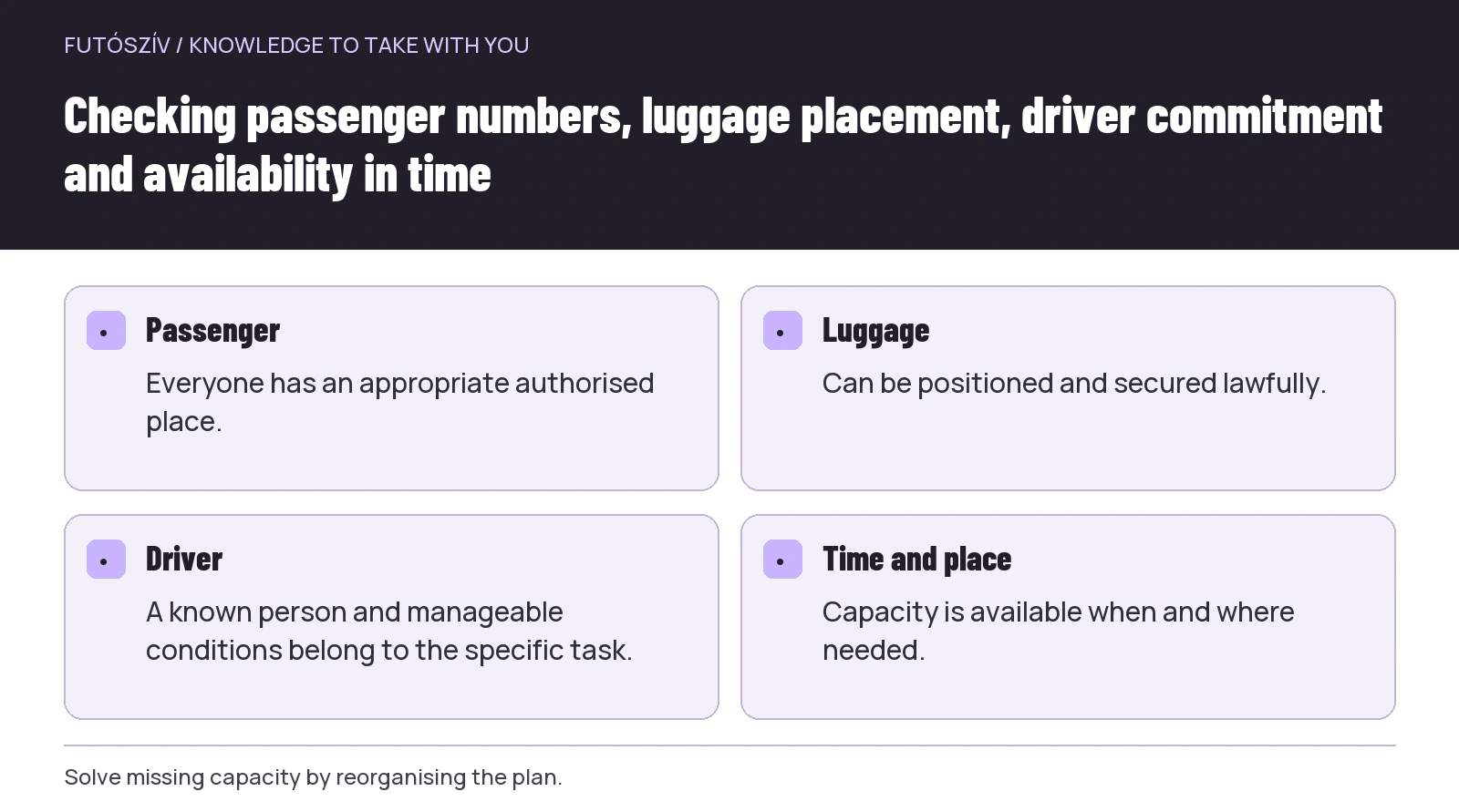 Enlarge diagram
Text version of the diagram
- Passenger
- Everyone has an appropriate authorised place.
- Luggage
- Can be positioned and secured lawfully.
- Driver
- A known person and manageable conditions belong to the specific task.
- Time and place
- Capacity is available when and where needed.
A fictional example: why is adding empty seats insufficient?
Imagine an adult team with two vehicles carrying different responsibilities. On paper, authorised seats suffice for the people currently needing transport. Before the next point, however, runners would leave one car while others return to it, and the second vehicle remains at an earlier task. At that moment the problem is not total capacity but where it is available.
Seek solutions in the sequence of movements. You could assign someone to another group beforehand, alter a manageable leg allocation within the rules or take fewer people to a particular point. Squeezing in more people just for this short journey is not a solution. Correct the logistical gap in the plan.
The same can happen with luggage. If one car holds a large bag another group soon needs, distant spare space does not help. Coordinate the object’s journey separately with people’s movements. Timing checks alongside packing and passenger lists are therefore useful: fitting somewhere is insufficient; the item must also be in the right place.
Communication should support the next decision
During a long team race, experience photos, estimates and important changes can easily become mixed in the shared conversation. Establish an identifiable way to signal an actual logistical change. A short message should state the affected person or vehicle, the changing task and whether confirmation is needed.
Do not let estimated arrival quietly become settled fact. If your runner’s time differs from expectations, reassess the next pickup or vehicle movement. The aim is not for everyone to watch the same complete spreadsheet constantly. What helps is affected people understanding the same next task and knowing who decides on a change.
Do not burden the driver with organisational messaging on the move. Assign navigation and communication while the vehicle is stationary and driving conditions are appropriate. Team organisation gives no priority over other road users. If a message can only be handled safely after stopping, the system must tolerate that too.
Plan the journey home separately from the end of the circuit
After finishing, the same people may not need to travel in the same directions as on arrival. Some stay at accommodation, others travel to another town, and someone may have joined the team earlier. Collect homeward travel needs before the weekend. Then you will not discover at the finish that too many people have counted themselves into one car.
Name drivers and manageable departure conditions separately. Do not automatically expect someone who handled many tasks during the circuit to immediately undertake the long journey home too. Being fit to drive is a basic requirement; leave room in the itinerary for decisions matching actual condition. No universally valid number of hours can specify when such a journey becomes manageable.
Check homeward luggage distribution too. Reunite personal items and keys that travelled to several places during the race before splitting in different directions. A short name-by-name check may suffice: does everyone have their belongings and the items needed for their next journey? This can prevent much later searching and extra driving.
A shared rehearsal before departure
Select a few consecutive relay exchanges from the plan and talk through who will be where. Do not merely list runners’ names: follow passengers, drivers and bags too. If two people give different answers about the same pickup, discussion is still needed. If a car would be in two places simultaneously, the plan does not work.
The aim is neither the most elaborate spreadsheet nor the fewest vehicles at any cost. Build team travel around real capacity, organiser traffic arrangements and people’s commitments. When the next task and its passenger, luggage and driver allocation are clear, organising the shared Lake Balaton circuit becomes more predictable.
How Futószív articles are prepared: our editorial guidelines.