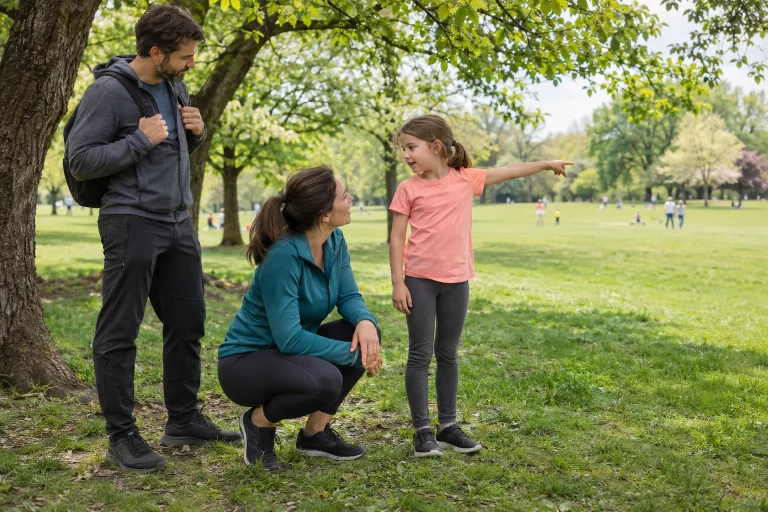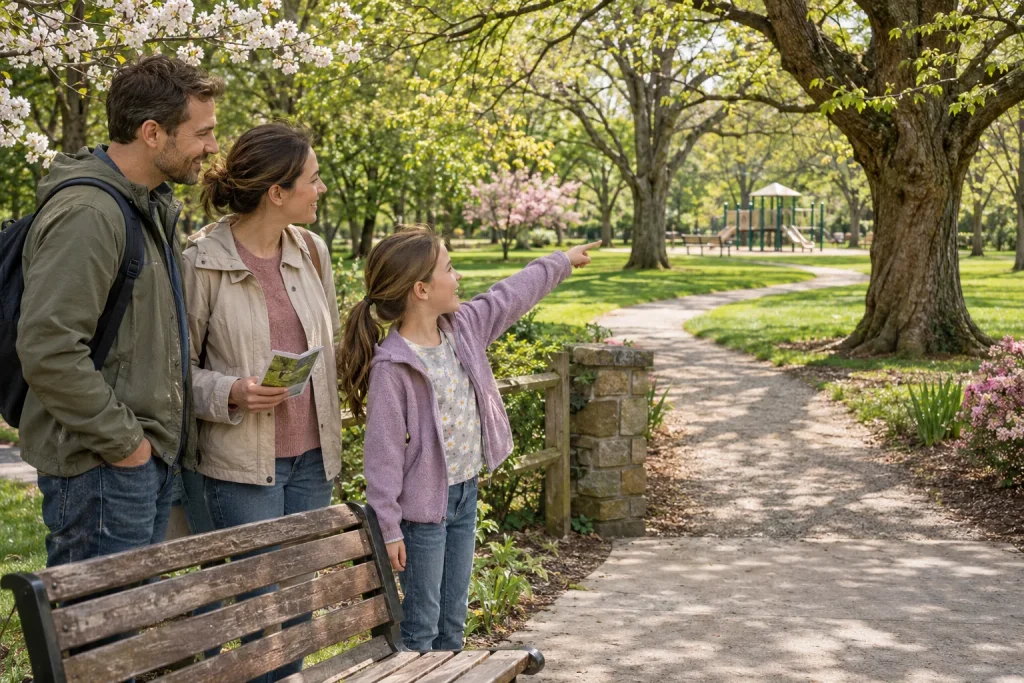
The largest park or one with the most attractions is not necessarily best for a short family activity adventure. Easy travel, a clear shared area and a straightforward journey home after a shorter programme may matter more. Running can be an optional part alongside walking, observing and playing.
Do not therefore begin choosing a place with a promise to explore the whole park. An entrance, a small explorable area and a usable shared point may provide enough framework. The following method is an original family-planning aid. Named Budapest locations illustrate official information sources, not an unchecked route or identical recommendation for every family.
Choose the programme’s size first
A short programme includes more than activity time inside the park. Travel, finding the entrance, reaching toilets and returning belong to family time too. If the park is too far for available time, you may rush throughout the visit. A nearby partly familiar place sometimes allows more real discovery than a famous park reached through complicated travel.
Discuss the day’s shared element. It might be observing a few interesting details, a short movement story or walking together beside a playground. Every available attraction need not be added. Ask about children’s interests too, offering only options fitting adults’ supervision and time commitments.
Give the programme an early enough finishing point. This is not a distance that must be completed but a structure complete even after a brief part. With interest and time remaining, another previously considered part can be added. Continuation should not become compulsory because much remains unseen on the map.
Look for practical use information on the official park page
Attractive pictures and reviews offer ideas, but find current conditions in official information from the maintainer, operator or municipality. Check maps, usage rules, access restrictions and events. The park as a whole and a playground or sports area within may operate under different arrangements.
The official Liget Budapest visiting page , for example, separately addresses family, sporting and other park uses. This reveals several functions meeting within one large park. Tie precise service locations and conditions to current official information rather than memories of an earlier visit.
The official BKM FŐKERT page on Margaret Island is another possible starting point for maintainer information. Presenting a venue does not, however, provide real-time confirmation that every gate, item or service works. Check specific details important to the family plan separately, particularly if the programme cannot happen without them.
 Enlarge diagram
Text version of the diagram
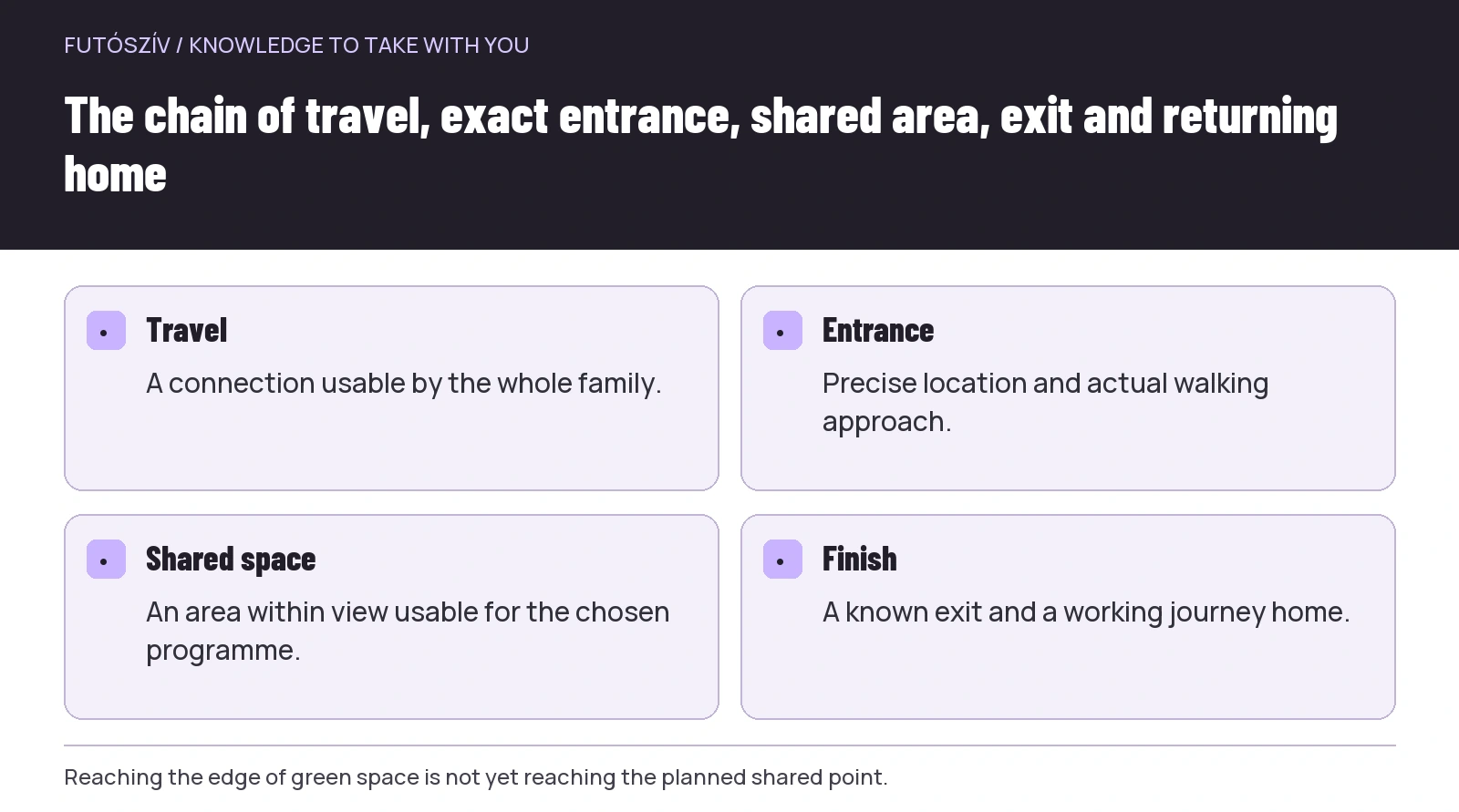
- Travel
- A connection usable by the whole family.
- Entrance
- Precise location and actual walking approach.
- Shared space
- An area within view usable for the chosen programme.
- Finish
- A known exit and a working journey home.
Check the first and last few hundred metres
Choose an actual entrance as the journey destination rather than the park name. The route from a stop or parking may be busy, involve a longer detour or stairs. Examine it from the perspective of family members moving with children. Reaching a green area’s edge on a map is not yet reaching the planned shared point.
Departure needs an equally precise connection. If finishing on another side, find the journey home from there. A nearby exit may not lead to a usable stop, and the outward service may not stop in the same place returning. In Budapest, the official BKK journey-planning information provides a starting point for the actual day and period.
The full connection particularly matters with pushchairs or mobility aids. Even beside a destination called accessible, an entrance or intervening section may be uncertain. Ask about specific characteristics of the intended route rather than a general classification. Do not assume a connection invisible in a photo is resolved.
A visible area makes a shared programme easier
Exploring does not require the family to split up. Choose an area where the adult can actually provide agreed supervision and boundaries are clear to children too. Instead of “stay nearby”, show which path and point define the shared programme. A hidden section and a connection short on the map can create a different real situation.
Examine where different users meet: pedestrians, runners, cyclists, dog walkers and others may be nearby. Your game route should not unpredictably cross busy connections. If beside a designated running loop or sports pitch, consider its usage rules too.
A brief active part does not require starting children before others or timing a competition. Playful movement from one shared point to another familiar one may suffice if consistent with local rules. Movement and participation can vary; the adult supervision task does not thereby become a playful role.
The park and playground may have separate rules
If including a playground, read its own rules. Conditions may concern age groups, accompaniment, equipment or entry. A vehicle allowed in the park may not be permitted among play equipment. Family members with dogs may likewise face differing rules in parts of the shared area.
The official Városliget Great Playground rules , for example, describe their own age and accompaniment conditions and possible partial closures for weather or technical reasons. These concern that facility, not every Hungarian playground. The example shows why information for the specific subarea also needs opening.
Explain simply to children beforehand which area serves which purpose. A running story may end before the playground entrance, followed by its own play rules. One game’s rules need not extend everywhere. On-site information and staff requests may override the programme imagined at home.
A useful comparison sheet for two parks
You can mentally review the original table below for two possible locations. No scoring is needed, and every criterion need not seek the same thing. An essential family condition should not remain uncertain merely because another park appears more spectacular.
| Question | Which specific answer should you seek? | What does it change in the programme? |
|---|---|---|
| Where do we arrive? | A precise entrance and actual approach | Length and simplicity of the outward journey |
| Where do we stay together? | A visible, usable shared area | Manageable play and supervision |
| Where can we take a break? | A place actually accessible | The ability to interrupt the programme |
| Where are the toilets? | Location, access and current conditions | The complete on-site schedule |
| Which rules apply? | Information for the park and subareas | Available movement and equipment choices |
| What is the simpler version? | A shorter loop or another programme | Handling changing conditions |
| How do we get home? | An exit and working travel connection | The day’s actual finish |
Treat missing information as a question. If toilet access matters, for example, do not write only that an icon appears on the map. Find current service arrangements. A plan grows stronger through answers to important questions, not collecting many locations beside one another.
 Enlarge diagram
Text version of the diagram
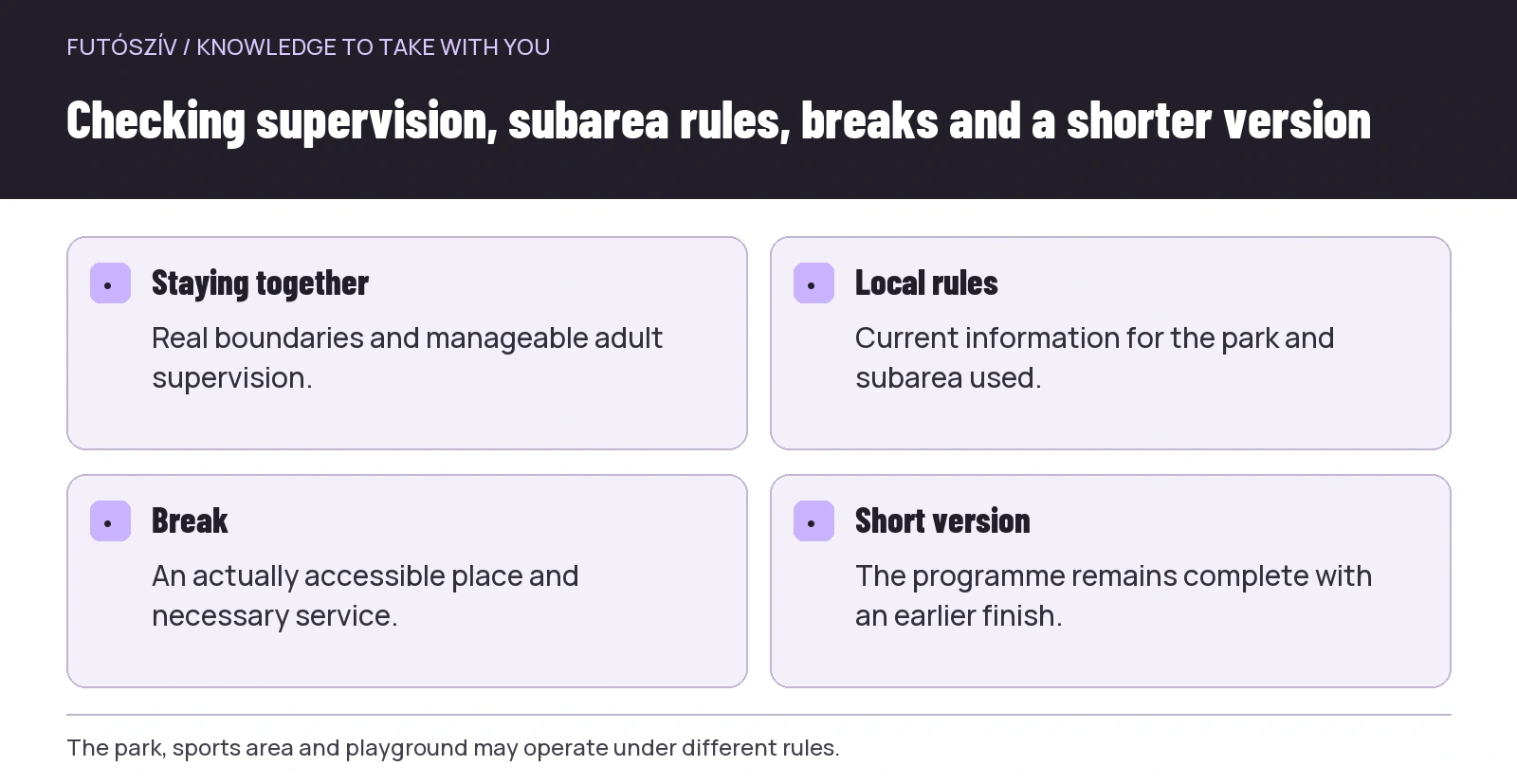
- Staying together
- Real boundaries and manageable adult supervision.
- Local rules
- Current information for the park and subarea used.
- Break
- An actually accessible place and necessary service.
- Short version
- The programme remains complete with an earlier finish.
An original fictional park programme with three stops
Imagine a nearby park whose entrance, internal paths and return connection usable by the family have been checked. The programme begins at a shared point, continues by observing an interesting building detail or statue and then offers brief play in a permitted visible area. Finally, you return to the shared point. This is not an actual Budapest route suggestion.
Children can decide what to notice during observation: shape, colour or a story-related detail. They need not collect objects or leave the shared route. For movement, the adult offers a simple framework in which walking and running are choices according to place and participants. The programme can end after a brief part too.
Now imagine an event occupies the intended play area. If the day works only there, you would need to improvise. If the short shared walk already exists as an independent programme, you need not quickly find another place for the same game. The content of discovery can change while the shared framework remains.
Observing nature is not an object-collection contest
A park is habitat and shared green space too. Family tasks should not require picking plants, handling animals or searching hiding places. You can name, draw or simply observe details. A “treasure” may be a noticed shape or invented story, not necessarily something to take away.
The Liget Budapest visiting information also asks users to respect plants and animals. Following local rules, avoid taking over planted areas or places used by others. A family photograph does not require entering areas not used for visits either. Play is no exception to venue rules.
Take props and packaging with you until appropriate disposal. Leave no object, paper, ribbon or hidden task that later becomes litter. To preserve shared observations, a memory sheet at home places less pressure on the area than a sequence of markings left on site.
Weather concerns the whole visit
Plan for travel, movement, waiting and leaving together. Surfaces and exposed or sheltered parts can differ within a park. Not every path and item can be used identically in every condition. Respect on-site closures and warnings even if expectations at home differed.
A shorter version or moving the programme to another day can be accepted beforehand. Children need not cover the whole route promised by adults because you already travelled there. Adults should assess current conditions and explain changes simply. Children’s interests are separate from usable space and local rules.
Before returning, make one simple final check: are you together, do you have all belongings and which exit will you use? An orderly finish belongs to exploring too. Leaving a venue can turn a supposedly short programme’s ending tense if considered only once you are already in a hurry.
What should you remember for next time?
Instead of a general good or bad label, record specific observations: which entrance was usable, how much area you enjoyed exploring and where breaks were actually possible. Children can describe details that interested them and what they would skip next time. Recheck changing conditions before another visit.
A short family activity adventure’s value is not how many kilometres or attractions it includes. The right venue leaves room for shared attention, chosen movement and stopping too. If arrival, used space and getting home work, a very small part of a park may suffice for an enjoyable shared session.
How Futószív articles are prepared: our editorial guidelines.