A running event does not become accessible simply because its invitation says everyone is welcome. To take part, people need to know how to reach the venue, what the route is like, whether there is a usable toilet, how the start works and whom to contact if they need an adjustment or assistance. Inclusion begins with answering these specific questions.
Disabled athletes are not a single group with identical needs. Even the same diagnosis does not mean identical movement options or communication preferences. This guide offers considerations for organising participation; health-related exercise demands and assistive-device adjustments are matters for the athlete concerned and the appropriate professional.
The first question can be simple: what do you need?
Good assistance starts with a question. Do not take hold of someone, push their wheelchair or start rearranging their equipment without discussing it. The athlete can explain which approach helps them. They also decide what language they use about themselves and how much they want to share about their condition.
Speak directly to the person concerned, even when they arrive with a companion. Do not ask the companion what the other person wants to run. If communication needs more time, a written format or another form of support, allow for it. The convenience of quick administration should not take priority over a clear, independent decision.
The CDC information on barriers to inclusion describes physical and non-physical barriers alike. Steps are a visible obstacle; a programme published only as an image, an unclear entry form or helpers’ assumptions are less obvious, but can make participation just as difficult.
Make accessibility a description, not an adjective
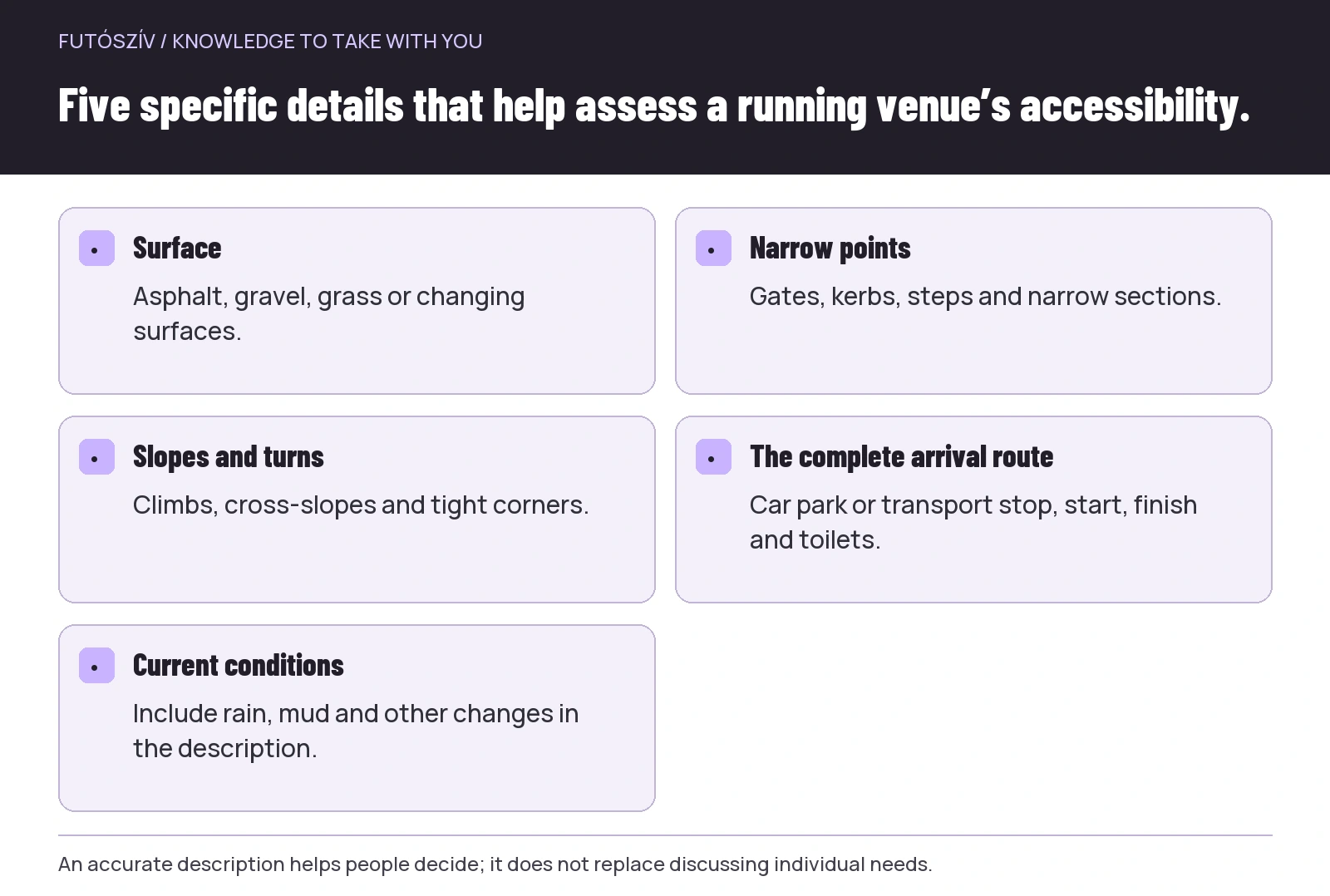
Instead of “an easy, accessible course”, provide useful details. What is the surface? Approximately how wide is the narrowest section? Is there a kerb, step, gate or climb that the map does not show clearly? The route between the start, finish and toilets is part of the venue too, not just the race course itself.
Create a short photographic or written route guide, but not only of the ideal sections. Show the difficult points too and explain where they are. An honest account of a route’s limitations enables decisions. It is much more useful than a reassuring but empty promise.
Weather can also change accessibility. Gravel that is easy to use when dry becomes a different surface in mud, while a car park on grass may become harder to use in rain. A pre-event update should say what has changed and whether there is an alternative approach. A report from last year does not establish the current conditions.
 Enlarge diagram
Text version of the illustration
- Surface
- Asphalt, gravel, grass or changing surfaces.
- Narrow points
- Gates, kerbs, steps and narrow sections.
- Slopes and turns
- Climbs, cross-slopes and tight corners.
- The complete arrival route
- Car park or transport stop, start, finish and toilets.
- Current conditions
- Include rain, mud and other changes in the description.
Review the complete chain of arrival
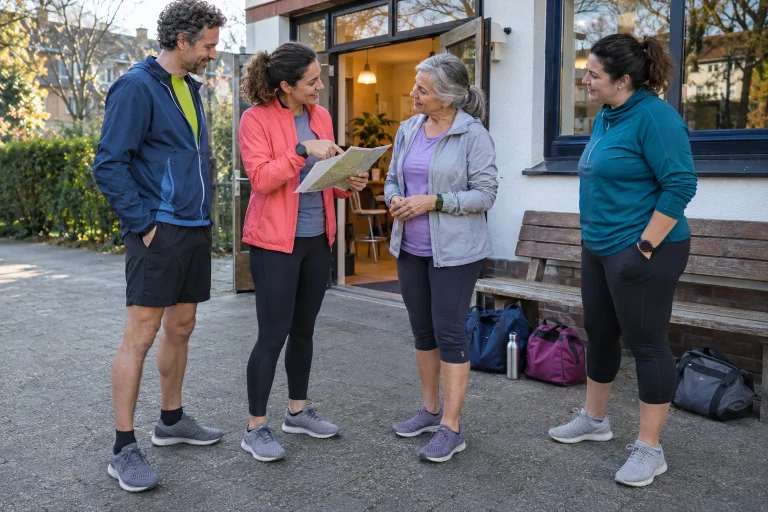
Even a good running loop in a park is not accessible to everyone if the meeting point can be reached only by steps. Think through the route from the stop or car park, through registration and on to the start. Where is there a covered or quiet waiting area? Is seating available? Does a gate work differently during the event than on ordinary days?
At the toilets, do not stop at the pictogram. Usability includes the approach, opening times, access to a key and whether event equipment blocks the entrance. If you have not checked these things, say so clearly and identify whom to ask for more detail.
A brief arrival guide in sequential order can help: access, meeting point, on-site contact, start, toilets, bag storage and departure. People then do not have to piece the information together from separate social media posts. Easily found information helps many participants, not only those who have declared an access requirement in advance.
A visually impaired runner and guide: learning to work together
Do not automatically assume that a visually impaired person sees nothing or always requires the same kind of guiding. The RunTogether guidance also draws attention to individual differences. Light, contrast, field of vision and surfaces can create different situations for different athletes.
Guide running is a distinct skill. The England Athletics course teaches communication, safety, adaptation and practical guiding. Alongside enthusiasm, learning and shared practice are therefore needed. A short online description does not replace appropriate preparation.
First discuss, in a calm setting, which side to use, the pace, how to give advance information and the signal for stopping. Do not try the chosen aid or tether for the first time during a race. Use clear words agreed beforehand; “watch out” alone often provides too little information.
On a community run, the group can also help by moving predictably, not cutting suddenly in front of the pair and allowing enough space. Choose a route suited to the guide’s tasks. A crowded start, frequent changes of direction and poorly marked obstacles are all matters worth clarifying with the organiser beforehand.
Using a wheelchair or another mobility aid
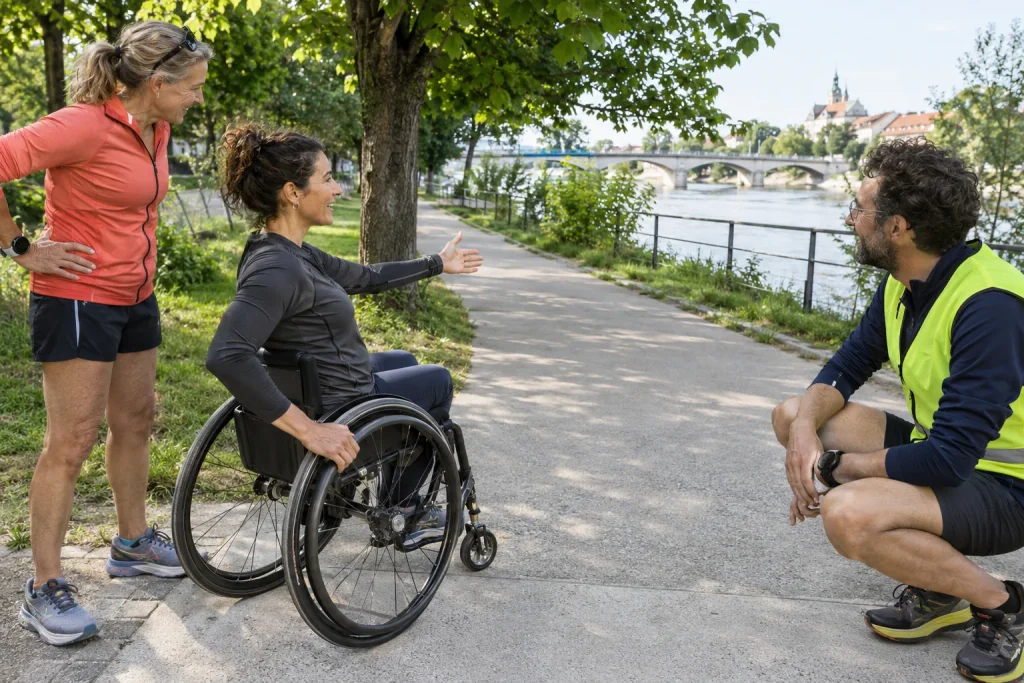
An everyday wheelchair, an active wheelchair and sport-specific equipment can involve different situations. Do not assume all participants travel at the same speed, turn within the same space or use the same surfaces. Equipment adjustment, securing and loading need knowledgeable help; the organiser’s role is accurate venue information and discussion.
Cross-slopes, gates, turns, loose gravel and the position of drainage grates may matter on a route. Distance does not describe its full difficulty. Seek feedback from a participant who uses the course with the intended equipment, but do not treat one person’s test loop as universal proof of suitability.
Before an event, clarify the entry category, starting arrangements, overtaking and the presence of any companion. Competitive sport rules and recreational event conditions can differ. Do not leave it until just before the start to discover that an event does not accept the equipment concerned or requires a different safety procedure.
For hearing impairment, important signals must not be sound only
A public address system is useful but insufficient by itself. Make the start time, route changes and safety announcements available in writing or another agreed visual form too. Before a group run, demonstrate the signals for turning and stopping, and check that everyone knows the plan.
When talking, do not cover your mouth if lip-reading helps the other person, and do not assume shouting is the answer. Ask what works. During movement, take particular care not to give an instruction when the person cannot see the speaker.
Have an easily identifiable information point in the starting area. Do not communicate a late change solely over the loudspeaker. Repeated information available through several channels helps others too, including people who happen to be at the toilets or bag storage.
 Enlarge diagram
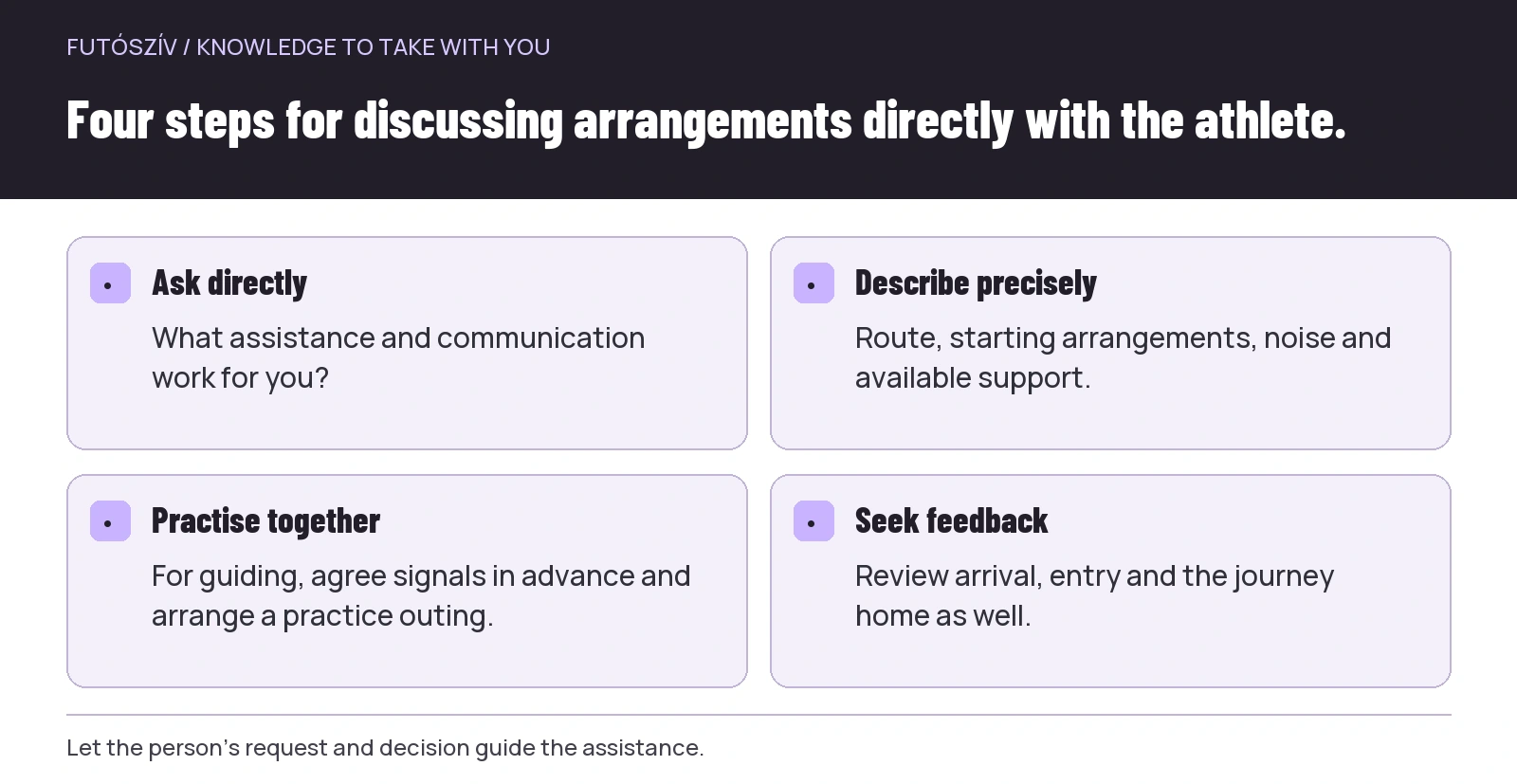
Text version of the illustration
- Ask directly
- What assistance and communication work for you?
- Describe precisely
- Route, starting arrangements, noise and available support.
- Practise together
- For guiding, agree signals in advance and arrange a practice outing.
- Seek feedback
- Review arrival, entry and the journey home as well.
Clarity, sensory demands and predictability
Learning disabilities, neurodivergence and other individual circumstances can involve very different support needs. Short, clear sentences, a sequence that can also be followed through pictures and a precise meeting point often make participation easier. Do not assume the same solution works for everyone; start with feedback from the person concerned and, where needed, their supporter.
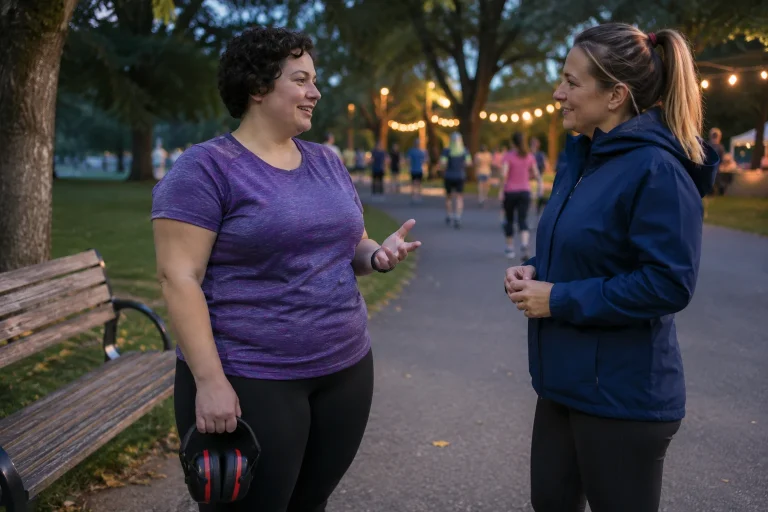
Describe in advance any expected loud music, flashing lights, crowded start or unexpected audience participation. A quieter waiting place and a clear option for leaving give practical freedom of choice. Participants should be able to decide which programme and environment they can manage.
Communicate changes simply. For example: “Because of the rain, the meeting point has moved to the covered entrance; a blue marker shows it on the map.” This is more useful than a long post full of extra information. When someone asks a question, do not challenge them about reading an earlier post; help them find the answer they need.
Health and exercise demands: personal questions, handled discreetly
According to the CDC , adults with disabilities or chronic conditions can also benefit from regular physical activity. If the full general recommendation is not achievable, activity adapted to individual abilities still counts. This does not mean that every activity is suitable in every condition.
The CDC professional guidance also highlights professionals with expertise in adapted exercise. A participant may seek an individual assessment, especially with a new sport, new equipment or changing symptoms. An organiser, however, does not need to request a public list of diagnoses to explain the course and the help available.
Ask only for information genuinely needed for participation, with a clear purpose and appropriate data handling. Do not make someone’s health information a subject of group conversation. Discuss the information needed for the safety plan with the person concerned, including who can access it.
A Hungarian starting point and a practical next step
The SUHANJ! Foundation’s own “Erőt adunk!” page presents inclusive activity programmes and participants’ experiences. It can be a starting point for exploring sporting opportunities connected with the foundation, but do not treat the campaign shown on the page as a current timetable. Discuss currently available sessions, use of SUHANJ! Fitness, participation conditions and assistance directly with the organisation.
If you are organising an inclusive run for the first time, do not promise everything in general terms at once. Assess a specific route, write accurate information, name an available contact and ask the people concerned for feedback. Build the lessons into the next outing. Accessibility is ongoing, visible work aimed at enabling an athlete to make their own decision about participation.
After a trial outing, ask separately about arrival, information and the journey home too. The loop itself may have worked well, while the entry form or approach prevented someone from reaching the start at all. That experience deserves equally serious attention.
Sources and editorial note
For the health framework for activity, we used the three CDC resources linked above; for guiding, the England Athletics and RunTogether guidance; and for Hungarian opportunities, SUHANJ!’s own information. The on-site checking questions are editorial suggestions, not accessibility certifications. Individual exercise demands and assistive devices require an appropriate professional. Sources checked: 18 November 2026.
How Futószív articles are prepared: our editorial guidelines.