Food arrangements for a night relay stage involve more than the minutes spent running in darkness. There may be waiting or rest beforehand, departure can shift and personal food may be with another helper. A workable system connects the food, access and handover to your own race plan. A general night-time menu cannot resolve a label unreadable in the dark, a forgotten pack or inaccessible storage.
This article is an organisational guide, not a night-time sports diet, sleep-deprivation programme or caffeine-use plan. It does not recommend the same meal time, portion or fuel for everyone. Clarify your own needs and health conditions within an appropriate individual plan. Event rules apply during the night stage and support activities too. The examples are fictional team situations, not observations from our own testing at a real event.
Divide the night stage into three separate states
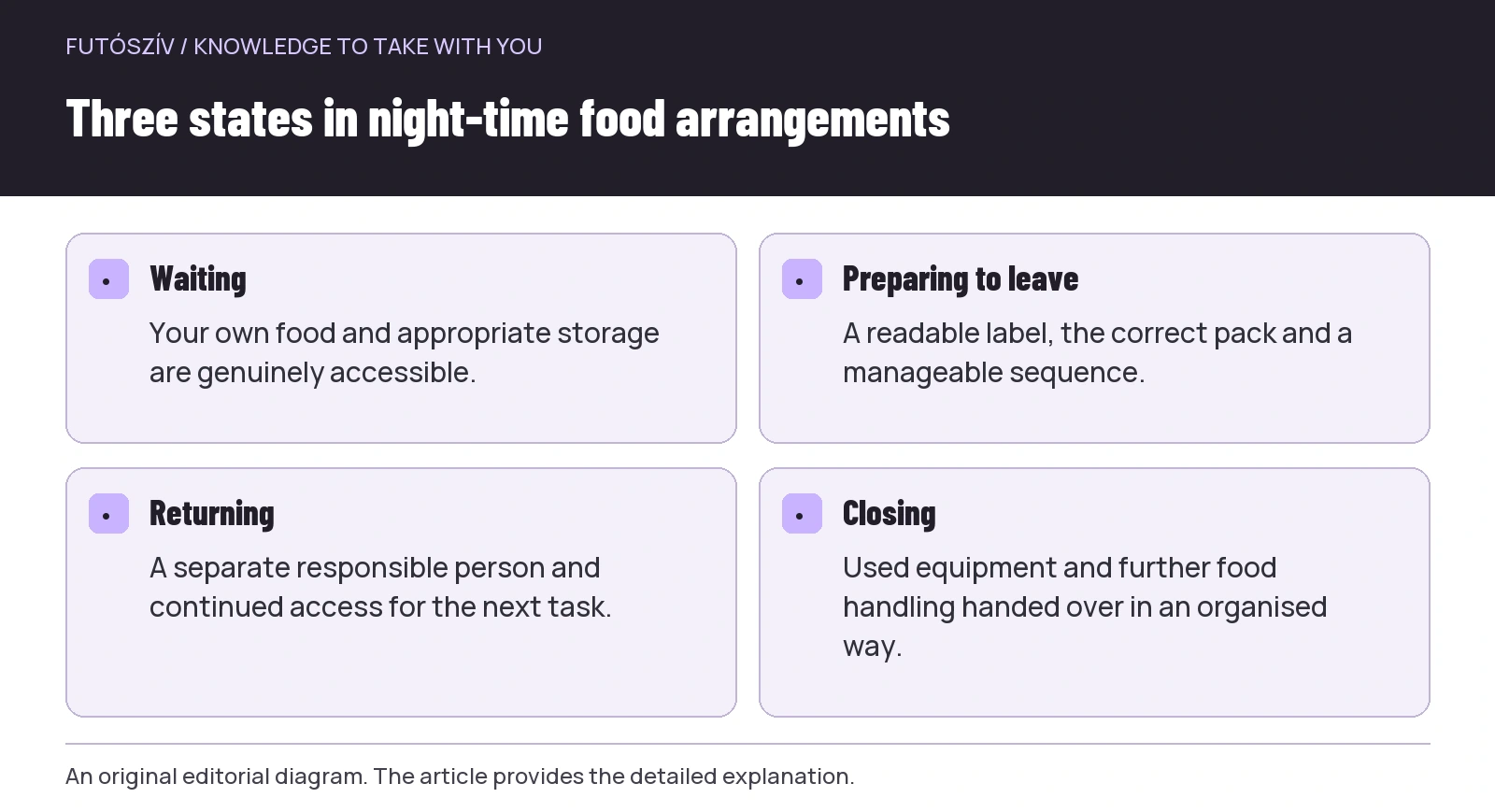
The first is waiting: you are not starting yet, but you need access to meals under your own plan and appropriate storage. The second is preparing to leave, when you organise clothing, a light, mandatory equipment and the personal pack you need. The third is returning, when another task may follow, such as rest or onward travel. The three states may involve different places and responsible people. Do not let one ‘night pack’ label conceal every distinction.
The British Dietetic Association’s sports-nutrition overview considers eating according to activity demands and individual needs, including recovery between repeated efforts. The night stage is therefore part of your whole personal race programme, not an isolated number of hours in the team spreadsheet. Practical arrangements serve to implement that individual plan. Darkness alone does not determine identical food or quantities for every runner.
Communicate readiness status alongside the time
The estimated start may change, so do not put only a clock time on the food pack. Make clear which state in your own plan it belongs to: accessible while waiting, to take at departure or to hand over after returning. This organisational label is not general advice on meal timing. It prevents a helper giving you a pack intended for the wrong occasion merely because the containers look similar.
If planned departure moves later, specify which access changes. Reassessing the personal plan is the person concerned’s task, not a random decision for the helper. The helper can accurately state where food is, its condition and when it is available. You do not need to force your eating into an old minute-by-minute schedule left on a phone. The aim is for the changing race still to provide what your own appropriate plan needs in a traceable way.
Keep labels usable in the dark simple
Use readable, well-positioned text, not a label only on the container’s base. Briefly separate the name, pack’s purpose and handling required. Add text to colour coding, because colours may not be equally distinguishable under different lighting. Do not crowd every detail onto one label in tiny letters. Keep full ingredient information traceable while providing separate quick identification with only a few details.
Try the label under the lighting you would actually use for eating or handover. This checks readability, not a running light’s performance. Avoid dazzling another participant and use light in accordance with venue rules. If a label is readable only in strong daylight, change its type size or position while still at home. Less, clearer text is better here than a detailed but barely understandable list.
 Enlarge diagram
Text version of the diagram
- Waiting
- Your own food and appropriate storage are genuinely accessible.
- Preparing to leave
- A readable label, the correct pack and a manageable sequence.
- Returning
- A separate responsible person and continued access for the next task.
- Closing
- Used equipment and further food handling handed over in an organised way.
Do not bury personal food inside the rest kit
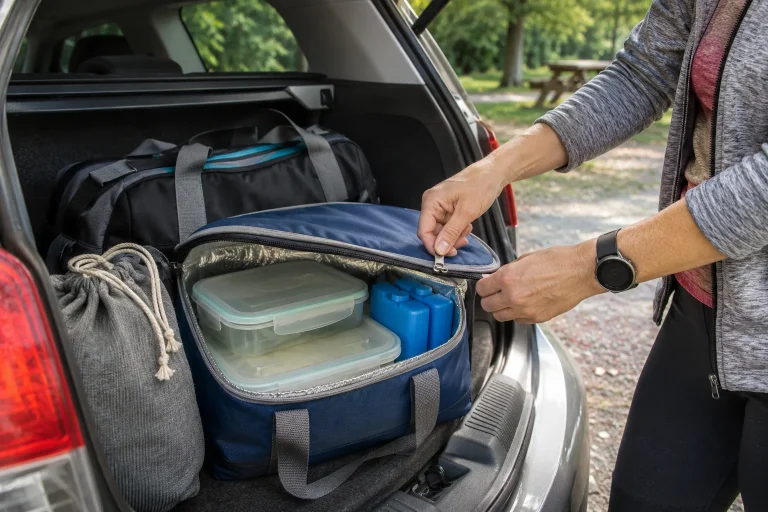
Identify beforehand which compartment holds the food and drink currently needed. If everything is beneath a sleeping bag or spare clothing, retrieving it can wake people resting around you and slow preparation. Appropriate storage conditions must still remain in place. Easier access does not justify simply putting chilled food into a convenient pocket. Arrange the pack’s physical location and handling needs together.
If you have two personal bottles, make their contents separately recognisable too. Water in one and the drink in your individual plan in the other should not be identified only by remembering the cap. Helpers should not add or mix anything on their own initiative. Make the request precise: which item, for which task and according to which instructions? A short clarification preventing the wrong handover is better than declaring an unknown mixture usable afterwards.
Agree arrangements connected with rest beforehand
If you rest while waiting, agree who will alert you and how when it is time to prepare under the current circumstances. This should concern more than the running start: allow time for access needed for your own preparations and eating plan too. A helper should not estimate your preparation needs for you. Make the agreement easy to recall and communicate changes through the same channel as the original arrangements.
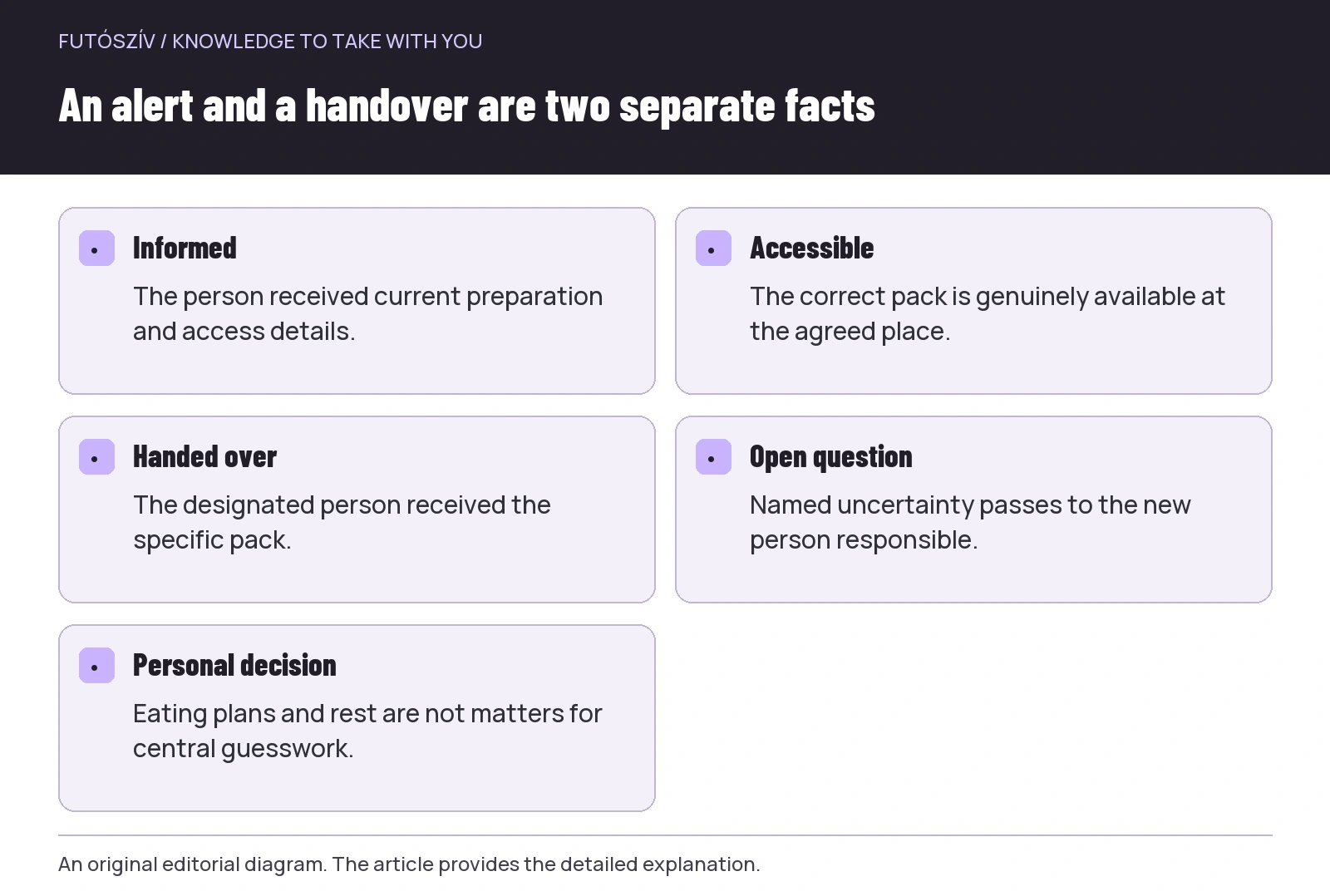
Distinguish acknowledging a wake-up or preparation alert from receiving the pack. Waking and reading a message does not automatically mean the food is with you. The helper’s sheet can record two short statuses: person informed, and required pack accessible or handed over. There is no need to centrally monitor actual consumption. The system prevents information and access failures while leaving personal eating decisions with you.
Night-time cold is not automatic food refrigeration
The food-safety guide from Nébih also emphasises appropriate refrigeration and a refrigerator range of 0–5 degrees Celsius checked with a thermometer. A particular food’s own storage instructions may specify different details that must be followed. Cool outdoor air, a car boot or a supposedly shaded spot is not, by itself, verified storage. The full path from evening preparation through waiting to early-morning use matters.
Taking food out and putting it back does not start a new handling history. If several helpers take turns, pass on the relevant time and actual condition too. Do not give the pack a new date merely because another person received it. If when and under what conditions it was stored are unknown, switch to the necessary alternative. Night organisation is meant to reduce rushing, not excuse inappropriate handling.
Hot food and drink add another task
If a hot dish appears in your own plan or event offerings, clarify access and necessary equipment beforehand. Handle food in an appropriate place according to its own instructions and the provider’s arrangements. Do not improvise heating inside an enclosed vehicle cabin or using unsuitable equipment. A portable device merely existing does not mean it can be used in that car park or venue. Follow event rules and manufacturer instructions too.
Check the cup or container’s temperature suitability as well. Not every soft flask, container or hydration reservoir is suitable for hot liquid. Manufacturer-permitted use and safe consumption are separate conditions. Especially in darkness, the first sip should not be how you identify the contents. Helpers should explain exactly what they are handing over and should not unknowingly transfer personal food or drink into another bottle previously serving a different purpose.
| Night-time moment | Brief check | What remains a personal decision? |
|---|---|---|
| Waiting | Where and in what condition is your own pack available? | Following an appropriate individual eating plan |
| A changed time estimate | Has everyone concerned received the current access information? | Any necessary reassessment of personal timing |
| Preparing to leave | Is the label readable and the right bottle to hand? | The product and quantity in your own plan |
| Returning | Who will hand over the next pack, and where? | Individual conditions for eating, rest and subsequent activities |
 Enlarge diagram
Text version of the diagram
- Informed
- The person received current preparation and access details.
- Accessible
- The correct pack is genuinely available at the agreed place.
- Handed over
- The designated person received the specific pack.
- Open question
- Named uncertainty passes to the new person responsible.
- Personal decision
- Eating plans and rest are not matters for central guesswork.
Eating should require few actions at once
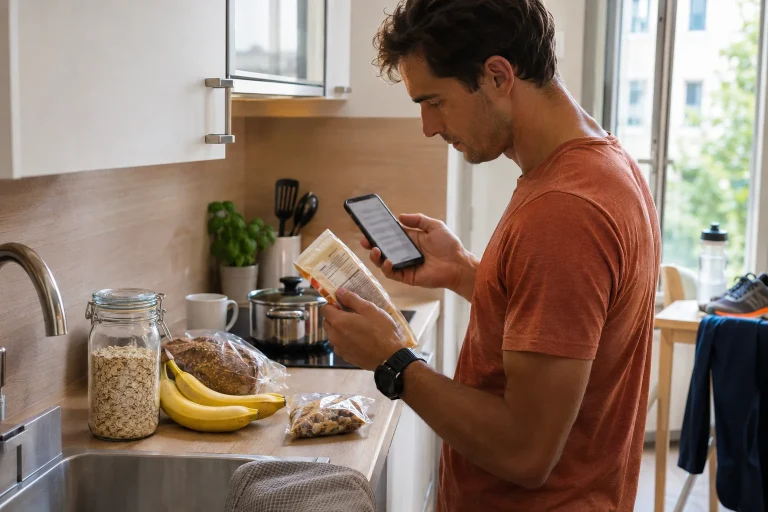
Try using familiar food’s packaging in the dark in a calm place too. How many lids need removing? Does anything need cutting, pouring or separate mixing? Where will used utensils go? A multi-part arrangement comfortable at home can be awkward at a night stop. Adapt packaging and food format to keep it manageable while preserving personal suitability. This is an access trial, not proof that the food suits any night-time physical demand.
Packaging should not demand so much attention that the exchange or equipment check becomes hard to follow. Put tasks in sequence: eat in a suitable place, pack away neatly, then make the departure check. Do not try to squeeze the time your own plan needs into one frantic minute. Tell the team this beforehand. Good organisation is flexible because necessary actions have a real place, not because everything happens at once.
A caffeine label is not proof of fitness to drive
If your own plan includes food or drink containing caffeine, identify it precisely and clarify individual use appropriately. This article does not give an amount to add or a timing recipe. Helpers should not put it unnoticed into someone’s drink, and a new product should not be judged only by flavour or package colour. Keep the personal plan and ingredient information intact within shared pack handling too.
According to the US National Highway Traffic Safety Administration, NHTSA, coffee or an energy drink alone is not a reliable solution to drowsy driving. Arrange safe travel for a tired team member or helper separately. Eating or drinking does not establish fitness to drive. Someone who is drowsy should not continue driving to preserve the team schedule; appropriate rest, another fit driver or another safe solution is needed.
On return, look beyond the runner setting off
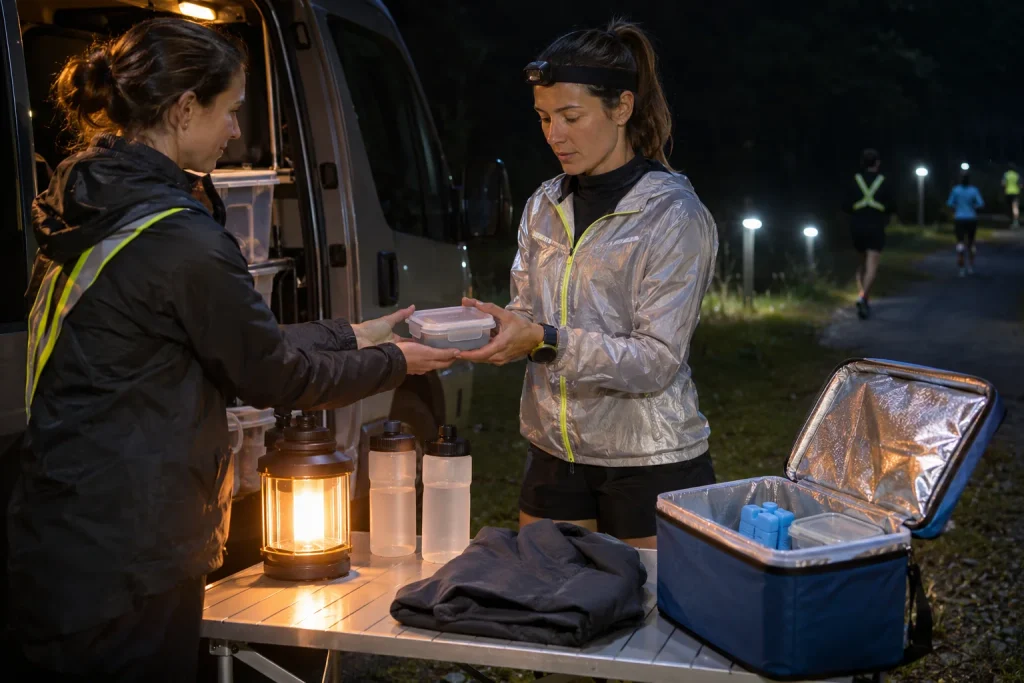
After the exchange, the next runner is on the course, but the previous runner still needs access to their own equipment and food. The car leaving quickly should not automatically take their pack away. Have a named meeting and responsible person who knows what they are handing over and what stays with them. The finishing runner should not have to call every team phone to locate their container. Returning is a separate stage of the system.
If the personal plan calls for rest afterwards, arrange the necessary access too. Keep used and ready-to-use equipment separate, and handle opened food further according to its known condition. Do not leave unnamed leftovers stored uncertainly beside the rest area for a later wake-up. Closing the night-time cycle shapes the next occasion’s arrangements too, not just packing before departure.
Pass open questions on when helpers change
Do more than show the new responsible person the containers. Explain which runner has already been informed, which pack handover remains and what changed from the original plan. Do not conceal uncertainty behind a general ‘everything’s there’. A brief, precise handover makes the next person’s work easier, especially if the previous helper is also going to rest and will not be immediately available for a while.
The following day, the team should examine which night-time task became difficult: an unreadable label, a pack in the wrong place or unclear handover status? Target the next improvement at that issue. Night relay food arrangements work when food suitable for the personal plan remains recognisable in darkness, accessible, appropriately handled and precisely transferable. Less guesswork leaves more calm for running and necessary rest.
Sources and further reading
- British Dietetic Association: Sport and exercise
- Nébih: Preventing foodborne illness
- NHTSA: Drowsy Driving
How Futószív articles are prepared: our editorial guidelines.