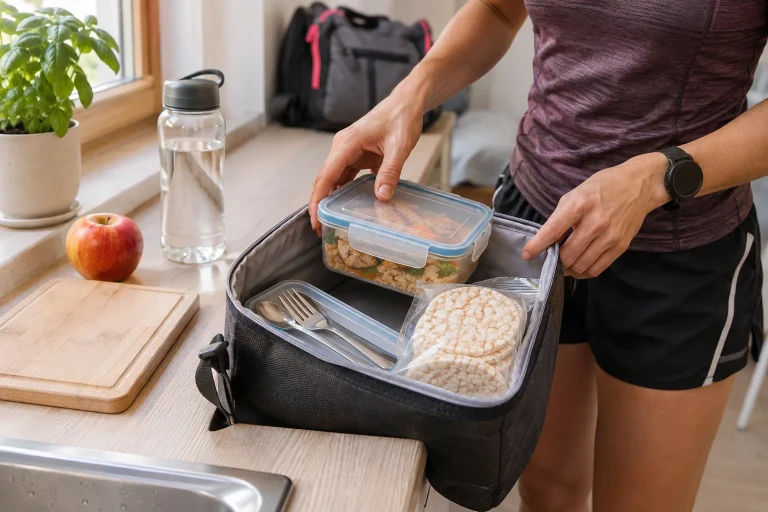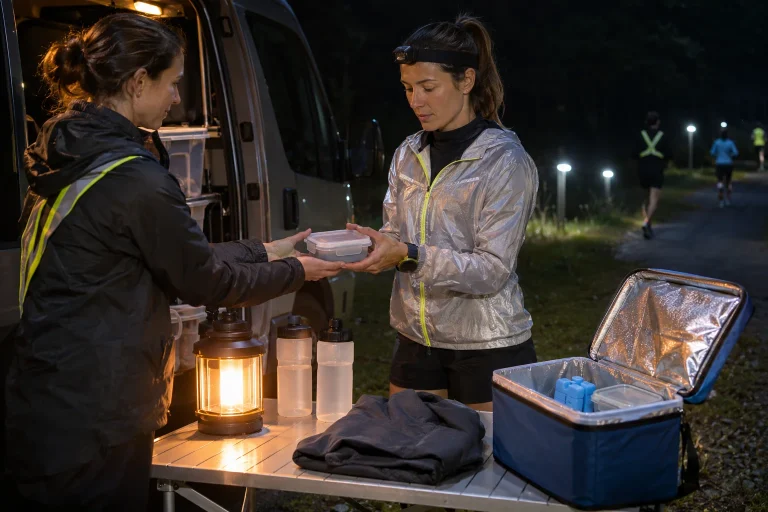
Before a running race abroad, you do not need to rule out every local food in advance, but you do need to think through how to provide your own familiar meals. Shop opening times, food names, package sizes and accommodation equipment may differ. Good preparation addresses these specific differences. It does not judge an entire country’s cuisine; it establishes where, when and under what conditions food and drink appropriate to your personal plan are available.
This guide concerns organising food while travelling. It is not a personalised race diet or guidance on food-import and allergen laws applicable to every country. Check the rules for your particular route and date through official sources. With an illness, food allergy or prescribed diet, personal requirements still apply abroad; routes and services should accommodate them. We do not suggest unjustified exclusion of food groups or independently starting an elimination diet without symptoms.
Describe the meal’s function before its familiar name
The exact brand you buy at home may be unavailable while a similar meal suited to your personal plan remains entirely feasible. Identify the occasion: dinner on arrival, race morning, a meal during travel or access after finishing? Alongside the familiar food’s name, record the ingredients and preparation conditions important to you. Evaluate a substitute against those rather than the similarity of its outer packaging.
The NSW Institute of Sport’s travel information emphasises planning ahead in unfamiliar surroundings and choosing options similar to familiar meals close to competition. This is not a general ban on every unfamiliar flavour. For your own preparation, it means not basing an important race meal on an unresolved experiment. Exploring local food culture and maintaining your personal race routine may serve different roles during the trip.
Map local access
Saving two restaurants near the accommodation is not enough. Check when you arrive, when you can shop and how you will get from the shop to where you are staying. Sunday or public-holiday opening may differ from weekdays. Race-pack collection and the start may be in another part of the city. Assign meals to the actual route in your plan rather than placing every task in the neighbourhood that looks most attractive on the map.
You can mark three points: the first suitable shopping or eating opportunity, a backup meeting your own conditions and the next access after finishing. For each, include the source of opening hours and when you checked them. You do not need to map the whole city’s offerings. A focused list works if it provides a clear next step when something changes. Twenty places without times or ingredient information are harder to use after a tiring arrival.
A local product name is not an ingredients list
A familiar pastry or soup name may refer to a different recipe abroad. For packaged products, read the full label, paying separate attention to ingredients and the quantity on which figures are based. Similar branding colours or the same main ingredient as at home do not prove complete identity. An earlier product record cannot automatically be transferred to a new local version. Identify information relevant to your personal conditions from the actual package.
A translation app can help you find your way, but an uncertain or incorrectly recognised word does not become reliable information. Keep the original label readable and ask an appropriate person to clarify if needed. If essential allergy information is unclear, do not base the eating decision solely on recognition of a blurred image. Treat unknown information as unknown. A suitable alternative gives real flexibility precisely in such situations.
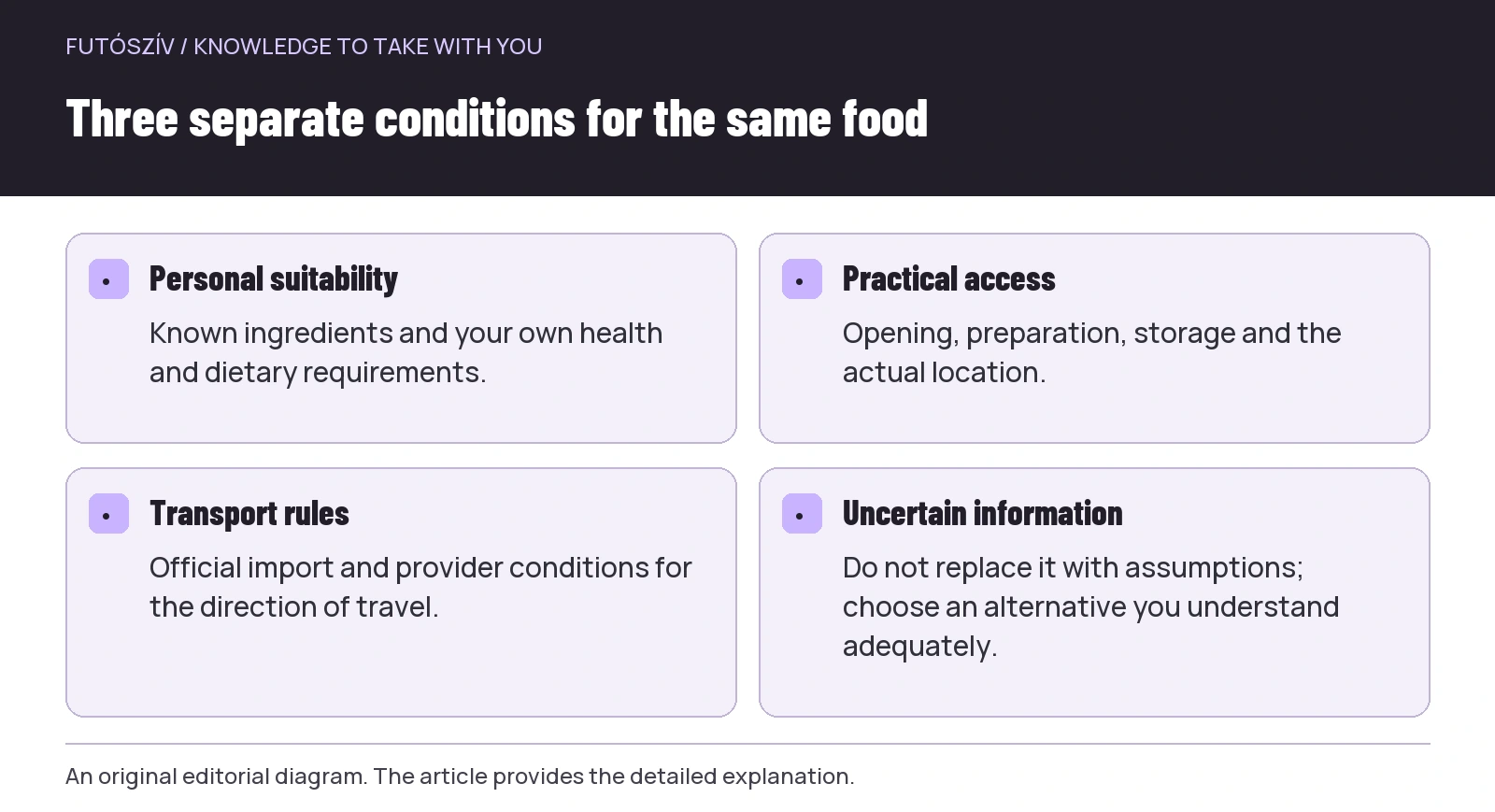 Enlarge diagram
Text version of the diagram
- Personal suitability
- Known ingredients and your own health and dietary requirements.
- Practical access
- Opening, preparation, storage and the actual location.
- Transport rules
- Official import and provider conditions for the direction of travel.
- Uncertain information
- Do not replace it with assumptions; choose an alternative you understand adequately.
Understand the geographical scope of allergen labelling too
The European Commission’s allergen information also explains the fourteen allergen groups requiring declaration in the EU, highlighted ingredients and statements about possible accidental presence. This concerns the EU framework, not an identical system in every foreign country. For a destination outside the EU, understand the local official rules and specific product information separately. The absence of familiar typography does not automatically imply an ingredient is absent.
For catering, you may need preparation information beyond the dish’s name. The venue can explain its ingredients, utensils and feasible modifications. Do not infer them from a similar-looking plate at the next table. If staff cannot give a reliable answer, do not replace it with your own confident translation. A decision under your personal health and eating plan needs adequately understood conditions, not a yes negotiated at any cost.
Build a short language card from concrete questions
The card should state the necessary condition accurately in the local language or one the provider understands, with separate questions about ingredients and contact during preparation. For medically necessary avoidance, it matters that this does not sound like a preference. Have the translation appropriately checked if it is critical to your health. The card supports discussion; it does not establish a dish’s safety by itself.
Simple organisational questions might be ‘When can I collect the breakfast arranged in advance?’ or ‘Who can give an accurate answer about all the ingredients in this food?’ These are shorter and easier to clarify than a long account of the whole race weekend. Check the answer back too: do you mean the same food, day and format? Good language support makes information more accurate rather than hiding details not yet understood.
Check the route’s rules for supplies you bring
The official Your Europe information addresses carrying food within the EU separately from entering the EU from outside. It also notes possible local restrictions related to animal or plant disease. For your own pack, check the direction of travel, product type and current rule together. Intended personal consumption does not mean unlimited import permission at every border.
Consider more than the outward journey. Connections, an intermediate country and leftovers brought home may introduce different conditions. Airport security restrictions, a carrier’s baggage terms and bringing food across a border can be separate sets of rules. A permitted bag size does not establish permission to import its food contents. Before the particular trip, consult the relevant official authority and provider information; do not treat a friend’s old experience in another country as general permission.
Do not carry large supplies of uncertain condition to the border
Lawful transport and appropriate handling of food are separate conditions. Even if a product is permitted on the route, its own storage instructions must still be met. Long travel, waiting for accommodation and local transport all belong to the full time window. If the required refrigeration or another condition cannot be ensured, choose another suitable solution. Insisting on familiar food should not make handling untraceable.
Supplies you bring should primarily address identified gaps in access. You may need to cover the first evening’s arrival, a specific personal requirement or familiar fuel during the race. You do not necessarily need to bring every meal for the whole trip from home. An appropriate combination of local purchases and your own backup can be simpler when both sets of conditions are clear. Let actual use and personal needs guide the decision.
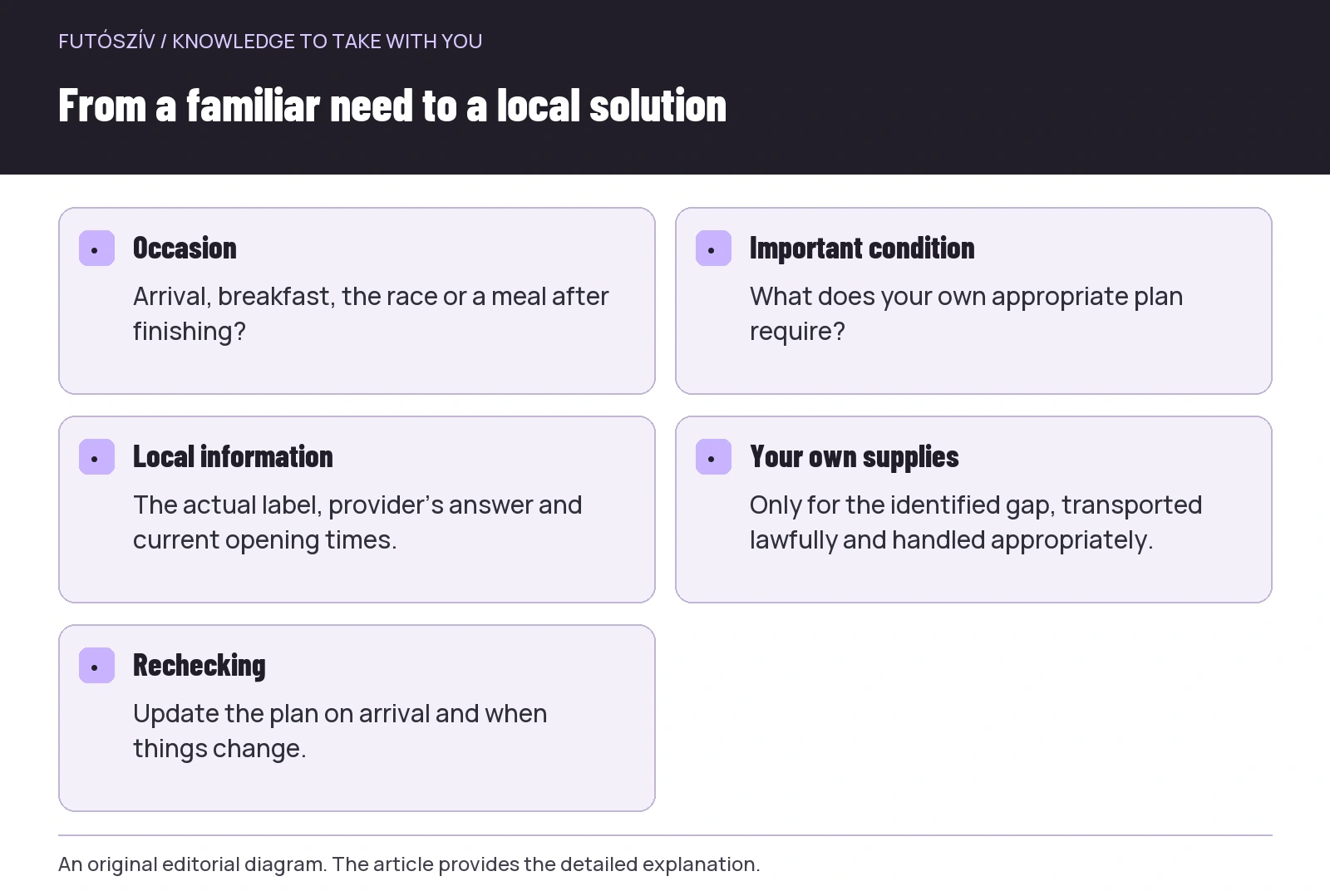 Enlarge diagram
Text version of the diagram
- Occasion
- Arrival, breakfast, the race or a meal after finishing?
- Important condition
- What does your own appropriate plan require?
- Local information
- The actual label, provider’s answer and current opening times.
- Your own supplies
- Only for the identified gap, transported lawfully and handled appropriately.
- Rechecking
- Update the plan on arrival and when things change.
Do not imagine accommodation equipment in place of checking the photograph
If you expect to prepare your own food, ask which cookware, storage and usable appliances are provided. The term kitchenette may be insufficient for your chosen recipe. Refrigeration, a clean preparation surface and washing-up facilities are separate tasks too. Use appliances only as intended and follow the accommodation’s rules. You need a backup workable in the real setting, not only in your kitchen at home.
Confirm the arrangement on arrival while another option is still available. Discovering in the evening that suitable storage is missing or the kitchen closes at a different time can affect the following morning’s breakfast too. Present the necessary information to the accommodation as a concrete question. You are not asking for an opinion on your whole sports diet, but whether the task and condition you identify can be met. An uncertain answer should remain an open question on your own list.
| Difference from the home routine | Specific check | Direction of the solution |
|---|---|---|
| Different product name or recipe | The actual ingredients and quantity basis | A familiar alternative matching your personal requirement |
| Different opening hours | Arrival day, public holiday and actual food service | The first meal arranged beforehand or another means of access |
| Language uncertainty | An adequately understood wording of the decisive question | Checked language assistance and precise follow-up questions |
| Transporting your own food | Direction of travel, authority and provider conditions | Only supplies that can be transported and handled appropriately |
| Unknown accommodation equipment | Specific storage and preparation facilities | A meal suited to the real kitchen |
Search local options according to your own criteria
In a shop, first find the elements needed for the particular eating task. You are then not trying to construct a new race diet from the entire shelving system. Read the package size and storage instructions too: a local product may be a larger portion or need different handling after opening. If staying several days, buy only quantities you will actually use and have suitable storage for. A favourable package price does not justify uncertain leftovers.
Even with apparently familiar food, check whether it is ready to eat or needs further preparation. The package photograph is not a set of instructions. If you lack the equipment or time at your accommodation, the product is not a good solution for your weekend even if its ingredients would otherwise fit your plan. By the end of shopping, know which food will become an actual meal and when. This is the best check that local purchasing genuinely solved a task.
Treat race services separately from the city’s offerings
Alongside restaurants and shops, review the event’s own aid-station arrangements, conditions for personal supplies and post-finish provision. If a supplied product’s ingredients matter to your own plan, start from current organiser information. The previous year’s sponsor list may not match this year’s station contents. Check the particular event’s required labelling and drop-off time for personal refreshments too.
Your language card can also contain short organisational questions: where to find your own bag, whom to approach at a station or where designated help is available. Keep these separate from questions about ingredient suitability. A nearby place on the map may be prohibited or inaccessible for personal assistance during the race, so know the published rules. Good preparation arranges access and permitted use together.
Review leftovers again before returning home
Do not automatically decide to bring unused products back. First check appropriate condition, further storage possibilities and official conditions for the return journey. Unnamed supplies transferred into your own packaging are harder to identify, so retain accurate information throughout. Every travel decision need not remain tied to your pre-departure idea if circumstances have changed. Adjust using current information.
Preparing food arrangements for a race abroad works when it turns an unknown into a specific question. You know which task your own supplies address, what you will buy locally, how you will understand the label and provider’s answer, and where official rules need checking. Your personal requirements remain in place while you adapt flexibly to local surroundings. A considered trip is built on a few appropriately arranged meals rather than a general blacklist.
Sources and further reading
- NSW Institute of Sport: Trips and travel
- European Commission: Allergies – allergen information in the EU
- Your Europe: Taking animal products, food or plants with you
How Futószív articles are prepared: our editorial guidelines.