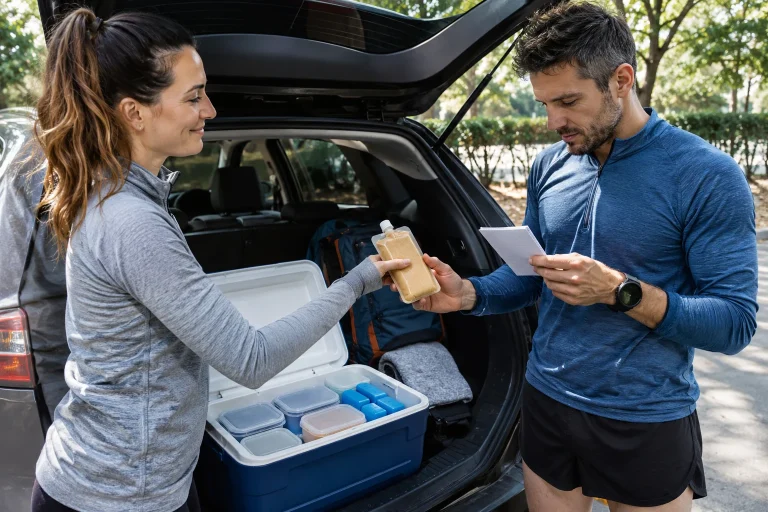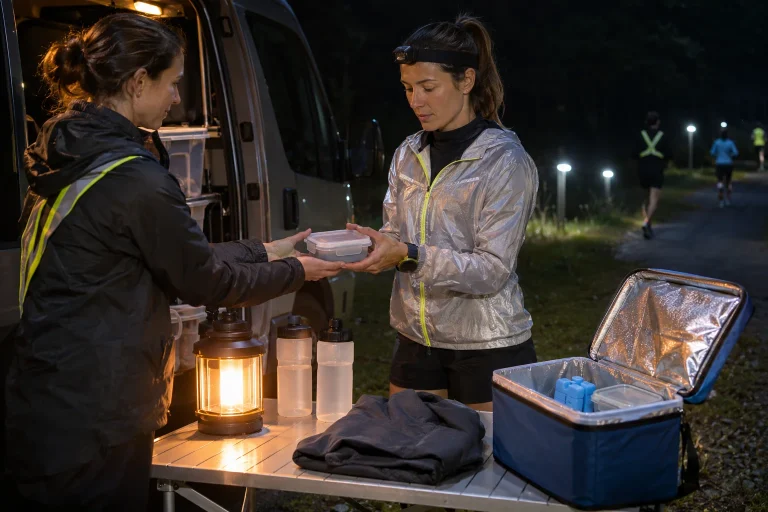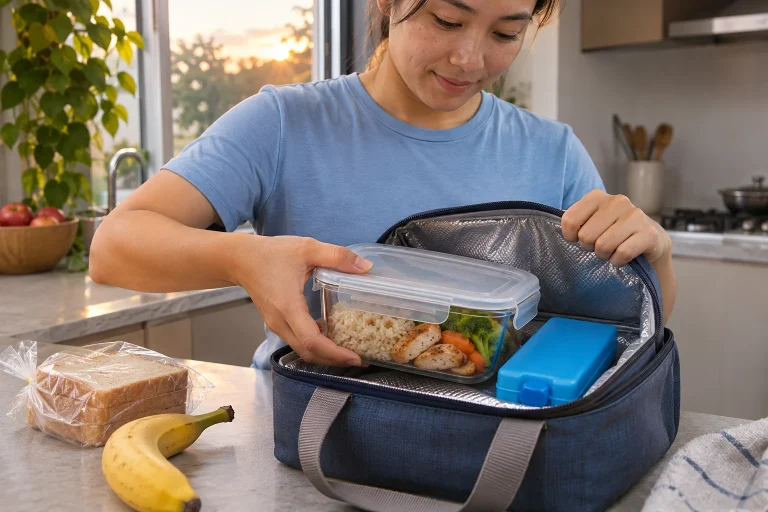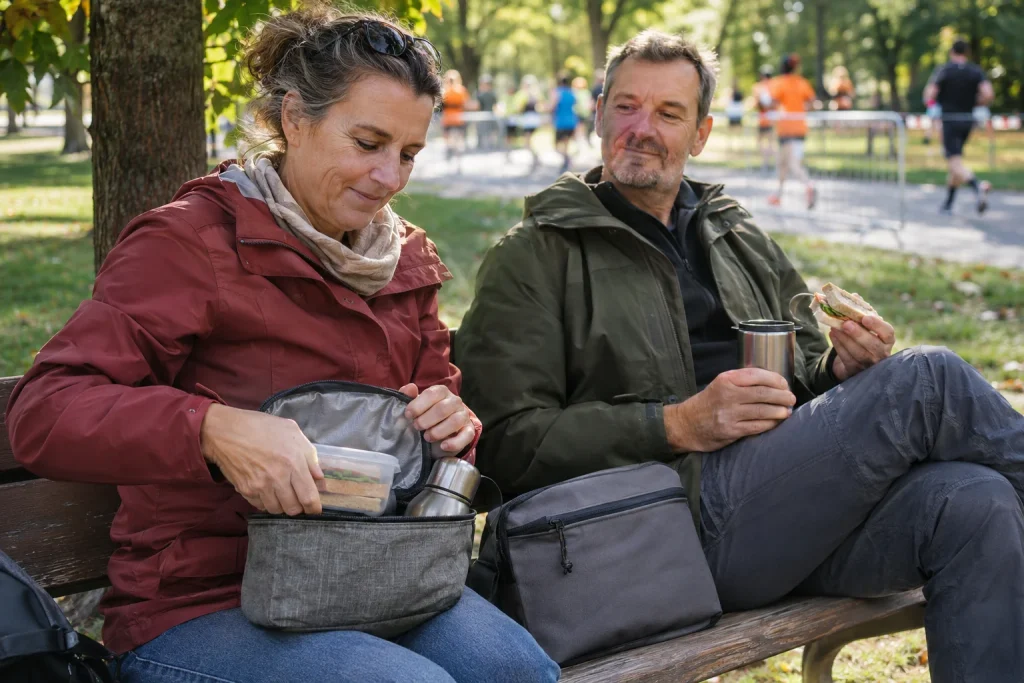
A spectator or supporter at a running race often spends longer away than the advance programme suggests. Walking from parking, waiting for the runner, reaching the next point and meeting after the finish are all part of the day. Your food pack therefore serves your own needs too, while it may also contain a separate pack agreed beforehand for the runner. Organise the two tasks separately so both your own meals and the athlete’s personal plan can happen.
This guide concerns spectator and personal-support organisation, not operating an official aid station or designing a personal sports diet. Follow event rules and staff instructions. Races do not all permit personal assistance in the same places or ways, and not every spectator point is suitable for handing over food. The particular food’s storage and use instructions still apply beside the course. The examples are fictional schedules and packs.
Three kinds of food have three different roles
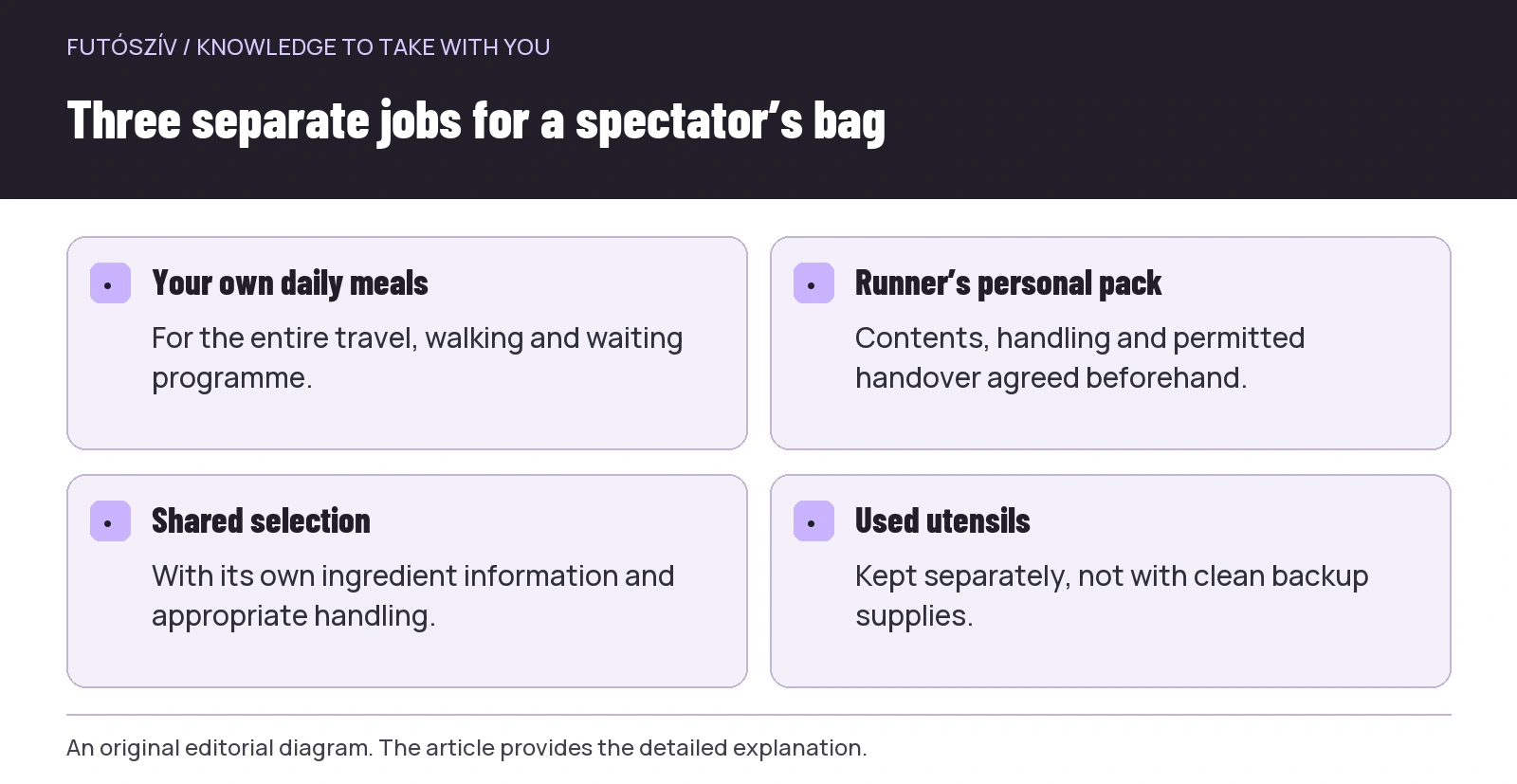
The first is food and drink for your own day. The second is the runner’s personal pack agreed beforehand. The third is any shared selection, with its own ingredient and handling questions. Do not mix the three supplies. The runner’s own pack is not automatically shared backup, and your meal does not necessarily fit their personal plan for the physical demands. Identify the name and intended use together.
While packing, distinguish what you may use freely from what must be handed over untouched. A personal supporter’s job is to deliver the agreed food, not independently alter the recipe or amount. Those preparing for a spectator day should organise their own appropriate meals. Family or friendship does not make individual conditions identical. Anyone with particular dietary requirements needs precise information about what they can use from the shared pack too.
Start with official spectator information
The Salomon Ultra-Trail Hungary map information for companions, for example, links aid-station opening and services to station markers and highlights differences in access. This shows why you need to understand the specific spectator location. A point appearing nearby on a map may not be a few steps from the car. Plan access to your own food around the full walk and wait.
Check the organiser’s current guidance for where you can wait, park and find the service needed. The runner’s course is not necessarily a permitted spectator route. Do not stop somewhere prohibited or dangerous to hand over food quickly, or obstruct runners or a crossing. If venue conditions are unknown, request precise information beforehand through the event’s appropriate public channel. An old spectator photograph is not permission to use a place.
Your own day needs real eating opportunities
Record when you leave home, how long you wait at the first point, how you move onwards and when the next actual eating opportunity occurs. ‘I’m only cheering’ does not mean you need no food, drink or rest. Adapt the programme to your circumstances too. Do not rely solely on the runner’s refreshments or a snack bar that might be operating. Plan appropriate storage and access for your own supplies as well.
If several people attend as spectators, avoid putting everyone’s necessary food into one constantly moving backpack. Agreed distribution is simpler than later searching through a crowd for whoever took the bottles. At important moments, your pack should genuinely be with you or a reliably accessible companion. You do not need separate food for every moment: arrange appropriate meals suited to the whole day.
 Enlarge diagram
Text version of the diagram
- Your own daily meals
- For the entire travel, walking and waiting programme.
- Runner’s personal pack
- Contents, handling and permitted handover agreed beforehand.
- Shared selection
- With its own ingredient information and appropriate handling.
- Used utensils
- Kept separately, not with clean backup supplies.
Agree a precise pack with the runner, not a general wish
Before leaving, ask which item or food they want, in what condition and where personal assistance can lawfully be received under the rules. ‘Bring something sweet’ is too broad if the athlete’s own plan specifies a product. Know the pack’s exact name, version and labelling. Report any missing necessary product beforehand. The race should not be when they discover you substituted food you independently considered similar.
The official Salomon UTH event page restricts personal assistance to aid stations. This is a particular event example; another event’s own rules govern there. For supporters, the lesson is that reaching the runner and being permitted to assist are separate questions. A good viewing spot does not automatically become a permitted food-handover point. Adapt the meeting and pack handling to those local arrangements.
Keep pack information readable
Identify the runner and pack’s role on the food or outer package. If carrying separate supplies for several occasions, distinguish them in the order you personally agreed. Keep original ingredient and storage information accessible. Identify the contents of a personal bottle too and do not swap mouthpieces with another person. Labels must remain understandable at the point, perhaps in poorer light or with wet hands.
A label is not a storage solution. Writing ‘after the finish’ does not remove the need to know how food will remain in appropriate condition until then. Do not quietly add a new ingredient later to a personal mixture or meal. If something changes, give the runner precise information and let them decide within their own plan. A brief, honest statement from the helper is worth more than a reassuring but unchecked substitution.
The food’s journey includes the spectator’s walk
The food-safety advice from Nébih emphasises appropriate transport of chilled foods, label conditions and protecting prepared food from contamination. Walking from parking to the point is part of transport just as much as the drive. Necessary storage must remain available while waiting for the runner too. Choose exact packaging and handling based on the particular food, not the anticipated atmosphere of race day.
If suitable storage is heavy and the point requires a long walk, rethink contents or the handover location within permitted options. Do not omit necessary cooling merely for a lighter bag. Cooling equipment left in a car elsewhere does not protect food you carry. Theoretical supplies and an actual solution moving with you are different things to reconcile while still at home.
Give the waiting area a clean section
Do not place open food on the ground or beside shoes and used clothing. Eating requires appropriate handwashing, utensils and a clean surface suitable for food. If that is impossible there, choose another occasion or a suitable meal that is easier to handle. Packaging need not require elaborate serving on site. Fewer, orderly actions can help without cutting necessary hygiene steps.
The Food Standards Agency’s hot-weather guide also treats foods requiring refrigeration at home as needing to stay cold at a picnic, mentioning shaded placement, appropriate cool bags and ice packs. During waiting beside the course, meet the particular product’s conditions too. Shade alone is not a food refrigerator, and a race delay does not extend the food’s specified usability.
 Enlarge diagram
Text version of the diagram
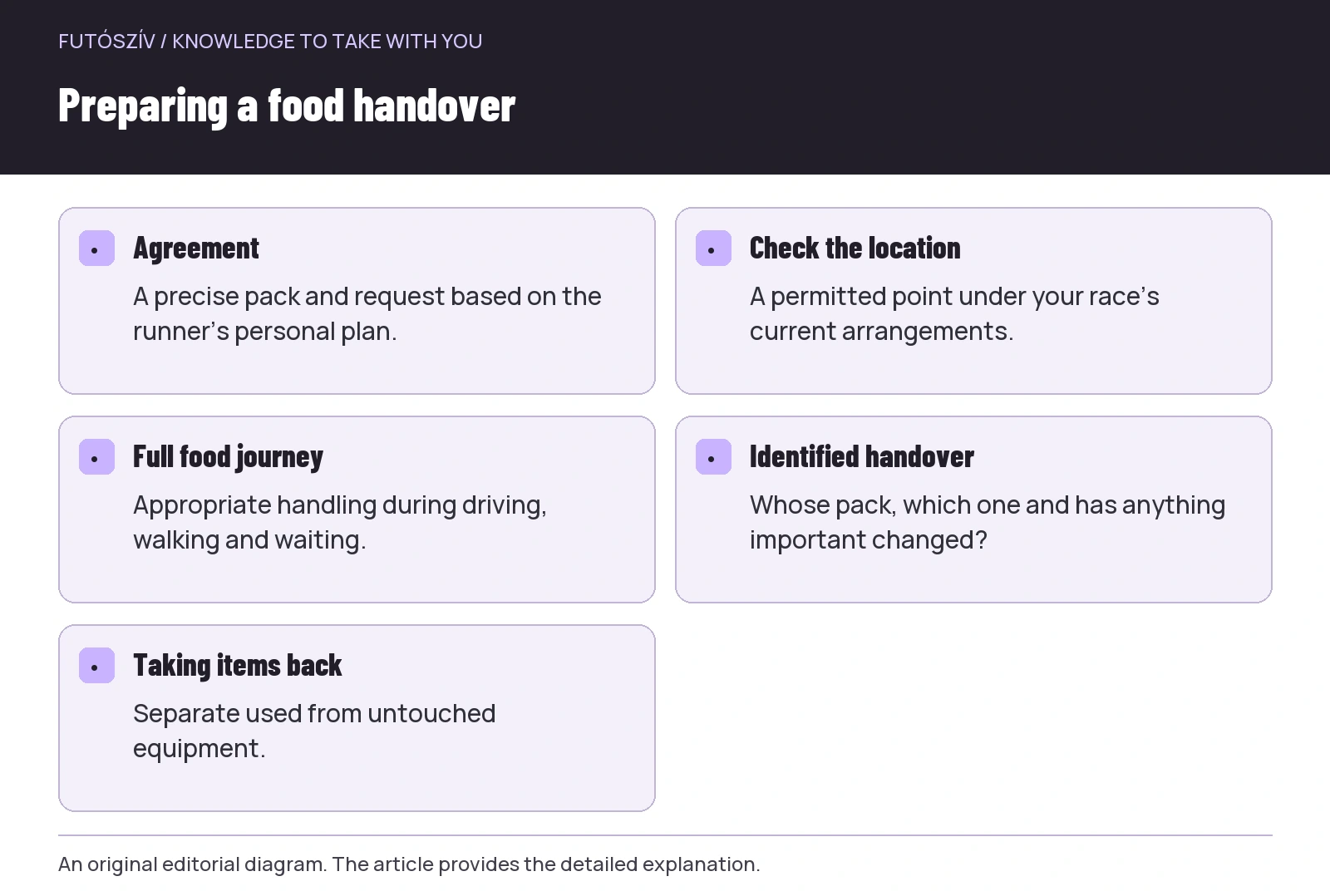
- Agreement
- A precise pack and request based on the runner’s personal plan.
- Check the location
- A permitted point under your race’s current arrangements.
- Full food journey
- Appropriate handling during driving, walking and waiting.
- Identified handover
- Whose pack, which one and has anything important changed?
- Taking items back
- Separate used from untouched equipment.
Use a few precise sentences for the handover
At the agreed, permitted place, identify the runner, explain which pack you are giving and state any important change. Do not open several containers in the middle of the running line or demand hurried choices from unknown supplies. Follow station staff’s arrangements. The runner decides what to use based on personal needs and condition; the supporter’s role is to provide the agreed, appropriately handled option.
If filling a bottle, make contents clear and close the item as intended. Do not alter a required recipe or instructions from memory, or use an unknown prepared drink as water for another powder. Keep returned used bottles or packs separate from untouched supplies. An orderly handover preserves what is clean, what is used and which item belongs to the next occasion afterwards too.
| Role | What should you plan? | Common misunderstanding |
|---|---|---|
| Spectator’s own meals | Access throughout the day, storage and a suitable place | The runner’s refreshments or an uncertain snack bar will cover everything. |
| Agreed personal assistance | A precise pack, permitted place, labels and handover | Every spectator point permits assistance under the rules. |
| Shared food among friends | Known ingredients, clean utensils and its own handling conditions | Homemade food is automatically suitable for every participant. |
| Taking used equipment back | A separate bag and later cleaning | A returned bottle immediately becomes clean backup again. |
Do not offer another runner unknown food from a personal pack
Wanting to help beside the course is understandable, but you do not know a stranger’s plan, health or dietary requirements. Do not unexpectedly offer a homemade mixture or food without ingredient information, or pressure them to accept. The event’s aid stations and staff have their own roles. If someone requests help or appears unwell, directing them to appropriate event or medical assistance matters, rather than offering randomly selected food.
Within your own group too, clarify what may be offered to others. Known ingredients and preparation conditions may matter to someone, so say more than ‘running cake’. If you cannot give a reliable answer, explain that. Offering does not guarantee suitability, and retaining a separate personal pack is entirely acceptable. Good help gives the other person accurate information and workable options for their decision.
The runner’s arrival time can change
Alongside estimates from tracking, update food arrangements and your own spectator-access plan. You may need to wait longer at a point or move onwards earlier. If the agreed handover is impossible, report the actual next opportunity in time. Do not send a general ‘we’re here’ if it does not specify the precise place and pack availability. The runner can respond within their own plan only to real information.
If another helper takes over, pass on handling details and status too. Which pack remains untouched, which bottle is used and what is the next task? A photograph or short identifier can help, but a photograph does not automatically reveal storage history. Handing over a personal pack should involve more than passing on a bag. Its associated knowledge is also part of the task.
Plan the post-finish meeting too
The runner may first go to bag storage, medical services or another designated place. Adapt the post-finish personal-pack handover to event procedures and the person’s actual situation. Spectator access restrictions or crowds mean you should not assume everything can happen directly at the finish arch. An accessible meeting point agreed beforehand is often easier to follow than crossing the runner’s path at the last minute.
Keep your own homeward-travel meal and the runner’s further personal plan arranged too. Do not divide leftovers in uncertain condition merely because you carried them a long way. Take used equipment home separately and handle appropriately preserved supplies according to known instructions. For next time, note where access or precise information was missing. A good spectator and supporter food pack supports both your own day and the agreed help in a traceable way throughout.
Sources and further reading
- Salomon UTH: Map for spectators and companions
- Salomon Ultra-Trail Hungary: Official event information and personal assistance
- Nébih: Preventing foodborne illness
- Food Standards Agency: Food safety in a heatwave – advice for consumers
How Futószív articles are prepared: our editorial guidelines.