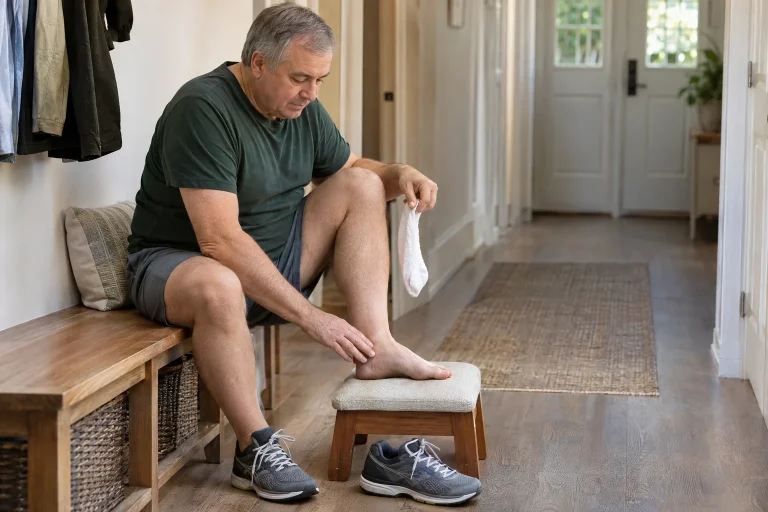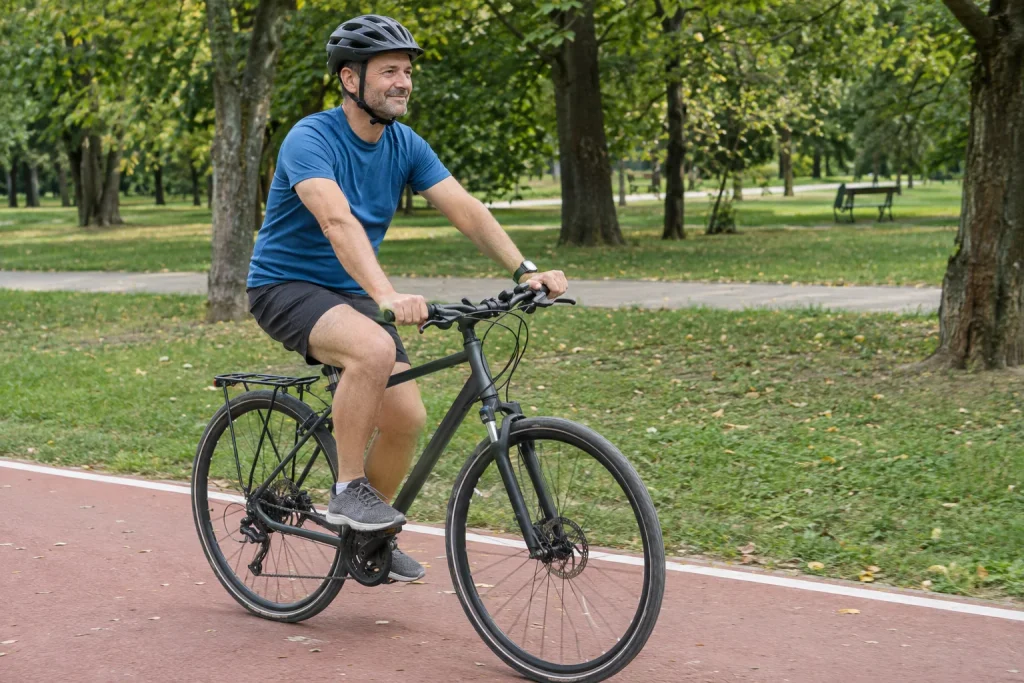
For a runner, a bicycle can be transport, a weekend outing and a carefully controlled endurance-training tool. That versatility makes misunderstanding easy. A hilly group ride starting pleasantly can leave more fatigue than the run it supposedly replaced. Commuting can also add to the week without one line in the training plan.
The question is therefore not whether cycling is good for runners. The useful question is which task you want it to solve and how you will establish whether it did so. A bike becomes a deliberate tool when treated as its own activity rather than a source of imaginary running kilometres.
What does transfer mean?
Endurance-training effects and the actual execution of running are separate questions. Cycling also involves sustained work, but movement rhythm, posture, resistance and contact with the ground differ. A demanding ride does not mean you practised race-specific running steps, cornering or pace distribution in the same way.
A small five-week study compared running alone with alternating running and cycling in eleven moderately trained runners. Both groups improved on several endurance and running-performance measures, without a clear between-group difference. This is a short-term finding from a small sample, not evidence that any part of any running programme can be exchanged without consequences.
The proportionate practical conclusion is that a combination may work, but purpose, prior fitness and remaining running matter. Running-specific practice has a different importance in general base training from a few weeks before an important road race.
First label the plan: replacement or addition
Cycling in place of an easy run replaces part of your running workload. Keeping every run and adding cycling increases total exercise time. Do not give these changes the same name. This matters particularly if you chose the bike because you feel more tired.
A log’s purpose statement might read: “A calm ride instead of Wednesday’s short easy run because I want more variety.” That can be checked. “I will cycle a bit too” does not establish what still fits. Add the intended finish time so the route does not automatically expand at every junction.
It is worth making transport cycling visible too, particularly as a new habit. Every shopping trip need not be labelled training. But daily long climbs while carrying loads have a real time and energy demand within the week regardless of the activity name chosen in an app.
Research provides no universal exchange ratio
Another study followed eleven female collegiate runners through a five-week between-season period. One group replaced some running with cycling. Estimated maximal oxygen uptake was essentially maintained, while three-thousand-metre times became slower in both groups. Interpret the result alongside the conditions of a reduced-training transition period .
This does not mean every runner can replace the same minutes of running with cycling. Participant numbers were small, the period short, and the programme did not model beginners’ first preparation or marathon-specific weeks. The ratio selected in a research protocol is not a universal conversion table.
In your own plan, specifying duration and effort, then observing consequences, may be more useful. Keep cycling kilometres separate from running kilometres. A combined monthly distance can look good on a graph while saying little about what you actually prepared for.
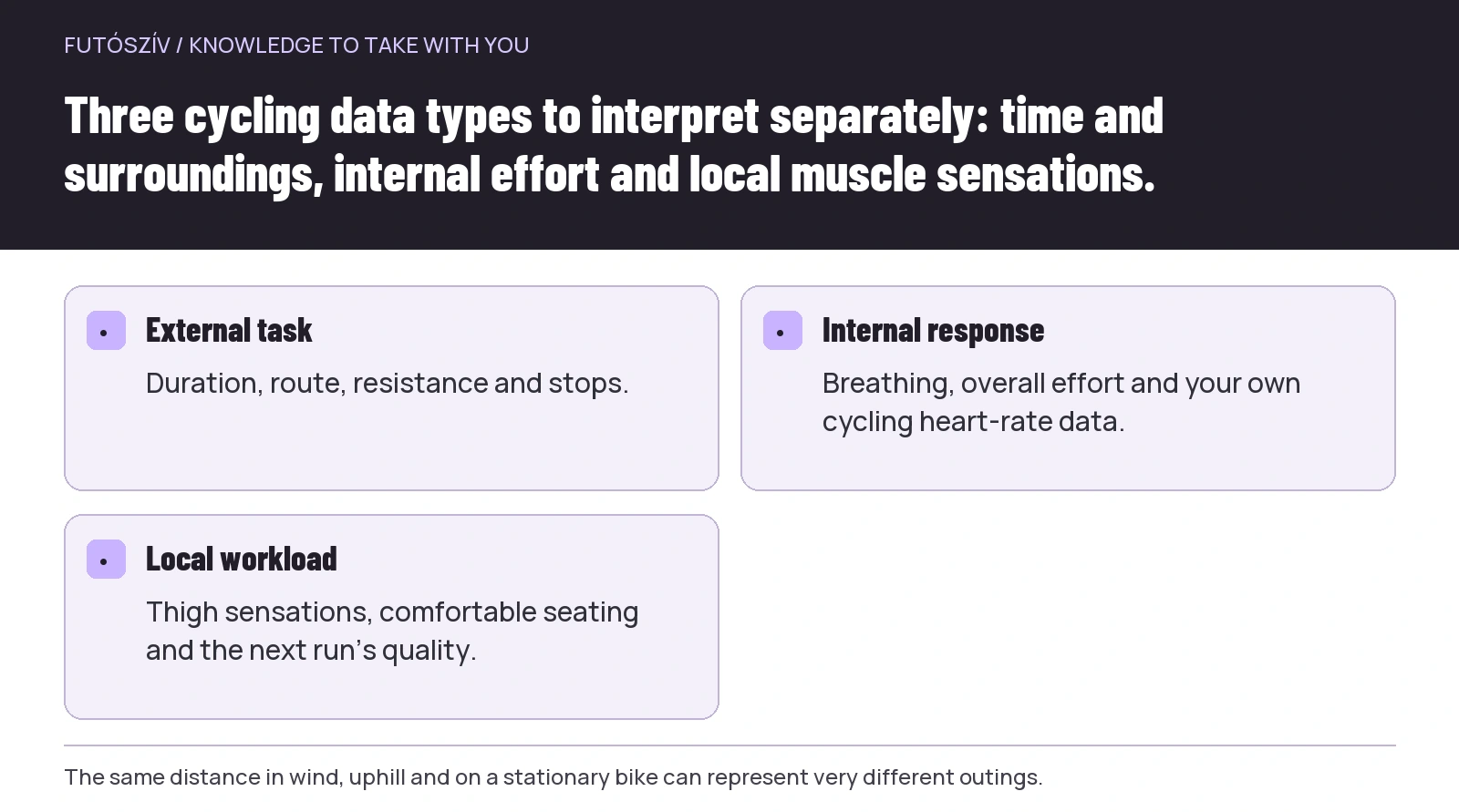 Enlarge diagram
Text version of the illustration
- External task
- Duration, route, resistance and stops.
- Internal response
- Breathing, overall effort and your own cycling heart-rate data.
- Local workload
- Thigh sensations, comfortable seating and the next run’s quality.
Leave running pace with your running shoes
Wind, terrain, road surface, stops and the bicycle strongly shape average cycling speed. A planned calm ride may look fast in a tailwind; speed may be low on a hard section. This cannot produce a target speed meaningful in every situation in the way one might seek a running pace.
Indoors, resistance and device data may matter more, but displayed numbers remain device-dependent. The same “level” on two stationary bikes is not a common measurement unit. Without genuinely comparable power measurement, do not try to justify the session’s value with virtual distance.
In the first weeks, repeatability is a more useful goal. Similar duration, a known route or machine, comfortable pedalling and brief written evaluation will show sooner what fits alongside running than imitating other cyclists’ speeds.
Do not automatically copy running heart-rate zones
The relationship between sports’ heart rates is not a fixed difference for everyone. Simply subtracting an online number from running zones is unhelpful. If cycling becomes an important regular training tool, your own cycling data and, where needed, sport-specific assessment provide better guidance.
In a crossover experiment involving eleven male team-sport athletes, short running and cycling intervals with the same structure produced different physiological responses; running yielded higher average heart rate and oxygen uptake, among other measures. The result of that specific intense protocol is not a zone formula for runners, but a reminder that exercise mode matters.
Combine heart rate with overall effort, breathing and local muscle sensations. If your thighs are already very tired while the watch shows less than your usual running heart rate, you need not keep increasing resistance for the number’s sake.
Thigh fatigue is a separate signal
As a runner, your breathing may remain comfortable while pedalling feels unusually demanding on your legs. This is an important experience with a new movement. “I was not out of breath” is insufficient to establish that the outing was easy and tomorrow’s run will definitely go well.
One compulsory cadence need not be prescribed for everyone. Seek a comfortable, controllable rhythm and manageable resistance. If progress requires forceful, jerky movements, the task is unlikely to match a calm supplementary outing. Outdoors, route choice can prevent such situations beforehand.
Heavier-than-usual legs at the next run’s start are not automatically a problem, but provide important feedback. If this repeatedly undermines a key session, adjust the ride’s placement, length or difficulty. Do not simply force improvement in running pace.
Indoors, comfort and surroundings are tasks too
A stationary bike offers a predictable location but still needs careful preparation. Keep the equipment stable, adjustments secured and learn the manufacturer’s use, stopping and load-limit instructions. Not every home device suits the same task.
Consider ventilation, comfortable surroundings and accessible drinks too. A workout or film on screen can distract from the planned ending. Use a preset time frame and do not extend merely because the video still has a climb remaining.
Do not regard persistent discomfort, numbness or pain as compulsory features of cycling. Stop, check the situation and seek appropriate professional help for recurring symptoms. A general article cannot replace bike fitting and an individual musculoskeletal assessment.
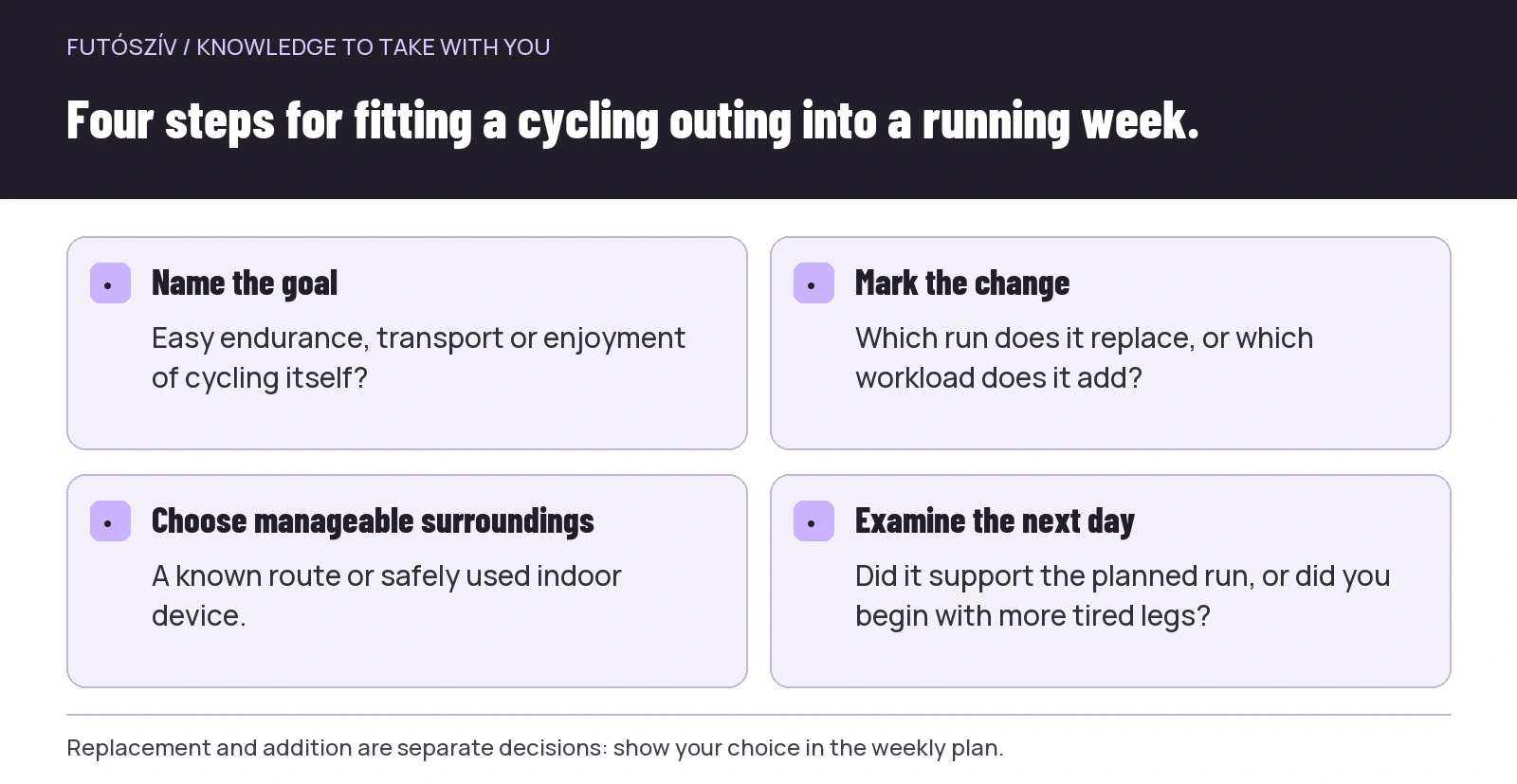 Enlarge diagram
Text version of the illustration
- Name the goal
- Easy endurance, transport or enjoyment of cycling itself?
- Mark the change
- Which run does it replace, or which workload does it add?
- Choose manageable surroundings
- A known route or safely used indoor device.
- Examine the next day
- Did it support the planned run, or did you begin with more tired legs?
Outdoors, become a safe cyclist first
Good running endurance does not automatically provide road-traffic experience. Braking, cornering, observation and route planning are separate skills. For a first session, choose familiar calm surroundings where you can focus on bike handling and follow the applicable traffic rules.
Before departure, check bicycle condition and necessary equipment; adapt visibility and protective equipment to conditions. Operate the phone, route and watch while stationary. An interval-end sound does not authorise a risky manoeuvre or ignoring traffic.
Group cycling can have its own communication and rhythm. With new companions, clarify pace, route length, stops and what happens if somebody falls behind beforehand. If the running plan calls for an easy day, choose company where you can genuinely maintain it.
Two situations, two decisions
The first runner wants variety alongside three weekly runs. There is no nearby race, and they would enjoy cycling a familiar route. Replacing one easy run with a manageable ride first, then deciding from several weeks’ experience, may be reasonable. Increasing both running and cycling immediately is unnecessary.
The second runner is preparing for an approaching ten-kilometre race and already has several harder sessions. They plan to add a long weekend ride alongside the long run. Here, first reconsider the whole week: which task matters for the goal, and where does rest remain? Cycling does not become easy because it is done without running shoes.
These illustrate decisions, not personalised programmes. In each, the new outing has a name, role and place. Observation underpins next week’s adjustment: how did it go during movement, afterwards and on the remaining runs?
Do not accidentally create triathlon training
Preparing for a running race does not require running immediately after cycling. Practising the sports consecutively can have a separate purpose in a multisport race, but is another workload decision in a runner’s week. An odd leg sensation on transition does not itself justify ending every ride with a run.
If two activities are adjacent only because of scheduling, account for that too. “Just a few kilometres” after a long ride is no longer the same run as when fresh. Make the preceding work visible in the log to avoid misinterpreting pace and sensation.
Specific training means practising your goal through the task. It does not mean borrowing as many difficult elements as possible from many sports. A useful running week need not look impressive in an app to build consistently.
What should you record after a four-week trial?
Evaluate enjoyment, feasibility and effects on running separately. Did you enjoy it? Did it fit the day including preparation? Did important runs go better or worse? The new sport can have value without immediately improving race time, but do not automatically call that proven running-performance improvement.
If retaining it, first change one variable: placement, duration or difficulty. This keeps the next period’s experience interpretable. Changing everything simultaneously makes it hard to identify which decision helped.
A bicycle can complement running well when given a place in its own right: a clear goal, manageable workload, appropriate surroundings and honest feedback. It need not copy running at any cost. Let it perform the task you actually chose it for.
Primary sources used
- Effect of run vs combined cycle/run training on VO2max and running performance – a small five-week training study.
- Effectiveness of cycle cross-training between competitive seasons in female distance runners – replacing running with cycling between seasons in female runners.
- The physiological, perceptual and neuromuscular responses of team sport athletes to a running and cycling high intensity interval training session – sport-dependent responses to a specific intense protocol.
How Futószív articles are prepared: our editorial guidelines.