Fartlek is speed play: during a run, you alternate brisker and easier sections, with changes prompted by time, landmarks, the route or an agreed group signal. Its freedom does not mean every fast section must be all-out. It is an opportunity to adapt loading to the task and surroundings.
It may be a good alternative for someone uncomfortable with precise lap times, or running where terrain makes a constant kilometre pace misleading. Others find predictable intervals reassuring. Neither format is superior: the question is which serves the particular session’s aim more clearly.
What makes it speed play, and what makes it training?
The NSCA professional guide describes fartlek as variable-paced activity in which faster and slower sections alternate. Implementation may depend on participants’ background and the aim. The name therefore does not identify a single compulsory training recipe.
It can be a loosely organised run with a few brisk sections chosen beforehand, or precisely timed alternation. There is no sharp linguistic boundary between a planned version and interval training in every situation. Do not spend more energy on terminology than on making the tasks of fast and easy sections clear.
It becomes deliberate training when you have an idea beforehand of load size and finishing. “Today I accelerate until completely tired” also produces varied pace, but offers little guidance for planning the following week.
Make the task clear with four questions
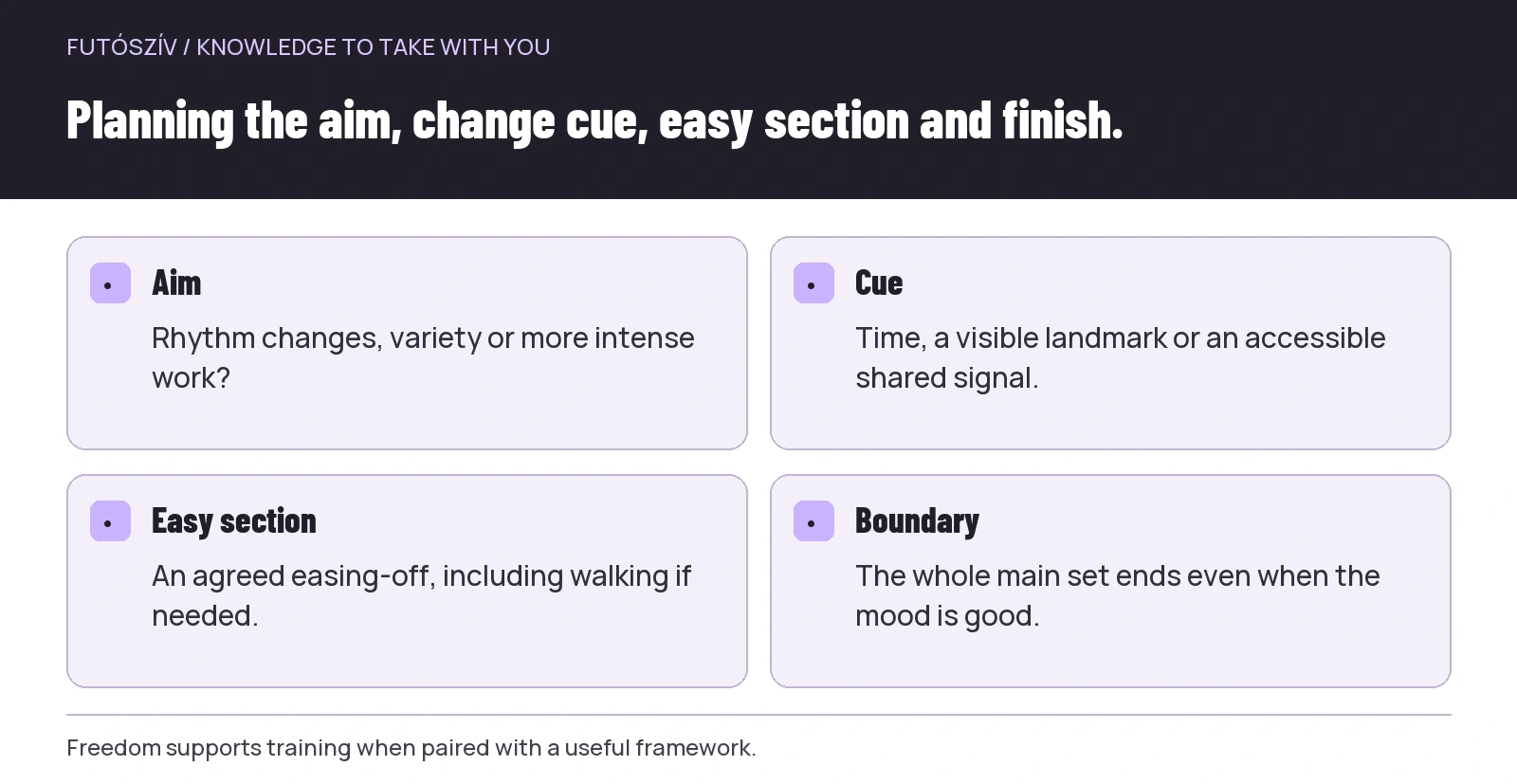
First decide the main aim: practising rhythm changes, seeking variety or deliberately planning more intense endurance work? Different purposes suit different fast sections and recoveries. If you want to explore ease of movement, you do not need to finish every change very breathless.
Second, define what signals a change. A timer is predictable; a distant tree is playful, but its distance is easily misjudged. Third, clarify the easy section. Finally, set an upper boundary for the whole main set even if the mood is good and the group would continue.
A session card can contain just four lines: aim, cue, easy section and finish. It does not replace personalised planning, but helps you notice if execution has turned into an entirely different task along the way.
By time or to a landmark?
Timed changes have the advantage of a known section duration. Hills and wind alter the distance covered in the same time, but the planned time frame remains. Keep the notification simple; there is no need to read a complicated watch screen while running.
With landmarks, check beforehand that running to them is actually safe. The next bench or lamp post is a useful cue only if it does not take you across a road, crowded path or sharp bend. A traffic situation should not determine the fast section’s end.
The two can combine: the overall main set is time-limited, with a few short changes inside it marked by visible landmarks. This preserves playfulness without allowing the session to expand unnoticed without limit. Adapting to the landscape is an advantage of the format, not an exemption from foresight.
Fast does not mean maximal
A faster section can be noticeably brisker than easy running while still well controlled. In another session, it may be genuinely hard. The word fartlek alone says nothing about how demanding the work is, so entering only the name in a training log is insufficient.
Observing movement and effort is useful. Can you change gradually at the start, keep something in reserve and stay composed at the end? Changes in ease of speaking can also offer a clue, but are not precise laboratory threshold measurements.
The first outing should not be a maximum sprint test. Background for fast running and the day’s condition matter; comfortable slow running does not automatically make every sudden acceleration a good idea. Introducing speed when returning from injury requires separate consideration.
 Enlarge diagram
Text version of the diagram
- Aim
- Rhythm changes, variety or more intense work?
- Cue
- Time, a visible landmark or an accessible shared signal.
- Easy section
- An agreed easing-off, including walking if needed.
- Boundary
- The whole main set ends even when the mood is good.
The easy section determines the character of the game
If you genuinely slow during the restrained section, the next fast section can remain a distinct, composed task. If you barely ease the pace, the whole sequence can become continuously hard work. Both formats exist, but do not represent the same load.
A common trap in group running is setting even the slow part to the fastest participant’s comfortable pace. What is recovery for them is more hard running for someone else. A shared cue must not therefore mean a shared kilometre pace for everyone.
If your task requires walking to recover, that does not invalidate the session. You do not need to jog for the sake of the label. Match recovery to the aim and your condition, and include it in the log too.
Three different ways to structure it
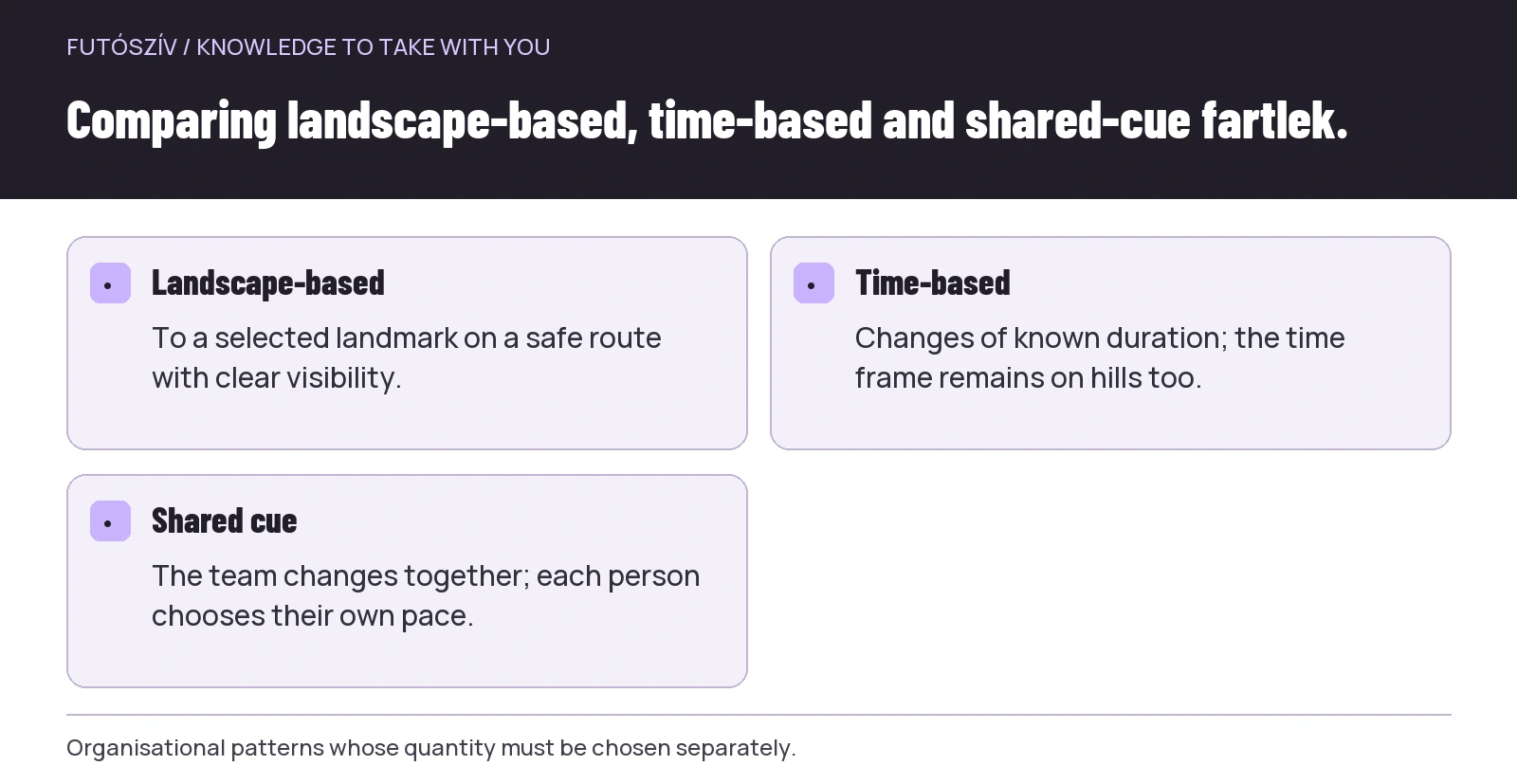
The first version is landscape-based play: on an easy, familiar route, move more briskly over short, visible sections selected beforehand, with comfortable movement between. Learning the format and controlling rhythm changes may be the aim, rather than maximising all fast metres.
The second is a time game with varying durations. Shorter and longer brisk sections alternate, but the whole sequence and easy sections are clarified beforehand. A longer part generally requires a more restrained start than a short one; do not force the same speed onto every duration.
The third is fartlek at individual paces to a shared cue. Everyone changes together but regulates their own effort. Agree meeting points and regrouping beforehand. These are organisational patterns, not universal weekly programmes: choose specific durations and quantity for the background involved.
Understand a pattern before attaching numbers
Imagine someone wanting to break the monotony of a familiar run by adding a few short, brisk sections. Their first decision is not which professional sequence to copy, but how much new loading fits the week and where a suitable route exists.
After warming up, they make one restrained attempt. In the easy section, they observe how movement and breathing settle. If the trial was too hard, the next can be shorter or slower; if unusual symptoms occur, they finish. You do not need to reinforce a poorly chosen start by completing a predetermined number of repetitions.
For evaluation, they record the relationship between fast and easy sections. The next adjustment can start from this. Alongside playfulness, a learnable system then develops in which momentary enthusiasm does not determine the entire load.
What do studies of pace-changing training show?
The original study of the 10–20–30 training concept tested repeated sections with specified duration and intensity in moderately trained runners. It was a specific intervention, not scientific validation for any freely chosen fartlek.
A later study in recreational running communities also used a predetermined system and found performance changes. Participants, the training replacement and the programme followed belong together with the result; a research title is not a personal outcome promise.
The lesson is not that everyone should choose this number sequence. Rather, deliberately combining more intense and easier sections can provide a measurable training stimulus. The name of the alternation alone does not establish whether that version fits your aims and capacity.
A professional account provides ideas, not a dosing sheet
The dsm-firmenich running team’s own training feature explains fartlek’s role and the experience of group work. This is direct insight into a professional setting, but its volume and intensity are not automatically suitable for someone training alongside work.
An elite athlete’s session is explained by the full week, volume built over years, recovery opportunities and race aim. Isolating the striking main set hides that background. Variety or social support may be transferable principles while the dose differs completely.
If you find an inspiring session, first write one sentence about what appeals to you. If it is changing rhythm or running together, that does not necessarily require the same minutes, repetitions and speed.
 Enlarge diagram
Text version of the diagram
- Landscape-based
- To a selected landmark on a safe route with clear visibility.
- Time-based
- Changes of known duration; the time frame remains on hills too.
- Shared cue
- The team changes together; each person chooses their own pace.
Follow effort on hilly routes
Uphill, the same pace may demand more work; downhill, braking and ground control matter alongside speed. Fartlek can let you adapt pace to the route, but fast descending can become a new load in its own right.
For first trials, a predictable, gently rolling or flat route may therefore be simpler than a technical trail. Do not treat the hilltop as a compulsory finishing straight if movement control is already deteriorating. An easy downhill section does not necessarily mean complete recovery either.
In wind, heat or slippery conditions, let go of the pace imagined beforehand. An environment-adapted version can be useful precisely because it does not insist at all costs on a number devised under other conditions.
How can it be genuinely social?
Agree who gives the cue, how it can be heard or seen, and what happens if someone falls behind. A whistle-only signal is unsuitable, for example, for a participant with hearing loss. Develop route and cue accessibility together with the participant.
Choosing an individual pace should be real freedom. A more restrained section, walking or shortening should not prompt jokes or pressure to explain. The group supports people when it does not make the strongest runner’s load compulsory.
You can rotate leadership of the changes, but do not surrender the entire framework to unlimited enthusiasm. The next leader should know how long the fast section may last and where the group regathers. Here, the game’s rules serve safety and the shared experience.
What belongs in the training log?
Note the main set’s duration, approximate total time of fast sections, the nature of easy parts and your overall impression. If running to landmarks, you do not need to reconstruct a metre-accurate course afterwards. Proportions and experience often matter more for the next session.
Separate immediate experience from after-effects. A session can be fun yet cause too much next-day fatigue relative to the week’s other tasks. A good mood does not erase loading, and feeling the effort does not prove effectiveness on its own.
Success may mean consciously choosing your pace even in the last change, or keeping the easy sections genuinely easy. These provide a better basis for planning the next step than an average pace a few seconds faster.
Finishing is part of the game too
Stop the task for increasing pain, altered movement or unusual illness. With chest symptoms, feeling faint or severe breathing difficulty, do not seek a training-technique explanation; urgent help may be needed. With a known illness, clarify conditions for more intense loading individually.
An everyday finish need not be dramatic. You reach the planned boundary, ease back and close with comfortable movement. An extra section is not needed to prove you still have energy. Keeping a reserve often indicates the task was performed well.
Sources and the role of the examples
This article draws on NSCA guidance, the running team’s direct account and the two cited primary intervention studies. The organisational ideas help explain the format; they are not tested training programmes applicable to everyone. Fartlek can be playful while its load still needs serious selection based on personal background.
How Futószív articles are prepared: our editorial guidelines.