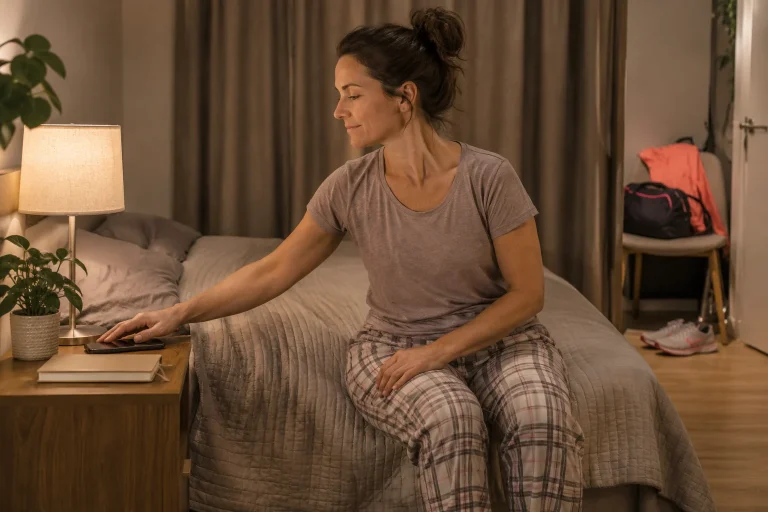
A November morning is dark, the pavement is wet, and putting on running shoes takes more organisation than in June. Not every difficult start is depression. But take it seriously if the change extends beyond outdoor training: meetings you used to enjoy no longer interest you, work becomes noticeably hard to manage, and neither rest nor a brighter morning restores your usual functioning. You can describe winter low mood more precisely by looking at your whole day alongside the weather.
A running plan can provide useful background here, but it is not a diagnostic tool. Missed kilometres cannot establish the help you need. This article aims to turn the uncertain feeling of “not being myself” into questions you can recognise: what changed, how long has it lasted, has it happened before, and what care can clarify it? Daylight activity and social plans can have a place in the week without becoming proof that you are recovering.
Winter inconvenience differs from a recurring pattern of depressive symptoms
The NIMH information on seasonal affective disorder describes a seasonally recurring pattern of depression. Onset in late autumn or winter and improvement in spring or summer are more common, but a summer pattern also exists. The seasonal form is not the same as stress associated with holidays, family events or a predictable busy period at work. Describe these circumstances too, because coincidence on a calendar does not itself explain the origin of symptoms.
Consider an everyday distinction. One runner dislikes dressing for the cold but still looks forward to indoor plans, and changing training times resolves the difficulty. Another skips not only the cold loop but also feels disconnected from a favourite film, a conversation with friends or cooking together. These are invented examples, not diagnostic cases. They show why changes in interest and everyday function provide more information than the number of runs uploaded to an app.
The history of recurrence can be particularly useful: when did the previous difficult period begin, when did it ease, and were there similar periods in other seasons? You do not need to recall exact months with certainty. Even remembering that last winter’s meetings were hard to attend is worth reporting. The criteria for recognising a pattern do not mean you must wait through more winters before asking for help. A current difficulty affecting your functioning is enough reason for a discussion.
Talk about the whole week, rather than just the missed run
The NHS guide lists low mood, reduced interest, hopelessness, irritability and difficulty concentrating, as well as sleeping more, tiredness and appetite changes. Not everyone experiences every symptom. The description is not a self-completed certificate: an individual assessment considers the combination of changes, their course over time and their consequences. Your situation need not match a running companion’s experience or every detail of an online story.
Describing the day can be easier than answering “how is your mood?” What is getting up like, what can you manage in the morning, what happens to afternoon tasks, and do you still connect with others by evening? If a run is missed, can you use that time for something else that matters, or does that feel inaccessible too? These questions have no answer that proves good running performance. They provide a way to understand your own change, even if you previously competed at a high level.
Describe sleep circumstances separately too. Are you spending more time in bed yet experiencing the day differently? Or does holiday work and early training simply leave you less opportunity to sleep? These accounts provide different information, although both can occur together. A watch’s total sleep score cannot replace saying that you cannot begin your usual tasks in the morning. Bring your observations as they happened, rather than adapting them to a label selected beforehand.
Changes in appetite and weight can also be discussed matter-of-factly. They should not become a task in dietary restriction, and winter difficulties are not a character flaw. The important information is what differs from your previous habits and how it relates to your day. A tighter item of clothing is not the most important measure of your mental state. A running community does not need comments about weight to notice that someone may need more support.
 Enlarge image
A daylight opportunity is an option, not a compulsory mood-boosting workout
The NHS mentions natural daylight, regular activity, maintaining relationships and continuing usual activities as parts of self-care. Adapt these to your condition and professional plan. This does not establish a running dose for everyone, nor imply that someone who struggles to get out does not want to improve. Running is one option among several; with a health limitation, another activity or rest may be appropriate.
A practical example is a working day with daylight free time only during the lunch break. The first question is not whether a shortened version of your summer long session will fit. Can you reach an outdoor space safely, return in time and eat, and would you like to meet someone? A shorter, manageable activity can be a complete plan in itself, without adding late-evening kilometres so the app will call it a full workout.
A weekend filled with caring responsibilities is another situation. If you must remain near home, a distant forest need not be the only valuable option. A nearby place accessible in daylight, or a meeting that does not require sportswear, may be possible. A plan’s practical value can lie in being genuinely accessible. The scenery, route length or resulting photograph does not measure the care you have given yourself.
The practical limits of winter conditions still apply. An icy path, current illness or an individual medical restriction does not become irrelevant because you planned a daylight outing. Connection can remain after cancellation: a phone conversation or an agreed indoor meeting. You do not need to treat the activity as a medical experiment, and the absence of an enjoyable feeling is no reason to force an effect with harder or more dangerous exercise.
Treatment has several routes, and suitability is individual
The NHS information on depression treatment describes support matched to the type and severity of the difficulty: guided self-help, psychological treatment, medication or combinations may be considered. Activity also has a role, but that does not make a general running plan appropriate treatment for every depressive condition. Individual assessment determines which route fits the current situation and how change will be followed.
The NIMH describes cognitive behavioural therapy adapted for seasonal difficulties, addressing season-related thoughts and a narrowing of activities. Behavioural activation here forms part of a professional method, rather than a universal instruction to “get up and run”. Personal goals can be much broader than sport: participating in everyday decisions again, dealing with important matters or keeping in touch with people who were already close to you.
It is also worth discussing light therapy with a professional before choosing a device. The NHS specifically cautions about certain eye conditions and medicines that increase light sensitivity. A light-therapy device, a running headtorch, room mood lighting and a daylight walk are not interchangeable interventions. This article therefore gives no duration or intensity instructions. A general running-portal explanation cannot establish the right device, individual suitability or monitoring arrangements.
For a treatment discussion, also bring your history of mood episodes, existing diagnoses and medicines or products you take. If you previously had a marked change in sleep need or an unusually energised period, do not leave it out because you currently feel low instead. Clinical decisions require the whole history. Do not start, stop or change medication simply because a brighter day arrives or you have a good run.
What does research comparing light therapy and targeted psychotherapy teach?
Rohan and colleagues’ randomised trial published in 2015 included 177 adults with a current depressive episode and a recurrent seasonal pattern. Professionally delivered cognitive behavioural therapy tailored to seasonal affective disorder was compared with light therapy. During acute treatment, depressive symptoms improved in both groups, with no difference found between treatments in remission measures. This was a study of structured care, not evidence that two self-help options bought online are interchangeable for everyone.
At follow-up one and two winters later, no treatment difference was detected in the first winter, while several outcomes, including recurrence rates, favoured the targeted psychotherapy group in the second. This helps explain why improving a current episode and preparing for the next season are different questions. It does not justify independently replacing care already started or predicting someone else’s treatment outcome.
For a runner, one useful lesson concerns the time horizon. Do not imagine help only as something to try quickly during the worst week of January. Ask how changes will be followed in spring and what the plan is for the following autumn’s discussion. The trial does not set your race calendar. It gives a reason to make separate room in the conversation for current symptoms and the possibility of later recurrence.
Questions that fit into a brief first discussion
You do not need a complete seasonal diary before asking for help. Three personal examples can start the conversation well: something you used to enjoy that now feels hard to access; an everyday task that has changed; and any previous winter or other seasonal experience. You need not turn the account into a score. If speaking from memory, feel free to mark uncertainty. The professional can ask for necessary details and decide what further assessment is appropriate.
- What symptom pattern is being considered, and what else needs clarifying in my history?
- Which care options are possible, and how will we choose between them?
- How might my current sport, work schedule and caring responsibilities fit alongside this?
- When should the next contact be, and which changes mean I should not wait?
- If I experience something similar next autumn, what should the agreed first step be?
You can make the sports-related request more precise too. “Should I run more?” differs from “I’m currently struggling to organise anything; how can a manageable activity I choose fit alongside the treatment plan?” The latter does not prescribe an answer in advance. It leaves room for physical condition, current symptoms and circumstances to make a different programme appropriate from the one used during an earlier period of good fitness.
 Enlarge image
A running community can offer connection, rather than a performance test
A friend or organiser can provide practical help through a clear meeting point, an agreed daylight time, an easy way to respond and no requirement to prove cheerfulness before taking part. For example: “Would you like someone to tell you about the weekend plans even if you’re not running at the moment?” This is a specific offer that can be declined. It is more precise than judging mood or training discipline, and does not require a public account of private health history.
Seek healthcare support for persistently difficult functioning or suspected depression; a running club cannot replace that assessment. Immediate danger or an acute severe condition requires urgent help; in Hungary, 112 can be called. Support is not conditional on completing the next workout. Winter days can still contain chosen activity, interest and human contact while your difficulty receives appropriate professional attention of its own.
Sources
- NHS: Seasonal affective disorder
- NIMH: Seasonal Affective Disorder
- NHS: Treatment – Depression in adults
- Rohan and colleagues: acute treatment outcomes
- Rohan and colleagues: one- and two-year follow-up
How Futószív articles are prepared: our editorial guidelines.