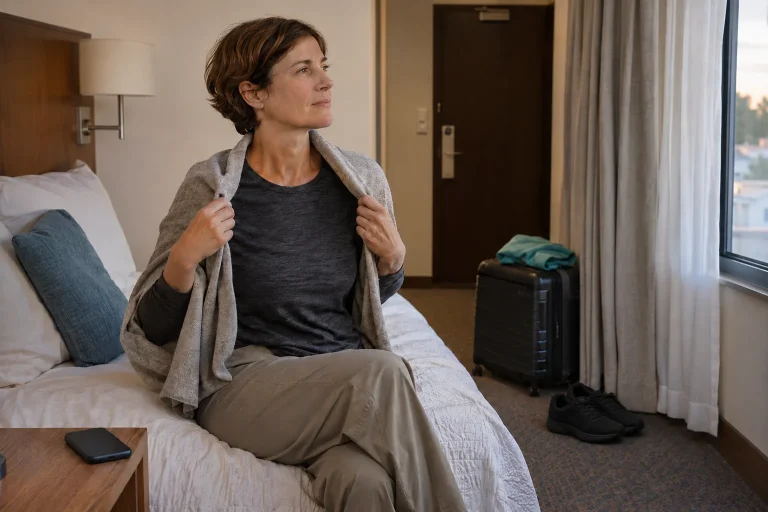
Recovery is more than a spare minute after running
Intervals, long runs and group sessions are easy to find in a weekly plan. Sleep often receives only whatever time remains. If training starts early while evening responsibilities stay unchanged, the visible sporting schedule can create an invisible loss of time too. Plan the whole day together.
A sleep routine does not mean perfect performance at falling asleep. It can provide a framework so opportunities to rest are not left to chance. This article offers everyday organisational ideas, rather than insomnia treatment or a personalised sleep programme. Persistent symptoms need an appropriate healthcare professional; a sleep disorder is not necessarily resolved by a tidier calendar alone.
Sleep opportunity and actual sleep are different information
A scheduled bedtime does not establish how much or how well you slept. CDC information emphasises quality alongside sufficient quantity and recommends healthcare advice for recurring sleep difficulties. Time in bed and restorative sleep are therefore not interchangeable concepts.
In a practical plan, first review how much opportunity you leave for sleep. Falling asleep at a particular minute does not need to become compulsory. If the opportunity exists but you still regularly cannot rest adequately, that raises a different question. Understanding the routine and individually assessing symptoms can together provide a useful next step.
Start with the actual routine, not an ideal version
List the main points of a usual training day: finishing work, travel time, family responsibilities and how the evening unfolds. A minute-by-minute report is unnecessary. The aim is to identify which step regularly moves later. A short run in the calendar may occupy a much longer total window.
Observation can lead to a specific question. Can something be prepared at another time? Can detailed training analysis wait? Can another meeting point be discussed? Not every obstacle can be resolved alone, and not every task can be dropped. A routine’s value lies in being workable alongside actual obligations, rather than resembling an idealised athlete’s day.
Early training starts the evening before too
A dawn group run affects more than the morning alarm. If the previous evening still runs late, sleep opportunity may shrink. NHLBI general information supports allowing sufficient sleep time and more predictable habits. For your sporting programme, examine whether an appropriate evening framework is genuinely available for the early start.
When talking to a coach or group leader, describe more than when you can attend. The day and night accompanying that time matter too. The 2021 athlete-sleep consensus also considers training, travel and competition circumstances. This does not establish one universal starting time, but calls for reviewing the whole situation individually.
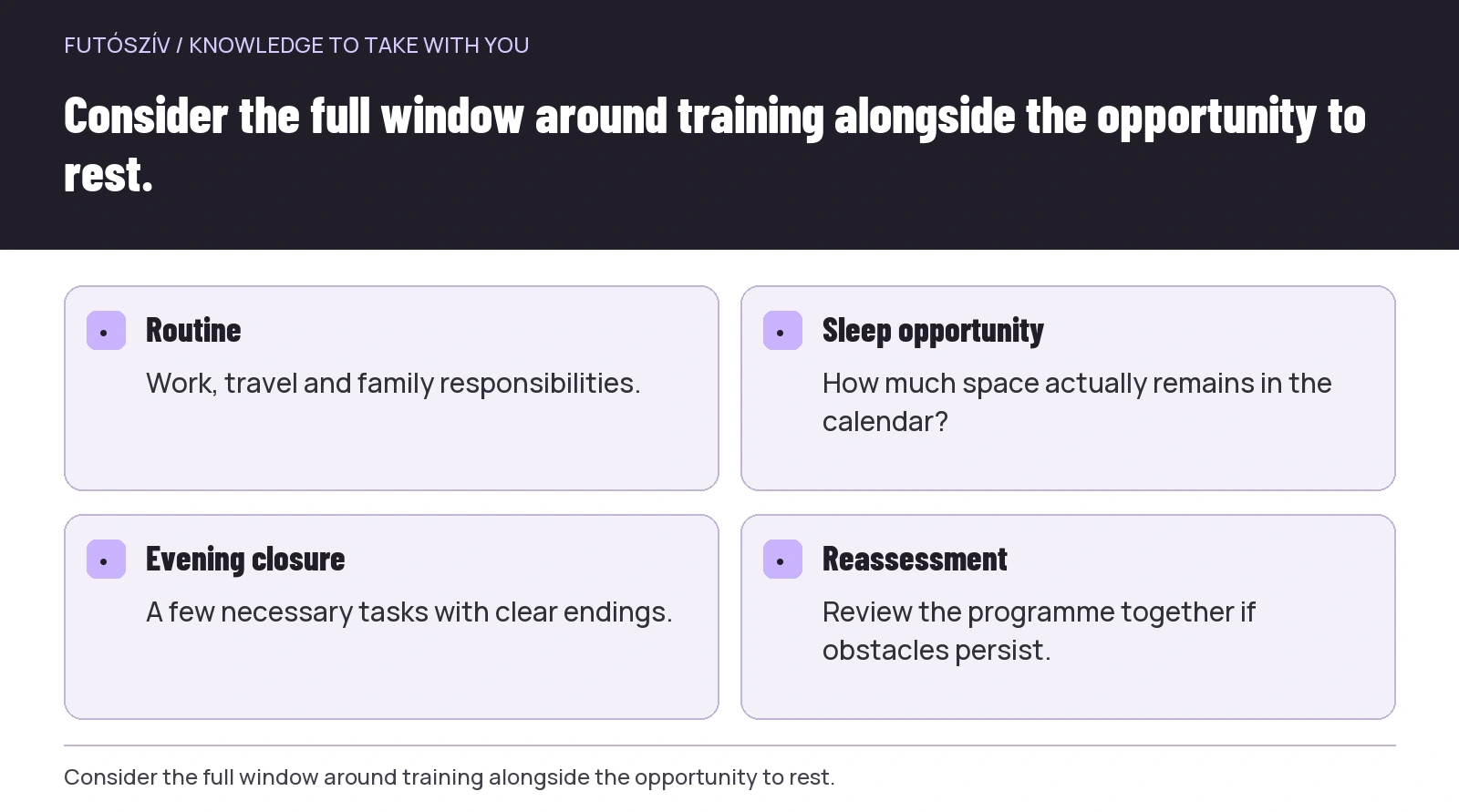 Enlarge diagram
Text version of the illustration
- Routine
- Work, travel and family responsibilities.
- Sleep opportunity
- How much space actually remains in the calendar?
- Evening closure
- A few necessary tasks with clear endings.
- Reassessment
- Review the programme together if obstacles persist.
Use a short evening wind-down sequence
The system before bed should not become another long to-do list. A few necessary steps may suffice: noting an important task for tomorrow, putting required items in place and ending the day more quietly. These are practical examples, not treatment instructions. Choose a sequence that does not need perfect conditions at home every evening.
If one element regularly prolongs the evening, separate out what is genuinely necessary. Preparing running clothes may be brief; reassessing equipment for the next three races is another task. The sequence aims at a recognisable ending, rather than a final answer to every unresolved question before bed.
Adapt the environment to available possibilities
NHLBI discusses a quiet, cooler and dark sleeping environment among general sleep habits. Real homes can impose different limits: a shared room, street noise, family responsibilities or changing work hours. Identify which disturbance can actually be changed rather than perfecting every detail at once.
For example, discuss late-evening household tasks, handling morning alarms or where sports equipment stays. Choosing aids or treatment for an individual health situation needs appropriate advice. Practical change does not need to begin by buying an expensive sleep gadget. First clarify the actual obstacle and a feasible solution.
A race weekend involves more than the start time
A distant event can involve travel, race-pack collection, accommodation and an early departure. Consider these alongside opportunities to rest. If every arrangement is left for the final evening, the calmer period important for sport can disappear. A brief itinerary prepared beforehand can reduce late decisions.
Leave room for uncertainty too. Transport may be delayed or collection arrangements may change. You do not need to reconsider every possibility each evening; identify where to find current official information and the backup option. Rest cannot be completely guaranteed, but some unnecessary organisational demands can be resolved in advance.
A watch score should not be a morning verdict
If you use a sleep-tracking device, consider its data alongside your experience and appropriate professional interpretation. A score alone is not a diagnosis and does not describe the entire night. Every morning need not begin with the display deciding whether you rested well or badly. A number helps when it contributes understandable information to a specific question.
If checking the device increases worry about sleep, mention that in professional discussion too. You do not need to wait until buying another device. Actual difficulty falling asleep, waking or daytime sleepiness may matter more in describing recurring problems than one app’s overall colour.
Give the weekly plan a review point
If planned sport repeatedly leaves insufficient sleep opportunity, review the programme with your coach. The answer may be individual: a different time, fewer practical demands or another weekly arrangement. This article does not prescribe an automatic training-reduction rule for one poor night. The whole situation and current health matter.
Distinguish occasional changes from persistent patterns in the discussion. One unexpectedly late evening differs from weeks with little access to rest. A plan helps when it works beyond paper. Recovery does not need justification after the calendar has been finalised; it can inform decisions while the programme is designed.
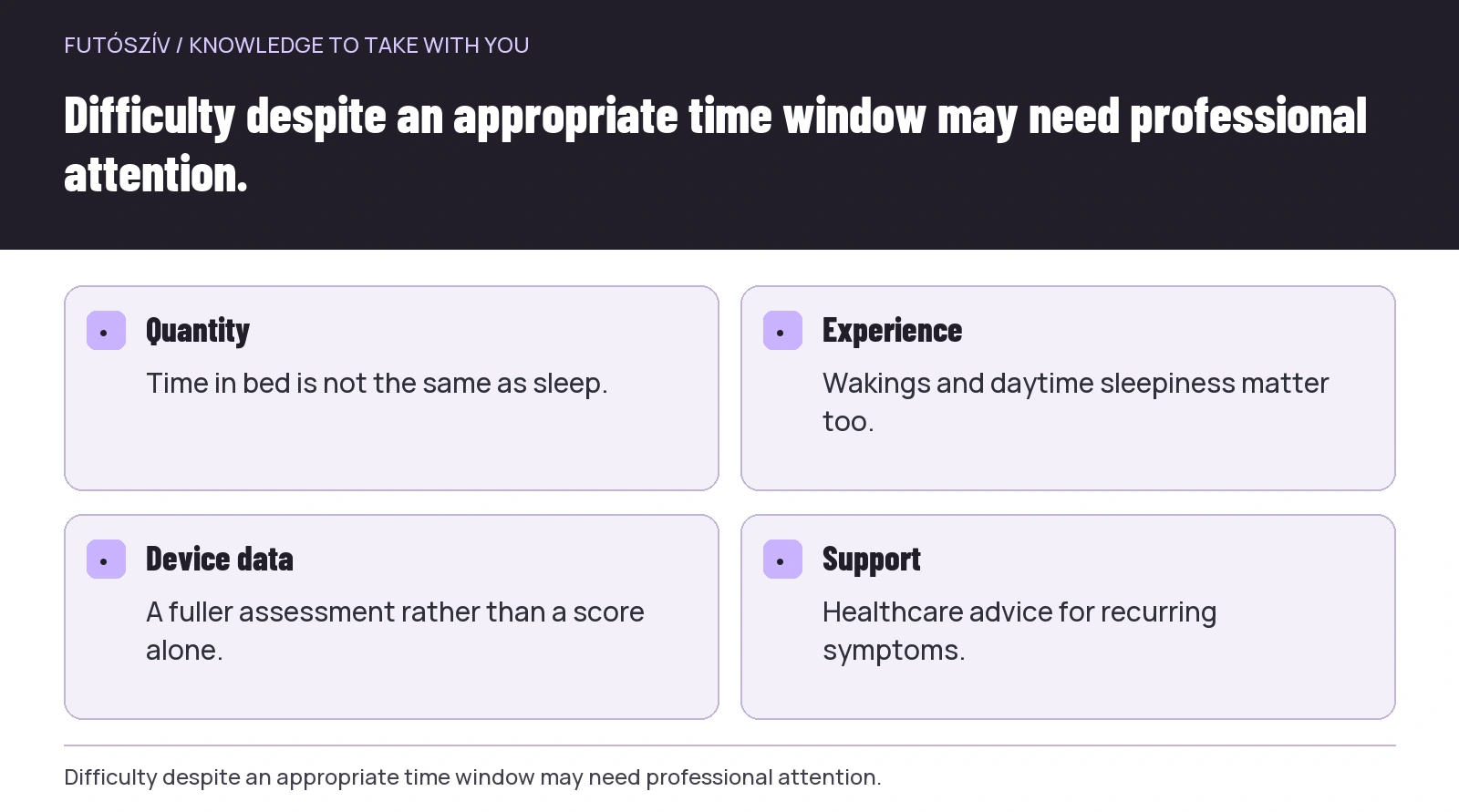 Enlarge diagram
Text version of the illustration
- Quantity
- Time in bed is not the same as sleep.
- Experience
- Wakings and daytime sleepiness matter too.
- Device data
- A fuller assessment rather than a score alone.
- Support
- Healthcare advice for recurring symptoms.
Keep a diary brief and purposeful
If a professional requests it, or you want to understand a specific question, note key points about sleep opportunity, wakings and daytime experience. You do not need to keep checking the clock at night to produce precise data. Discuss the diary’s format within care if needed. Its purpose is to make the situation clearer, rather than monitor the night constantly.
Late travel or a changed shift may matter in the record alongside running time. A simple description helps distinguish calendar obstacles from symptoms persisting despite an appropriate window. Mention it if logging itself becomes burdensome. An observation tool needs to adapt to individual needs too.
When should you do more than change the routine?
Contact a healthcare professional for regular difficulty falling asleep, repeated wakings, substantial daytime sleepiness or concerning signs noticed during sleep. CDC also recommends assessment of recurring problems. A sporting lifestyle does not exclude a sleep disorder. You do not have to treat this as indiscipline or try every possible evening habit first.
Do not drive while sleepy or enter situations where reduced attention creates danger. Road and workplace safety are not details to fit around the running plan. Regular or severe sleepiness needs appropriate support. A good watch score, or the thought that exercise will surely wake you up, does not replace a personal safety decision.
In a shared household, discussion belongs in the plan too
If you live with others, your opportunity to rest can relate to shared responsibilities. Ask for more than quiet: establish who does which task and when. Morning preparation for early training should not unnecessarily wake everyone, while evening housework should not always postpone the same person’s bedtime. A workable agreement is mutual and grounded in actual possibilities.
Discussion does not guarantee a perfect night, especially with caregiving or young children. It can reveal where a burden can be shared and where sport needs adapting to current life. If a proposal works only by someone else regularly giving up rest, review it. A runner’s recovery belongs within the shared routine, rather than as a separate project placed above every other need.
An example of reviewing an overcrowded training day
A runner travels far to an evening group, shops afterwards and then analyses the session in detail at home before an early start next day. Review more than the evening run: shopping could move, analysis could wait until tomorrow, and a nearer meeting point could be discussed with the group. A specific change targets the actual obstacle.
The example does not promise that every sleep symptom will disappear. It shows how recovery time can be lost through several small decisions. Better practical arrangements allow a clearer discussion of what remains. A sleep routine can then become a useful part of the week without turning into another sporting achievement or a universal explanation for every difficulty.
Sources and further reading
- CDC: About Sleep
- NHLBI: Healthy Sleep Habits
- Walsh et al.: Sleep and the athlete, 2021 expert consensus
How Futószív articles are prepared: our editorial guidelines.