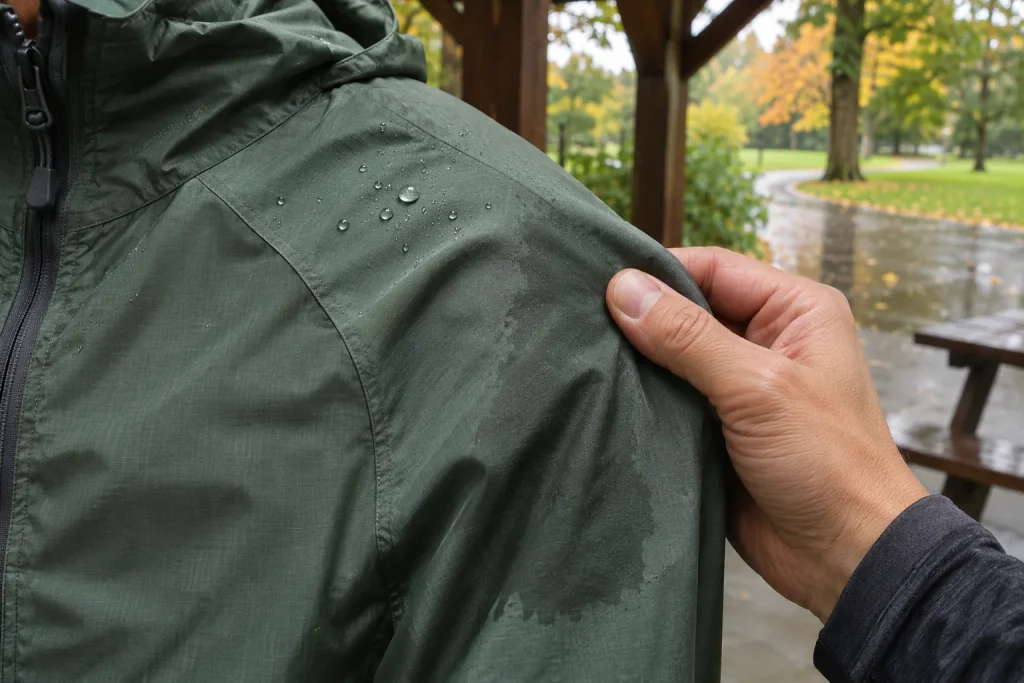
Water once stood in tiny beads on your new jacket, but after a few uses larger, darker wet patches appear. The change is striking, but it is not equivalent to saying the whole garment has stopped being waterproof. “Wet-out” refers to the outer fabric becoming saturated. Water absorption at the outer surface and water passing into the garment may be related, yet they remain separate questions.
This article interprets the visible external change: what beading shows, what a darker patch does not prove, and what information an online jacket photograph lacks. We do not give the same washing or reproofing recipe for every garment. Specific care requires the exact product’s instructions; here you will find organised considerations for understanding the phenomenon.
The water-repellent surface and waterproof construction may perform different jobs
DWR, or durable water-repellent treatment, helps water remain in droplets and roll off the outer surface. Arc’teryx’s manufacturer explanation describes water repellency through reduced surface energy and separately identifies the membrane’s role. A multilayer rain garment’s outer fabric is therefore not necessarily the same layer that prevents liquid water passing through.
Two meaningful statements can thus be made separately: “Part of the outer fabric absorbed water” and “Water passed to the inside.” You cannot automatically replace the first with the second. Accuracy matters in the other direction too: attractive water beads do not establish the function of the zip, seams and every opening. Surface behaviour provides information about one part of the system.
It may help to picture the external contact surface separately from the garment’s whole construction. You do not need to know every layer’s chemical composition. Recognise that an external phenomenon cannot reveal every internal property. A striking photograph of water droplets is therefore not complete product certification, and a saturated outer fabric is not automatic proof that all protection has disappeared.
What is wet-out, and why does its location matter?
In manufacturer explanations, wet-out means the outer fabric becoming saturated with water. Patagonia’s care information also discusses it as a sign starting from observation of the exterior. Appearance can depend on garment colour, material and lighting; do not interpret a shade difference in a photograph as a quantity of water or degree of fault on its own.
Make your observation location-specific: did water behave differently on the shoulder, forearm or a larger area? If a vest strap runs over the shoulder, record that too without immediately asserting a proven cause. Several circumstances may have coincided there. Naming the location makes an investigative question more precise; it does not supply its answer.
In our imagined example, a darker patch appears on the left shoulder while droplets remain elsewhere. The accurate description is not “Half the garment is ruined”, but that the outer surface behaved differently in a particular area. This sentence remains useful even if discussion with the manufacturer later evaluates the cause differently from your initial suspicion.
 Enlarge image
A cool, clammy sensation cannot establish the water’s route
A saturated outer surface may reduce comfort while the waterproof layer’s function remains a separate question. Patagonia’s own performance-testing description lists surface water repellency, waterproofness, breathability and durability as separate criteria. This illustrates why reducing everything to one “dry or wet” judgement would be too narrow.
If the jacket felt cold or clammy, do not trivialise the experience, but do not immediately turn it into a statement about membrane condition either. Subjective sensation, water actually observed on the inner surface, and investigating where that water came from are different matters. Describing them separately gives a clearer starting point for discussion.
A runner might note, for example, that the outer shoulder became darker and the jacket felt heavier, but they checked the inside only later. This contains several valuable observations while preserving missing information. You need not fill the gap with an assumption. For later documentation, not observing something at the time is also important information.
Why not rank garments from two different online photographs?
Droplet size, the angle of light, fabric orientation and the moment of capture can all alter appearance. A product photograph of a clean, nearly new garment and a phone image taken after a run are not a controlled comparative experiment. Their difference cannot isolate and quantify a brand’s or surface treatment’s advantage.
Be particularly cautious with image pairs if you do not know whether equal amounts of water reached both fabrics in the same way. One photograph does not show the full chronology or necessarily reveal prior care or use. You need not assume deception to regard its comparative value as limited.
A manufacturer’s test description, by contrast, may state specified criteria and an evaluation framework. You still need to read what the finding concerns. If it is a separate surface water-repellency test, do not reword it as though it alone guaranteed complete dryness in every finished-garment situation. Keep the method’s question within the conclusion.
Keep four possible observation situations separate
You can imagine observations of the outside and inside as two separate axes. This does not create a ready-made fault-finding algorithm, but shows that more than two simple states exist. The table separates the description from a claim that does not yet follow. It deliberately leaves the unknown part unfilled by technical diagnosis.
| What did you observe? | What should remain distinct? |
|---|---|
| Droplets outside; the inner surface appears dry. | This is the condition on the occasion observed, not a guarantee for every future use. |
| Outer fabric wetting; no water observed inside. | External water absorption and internal dryness can be observed simultaneously. |
| Droplets outside; moisture inside. | External beading cannot establish the origin of internal water. |
| Wet-out outside and moisture inside. | The two occurring together do not reliably identify the water’s route. |
Complete the table for your own case only if you actually observed both sides. If you did not inspect the inside, leave that field unknown. Not feeling a leak is not necessarily the same as checking every internal section. Accuracy here means separating what is certain from what is uncertain, rather than doing more administration.
The next step can match the particular garment. You may simply need its care information, or want service advice about a recurring phenomenon. Do not make the answer depend on a score invented in the table. The aid supports formulating an understandable question for further assessment.
Use history is part of surface condition
Arc’teryx’s care information names several possible contaminants as factors affecting the water-repellent surface’s function. This does not mean you can identify the exact contaminant for every wet patch. Collect what you genuinely know about your garment’s history, however: how it was worn, stored and cared for.
If the jacket remained packed for a long period, travelled with other equipment, or you cannot recall details of its last treatment, state that plainly. Incomplete history is not a moral issue. It is background that can clarify the care instructions and your question to the manufacturer. Do not retrospectively turn an uncertain memory into a step definitely completed.
When buying a used jacket, ask whether there is a recent photograph of its current surface condition and what is known about care history. An old factory product image does not show the present surface performance of the garment offered. Possessing a bottle of care product does not prove by itself that it was used correctly on the appropriate material. The object and its described history together can provide an interpretable picture.
 Enlarge image
Keep care instructions model-specific
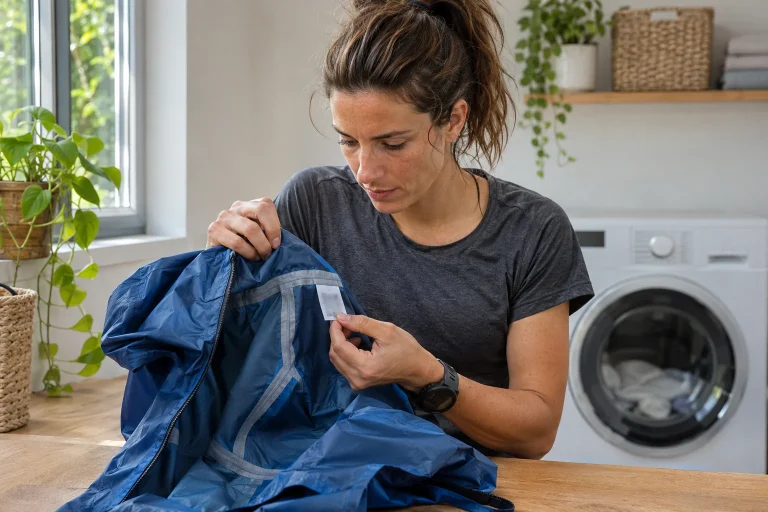
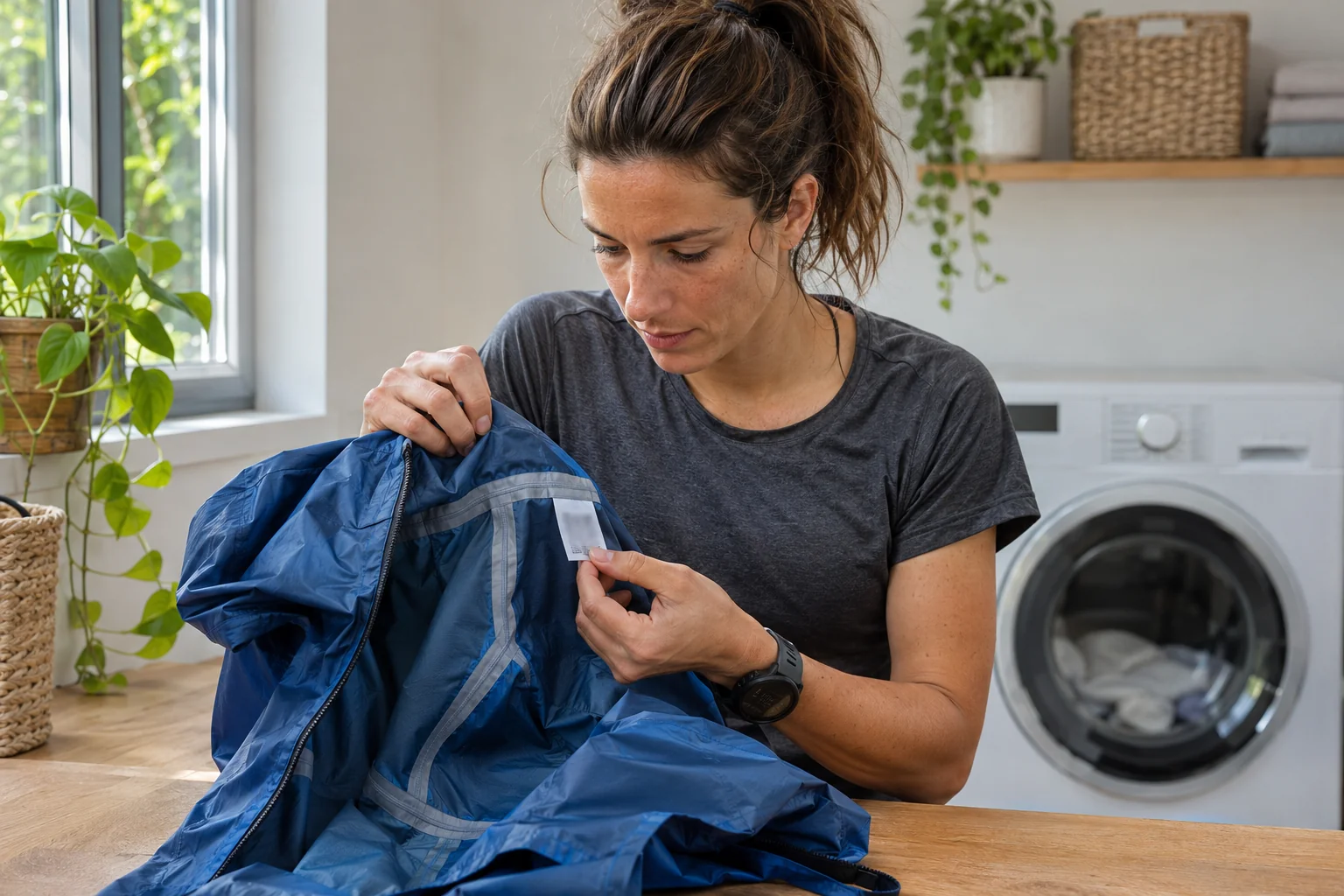
If you plan care because water repellency has changed, start with the jacket’s own label and the manufacturer’s current instructions. Precise identification matters because instructions should not automatically be copied even between similar-looking versions or members of the same product family. This article therefore gives no universal drying temperature, washing frequency or chemical recommended for every membrane.
Name the purpose of care too. Are you discussing cleaning, restoring surface water repellency according to instructions, or repairing actual damage? These are different tasks. Even correctly performed care should not be expected to repair a structural fault the procedure is not intended to address. If the instructions leave the situation unclear, manufacturer discussion is more sensible than trying several recipes one after another.
Briefly document the change: which exact instructions you followed, what step occurred and what surface behaviour you observed afterwards. The note does not thereby become a laboratory report. Its value is avoiding reconstruction from memory later and accidentally attaching the wrong care history to a different result.
What should you ask when the claim and experience do not align?
Briefly name the model, the external phenomenon observed and what you noticed—or did not examine—inside. “It does not bead” is less precise than saying the outer shoulder fabric became darker while droplets remained elsewhere. If the manufacturer requests photographs, add a wider view identifying the affected garment area alongside the close-up.
For example, ask: “For my model, what care or assessment step does this surface change warrant? Which instructions should I follow, and what condition should I document beforehand?” This enquiry does not demand a predetermined fault name. It requests an answer tied to the garment’s condition and the manufacturer’s own guidance. If assessment is recommended, clarify its process separately.
Distinguishing wet-out from leakage therefore does not dismiss your experience. It allows external water absorption, comfort during wear and possible moisture inside to remain in their appropriate places. Droplet behaviour is a useful sign, but cannot tell the whole jacket’s story alone. Precise observation produces a question for which a focused, verifiable answer can be sought.
Sources and editorial scope
For distinguishing the surface from waterproof construction, we used Arc’teryx’s official DWR explanation; for wet-out in the context of care, Patagonia’s own waterproof-clothing guide; and for separating testing criteria, Patagonia’s H₂No performance-testing description. These explain the manufacturers’ own products and systems; they are not shared care instructions for every jacket. The observation table and cases are our own editorial aids, not fault-diagnosis tests. Checked: 21 November 2026.
How Futószív articles are prepared: our editorial guidelines.