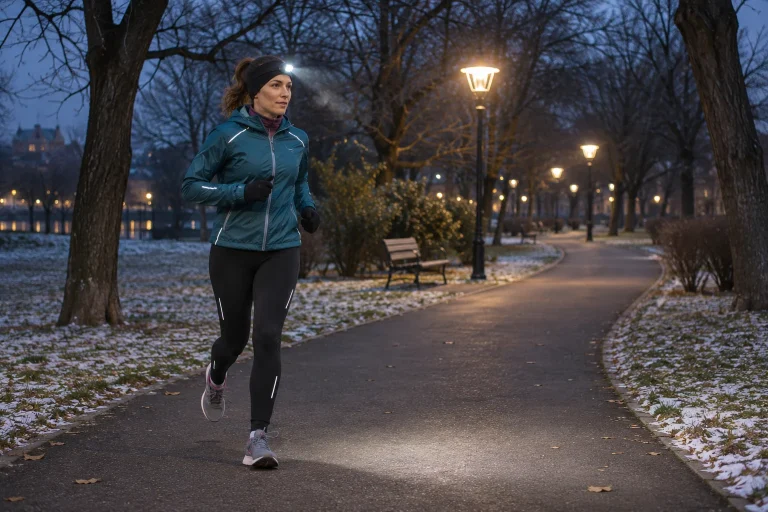
Under grey skies, the thermometer often does not decide how running will feel. The same air can feel very different in a sheltered park, on an open embankment and on a long, rainy descent. Clothing therefore needs to do more than cover the body with as many layers as possible. It must manage moisture inside, rain outside and wind while letting you move freely. A good system often has fewer, more purposeful pieces. This guide supports everyday decisions; no jacket turns extreme weather into suitable running conditions.
Plan the route before the clothes
Before leaving, check the local forecast, expected rainfall timing and wind gusts, not merely the colour of a phone weather icon. In Hungary, the current HungaroMet warnings provide a useful starting point. A forecast is not a personal guarantee, and a route may include particularly exposed stretches. With thunderstorms, dangerous gusts, ice or rising streams, changing place and time is worth more than any clothing upgrade. A usual loop does not necessarily remain suitable in every kind of weather.
Ask what happens if running becomes walking too. A minor symptom, losing the route or a closure can slow you, changing the clothing’s job compared with continuous movement. Turning home is easier on a short urban loop; on a remote woodland route, reserves and reliable return matter more. You can plan shorter loops near home, choose shelter or postpone. This adapts training to circumstances rather than abandoning preparation. The clothing plan then has a real task and a realistic view of risk.
Three functions, not necessarily three garments
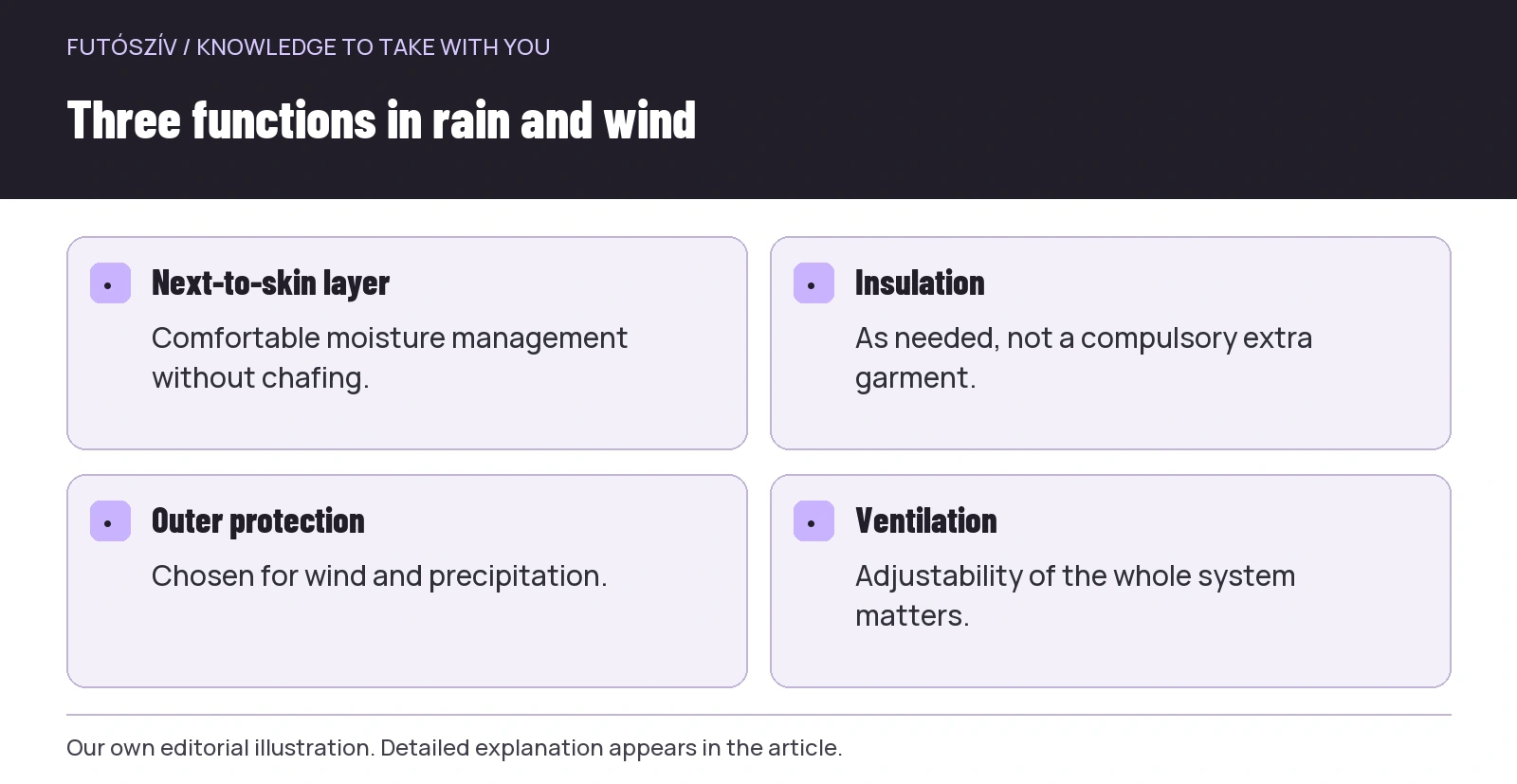
The first function is managing moisture near the skin. The second is insulation when needed; the third, protection from wind and precipitation. In mild rain during harder running, a separate middle layer may be unnecessary; slower activity in cool conditions may call for more insulation. No temperature-to-garment chart suits every runner. Personal warmth, route, intensity and available shelter change the combination. Choose layers by function rather than count.
Assess a next-to-skin top’s comfort while moving. It should not bunch at the armpits, rub the neck or need constant pulling down at the waist. Seams under a jacket and vest straps can overlap, so try the combination together. A top draping well in a shop mirror may ride up while running. Raise your arms, lean slightly forward, turn sideways and imitate easy arm swing. Free movement is not worth trading for a fashionable cut that needs constant adjustment.
 Enlarge diagram
Text version of the illustration
- Next-to-skin layer
- Comfortable moisture management without chafing.
- Insulation
- As needed, not a compulsory extra garment.
- Outer protection
- Chosen for wind and precipitation.
- Ventilation
- Adjustability of the whole system matters.
Windproof, water-repellent and waterproof: different things
These terms indicate different tasks. A light wind jacket may work well on a dry, windy loop without protecting you through prolonged rain. Rain can initially bead on a water-repellent surface while the material system itself is not waterproof. A waterproof jacket’s full construction, seams, zips and openings determine usability together. Look beyond one impressive word on the product page. Find the exact protection the manufacturer claims and the conditions under which it applies.
The GORE-TEX DWR explanation distinguishes the outer water-repellent treatment from the membrane providing waterproofing. This helps interpret a wet outer fabric: its colour change alone cannot establish membrane failure. Equally, beading water does not establish that the whole jacket is flawless. Moisture inside may come from external entry, internal vapour or several factors. Observe its location and use conditions rather than declaring one cause immediately.
Ventilation is more than a material property
Even a “breathable” jacket cannot remove unlimited exercise moisture. Usable zips, vents, cuffs and cut therefore matter greatly. Test whether you can reach the zip one-handed or with gloves, and whether a vest covers the only vent. If adjustment requires removing the entire garment, changing intensity is harder to accommodate. After a short climb, timely ventilation and a suitable pace may be needed rather than another garment.
A very loose jacket may flap and interfere, while an overly tight one may restrict layering or ride up. Intended use determines the compromise. Bring your running vest to the fitting. If wearing it under the jacket, check space; if over it, check accessible pockets and vents. The two arrangements solve different problems. A catalogue photograph cannot inspect where your own equipment bunches or obstructs movement.
A hood seems a small detail until the wind blows
Do not test a hood only standing still. Turn your head, look sideways, lean forward and notice whether it follows or slides over your face. A rim blocking vision interferes at junctions and on rocky trails. Very stiff or noisy material may make surrounding sounds harder to hear too. Adjustment should be understandable and reachable without removing the whole jacket. Loose cord ends should not strike your face, and adjusters should not press uncomfortably on your head.
A peaked cap can help keep rain from the face in some setups, but is not compulsory and does not replace a good hood. With glasses, test misting and water across your field of view separately. For night running, check headtorch and hood together: does the beam move, can you reach the switch and does nearby fabric reflect it distractingly? The right solution lets you observe your surroundings well, not merely feel your head is covered.
Trousers and socks belong to the system too
Even excellent upper-body protection leaves running uncomfortable if soaked trousers become heavy, the waistband slips or water enters shoes. Cut, pocket placement and range of movement again matter more than a general label. Waterproof trousers are not needed for every rainy run: consider duration, warmth and setting. A fully enclosed combination may increase internal moisture, so examine ventilation and ease of putting the garment on. Do not try to fill a shoe tightly with excessively thick socks afterwards.
If many puddles are expected, consider a route avoiding unnecessary soaking. Waterproof shoes do not prevent every entry point: water can enter from above around the ankle too. In another situation, protection from external moisture may be useful. Do not turn waterproof versus non-waterproof shoes into a general debate of belief. Adapt to expected surfaces, water depth and run length. Do not first test a new sock–shoe combination on a long, remote route where correcting rubbing or tightness is difficult.
| Situation | Consider this first | What to assess in the clothing |
|---|---|---|
| A short urban shower | Turning home and changing | Comfortable ventilation and necessary protection |
| A longer, exposed route | Forecast, shelter and the ability to stop | The full combination and dry reserves |
| Changing intensity | When do you warm up and slow down? | Easily adjustable zips and layers |
| Strong gusts | Is the location safe at all? | A jacket does not solve environmental danger |
 Enlarge diagram
Text version of the illustration
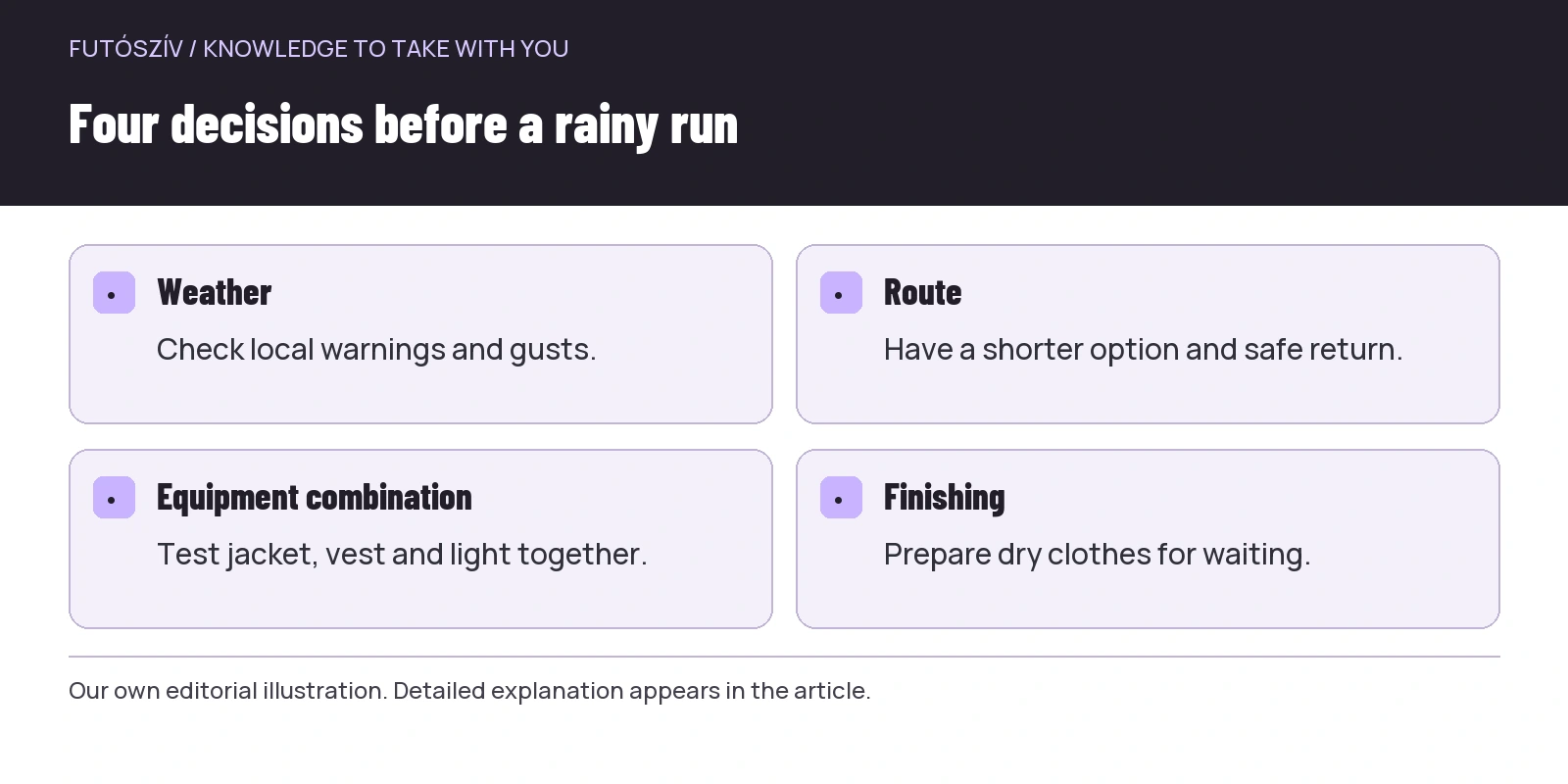
- Weather
- Check local warnings and gusts.
- Route
- Have a shorter option and safe return.
- Equipment combination
- Test jacket, vest and light together.
- Finishing
- Prepare dry clothes for waiting.
Wind changes the environment too
An exposed bridge, woodland and pavement beside construction bring different hazards. In strong winds, branches and windblown objects are risks; the Met Office wind-safety guidance therefore emphasises following warnings and adapting caution to the location. A windproof jacket does not make woodland safe. If overhead or sideways hazards are hard to judge, find another training option. Completing the original route at any cost is not the task.
Wind direction can change how running feels and how hard the return becomes. Think beforehand about where you will be far from home and where a more sheltered alternative exists. Pace need not stay identical in all conditions. You can adapt the planned task by perceived effort when the original pace becomes pointlessly hard in wind. Clothing is affected too: ventilation needs differ during hard effort and when easing off. Sometimes adjusting training is the useful regulator instead of a jacket.
Phone, keys and dry clothing
Do not assume every pocket and zip in a waterproof jacket equally protects its contents. Check the specific product information and choose appropriate separate protection for sensitive electronics. Test the packaging at home first: can you use it with wet hands, might the phone slip out and does it fit where needed? Keys and phone should not strike each other while running. A longer route needs arrangements serving an anticipated interruption and return too, not only an ideal, trouble-free run.
Include finishing in the plan. If returning to a car, public transport or a longer walk, a dry top and appropriate outer layer can be more useful than another technical jacket specification. Keep the change genuinely dry, rather than in the same soaking bag as wet equipment. For a short home-based loop, a prepared towel and clothes may suffice. An organised finish reduces the likelihood of solving tired, wet and hurried what was easy to arrange beforehand.
Washing and drying: follow the label
Technical fabrics need different care, so read the garment’s own label. The GORE-TEX outerwear guidance gives detailed washing, drying and water-repellency restoration steps, but also asks users to follow the clothing manufacturer’s instructions. Do not automatically copy what worked for another jacket. If a coating, seam tape or zip seems faulty, manufacturer service or suitable repair may help more than repeated, increasingly harsh treatment.
After running, open out and dry the combination as instructed. Leaving a wet jacket crumpled is not a care plan. Notice small faults early: document loose stitching, a faulty adjuster or separation and investigate repair. Do not regard maintenance as a final attempt before replacement. A good clothing system consists of familiar pieces you know how to wear, adjust, store and care for. This makes rainy running more predictable; fashionable adjectives alone do not.
Sources and further reading
- HungaroMet: current severe-weather warnings
- GORE-TEX: DWR and waterproofing
- GORE-TEX: outerwear care
- Met Office: safety in strong wind
How Futószív articles are prepared: our editorial guidelines.