It is easy to ask whether the WalkingPad C2 fits under a sofa. The more useful question is whether you will take it out on an ordinary Tuesday. A folding walking pad moves into your home with recurring small tasks as well as dimensions: you make space, check its surroundings, use it, stop it and put it away. We therefore read the C2 instructions through the lens of daily storage. This is not our own durability test, but a decision framework you can try against the realities of a small home and working from home.
The C2 is for walking: start your space planning there
The UK manufacturer’s product page describes the C2 as a walking model with a maximum speed of 6 km/h. The listed 120 × 40 cm walking surface and 100 kg capacity do not by themselves establish whether it will feel comfortable for you. These are size and limit specifications to check against your own unit’s documentation. The manufacturer’s US questions and answers also distinguish walking from models offered for running.
This affects its place in your home too. If you are choosing the C2 for a desk, the main question is creating a manageable walking workstation. If you want it to replace winter running workouts, the purchasing goal is already inaccurate. Working-day walking can be a separate activity for runners, but that does not make it the same training as running on a suitable machine. Consider planning the two alongside our article on the role of walking within a training week.
Your own use statement should be short and specific: for example, you want to handle a few easier telephone conversations while walking. You can then measure where that could happen. If the statement already includes fast running, a steep incline or constant handrail support, you also need to investigate another type of equipment. Compactness is useful only when the device’s intended purpose and your task genuinely meet.
You need three plans: operation, moving and storage
Draw the room in three different states. The first is ready for operation, including the desk and clear walkways. The second is the area used to fold and move the stopped machine. The third is storage, when the device has no active task. A single drawing of its folded rectangle completely hides problems with the first two states. In a small home, the space needed for transitions is often the bottleneck.
The UK manufacturer’s manual opened on 21 November 2026 identifies model WPS1F. Its safety diagram shows at least 2000 mm of clear space behind and at least 600 mm on each side. Linking this to a precise document matters because older C2 instructions with different distances also exist online. Follow the valid instructions supplied with your own machine and ask the seller to clarify any contradiction.
An original illustrative calculation: adding 60 cm on either side of the 51.8 cm external width listed in the US specification produces a strip 171.8 cm wide. The 144.5 cm machine length plus the stated 200 cm rear clearance totals 344.5 cm. This is not a complete installation plan, does not validate desk placement and does not override other manual requirements. It shows how different the machine’s narrow body is from the operating environment considered alongside the instructions.
Folding does not mean permission to store it upright
The safety page of the UK manufacturer’s C2 manual prohibits both vertical placement and placing it on its side. This is one of the article’s most important storage distinctions. A design that folds in half does not mean the machine can be stood behind a door or against a wall. Nor can storage options for other WalkingPad models automatically be transferred to the C2. A retailer’s photograph or general ‘space-saving’ label does not override the manual’s diagram.
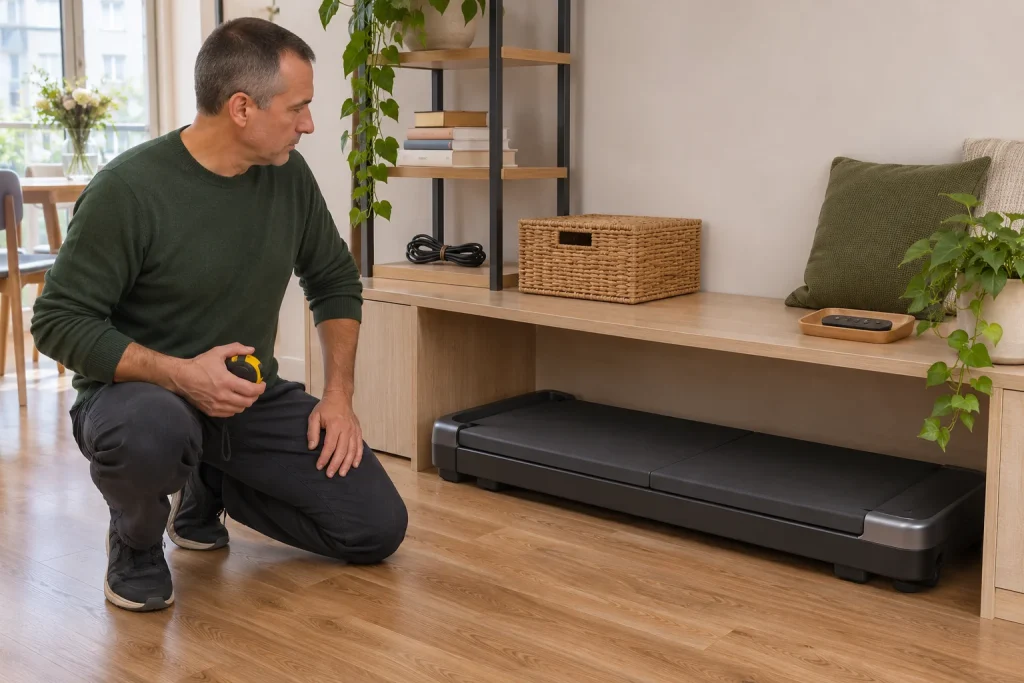
The UK product page gives a folded height of 13.6 cm. When measuring storage, do not look only for the sofa’s highest opening: its lowest internal brace, trim and the route for sliding the machine in all matter. If the opening exactly matches the nominal height, a match on paper does not ensure easy handling. Measure at several points and assess the full external dimensions in the storage position specified for the machine.
A practical trial before buying is to mark the stored device’s space with cardboard. You are not trying to replicate a working machine; you want to see whether you can access a cupboard, leave space for the vacuum cleaner and avoid turning a walkway into an obstacle course. Cardboard does not prove the machine’s mobility or strength, but quickly reveals clashes in household use that a product page cannot show.
 Enlarge image
Transport wheels do not lift it over a threshold for you
The UK C2 page lists a weight of 25 kg, while the table in the opened WPS1F manual states 26 kg. We do not average these values or claim every market has the same version. Check your own unit’s specification. The practical conclusion remains clear: wheels do not turn an object weighing tens of kilograms into lightweight hand luggage, particularly at corners, thresholds or changes in level.
Inspect the moving route as carefully as the final position. A narrow corridor or projecting door leading to roomy storage can make daily access difficult. Note every point where the machine must turn, be lifted or have another object moved out of its way. Follow the manufacturer’s holding and moving method; do not rely on the hinge, display housing or a dangling cable to support the device.
If the daily route includes stairs, treat that as a separate purchasing obstacle. ‘I will just carry it up’ is not enough. Delivery, placement and whether repeated changes of level will be needed must be clarified beforehand. This is not a strength competition. A routine beginning with heavy lifting before every use may lead to less frequent use; that is a consideration about your home, not a claim about C2 durability.
Stopping and putting away are separate actions
The UK manual indicates switching off before folding and unplugging when not in use. The exact sequence is always determined by your own version’s instructions. The daily principle is that you do not start adjusting storage around a machine that is still moving or could start unexpectedly. A completed workout on your phone, a sleeping display and a disconnected machine are different states.
Give the cable a designated place too. A loose lead can catch during moving or cross a passage once the machine reaches its operating position. Putting away should therefore finish not merely when the machine disappears under the sofa, but when the machine, accessories and route are orderly. We are not proposing a DIY alteration, but household organisation that prevents the next use beginning with untangling a cable.
It is worth writing down the daily routine briefly, without turning it into improvised servicing instructions. Stopping according to the manual, appropriate moving and designated storage can be three reminders. If a stiff hinge, damaged cable or misaligned belt interrupts the process, faster folding will not solve it. The appropriate next step is the documented support route rather than continuing use.
Remote, machine display and app: give each its place
The US C2 specification describes a built-in LED display and handheld remote, while the model comparison lists app, FootSense and remote control. The display provides information; the remote is one direct control tool; the app may provide additional settings and data views. These should not be merged into one ‘smart connection’ label, because you need them at different points in daily use.
Give the remote a permanent, accessible storage place that other household members will not confuse with a drawer of unused electronics. The manufacturer’s FAQ specifies a CR2032 battery for the C2; check the marking on your own remote and keep batteries away from children. If the remote disappears, having a phone does not prove every function can be controlled identically or that you will immediately find a working connection.
Do not learn automatic mode as a workaround for a missing remote. The manufacturer prioritises familiarisation with manual operation, while FootSense controls speed according to position. First learn your own machine’s behaviour without working. Uncertain controls will not become safer because there is a laptop on the desk. Add the work task only after operating the device is clear on its own.
Check quietness where you intend to use it
A product page promising quiet operation is not a noise assessment in your home. The manufacturer’s FAQ also mentions the roles of model, speed, user, floor covering and maintenance in noise. For your own decision, separately consider the sound reaching someone on a call, the noise in the room and what people hear in another room. We do not claim our own decibel measurements or results about disturbance to neighbours for this model.
During a permitted trial, ask for feedback in the same room, with the same microphone and calling app you would later use. Ask whether speech is clear and whether a distracting, repetitive sound is audible. The other person’s answer is practical experience of that setup, not a standardised acoustic measurement. This distinction prevents treating one successful call as proof of quietness in every home.
A soft rug is not automatically a solution. The manual requires level placement and prohibits thick, soft support, so choosing an appropriate accessory needs to follow the specific model’s documentation. Do not stack rugs to make an advertising promise work. Position, a correctly chosen flooring solution and necessary maintenance need to be considered together; sound can be meaningfully assessed in the real environment.
 Enlarge image
Children, pets and a shared living room: storage is also a state of use
The manual specifies one user, prohibits use together with pets and asks that children do not play with the machine. This remains an important household consideration when the device is in a living room rather than a gym. Putting away the remote or using an app lock does not by itself replace appropriate supervision and management of access.
Do not treat the stored machine as furniture, a seat or a play surface. As a household-planning question, consider who can access it, whether someone might step on it accidentally and whether it hides something another person uses daily. Discuss its position clearly with others. ‘It is not switched on’ does not answer whether someone might trip, put objects on it or move it for another purpose.
If the shared space is free only at certain times, include that in the buying plan. The C2 may fit your day well a few times a week, while an all-day workstation is unrealistic. Fewer well-organised sessions can be a more sensible aim than constant use in a space the family actually needs for other things too. Your home’s routines, not the machine’s marketing name, determine available time.
Measure the routine’s cost in time too
An original fictional working-day example: preparing the space takes two minutes and putting the machine away properly takes three. At five sessions a week, that is 25 minutes, or 100 minutes over four weeks. These are not measurements made on a C2, nor an attempt to judge five minutes as too much or too little. They show why a simple, repeatable storage route may be more valuable than a few centimetres’ difference in folded catalogue dimensions.
During the trial, record preparation time separately from actual walking. If seven minutes of a ten-minute opportunity go into arranging furniture, the result differs from a setup where taking out the machine is easy. Do not rush safety steps to improve the time. Instead, consider whether you need another location or equipment type. Usage time is not a competitive event, and savings must not come at the expense of documented conditions.
There is a strong personal argument for the C2 when the walking task is suitable, the complete operating space exists, approved storage works and taking it out realistically fits your day. If you like only the folded photograph, the decision is unfinished. A well-measured space under a sofa and a calm, workable daily routine may say more about likely use than the number of colours on the product page.
Sources and document version
Checked on 21 November 2026. The UK manufacturer’s manual is marked WPS1F; relevant pages were also checked as images. The example calculations are original illustrations, not installation certifications. The documentation supplied for the specific unit takes precedence.
- WalkingPad C2 UK manufacturer’s product page
- WalkingPad C2 US specifications and model-specific questions
- Manufacturer’s WalkingPad C2 manual, WPS1F: operation and safety diagrams
- The manufacturer’s manual-selection page
- WalkingPad FAQ: accessories, FootSense, noise and power supply
- Official model comparison
How Futószív articles are prepared: our editorial guidelines.