The more experienced a runner becomes, the easier it is to regard walking as insignificant transport or interrupted running. Yet walking can fulfil several roles: a short movement break at work, a shared evening outing, deliberate walking during a steep race or an all-day mountain hike. The same word covers very different tasks.
Your running results therefore do not determine walking’s place. Its purpose, workload and effect on the rest of the week matter. Walking fitted well can keep movement in life beyond a race plan. An outing that quietly grows longer can instead consume the freshness intended for the next session.
Do not let running erase everyday movement
Even with a morning run, you may spend long hours sitting. Walking during the day answers a different question from a tempo session: it interrupts stationary time and provides movement otherwise absent. Every such minute need not compete as another workout.
In a short laboratory experiment involving nineteen middle-aged adults living with overweight or obesity, interrupting prolonged sitting with regular brief walks was associated with more favourable post-meal glucose and insulin responses. The study was not a performance test in experienced runners and does not prove a few walks remove every sitting-related risk.
The usable idea is simpler: training and the rest of the day are separate planning areas. You can walk during a call, do an errand on foot or include a movement break. These need not become new performance targets to belong in the day.
Walking is not automatically easy
Comfortable flat walking and brisk climbing differ in intensity. The CDC physical-activity information provides guidance on relative effort too: moderate intensity typically allows talking, while singing is harder. This is general public-health guidance, not a personalised running-training zone.
For a fit runner, flat walking may be very easy while a steep climb is demanding. Watch breathing, overall effort and leg loading rather than the name. Your watch’s “walking” category does not erase fatigue.
Unfamiliarity matters similarly. If you rarely hike, a long rocky descent may be entirely new even if you run fast on the flat. Running experience is not a universal entry ticket to every terrain and duration.
Name four roles separately
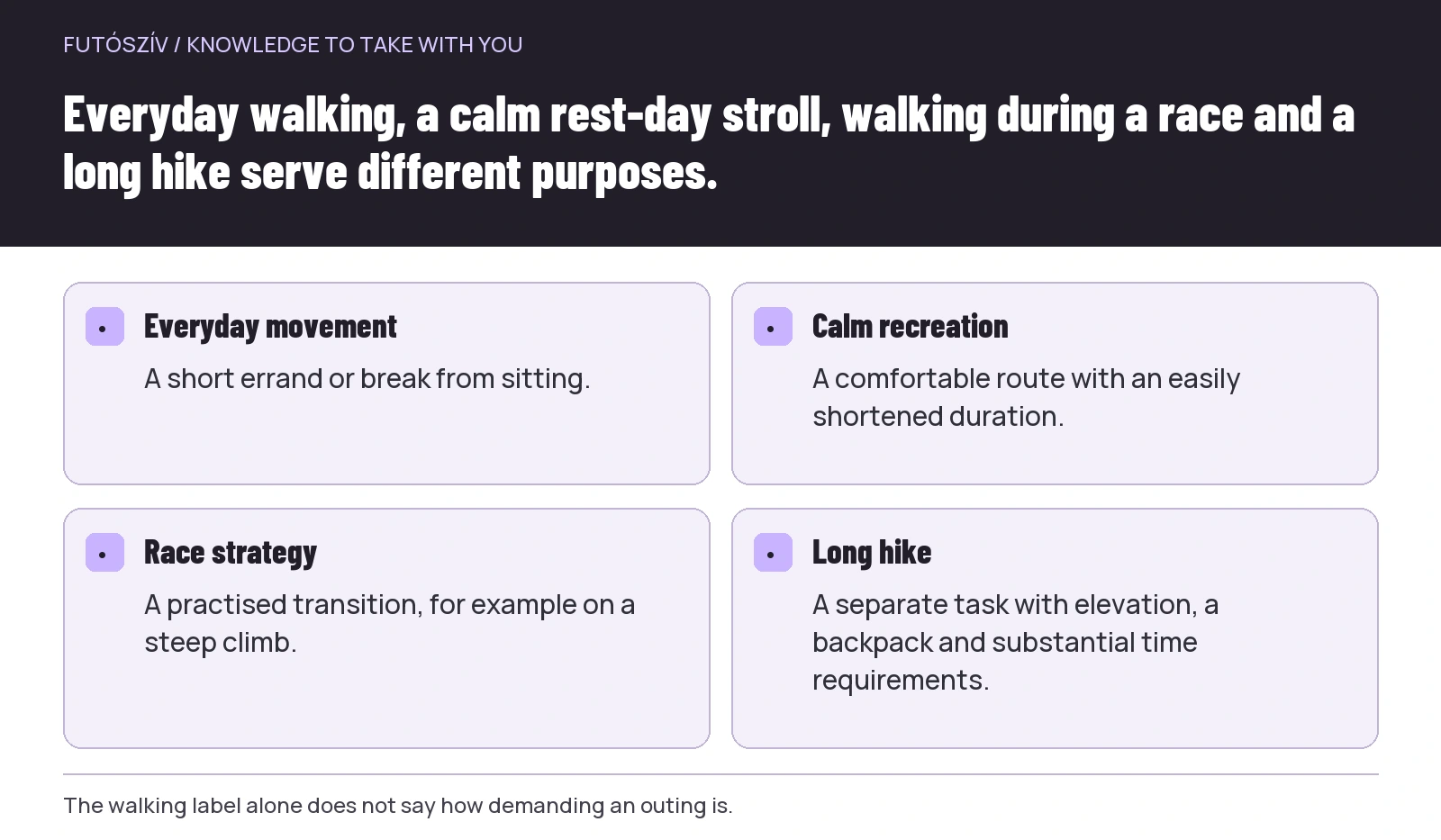
First comes everyday movement: short journeys, small walks and breaks from sitting. Second is deliberately calm recreation, where an easily shortened route and comfortable pace matter more than distance. Third is walking considered in advance within a run or race.
Fourth is a standalone walking-sport programme, such as a long hike. View this as separate workload. Spending all day in the mountains with substantial elevation and a backpack is not a rest day simply because you never ran.
The categories support decisions. You need not record every detail of every walk, but make new, long or demanding outings visible. This avoids discovering during the next disappointing interval session that the weekend activity was actually a large task.
 Enlarge diagram
Text version of the illustration
- Everyday movement
- A short errand or break from sitting.
- Calm recreation
- A comfortable route with an easily shortened duration.
- Race strategy
- A practised transition, for example on a steep climb.
- Long hike
- A separate task with elevation, a backpack and substantial time requirements.
Walking steep climbs can be deliberate
A laboratory study measured running and walking energy demand on very steep inclines. At the vertical speed tested, walking was more economical above certain gradients. The research finding is not a universal slope threshold for every terrain and runner: speed and testing conditions matter too.
On trails, ground, bends, traffic and safety also influence choice. On a steep technical climb, the best strategy need not resemble flat running most closely. The goal may be more even effort and retaining control for the next section.
If your race is likely to include walking, practise it on familiar manageable terrain. Observe more than faster progress: make transitions from running to walking and back orderly. Do not turn practice into a compulsory maximal climbing test.
A walking section is not a health guarantee
An experiment in forty-two non-elite marathon runners found no clear finishing-time difference between run–walk and continuous running, while run–walk participants reported less muscle pain and fatigue. The cardiovascular stress markers examined did not establish a protective effect, however. The study therefore does not support “walking breaks make a marathon safe”.
Walking can help distribute effort, but does not authorise continuing with warning symptoms. Chest symptoms, feeling faint, unusually severe breathlessness or other concerning illness make stopping and appropriate help more important than retaining the original strategy.
A race transition should have a practical reason and prior trial. If your goal is continuous even running on the flat, you need not walk simply because it worked for somebody else. If walking belongs to your plan, do not treat it as failure.
Movement arrangements matter at aid stations too
Walking may help handle a crowded aid station more calmly, but suddenly stopping in others’ path can create danger. Examine how the field is moving before reaching it and move predictably under organiser instructions.
Before the race, practise taking a cup, slowing and comfortably returning to running. This is a logistical skill as well as a pacing question. The training approach should fit the actual event’s supplies.
You need not walk an identical duration at every station if the task and your experience suggest otherwise. The aim is considered fuelling and orderly progress. Panicked sprinting to recover lost seconds can undermine exactly that calm.
A rest day should not have a secret distance target
If reducing workload is the day’s purpose, a walk fits while genuinely manageable and calm. Choose a route you can shorten and drop the idea of a daily record. Walking need not prove you used the day productively enough.
A step counter can easily create another obligation. If you set off again at night because a few hundred steps are missing from an arbitrary threshold, ask whether it serves the day’s purpose. A measure describes behaviour; it does not provide a useful instruction in every situation.
Having no separate walk on a rest day is fine too. Life circumstances, sleep, fatigue and the next day’s task all matter. Recovery need not be earned through more movement every time.
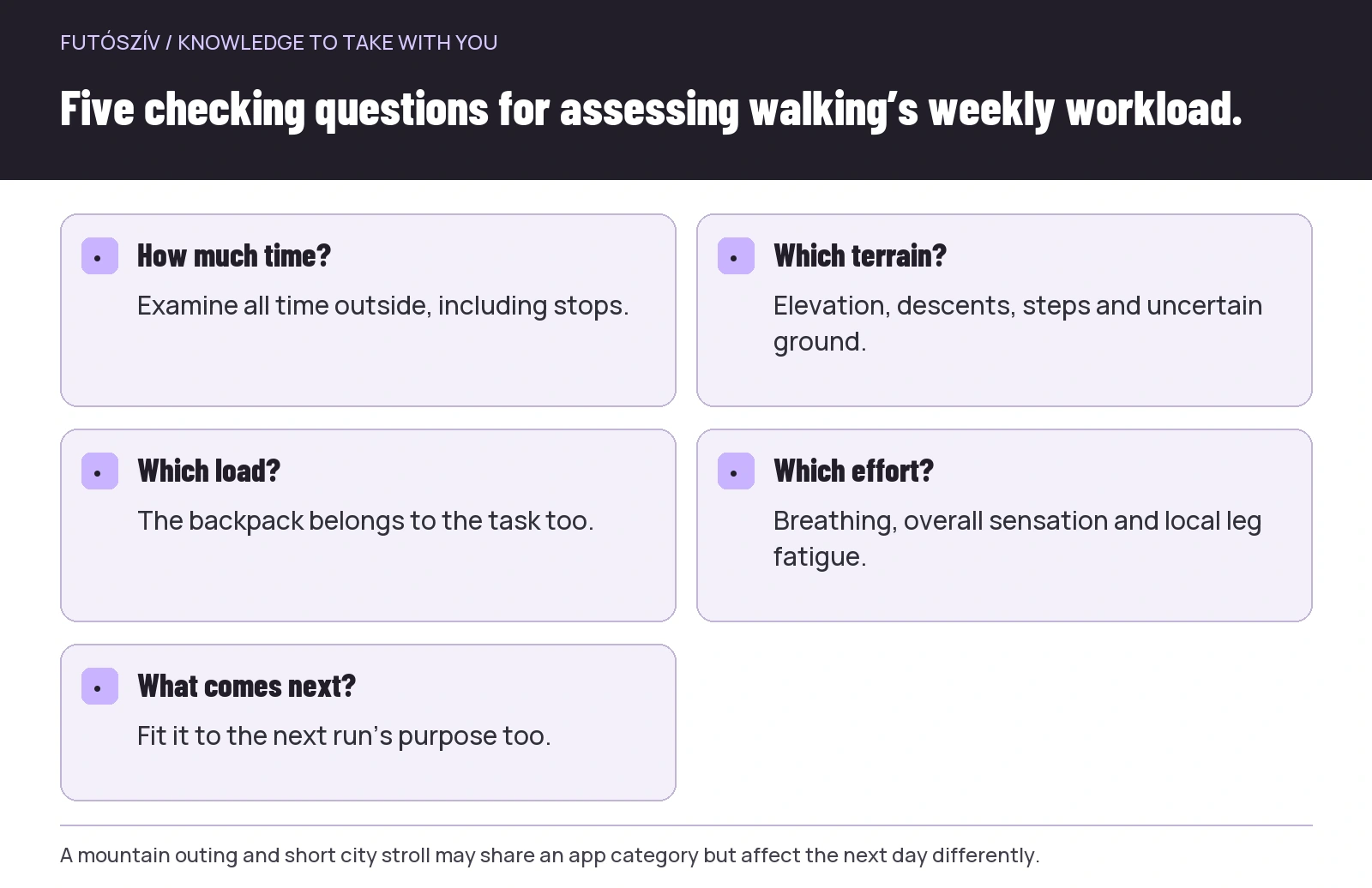 Enlarge diagram
Text version of the illustration
- How much time?
- Examine all time outside, including stops.
- Which terrain?
- Elevation, descents, steps and uncertain ground.
- Which load?
- The backpack belongs to the task too.
- Which effort?
- Breathing, overall sensation and local leg fatigue.
- What comes next?
- Fit it to the next run’s purpose too.
All-day sightseeing remains in your legs too
On race weekends, walking can become invisible: station, race-pack collection, exhibition, sightseeing and finding a restaurant. Individually none appears to be training; together they may involve much standing and walking. If the race matters, organise the programme to retain rest.
You need not shut yourself in a hotel room. Group tasks beforehand, choose transport for longer journeys and allow seated breaks. Agree with supporters which shared activities fit the day before the start.
For later result evaluation, note a substantial departure from your usual time on your feet. This avoids attributing a harder-feeling run solely to the training plan. The race experience also develops in the hours before the line.
A long hike requires separate preparation
Duration, elevation, descents, ground and carried load shape a hike together. Examine the route, turnaround options and current conditions. Completing a ten-kilometre road race well does not show how you tolerate hours of mountain walking.
If unfamiliar, treat it as a new training stimulus rather than automatically placing it beside the hardest running week. After initial experience, the next day’s condition helps decide future placement. Extensive descent and long uninterrupted progress can be particularly new demands.
The group’s purpose matters too. Do not turn a relaxed family outing into a hidden fast march, or promise a sporting hiking group progress estimated solely from running results. Shared activity works when participants mean the same day.
Fit it into the week through three simple decisions
First name the role: transport, recreation, specific practice or a separate long programme. Second, examine the run that follows and whether the order needs changing. Third, leave room to adapt duration to current condition.
An easy everyday walk often fits without special planning. A new multi-hour hike needs a place in advance. A race-specific walking section should be named within the relevant workout so it is not confused with accidentally tiring.
In next week’s review, look beyond pace. Did important runs retain quality? Was the shared outing enjoyable? Did it become another compulsion? Judge walking’s benefit against its selected role rather than one universal performance metric.
If walking causes symptoms too
Walking is not a symptom-free alternative in every situation. If replacing a run because of a new complaint but pain remains or condition worsens, do not automatically call it good rehabilitation. Permitted activity and the need for assessment are individual questions.
The same applies to persistent unusual exhaustion. An even longer walk is not necessarily the right response to running feeling impossible that day. Review workload and life circumstances, and seek appropriate healthcare help for prolonged or worrying symptoms.
One useful skill of an experienced runner is choosing movement for the task and adjusting the task where needed. Walking is not inferior running within this. It has a role of its own in the day, preparation and life outside running.
Primary sources
- Energetics of vertical kilometer foot races; is steeper cheaper? – laboratory comparison on steep inclines.
- Does a run/walk strategy decrease cardiac stress during a marathon in non-elite runners? – examination of a specific marathon strategy.
- Breaking Up Prolonged Sitting Reduces Postprandial Glucose and Insulin Responses – short laboratory experiment with specified participants.
- CDC: What Counts as Physical Activity for Adults – general intensity and activity guidance.
How Futószív articles are prepared: our editorial guidelines.