The first half-hour feels easy; later, the same pace demands more attention and effort. On a longer run, what matters is not only the condition you start in, but also how well you preserve the functions needed to perform as the effort continues. Durability puts this time-dependent aspect at the centre.
The term does not mean enjoying suffering or ignoring symptoms. The question is how, and by how much, the characteristics of your running change during a defined task. An observation becomes useful information when the pace, environment and preceding circumstances are known too.
Fresh ability and ability you can sustain
A laboratory assessment or shorter test can show what you can do when relatively fresh. A long run asks a different question: how much of that ability remains available later? The two situations are connected, but they are not automatically equivalent.
A study conducted before and after marathon running found changes in several physiological measures during a standardised submaximal test. The research followed a particular exercise task, so it does not provide a percentage decline that applies to everyone. It does, however, illustrate the difference between fresh and fatigued conditions.
In everyday training, this does not mean you should regularly run a marathon as a test. The important point is to avoid explaining the end of a longer effort solely in terms of willpower. The duration and distribution of the workload are factors in their own right.
What do researchers mean by durability?
In the literature, durability often means resistance to physiological deterioration during prolonged exercise. Measurements might concern the cost of running or changes in the speed–duration relationship, for example. Different studies do not necessarily examine the same measure or time window.
A study of the durability of runners’ speed–duration relationship used a performance test after a prolonged preliminary exercise bout. This is a targeted research procedure, not a compulsory home test. You should not independently copy an all-out assessment on the basis of a general article.
When an article says durability improved, look for exactly what improved. A smaller change in a measure of running economy, the outcome of a later intense test and subjective fatigue are not the same thing. The measure behind the term is what makes the claim interpretable.
Perceived fatigue matters, but it is not a complete measurement system
Perceived effort can provide plenty of useful information about how an exercise bout unfolds. Towards the end of a longer run, effort can feel greater even if your pace stays the same. This is not necessarily failure, but it does not by itself identify the precise physiological cause of the change.
The experience can be influenced by attention, the monotony of the route, the previous day, the environment and familiarity with the task. Two supposedly identical feelings of fatigue may therefore arise in different situations. In your log, describe when and how the feeling changed, rather than simply recording that it was hard.
Persistent, unusual exhaustion is not the same as the expected difficulty towards the end of a long training run. If it also affects everyday functioning, recurs or cannot be explained by the known workload, an individual health and training assessment may be needed.
 Enlarge diagram
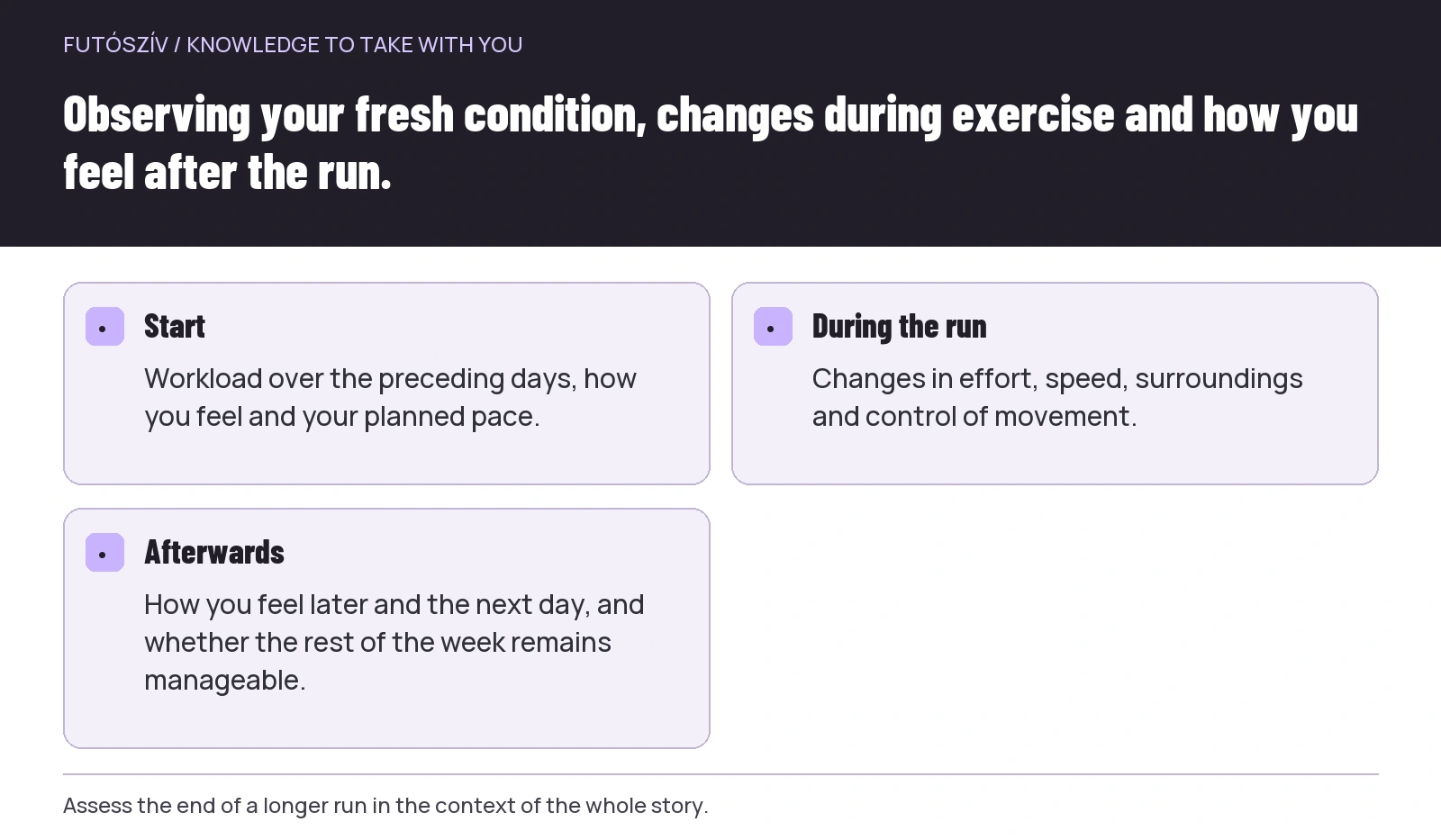
Text version of the illustration
- Start
- Workload over the preceding days, how you feel and your planned pace.
- During the run
- Changes in effort, speed, surroundings and control of movement.
- Afterwards
- How you feel later and the next day, and whether the rest of the week remains manageable.
Why look beyond heart-rate drift?
Your heart rate may change during a longer run at a roughly constant speed. This is an interesting observation, but it is not a single, unambiguous durability score in every environment. Heat stress, fluid balance, changes in speed and sensor accuracy can all influence it.
If you compare the first and second halves, check the terrain and wind direction. A hilly second section is a different situation from repeating the same flat loop. Do not try to hide the conditions of the measurement behind a percentage.
Low drift does not provide permission for unlimited exertion either. Fatigue in other parts of the body, problems with energy availability, pain or reduced concentration can still occur. Interpret cardiovascular data alongside the complete situation.
Changes in the cost of running are a separate question
Running economy in a fresh state examines how much a given pace costs. Its durability can also be measured during prolonged exercise. A study in trained male runners compared different expressions of oxygen and energy cost during prolonged running.
The study also highlights the importance of the measurement method. If different measures are used, the magnitude and interpretation of the change may differ too. A statement such as “I deteriorated by twenty per cent by the end” should always specify exactly which measure changed.
Out on a route, heart rate or the sensation of movement is not a direct measurement of energy cost. You can use them as warning signs or planning cues, but do not claim laboratory precision for them. Real experience remains valuable even when the exact metabolic cost is unknown.
Changes in speed also affect technique data
If you slow down towards the end of a run, stride length, ground contact and other movement characteristics may naturally change. Not every difference represents an independent breakdown in technique. First ask how much your speed and the terrain themselves changed.
A short video or running-dynamics graph therefore needs context. Comparing an earlier, faster section on flat ground with a later, slower section on a hill can easily lead to a mistaken conclusion. Matching the observation conditions helps avoid a false explanation.
If your movement changes enough that your footing becomes uncertain, you limp or compensate because of pain, a practical decision is needed. You do not need to keep running simply to complete the remaining distance.
Your starting pace helps shape your later condition
Starting too fast can use up the reserve you would need towards the end of a long run. This is not solely a psychological mistake: it creates a different workload across the whole task. Time gained early cannot always be retained at a low cost.
A suitable start reflects your own recent background and the conditions on the day. If the plan is a comfortable, sustained run, the first part should not turn into a pace test celebrating how fresh you feel. Restraint here prepares you for the work still to come.
Afterwards, look at when the run became harder and what preceded it. Was there a long climb, a fast section with companions or a strong headwind? The complete story often teaches you more than the drop in pace at the end alone.
Fuel and fluids are part of the conditions
Well-planned fuelling and hydration can matter during prolonged exercise, but requirements depend on the task and individual circumstances. When observing fatigue, also record when and what you actually managed to consume, and whether you had digestive difficulties.
Deliberately supplying too little to prove your tolerance is not a useful test. Developing durability does not mean ignoring basic needs. Familiar, well-tolerated approaches can be gradually adapted to the circumstances of your target race.
Do not treat fluids as unlimited protection either: excessive drinking can also be dangerous. If you have an individual medical condition, take medication or have recurring symptoms, discuss your fuelling and hydration arrangements with a professional. This article is not a personalised nutrition prescription.
 Enlarge diagram
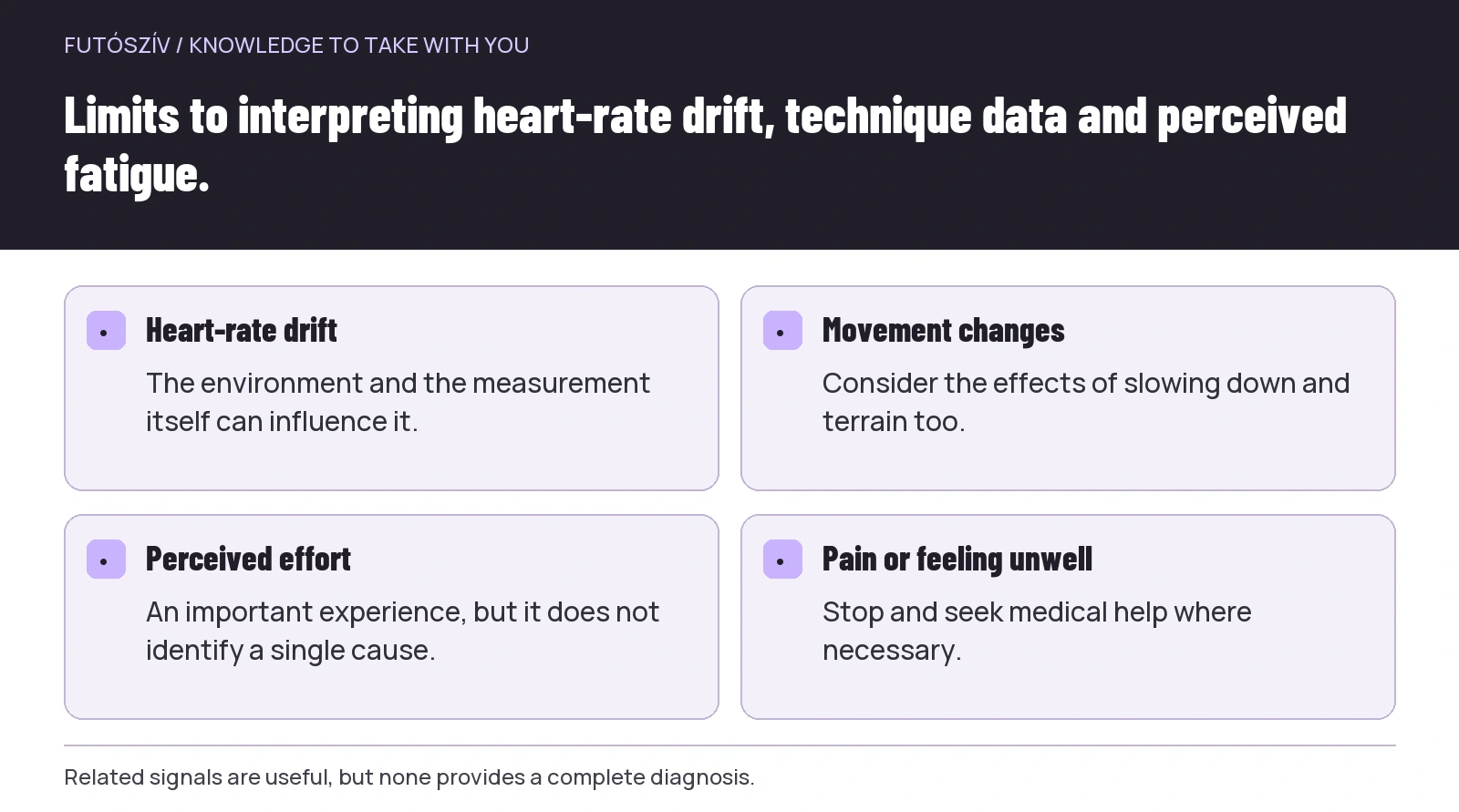
Text version of the illustration
- Heart-rate drift
- The environment and the measurement itself can influence it.
- Movement changes
- Consider the effects of slowing down and terrain too.
- Perceived effort
- An important experience, but it does not identify a single cause.
- Pain or feeling unwell
- Stop and seek medical help where necessary.
The same run can unfold differently in the heat
The same route and pace can impose a greater strain in hot weather. The CDC’s heat guidance for athletes emphasises adjusting exercise, monitoring conditions and taking symptoms of heat illness seriously. Environmental stress is not a test of a runner’s character.
Do not automatically compare a hot day with a cool one as though your fitness were the only thing that could have changed. Shortening the main part, reducing speed or postponing the run may be appropriate adjustments. The kilometres in your plan do not protect you from heat stress.
Confusion, collapse or severe illness requires urgent help. Continuing the run or doing “one more lap” is not a reasonable observation method in that situation. Assessing symptoms always takes priority over analysing training data.
How can durability develop?
The foundation is running training built consistently around your goal, rather than one special, exhausting session. A longer run can serve a useful purpose only when its preparation and recovery are manageable too. Increasing volume and intensity together makes it difficult to control what has changed.
A randomised study in trained male runners also assessed the addition of strength training in relation to the durability of running economy and performance after prolonged running. The finding belongs to a specific programme; it does not mean every exercise or every runner produces the same response.
The practical question is therefore what your own system is missing. It could be consistent easy running, gradual adjustment to volume, sufficient rest or a well-integrated strength programme. To answer that, it helps to look at the whole week.
Observation without an exhausting home test
Choose a familiar, manageable run that you would do as part of your programme anyway. Briefly notice your effort, control of movement and the conditions at the start, middle and end. Do not extend the run merely to ensure a dramatic deterioration.
A few sentences may be enough for your log: breathing became harder in the final section, but pace and movement stayed controlled; or pain changed your stride after the descent. These two cases mean different things, even if the final average pace is similar.
Repeated, similar experiences can help shape the next plan. If every longer run prevents your usual movement for several days, however, reassess the overall workload. Durability is not the same as accumulating a recovery debt.
When should you stop treating it as normal fatigue?
Increasing, clearly localised pain, limping, repeated dizziness or unusual illness is not simply a sign of a hard session. Stop running and seek help appropriate to the severity of the symptom. Serious chest or breathing symptoms may require urgent care.
Do not automatically dismiss recurring performance decline as weak mental resilience either. Sleep, energy availability, total workload and health can all be relevant. Identifying the causes requires an individual assessment, not a general online diagnosis.
Useful durability means that the functions needed for your goal remain manageable and controlled for longer. Another sign of progress can be recognising more accurately when you need to adjust. Regulating effort is as much a running skill as holding a pace.
Sources
- Effects of marathon running on running economy and kinematics.
- Using the 3-Minute All-Out Test to Explore the Durability of the Speed-Duration Relationship.
- Durability of Running Economy: Differences between Quantification Methods and Performance Status.
- Strength Training Improves Running Economy Durability.
- CDC: Heat and Athletes.
How Futószív articles are prepared: our editorial guidelines.