
After a successful first five kilometres, ten is a natural idea. Or perhaps you have raced five kilometres for years and now seek another challenge. These situations differ greatly: in one, five kilometres is a new longest run; in the other, it is a short racing distance within a more stable training system.
Do not let the two numbers on an entry page determine your next step. First examine what foundation your current running provides and how much time you can sustainably devote to the coming period. Your goal can be a first controlled ten kilometres; you need not immediately sustain your previous five-kilometre pace twice as long.
Two different questions: completing or racing?
Completing ten kilometres more comfortably and achieving your best possible ten-kilometre time require different emphases. In the first case, manageable longer movement and routine may be central. In the second, a pace suited to current ability and specific training can play larger roles.
Write your goal precisely. “I want to finish safely with controlled pacing” is no less valuable than a specific time target. If you are still becoming familiar with the distance, it leaves more room for learning and adapting to circumstances.
The goal may change later, but do not raise expectations after every successful workout. First develop useful experience of longer running. Entering a race does not by itself impose a deadline for your body to adapt immediately to every new demand.
What does five kilometres mean in your previous weeks?
Review the actual runs of recent weeks: how many sessions, how long they lasted and which was the biggest task. If five kilometres was a one-off major effort, the starting point differs from one in which several easy runs are natural parts of your week.
How you felt afterwards matters too. General well-being, unusual fatigue and any symptoms are more important than the desired distance being completed on a map. A repeatable routine provides a better foundation than completing one outing at any cost.
Include other sports and everyday demands too. If you stand a lot, do physical work or train in other ways, the running plan is only part of the picture. Fit the longer run’s extra time into the whole day.
Doubling distance does not imply the same pace
If you ran five kilometres in twenty-five minutes at full effort, completing ten in under fifty is not an automatic next step. Twice the distance at the same average pace takes twice the time, but learning and preparation are still needed to make the task sustainable.
Performance estimation also depends on the method. In a study of twenty-seven male recreational runners, even stage length during treadmill testing influenced how closely measured peak speed related to five- and ten-kilometre performance. The research demonstrates the importance of measurement conditions rather than simple distance multiplication.
Choose realistic, adjustable expectations for a first longer race. An estimate can guide you, but should not promise more than your background supports. Current running sensations and the environment still matter.
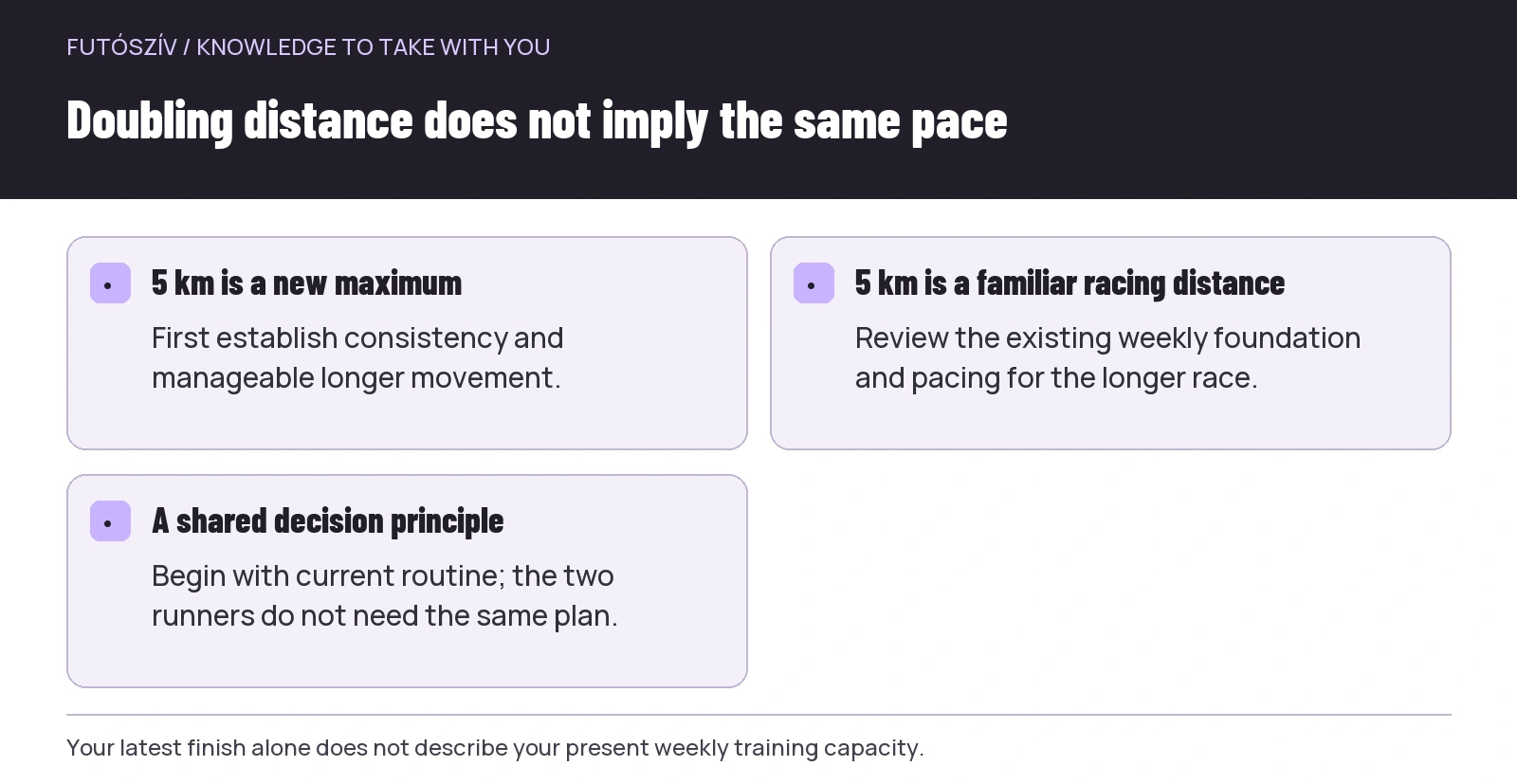 Enlarge diagram
Text version of the illustration
- 5 km is a new maximum
- First establish consistency and manageable longer movement.
- 5 km is a familiar racing distance
- Review the existing weekly foundation and pacing for the longer race.
- A shared decision principle
- Begin with current routine; the two runners do not need the same plan.
First establish the system, then enlarge the task
If your current running week is irregular, do not compensate by abruptly extending the longest outing. First find a rhythm that actually happens. A few consistent, manageable sessions teach more about your capacity than increasingly large weekend challenges placed between missed runs.
Alongside running days, plan their full time commitment. Setting out, changing and post-run tasks together need a longer slot than watch-recorded moving time. A sustainable plan does not leave this to chance.
If you want to add time, do not automatically take it from sleep. A different sequence, shorter route or freer weekend slot may work better. A longer distance becomes an enjoyable goal when it is not built from constant rushing.
Make each extension an observable step
Choose a change whose effect you can interpret. This might be moderately lengthening one session or stabilising your existing routine. If distance, frequency, pace and terrain difficulty all increase together, identifying the cause of unusual fatigue becomes hard.
Review the longest run’s recent history separately too. An observational study following more than five thousand runners associated larger jumps in a single session’s distance with increased overuse-injury occurrence. This is not an individual safety threshold, nor does it mean every risk disappears below a particular percentage.
Do not choose a bigger run because the calendar says it is time to reach ten. Decide from completed previous sessions, well-being and after-effects. Repeating a step can also belong to the plan when needed.
Do not turn the longer easy run into a hidden race
While becoming accustomed to the new duration, keep effort appropriate to the task. If you always chase your old five-kilometre record pace at the end, the day’s purpose changes. You add intense load to the distance completed.
A familiar route that is easy to shorten can help initial attempts. A park with repeatable loops or a route with turn-back options offers more decision freedom than an excessively long loop whose points all require a major detour home.
Do not regard uncertainty during running as something you must overcome. If new symptoms appear or you feel unusually worse, adjust the task and obtain appropriate help if needed. A line drawn on a map does not override current condition.
Do you need a new fast workout immediately?
If becoming accustomed to longer movement is the main goal, you may not need to introduce another intense task simultaneously. Begin with the existing, appropriately managed training system. Entering ten kilometres does not automatically require more hard days.
In a ten-week training study involving thirty endurance runners, ten-kilometre time improved under two different intensity distributions; the difference between the complete groups was not clear. This gives no beginner transition schedule, but does not support the idea that only one intensity recipe can work.
If more targeted pace work enters later, define its role and place. Do not let everything else quietly accumulate alongside the new longer run. Match the rate of programme progression to your own experience.
Longer time outdoors brings practical questions too
Think through clothing, weather, available toilets and the journey home. Something comfortable on a short loop may become distracting over longer time. A practice run is a good opportunity to observe these rather than leaving everything to race day.
Adapt drink and food questions to expected running time, conditions and your individual situation. The name “ten kilometres” does not mean an identical duration for everyone. Do not copy a faster runner’s routine or introduce an unnecessarily complex fuelling system solely because the distance is longer.
If uncertain, or a health circumstance affects fuelling or hydration, seek appropriate professional advice. You can record the tried solution and conditions in your training diary too. The next longer run then does not begin with more guesswork.
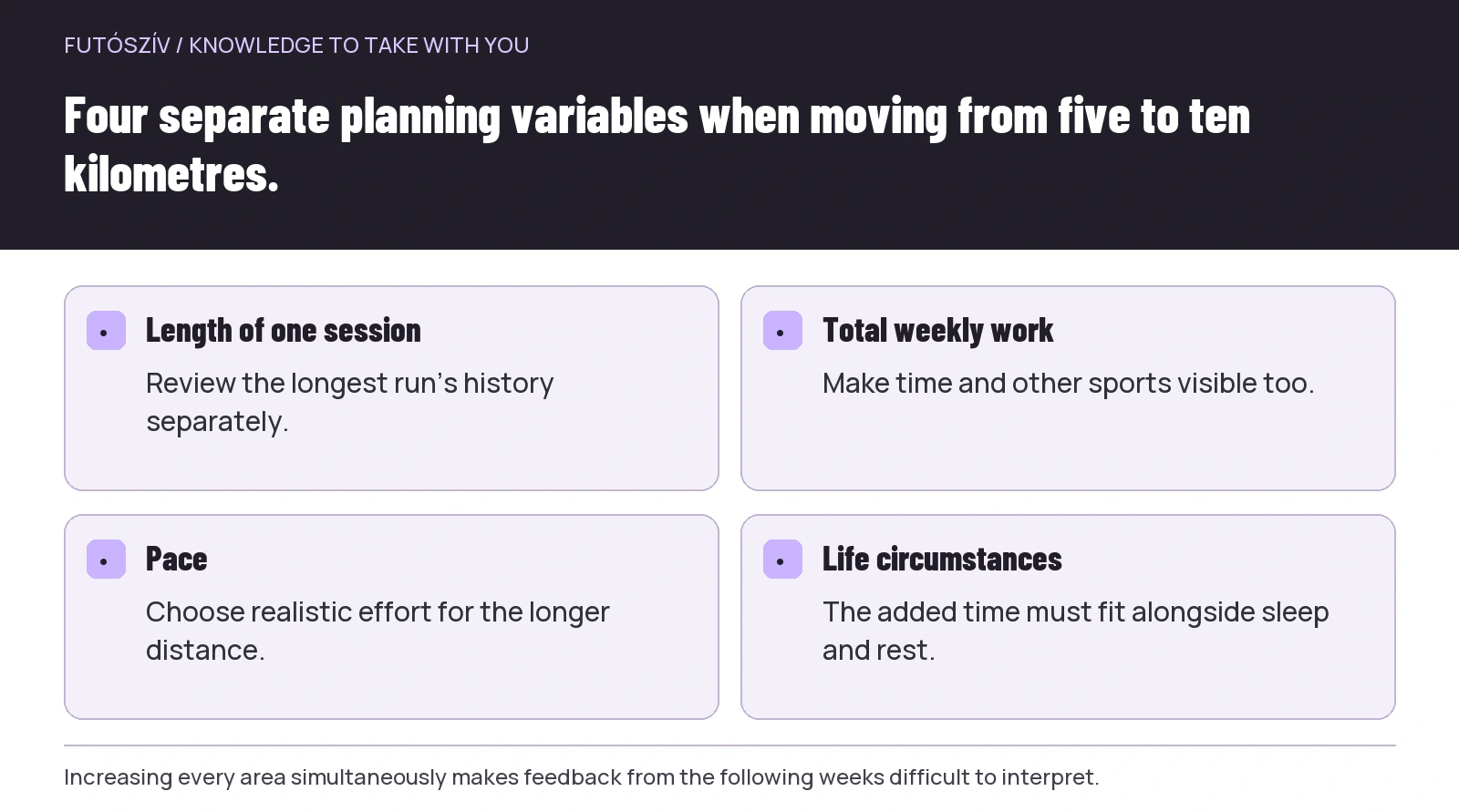 Enlarge diagram
Text version of the illustration
- Length of one session
- Review the longest run’s history separately.
- Total weekly work
- Make time and other sports visible too.
- Pace
- Choose realistic effort for the longer distance.
- Life circumstances
- The added time must fit alongside sleep and rest.
Let the first race serve learning
Learn the official course, starting arrangements, available refreshments and any time limit. These are current organiser details; check the event’s own platform before entering and starting. Experience from another race may not apply identically.
Keep the post-start aim simple: controlled progress, recognising your own effort and the realistic opening chosen beforehand. Do not try to make the first five kilometres a separate personal best when today’s task is managing the whole ten.
Decide later from the actual situation. Accelerating is an option, not an obligation. Allowing several acceptable outcomes beforehand makes adapting the race to conditions easier without treating every change as failure.
Three different starting situations
You have just completed five for the first time: the next period may focus on consistency and manageable longer movement. You need not immediately set a tight time goal. Let the date of your first ten kilometres follow how the routine actually develops.
You run regularly, but rarely for longer: review where a gradually developed longer outing fits. Evaluate existing fast work too, so the new duration is not merely extra load.
You already run ten kilometres easily but now want to race: completing the distance for the first time is not the main question. Realistic pace, specific tasks and pacing can come to the fore. The same “from five kilometres to ten” title may cover three different programmes.
Do not let making up missed runs drive your weeks
If a run is missed, the next day does not have to become longer. When preparing for a greater distance, it is especially easy to feel every lost kilometre threatens the entry. Accumulated catch-up work, however, creates a new situation rather than restoring the original plan.
Look at why the session was missed, what happened instead and which next task matters. A sensible programme adjustment may help more than achieving the original weekly total at any cost. If working with a coach, report the actual situation.
If the preparation window becomes too narrow, the race goal or date can change too. Entry cost and an earlier resolution do not make every new load appropriate. The longer distance remains available as a later goal.
How can you tell you are progressing well?
A more consistent running week, better-controlled longer outings and manageable following days can be positive signs. A new distance record or faster average is unnecessary every week. Stability is an outcome in itself.
Look for recurring difficulties in the diary too: symptoms always appearing in the same place, the week falling apart after the longer run or steadily less sleep. These are not merely compulsory companions of improvement. You can change the plan, and persistent or concerning symptoms require appropriate help.
After the first ten kilometres, review the whole process. What helped you get there, what was hard to sustain and what goal do you want next? You need not double again. Ten kilometres can remain an interesting, varied and enjoyable running task over the long term.
Primary sources
- Does polarized training improve performance in recreational runners? – a ten-week comparison of two intensity distributions.
- Incremental test design, peak ‘aerobic’ running speed and endurance performance in runners – the relationship between measurement protocol and performance estimation.
- How much running is too much? Identifying high-risk running sessions in a 5200-person cohort study – observational risk associations, not an individual safety threshold.
How Futószív articles are prepared: our editorial guidelines.