The history of running events is often told through winners, records and growing fields. A runner who crosses the finish line appears in the results, while the work of people out on the course is often less visible. Yet organising a shared run requires many different tasks, from recording times to welcoming participants. The history of volunteers is an important part of how this works.
Different periods and events have not all used the same division of labour, and even today not every on-site task is a volunteer role. An accurate account requires specific documents. The examples of a small, recurring community gathering and a large city race together show how volunteering can contribute to organising running and sustaining its communities.
For people to take part, someone has to make the event happen
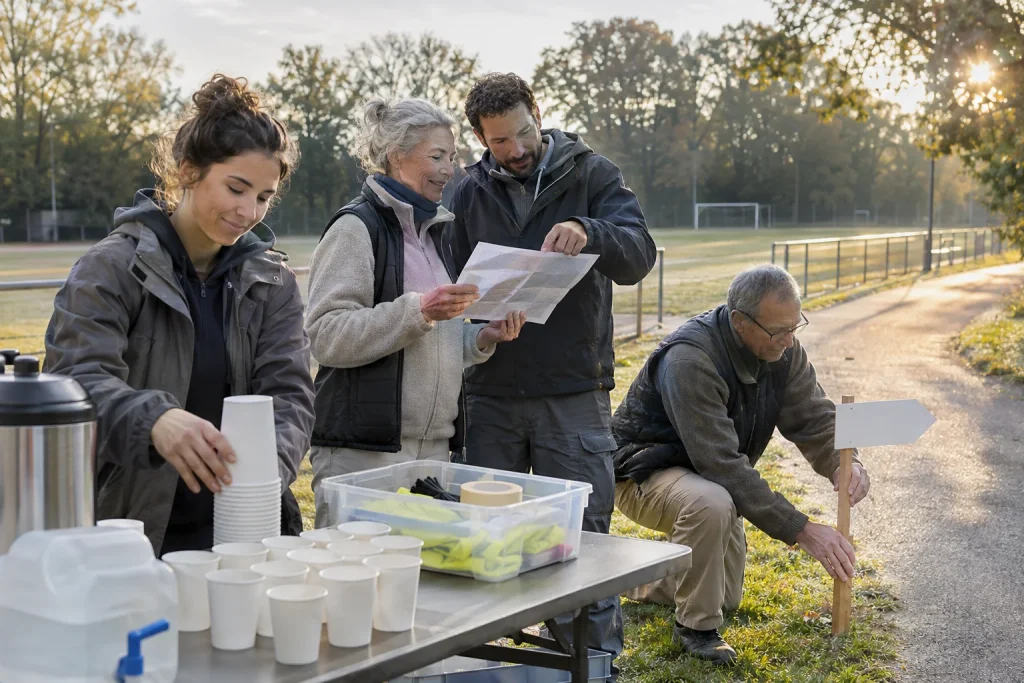
A starting point, a defined route and a results list may seem simple. Each involves work: someone prepares the venue, provides clear information, records data or puts the space back in order at the end of the day. When these steps work well, participants often overlook them precisely because they feel natural.
Understanding volunteers’ place in sporting history therefore takes more than counting them. We also need to examine what their work made possible. One person providing information in the right place makes a different contribution from a larger group handling bags together. The function of individual roles can reveal more about an event’s operation than a single total.
When recounting the history, distinguish between the organising leadership, employed specialists, public authorities’ duties and volunteer roles. You cannot put every on-site helper in the same category simply because they wear a vest. Documents from the particular event show who worked in which capacity. This makes the significance of volunteering more precise; it does not diminish it.
Bushy Park, 2004: helping was a distinct role even at a small event
The historical account in parkrun’s own magazine states that 13 runners and five volunteers attended the first gathering in Bushy Park on 2 October 2004. In the initiative then called the Bushy Park Time Trial, results were recorded with pen and paper and simple tokens were used at the finish. This is a specific historical example of an event in which running and organising already went together, even with a small field.
This does not mean that every subsequent event grew out of the same model. What makes the example interesting is that volunteering appears as more than an emergency solution for huge crowds. Even at the start of a friendly community initiative, some people needed to take on the work that allowed the gathering to function while others ran.
Holding the event repeatedly introduced another consideration. Organising a single occasion and sustaining a regularly recurring event are different tasks. In the latter case, it also matters how knowledge can be passed on and participation kept manageable. Regularity requires more than first-day enthusiasm: the roles must remain possible to fill, time after time.
From paper to apps, the purpose of the task can remain
Changing technology can alter how a helper works, but it does not automatically remove the need for human attention. Results still require accurate data and identification, and participants still need understandable information on site. Even with a new tool, people need to know their task and what to do if something is uncertain.
It is therefore useful to connect the history of technology with that of volunteering without treating one as a substitute for the other. Electronic data collection can transform some work while creating other tasks. Procedures, checks and contact with participants remain organisational questions. Saying that ‘machines do everything now’ tells us too little about an actual event.
For runners, the practical lesson is straightforward: follow the instructions even when the system works well. If an event uses a separate process to match your passage data with your identifier, every step may matter. The person working behind the scenes is not important only when you notice a mistake; their work also matters when nothing unusual happens.
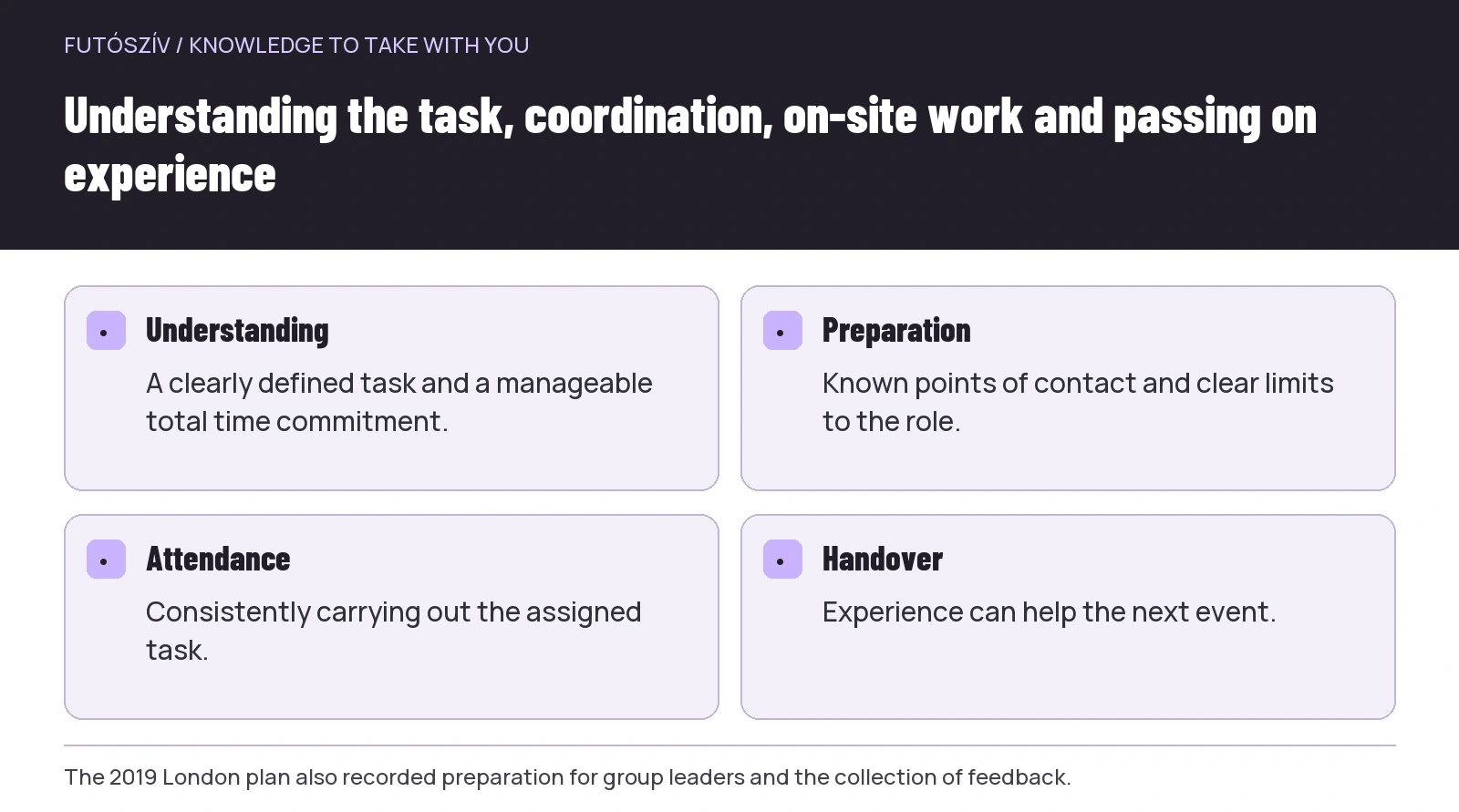 Enlarge diagram
Text version of the illustration
- Understanding
- A clearly defined task and a manageable total time commitment.
- Preparation
- Known points of contact and clear limits to the role.
- Attendance
- Consistently carrying out the assigned task.
- Handover
- Experience can help the next event.
A 2019 London plan makes the work behind the scenes visible
The 2019 event management plan for the Vitality Westminster Mile and London 10,000, available among Transport for London’s public documents, discusses volunteer tasks separately. It includes volunteers in informing spectators and runners, around crossing points and in designated roles. This is a historical example of event operations, rather than a standalone organising manual that can be applied anywhere today.
The plan specifically includes preparing group leaders and incorporating feedback afterwards. This shows that participation involves more than turning up on event day. Preparation, the assigned task, communication and subsequent evaluation together form an organised process. Through their knowledge and experience, volunteers can also contribute to the next event.
A document like this tells a different story from a video showing runners finishing. Its focus is not the celebratory moment but how the day needed to function. The two perspectives together provide a fuller picture. An organising document can be an important source in a race’s history, even if it is less striking than a photograph of victory.
Large events can offer several ways to volunteer
The London Marathon Events volunteering page describes opportunities for both individuals and groups. Its examples include helping along the route, distributing water, handing out finishers’ medals, supporting participants further back in the field and assisting with recycling. This is a snapshot of the organiser’s own system; current listings give the specific opportunities and conditions for applying.
Group participation can also connect clubs, schools and other communities with the event. The work remains a defined responsibility, rather than a leisure activity that can be changed without limits. A group’s shared presence and each person’s assigned role both matter. The clarity of both also forms part of the participant experience.
There is no need to assume that every task is equally difficult or suitable for everyone. The location, time commitment, communication and working environment may differ. One interesting thread in the historical development is precisely how a wider range of roles becomes visible. Someone who does not wish to race, or cannot race, may be able to connect with a running event in another way if the specific conditions allow it.
Helping can also carry knowledge of the sport
A returning helper may learn details that are not obvious to a first-time participant. Where are instructions often misunderstood? Which tasks need clearer information? How do new needs emerge? Such experience becomes lasting organisational knowledge when the event’s system can listen to it and pass it on.
This does not mean that every volunteer can answer any question. The limits of the role and the information that comes with it are important too. Someone carrying out a particular on-site task may not be responsible for changing an entry or handling a technical dispute about results. Directing a participant to the right person can itself be part of good assistance.
As a runner, respect this. Explain specifically what you need and accept that your question may need to be taken elsewhere. A volunteer is not personally responsible for every system at the event. Clear boundaries between tasks help the day remain workable for participants and helpers alike.
An event has a before and an after
For a runner, the time between start and finish may be the centre of the day. Organisational work begins earlier and can continue after the finish. Preparing the venue, arranging information and closing down the space are tasks that do not appear in the race results. The specific roles differ by event, but this difference in timescale is worth remembering.
When reading about volunteering in the past, ask what period a reported figure covers. The number of race-day helpers is not necessarily the same as the number involved in all the preparation. Total shifts and the number of individual people may also be different measures. A large headcount alone does not explain the full range of tasks.
Recognising this invisible time can change a participant’s attitude too. Closing a bag drop or finish area is not simply a decision tailored to one runner’s convenience. Behind it are people’s working schedules and the operation of the whole event. When planning your own day, find out when services are available and act accordingly.
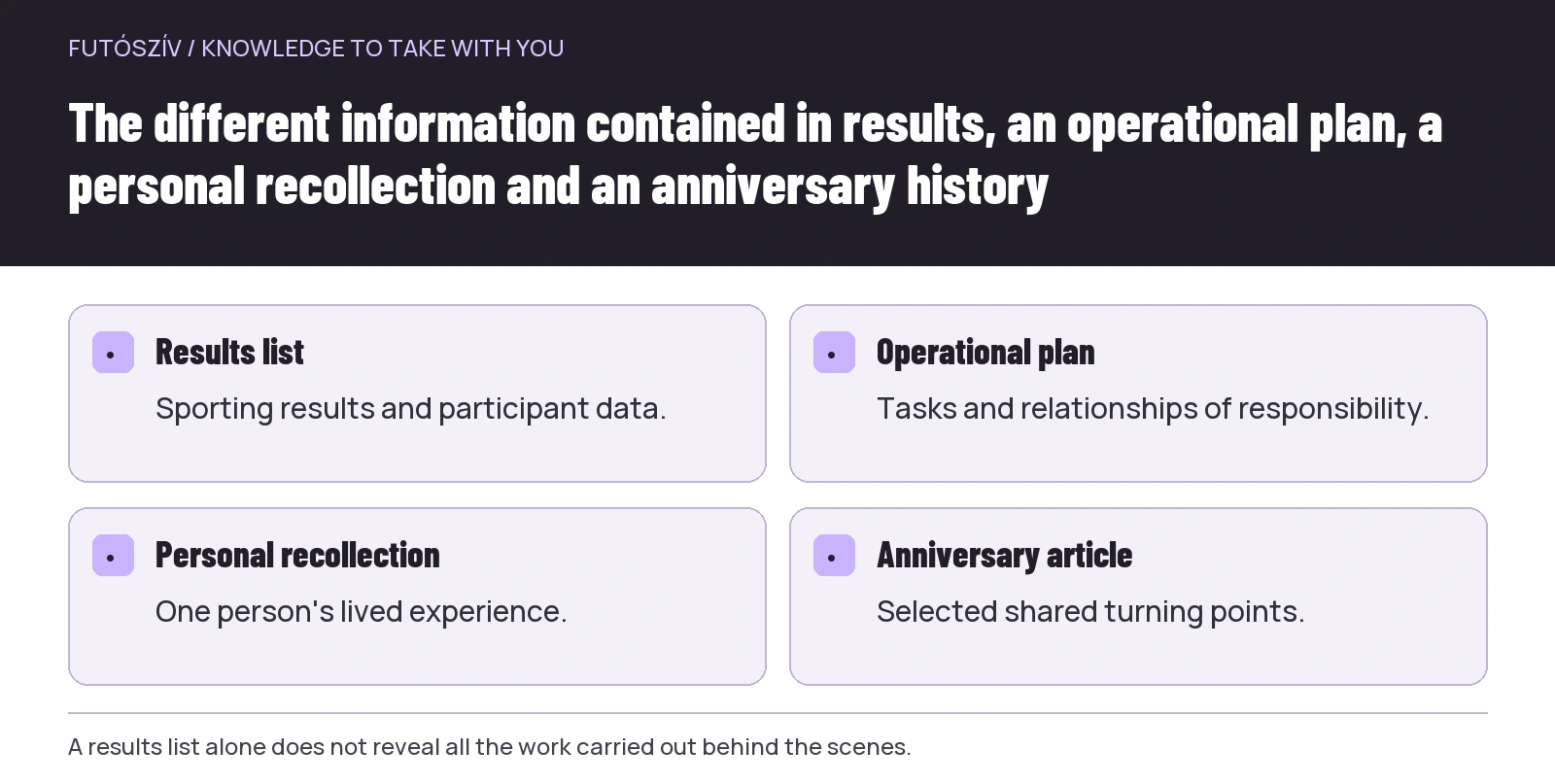 Enlarge diagram
Text version of the illustration
- Results list
- Sporting results and participant data.
- Operational plan
- Tasks and relationships of responsibility.
- Personal recollection
- One person’s lived experience.
- Anniversary article
- Selected shared turning points.
Four documents preserve different details
| Historical source | What can it show? | What might it leave out? |
|---|---|---|
| Results list | Participants’ sporting results. | Most roles carried out behind the scenes. |
| Organising plan | Tasks, responsibilities and operating procedures. | The full range of participants’ personal experiences. |
| A volunteer’s recollection | One person’s experience and lessons learned. | Every other perspective on the whole event. |
| Anniversary history | Turning points highlighted by the organisation. | All the less visible everyday details. |
The table also shows why it is unwise to expect one source to tell the entire story. Reading only the number of finishers will not explain how the work was organised. Looking only at the plan will not tell you exactly how everyone experienced the day. Different types of documents together help create a balanced picture.
An imagined moment: a crossing from the runner’s and helper’s perspectives
Imagine a designated spectator crossing at a fictional event. For the runner, it is a brief section of the full course. For a companion, it may be an important link to the next viewing point. For the helper assigned to the location, however, it is a situation requiring repeated attention and coordination. The three people experience the same space over different timescales.
This is not a standalone traffic-management instruction. The event’s official procedures determine the specific duties and authority. The example shows how a smooth event is made up of many situations that seem brief to participants. What is a moment for one person may be a much longer commitment for another.
A community’s memory is more accurate when it preserves these perspectives too. There is no need to turn every helper into a heroic legend. Recognising the actual work and its circumstances is enough. Specific, factual thanks often say more than general praise that erases every distinction.
Understanding the roles can offer a new way in
If the world of running events interests you, volunteering can be a form of participation worth choosing in its own right. It does not need to be presented as a substitute for people who are not currently running. Knowing the specific task, time commitment and application requirements helps you decide whether it suits you. Current information from the local organiser matters more than a general promise borrowed from an overseas example.
When first enquiring, ask about the role, preparation and points of contact involved. Consider the full time you will need to be present, and communicate your actual limitations. If something is not manageable, it is not a compulsory challenge to complete. Clear, realistic commitments contribute just as much to a community’s sustainable operation as enthusiasm does.
The history of a running event is the work of many people
From the small beginnings in Bushy Park to detailed city event plans, a related question appears at different scales: how does a shared running occasion come into being and remain workable? Volunteers can contribute tasks, attention, repeated attendance and experience. Naming the specific role and period makes that contribution historically visible.
The next time you read about a race anniversary, look for stories of its organisation alongside the winners and headcounts. Who recorded the data, how were groups prepared, and how was experience passed on to the following year? These details help explain how runners’ individual achievements became a shared event that could be organised again and again.
How Futószív articles are prepared: our editorial guidelines.