A male runner’s body needs energy beyond training too
A runner’s daily food needs to cover more than the next kilometre. The whole body’s function, recovery and everyday life require energy too. If sporting demands are persistently not matched by adequate intake, a condition affecting health and performance may develop. This is possible in men as well, even if those around them still regard it mainly as an issue for female athletes.
The 2021 professional consensus on the male athlete triad discusses three interrelated areas: low energy availability, disruption of reproductive hormonal function and impaired bone health. They do not appear in the same form or simultaneously in everyone. The description draws particularly on young male endurance and weight-category athletes.
REDs is broader, potentially involving several physiological and psychological functions. Neither approach is a label a runner can attach to themselves from one poor session or laboratory value. Their usefulness is instead in preventing certain changes from being normalised and encouraging timely professional help.
Why is a hard day not the same as REDs?
The 2023 IOC consensus distinguishes dysfunction associated with problematic, prolonged or severe low energy availability from brief situations involving adaptation. Hunger after a missed lunch is not itself a REDs diagnosis. However, regularly missed meals alongside increasing load can create a pattern needing attention.
Energy availability is not the same as a daily change on the scales and cannot be assessed reliably from a watch’s displayed “calories burned”. Errors in estimating eating and load mean even an attractive calculation can give false reassurance. Do not seek your own diagnostic threshold in an online table.
Evidence concerning men is more limited than we would like in several areas. Automatically transferring a single threshold from female studies to every man is therefore a particularly poor idea. Individual assessment needs history, symptoms, load and medical examination where necessary together; a formula can at most help explain the background.
Three paths that do not necessarily begin with deliberate dieting
The first is daily scheduling: rushing to work after a dawn run, lunch missed between meetings and a quick meal in the evening. A runner may be entirely happy with their body yet regularly underplan eating. The question to resolve is then partly organisational: where is there a genuine place for food in the day?
The second is increased load. A second session appears, weekends become longer and commuting increases, while food habits remain at the earlier level. A routine that once worked well may no longer be enough in new preparation. “I have always eaten this way” does not establish adequacy under changed circumstances.
The third is weight pressure attached to performance. The runner hears that losing a few kilograms will definitely make them faster and introduces more and more eating rules. If rules create fear, isolation or compulsion, this is no longer simply a shopping question. Difficulties involving eating and body image need serious attention too.
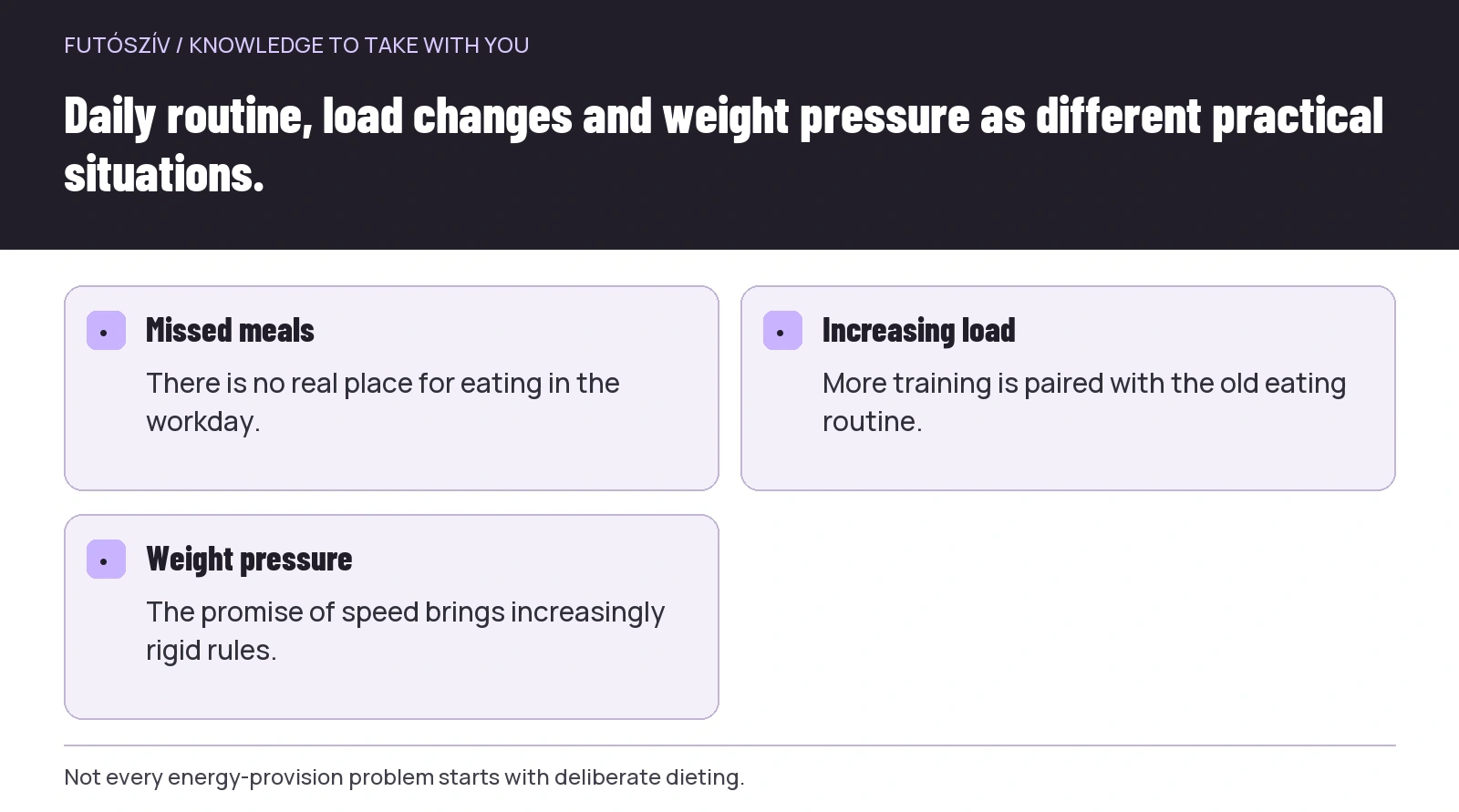 Enlarge diagram
Text version of the diagram
- Missed meals
- There is no real place for eating in the workday.
- Increasing load
- More training is paired with the old eating routine.
- Weight pressure
- The promise of speed brings increasingly rigid rules.
Less visible changes can matter too
Persistent fatigue, poorer response to training, repeated injury or feeling worse can occur with several conditions. REDs may be one possibility to assess, but does not explain every symptom. Infection, sleep problems, other illness and stress outside sport may contribute too, making medical consideration important.
A study in a clinical sample of young male athletes found associations between indirect indicators of low energy availability and several health and performance problems. It also used screening questionnaires and self-report. This does not prove inadequate energy directly caused every symptom or provide general prevalence figures for all Hungarian recreational runners.
The most important practical message from such research is to broaden questions. Looking only for visible weight loss or whether a runner still completes training may leave other important signals hidden. Your symptoms deserve assessment even if you can still start a race and others say you “look well”.
Sexual health is not an embarrassing side issue
It is worth discussing persistent changes in sexual interest and less frequent morning erections than usual with a doctor too. The male athlete triad involves hormonal function as well. These signs alone do not identify the cause or automatically mean low testosterone or REDs, however.
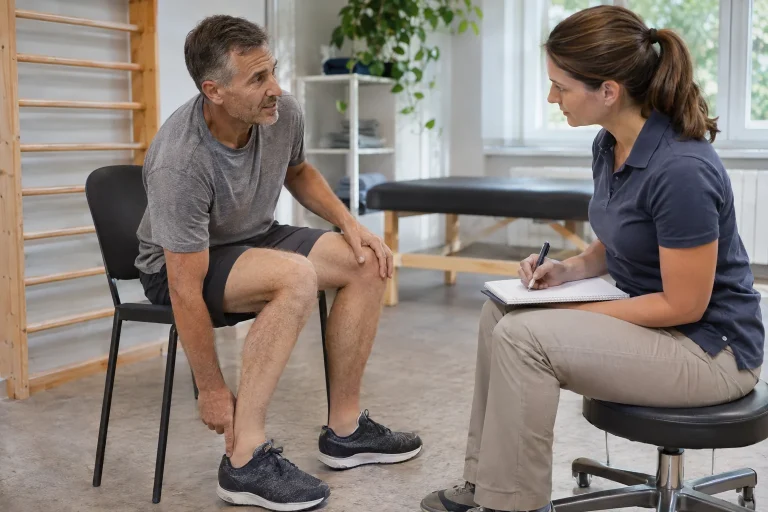
You can choose a private consultation instead of a community discussion. State clearly: I noticed this change, it has lasted this long and meanwhile my training, eating or wellbeing changed in these ways. You do not need to give the group a detailed account to receive professional help.
The consensus section on diagnosis and treatment places these questions within medical assessment. Do not choose treatment from one randomly timed hormone test or an online symptom quiz. A product sold as a testosterone booster, hormone treatment or blindly doubling training does not clarify the cause.
With bone symptoms, the race calendar is not decisive
The triad consensus discusses relationships between energy availability, hormonal function and bone health. With recurring bone stress injuries or suggestive symptoms, dietary and general health background may therefore matter too. Injury alone does not prove REDs, but can justify broader investigation.
Do not try to make well-localised pain around a bone that increases with load “safe” merely through warming up or painkillers. If it also hurts when walking, worsens or affects everyday movement, seek medical assessment. Severe pain, inability to bear weight or sudden deterioration requires prompt help.
Temporarily stepping back from preparation can be emotionally difficult. Clarifying who arranges the medical appointment, what information the coach receives and what stays private may help. Clearance to start is not decided by entry cost or how much training you have done. Bone health cannot be measured by one weekend’s result.
What does professional assessment mean, and what does it not?
The IOC REDs CAT2 was developed for healthcare and performance-support professionals under medical leadership. Screening, risk assessment and final clinical diagnosis are separate steps. The coloured risk categories are not for scoring yourself at home to permit the next hard session.
A brief description of load changes, eating routine, injury and illness history, medicine and supplement list, and symptom timeline can help at the meeting. You do not need to measure everything compulsively for a week. If calculation increases anxiety or earlier disordered-eating patterns, say so too; how information is collected can also be individualised.
Another important question is whether another illness could explain symptoms. Assessing REDs is not a shortcut replacing every other investigation. Medical, dietetic and, where needed, psychological work functions well when it offers a mutually understandable plan rather than leaving you between conflicting instructions.
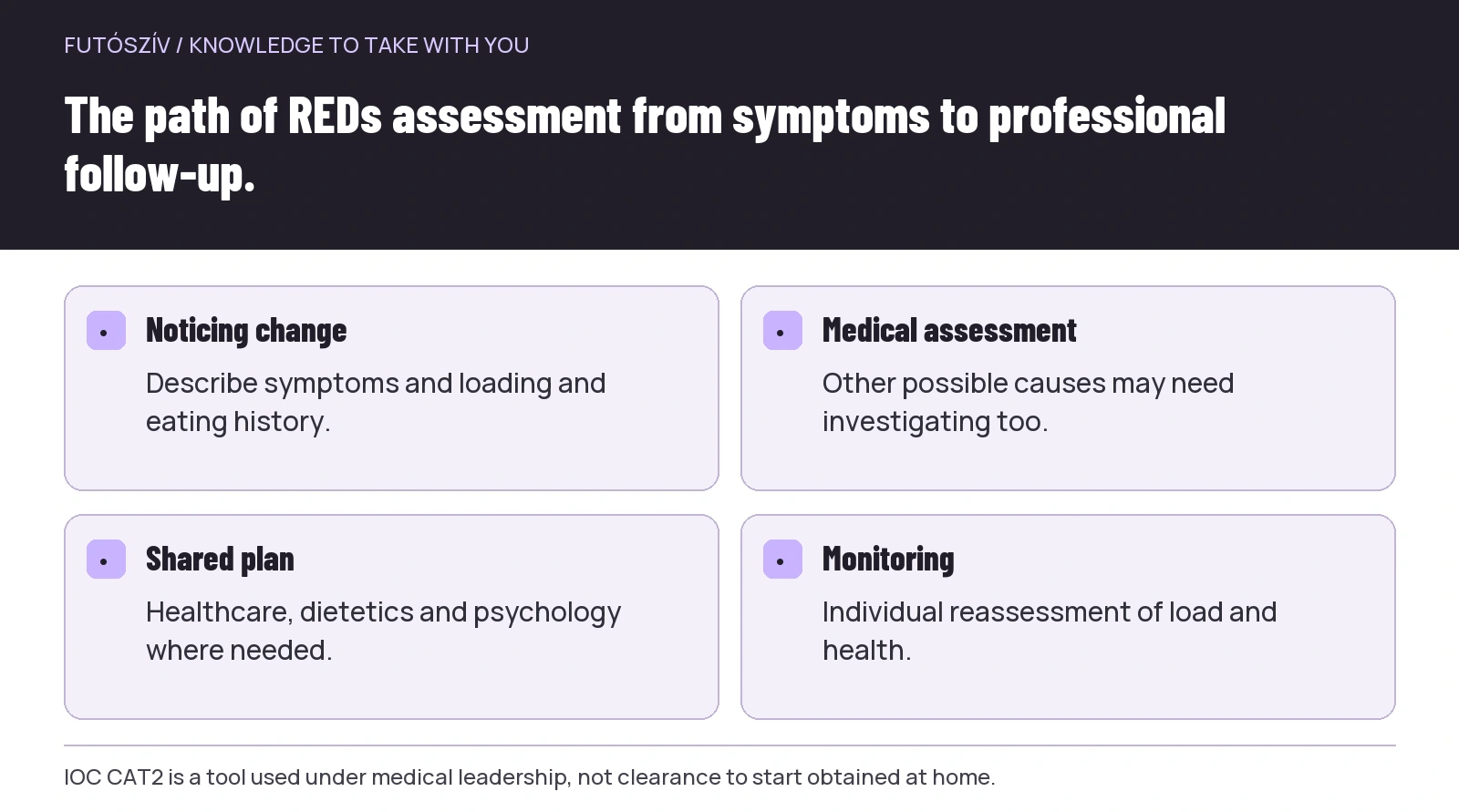 Enlarge diagram
Text version of the diagram
- Noticing change
- Describe symptoms and loading and eating history.
- Medical assessment
- Other possible causes may need investigating too.
- Shared plan
- Healthcare, dietetics and psychology where needed.
- Monitoring
- Individual reassessment of load and health.
Support means more than “eat more”
The Australian Institute of Sport material on energy availability emphasises coordination of eating and load. Addressing the situation may involve adjusting intake, reviewing training and spreading eating through the day. Specific requirements and the pace of changes are individual professional tasks, rather than an identical internet recipe for every man.
Name practical barriers separately. Are money and access to appropriate food available? Can you eat at work? Is there no time immediately after running, or do you fear eating? These are different problems. One may need prepared food and a changed schedule, another support for eating-related anxiety too.
Inadequate energy can occur with or without an eating disorder. The National Eating Disorders Association information on athletes emphasises the need for professional help in men too. Losing control around eating, compensatory movement or intense fear about weight is not a character flaw. Mental healthcare may have a place alongside dietary advice.
What can a coach and running community do?
Drop automatic praise for weight loss and group pressure around “race weight”. Weight loss that looks successful externally can conceal illness or difficulty others do not know about. A runner’s value and development need not be explained through body shape.
A coach can ask how training feels, whether you have time to eat and whether you need help finding a professional. Interpreting hormone reports, diagnosing an eating disorder or collecting private sexual information is not their job. Respecting scope and privacy is part of trust too.
Make fuelling and eating normal during shared training, rather than a privilege or sign of weakness. Someone wanting change for health reasons should not have to prove sufficient commitment. A long-term connection with sport often gains more from a supported reduction than another forced result.
A manageable first step instead of guesswork
If you notice persistent changes, briefly list when they began, how load developed and what changed in eating or life circumstances. Use this to seek medical assessment and, where needed, help from a dietitian knowledgeable about sports nutrition. Appropriate urgent care comes first with illness or severe deterioration.
If you have no symptoms yet but fit in more and more running alongside unchanged eating, you can review your routine now too. The aim is not finding REDs behind every more tired afternoon. It is ensuring care needed for training goes beyond shoes and a watch, and that seeking help can be a natural part of sport as a male runner too.
Sources and further reading
- The Male Athlete Triad, Part I: Definition and Scientific Basis, 2021
- The Male Athlete Triad, Part II: Diagnosis, Treatment, and Return-To-Play, 2021
- IOC REDs Clinical Assessment Tool, version 2
- Low energy availability surrogates are associated with REDs outcomes in male athletes
- Australian Institute of Sport: Energy Availability
- National Eating Disorders Association: Eating Disorders and Athletes
- 2023 IOC consensus statement on Relative Energy Deficiency in Sport
How Futószív articles are prepared: our editorial guidelines.