Today’s marathon is 42 kilometres and 195 metres long. The unusual number does not come from a race rule fixed in ancient Greece, nor was it used unchanged from the first modern Olympics. Understanding the history requires separating three events: the London Olympics’ specific course, later international standardisation and Olympic use of the uniform distance.
The brief timeline is this: London in 1908 held a marathon with the nominal length familiar today; in 1921 the international federation adopted it as standard; the 1924 Paris Olympics belong to the history of the standardised distance. The intervening years matter particularly. Without them, it is easy to suggest one London decision instantly determined every later race permanently.
The modern marathon initially did not mean one precise number
The Olympic Museum’s document-based account presents several differing distance descriptions from preparations for the first modern Olympics. Coubertin’s 1894 letter stated 48 kilometres, a later preliminary programme 42, and the detailed 1896 programme 40 kilometres. These are not three separately certified finishing results for the same race, but figures from different preparatory documents.
This distinction is one of the story’s most interesting parts. Selecting only the first number could lead us to claim the first marathon was 48 kilometres. Reading only an earlier programme could make 42 kilometres seem definitive. Without a document’s date and role, its number alone misleads. One preliminary figure cannot explain the race’s development.
The International Olympic Committee’s historical article describes the 1896 Athens race as approximately 40 kilometres from Marathon to the Panathenaic Stadium. Spyridon Louis won. For today’s distance, the important point is that the first modern Olympic marathon did not supply a 42.195-kilometre template unchanged from the beginning.
Ancient history relates to the name; the precise number needs another explanation
Many runners know the Greek story associated with the marathon name, and it retains an important place in events’ cultural world. Explaining a name’s origins is nevertheless different from asking when a precisely defined race distance was adopted. Keep these separate even if a brief account sounds attractive as one uninterrupted story.
The modern event’s development can be linked to the modern Olympic programme and its organisational decisions. This does not mean today’s final 195 metres were calculated from a precisely preserved measurement of an ancient route. Someone making that claim would need separate evidence. Official athletics and museum sources describing today’s distance discuss modern events.
This separation does not remove the marathon’s cultural meaning. It makes it more precise: a modern sporting event tied to historical memory developed into a uniformly named distance. Symbolic origins and later technical rules differ, yet both are important parts of the same event.
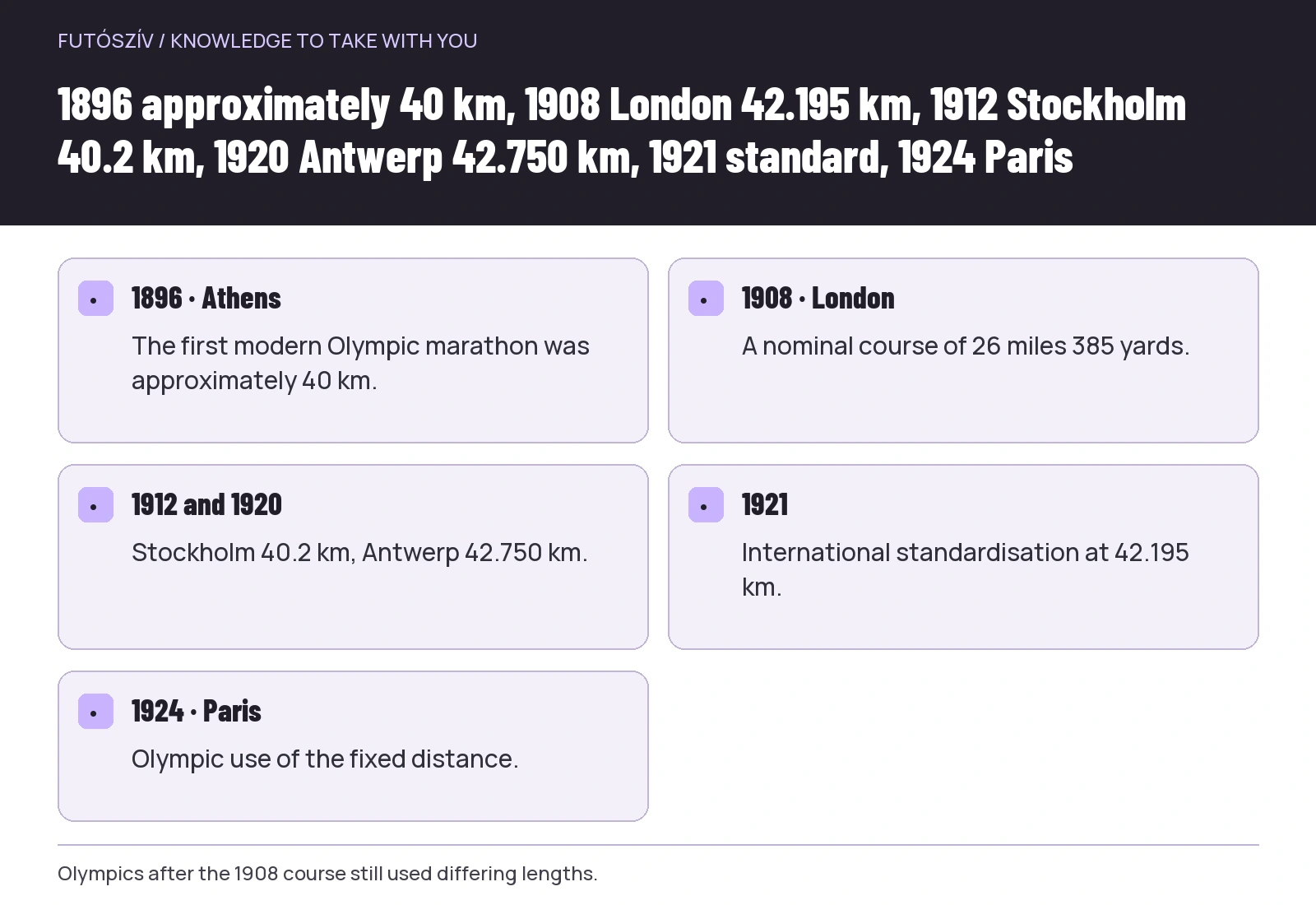 Enlarge diagram
Text version of the diagram
- 1896 · Athens
- The first modern Olympic marathon was approximately 40 km.
- 1908 · London
- A nominal course of 26 miles 385 yards.
- 1912 and 1920
- Stockholm 40.2 km, Antwerp 42.750 km.
- 1921
- International standardisation at 42.195 km.
- 1924 · Paris
- Olympic use of the fixed distance.
London had to organise a specific route
The AIMS historical article on the 1908 London Marathon gives more route-planning background than the simple statement that the length resulted from the royal box. The route between Windsor and White City Stadium, arrival through the city and the finish inside the stadium had to be arranged. Alignment changed during preparation; the article examines several organisational considerations and contemporary details.
The familiar nominal length became 26 miles plus 385 yards. In the AIMS explanation, the road to the stadium and the section within the stadium to the finish have separate roles. This helps explain why a number that is not round in kilometres endured. Behind it lay a particular London organisational situation whose later significance extended far beyond that Olympics.
Royal locations are indeed part of the London story, but a short colourful explanation should not be treated as final evidence covering every detail. Selecting start and finish, solving the route and choosing a later standard are three separate tasks. Attributing all of them to one person’s single wish is a simpler story than the route history warrants.
What does converting 26 miles 385 yards mean?
To understand the number, we can perform our own calculation using today’s precise unit conversions. An international mile is 1609.344 metres and a yard 0.9144 metres. Thus 26 miles is 41,842.944 metres, and 385 yards is 352.044 metres. Adding gives 42,194.988 metres, or 42.194988 kilometres, rounded to the usual metre precision as 42.195 kilometres.
This conversion explains the number using today’s unit relationships. It does not retrospectively prove every centimetre of the 1908 course was established to that precision. Actual measurement of the historical route and conversion of its surviving nominal distance are different claims. The AIMS historical analysis itself discusses limitations of reconstructing contemporary points today.
The popular 26.2-mile abbreviation is not the same as preserving every digit either. With modern conversion, 26.2 miles is 42,164.8128 metres, approximately 30 metres short of 42,195 metres. This does not mean every souvenir marked 26.2 is wrong. It means a community abbreviation and precise distance description serve different purposes.
| Description | What is it useful for? | What should you not infer? |
|---|---|---|
| 42 km 195 m | Naming today’s standard marathon distance. | Does not itself establish a particular course’s measurement status. |
| 42,195 km | The Hungarian decimal-comma form of the same distance. | The portion after the comma does not mean 195 kilometres. |
| 26 miles 385 yards | Traditional description associated with London origins. | The nominal figure is not a complete historical measurement report. |
| 26.2 miles | A widely used abbreviation. | Not a conversion preserving every digit. |
Not every Olympic marathon immediately became this length after 1908
The Olympic Museum account gives the 1912 Stockholm course as 40.2 kilometres and the 1920 Antwerp course as 42.750 kilometres. These two later examples alone rule out the simple claim that London’s 1908 length immediately became an unchanged Olympic rule. Distance variation persisted between the London race and standardisation.
Comparing the museum table, we can calculate our own differences: 40.2 kilometres is 1995 metres shorter than today’s marathon, and 42.750 kilometres is 555 metres longer. These differences cannot automatically convert old results. Weather, courses and racing circumstances may also have differed; distance ratios alone cannot establish what time anyone would have run over today’s distance.
As a reader, handle lists placing old marathon times alongside one another carefully. First check whether they concern the same distance and the capacity in which figures are presented. In the early period, the same event name did not yet guarantee today’s numerical identity. Understand contemporary performances within their own conditions.
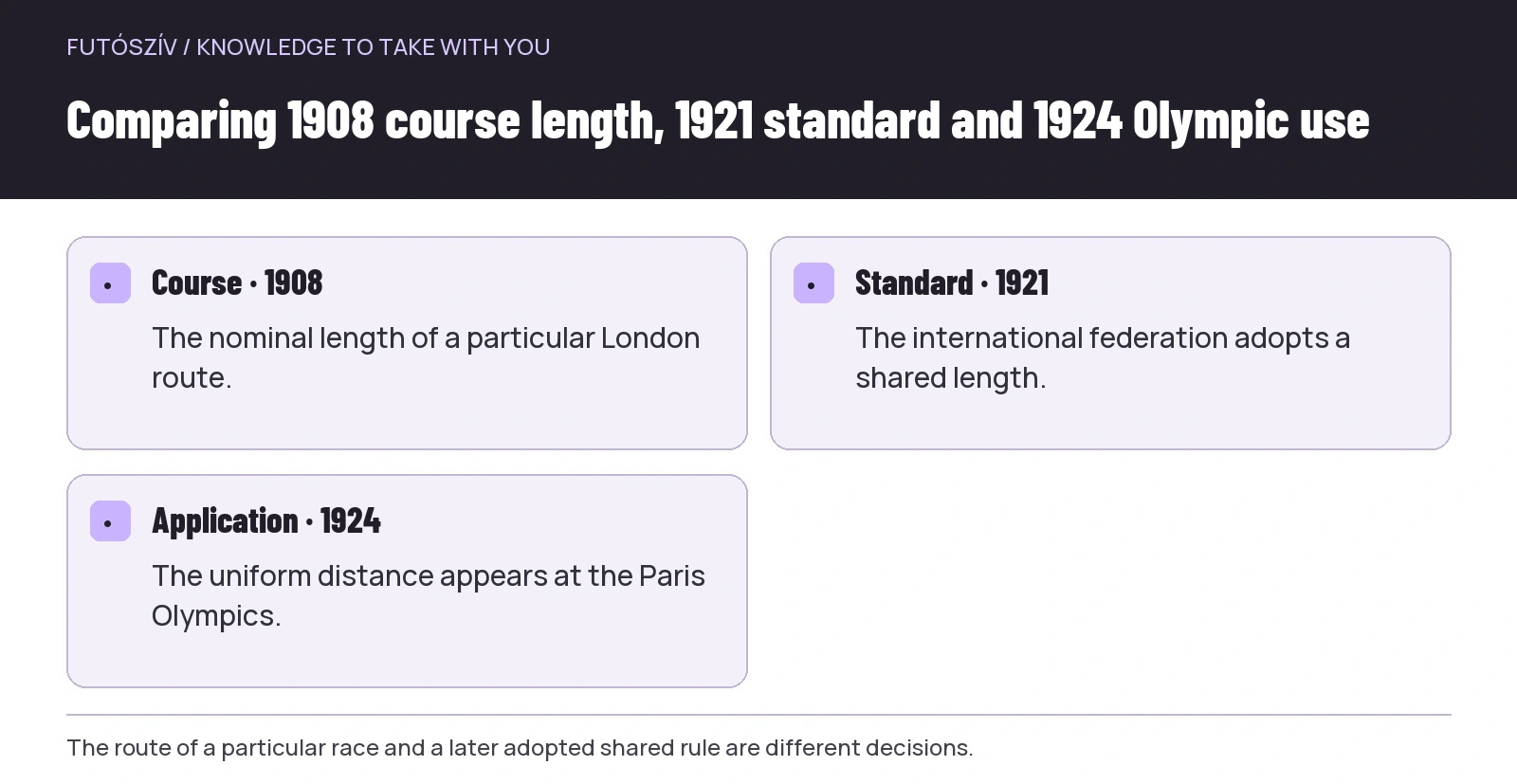 Enlarge diagram
Text version of the diagram
- Course · 1908
- The nominal length of a particular London route.
- Standard · 1921
- The international federation adopts a shared length.
- Application · 1924
- The uniform distance appears at the Paris Olympics.
The standardisation year is 1921
The World Athletics marathon page identifies 1921 as the year the 26-mile-385-yard distance was standardised. The decision by the international federation of the time, the IAAF, is a separate milestone from the London event. A precise short answer about today’s distance needs both dates.
According to the Olympic Museum, surviving IAAF records do not fully explain why this particular previously used, unusual length was chosen. This is a useful limitation: we can know the decision’s year and result without claiming certainty about every underlying intention. Missing evidence need not be filled with entertaining but unverified motivation.
The 1924 Paris Olympics are therefore an important stage in applying an already fixed length. When two sources mention 1921 and 1924, first examine whether they refer to the same event. One may be the year of international adoption, the other of Olympic application. Different numbers alone do not necessarily create a substantive contradiction, but imprecise wording can mislead.
Why is a common distance useful even when courses differ?
A uniform distance lets the same name provide a consistent basis for races and participant plans. When entering a marathon, standard length provides a shared reference point. Courses in different cities do not thereby become identical experiences or sporting tasks under entirely identical conditions. Route and daily circumstances still matter.
The name, precise course measurement and eligibility for recognition of a particular result are separate questions. Learning the history of 42.195 kilometres does not replace checking a race’s technical and regulatory information. An event name or advertising copy does not automatically establish every further designation.
Your own watch distance is not historical evidence for the standard’s origins either. It involves an individual track, measurement circumstances and course layout. Examine practical measurement questions for your current race using current sources. The 1908 story explains the development of the shared number; it does not provide a ready answer to every differing watch display.
Three common statements, more precisely
The marathon was always 42.195 kilometres. More precisely, this is today’s standard distance, while early modern marathon lengths varied. The word today is no trivial detail: it prevents projecting current rules back onto a period when they were not yet used uniformly.
In 1908 they decided the marathon’s final length. This merges London’s course with the later standard. More precisely: 1908 used the nominal length later adopted as standard, while international standardisation occurred in 1921. The intervening Olympic figures help explain the distinction.
The 195 metres were simply added to the original 42 kilometres. This does not preserve the structure of the London story in miles and yards. Better to explain how the nominal 26-mile-385-yard length developed, then show its kilometre form. The process then does not appear as a separate 195-metre addition attached to a retrospectively rounded base.
How can you tell the story briefly while preserving the essentials?
At a community run or family conversation, every preparatory document need not be listed. Four sentences may suffice: the first modern Olympic marathon was approximately 40 kilometres; London in 1908 used the later-famous 26-mile-385-yard length; this was standardised in 1921; today’s marathon is 42 kilometres 195 metres. The separate events remain distinct even in brief.
For anyone interested in detail, museum documents and the AIMS route analysis are useful further reading. One shows preparatory records and varying Olympic distances; the other explores the London race’s particular background. Different source types together make the history more interesting than one repeated anecdote.
Today’s precise number therefore results from several steps. The nominal length of a specific Olympic route, later standardisation and uniform use connect within it. When approaching the finish and thinking about the section beyond 42 kilometres, you are using the number produced by this modern sporting history: 42 kilometres and 195 metres.
How Futószív articles are prepared: our editorial guidelines.