
Putting an old running result beside a current one is simple: each has a time. The difference between the numbers does not yet establish what was compared, however. Event, course, measurement and reporting rules, field objectives or official status may differ. Past performances become clearer when context is restored alongside time.
The aim is not to declare every era incomparable. Results lists and record histories provide important information. Clarify instead which question a comparison answers. Who ran the shorter time differs from who would have been faster under every imaginable condition. A simple list provides no evidence for the latter.
First check that you are comparing the same event
Similar names may conceal different athletics categories. Track ten thousand metres and road ten kilometres are mathematically equal lengths but may be separate events. Historical marathon distances also need checking. A matching name alone does not establish identical basic conditions.
Participant category matters too. Senior overall performance, age-group record, national record, course record and a particular race’s best time are separate concepts. If two screenshots show the same abbreviation, read the key and full database heading. Without context, different claims can easily become one ranking.
Time should therefore not be the first and only item on your comparison sheet. Add exact event, location, date, category and published status. Keep missing information open in the comparison too. One impressive-sounding number cannot supply missing detail.
Historical digits also reflect reporting rules
The 2004 World Athletics retrospective on John Landy offers a specific example. For Landy’s 1954 Turku mile, it mentions both a measured 3:57.9 and the 3:58.0 result rounded according to the rules then. Two apparently different numbers can therefore belong to one performance when one is recorded information and the other its rule-based published value.
This does not mean every discrepancy should automatically be called rounding. The specific source must establish the link. The general lesson is that digit count and reporting method belong to meaning. Adding two zeros in modern formatting does not make a historical tenth-of-a-second result a more accurate measurement.
Normalising information and increasing measurement accuracy differ. A database may format old results uniformly for easier searching. That does not establish that the original device or procedure recorded as much detail as today’s display. Consider this limit when drawing large historical conclusions from small differences.
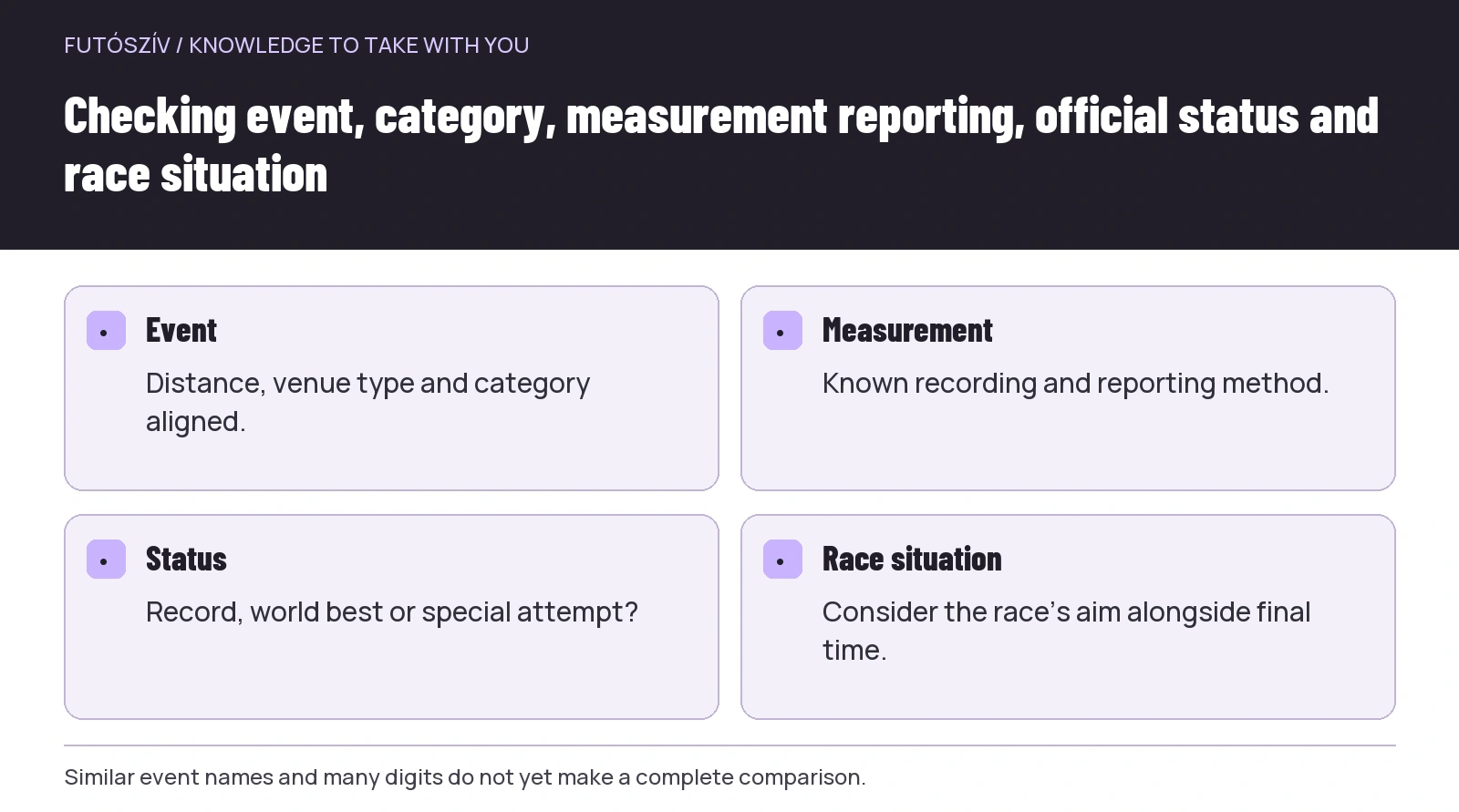 Enlarge diagram
Text version of the diagram
- Event
- Distance, venue type and category aligned.
- Measurement
- Known recording and reporting method.
- Status
- Record, world best or special attempt?
- Race situation
- Consider the race’s aim alongside final time.
The best known time and an official world record are not always the same term
The international federation announcement of 1 January 2004 announced official world-record recognition for listed road events. Previously, these events used world best terminology; runners’ physical performance did not change on New Year’s Day, but the official recognition system and its naming received a new framework.
Do not simply rewrite world best in an old text according to current habits. Translation and description should preserve the source’s stated status. If a historical list is organised using today’s system, read the database explanation too. Label and time together form the claim.
A changing recognition system does not devalue older results. It reminds us that sporting-history information also belongs to institutional history. A regulatory date and a run’s date are separate events. Distinguishing them supports precise discussion of when a performance occurred and when and within which system it was recognised.
An exhibition or special attempt may follow different conditions
The 2019 World Athletics report from Vienna presents Eliud Kipchoge’s 1:59:40.2 as a historical milestone and states clearly that it would not be ratified as a world record. This concerns that 2019 event, not today’s record list. Significant sporting achievement and world-record eligibility are separate questions here.
The example needs neither devaluing nor promoting to another status. Describe a special attempt held under particular conditions and the time officially reported, then identify the recognition limitation separately. Historical significance does not require abandoning the appropriate category.
When comparing the fastest figures across eras or event types, check status first. A race result, special attempt, ratified record or preliminary press figure? The distinction belongs to the claim itself. Under one large fastest headline, results treated differently by sport’s system easily become mixed.
Equipment rules are a framework valid at a particular time
The World Athletics shoe regulations effective from 20 April 2026 show that equipment can have separate dated requirements. Current rules must not automatically be projected onto a run decades earlier. Examine historical results with their status under contemporary rules.
This does not permit a simple seconds deduction between old and current times. Differing equipment circumstances alone do not establish how much a person would have run in another shoe. Far more information would be needed, and a hypothetical situation is not the race that occurred. The careful statement is that conditions may differ; precise effects cannot independently be calculated from final time.
This particularly matters in community debate. In today’s shoes they would run this too and everyone improves equally with the same shoes claim more than two results lists establish. Technology’s role raises interesting questions, but do not replace a question with an unsupported ready result.
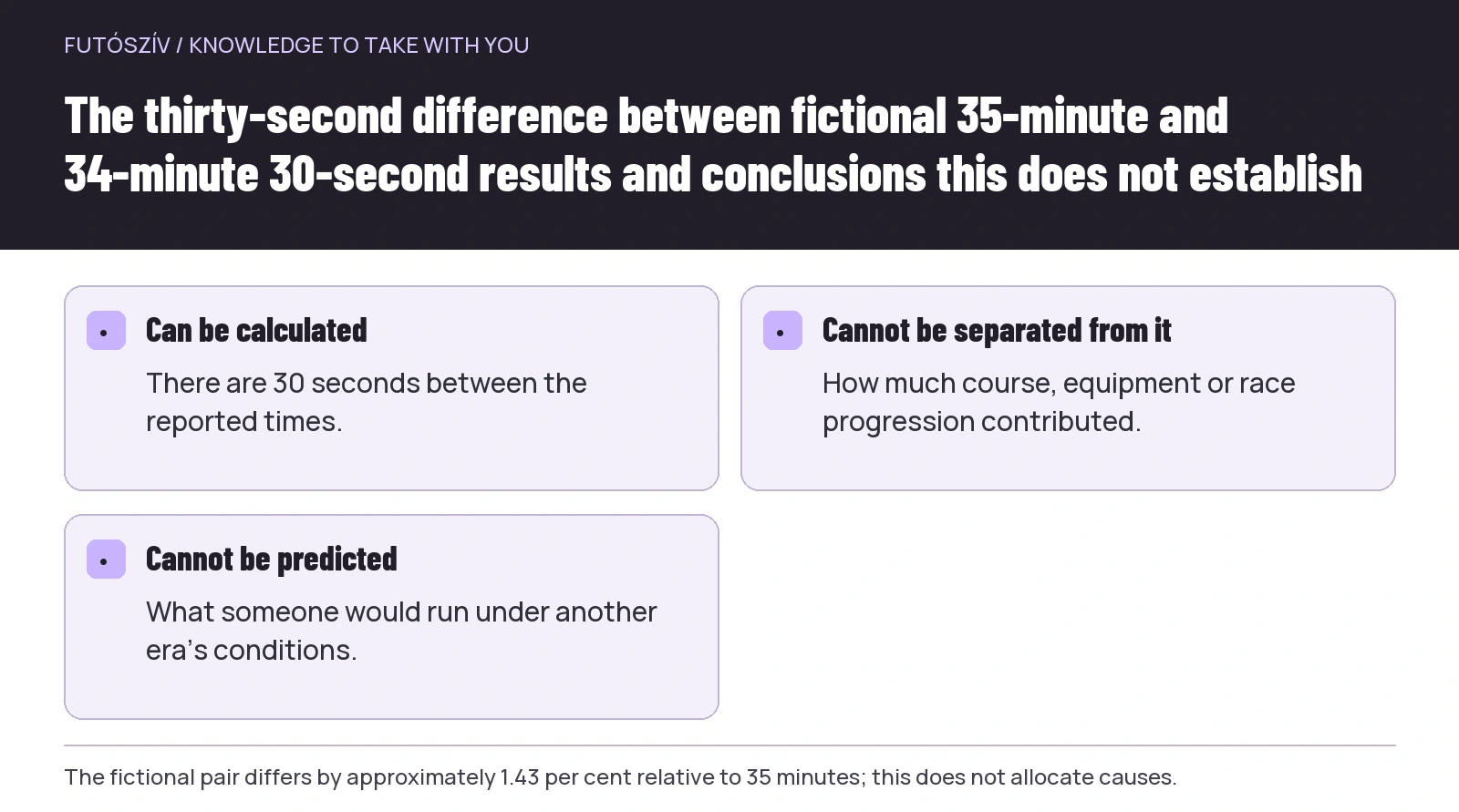 Enlarge diagram
Text version of the diagram
- Can be calculated
- There are 30 seconds between the reported times.
- Cannot be separated from it
- How much course, equipment or race progression contributed.
- Cannot be predicted
- What someone would run under another era’s conditions.
Racing for place differs from a race organised for time
Interpreting final time includes athletes’ task. A championship final may prioritise that day’s order, while another event may organise running around a planned time. Learn the situation from historical reporting and the actual race. Not every slower final time proves lower ability.
Imagine two fictional races of equal length. In one, the field stays together for much of the race before pace changes near the end. In the other, a steadier time effort begins early. Different split patterns tell different stories even if one final time is simply faster. The example does not establish what anyone could have achieved elsewhere.
Precise analysis can therefore place time, placing and race progression on separate lines. None automatically replaces another. A championship win’s significance cannot disappear solely through a faster list from another event, just as outstanding time alone cannot establish the outcome of a different tactical race.
An arithmetic example: calculating a difference is not explaining it
Suppose two fictional comparable-category ten-kilometre times are 35:00 and 34:30. The difference is thirty seconds. The older time is 2100 seconds, relative to which thirty seconds is approximately 1.43 per cent. This is pure arithmetic: it gives the numbers’ proportion, not the difference’s cause.
It cannot separately identify effects of course, weather, field, equipment or individual condition. Nor does it establish one person would be faster by that amount under every other circumstance. A percentage can easily become a scientific-looking yet unjustified story. Good analysis stops where its data ends.
| What the pair shows | What it does not establish alone |
|---|---|
| The absolute difference between published times. | The precise size of individual causes. |
| The proportion relative to a specified basis. | The expected time of someone moved to another era. |
| With appropriate data, order in the list. | A complete ranking of historical significance. |
| The result recorded at that event. | The outcome on another course, in another field or with another aim. |
The table does not prohibit comparison. It separates established results from interpretive questions. After calculation, the most interesting next step is often finding further sources rather than adding another forceful judgement.
Participation opportunities belong to history too
An era’s results list shows who entered competition and records within that system. It is not a complete inventory of everyone’s potential abilities. Changing event programmes or participation frameworks require different readings of list history. Start each athletics claim from primary sources for that particular period.
Do not automatically infer from a smaller historical field that options and access equalled later periods. A large current field does not itself establish equal opportunities in every respect either. These are separate social- and sports-history questions requiring more than the top ten names.
Accurate historical appreciation identifies actual achievements and context. Every era need not be placed in one imaginary present-day race. An early milestone, significant championship performance and later faster time can all be recognised while each remains important through its own claim.
A worksheet before comparison
Make two columns for the results. Rows should cover exact event; location and date; participant category; course environment; known timing and reporting method; official status; and sources on the race’s aim. Write unknown where information is unavailable. An unfilled place is not a fault in your work if information genuinely is missing.
Then state in one sentence what you want to learn. If interested in the published times’ difference, calculate from appropriate data. If seeking a hypothetical result for someone in another era, recognise that sources do not answer it directly. A precise question determines what comparison can do.
This does not make running history less exciting. More kinds of achievement become understandable: technical limits, institutional changes, tactical decisions and personal performances. Numbers matter, but preserving their conditions enables precise discussion of different eras beyond a simple ranking.
How Futószív articles are prepared: our editorial guidelines.