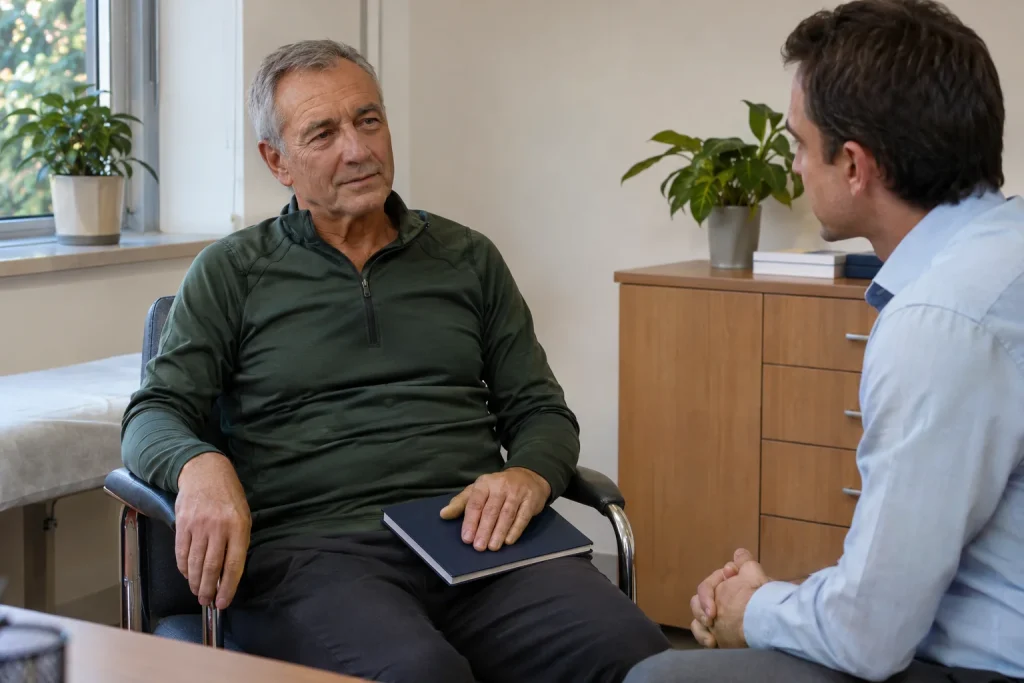
You want to run again after prostate treatment, but a few drops of urine escape during movement, or the whole activity revolves around reaching a toilet. This deserves a separate discussion at follow-up. Pads and spare clothes can help practically, but do not establish the type of problem or which treatment may support everyday life. A running goal is also an important quality-of-life question; you need not conceal it as a trivial inconvenience.
‘After prostate treatment’ can describe many stories. Surgical recovery differs from symptoms associated with radiotherapy, while previous urinary difficulties may also matter. For the next step, communicate current symptoms, history and exercise goals together. This guide helps prepare the conversation; it provides neither identical pelvic-floor exercises for everyone nor a deadline for returning to running.
Begin with the exact treatment and recovery stage
Describe the procedure or treatment, when it happened and the exercise guidance you received. If several treatments were linked, bring their sequence to the consultation too. A complete discharge report helps more than an abbreviation selected from memory. Ask for an explanation if a procedure’s name is unclear: you do not have to turn your story into urological documentation yourself.
The European Association of Urology guideline also discusses different quality-of-life consequences of prostate cancer treatments. Urine leakage after surgery and urinary symptoms associated with different radiotherapy procedures do not follow one identical pattern. A running companion’s recovery time is therefore an unsuitable personal deadline. Your specific treatment, current condition and care plan matter.
Report catheter history and the present situation too. If you still have a catheter or it was recently removed, do not restart an old routine based on a general sporting story. Clarify surgical-wound, treatment and individual restriction details with your care provider. A conversation about leakage does not replace this, but need not wait until every other question has been resolved.
Describe the circumstances, rather than only pad counts
Urine leakage can take several forms. The NHS distinguishes leakage associated with exertion such as coughing, leakage with urgency and situations related to incomplete bladder emptying. These can coexist. The ‘stress’ in ‘stress incontinence’ does not simply mean emotional tension. Describing your experience helps assess distinctions, but you should not have to definitively identify the type yourself.
Say when leakage occurs: setting off, coughing, lifting, taking running strides, with sudden urgency or after urination. List different situations separately. You need not provoke symptoms through forced jumps or coughing to prove them. Everyday events that have already happened can provide a useful description. Also mention difficulty starting urination or a weaker stream alongside leakage.
You can discuss products too, but quantities need context. A pad used on a long journey, a day at home and planned exercise represent different situations. You need not compress the impact into one number. Explain why you changed it, what worries you and which activities you avoided. Its effect on your day matters as much as describing the leakage.
 Enlarge image
Make the running goal specific enough to discuss
‘I would like to exercise again’ is a good starting point, but deserves clarification. Are you planning short activity near home, joining a group or returning to long race preparation? For now, preventing worry about leakage from determining your day may itself be a goal. The EAU also recommends rehabilitation based on personal goals and involving several professionals after radical treatment, considering continence and social support.
Bring a simple scenario to follow-up: you want to attend a nearby club meeting but do not know what activity is appropriate or how to manage symptoms. Do not ask for approval of a finished training plan without discussing the symptom. Clarify the next appropriate step, required assessment and how sport may later fit. Naming a goal helps, but does not override current condition.
Discuss fluid intake individually too. Severe restriction devised to avoid symptoms, or a general running-drink quantity, is not a personal urological plan. If fear of leakage has changed your drinking, tell your care provider. Arranging toilet access and necessary equipment is practical; fluid intake appropriate to treatment should remain a separate healthcare question.
| Detail to communicate | Specific example | Purpose of discussion |
|---|---|---|
| Treatment history | Which procedure occurred, when and with what instructions? | Understanding recovery stage and the care background. |
| Symptom circumstances | Does it occur during movement, with urgency or after emptying? | Professional assessment of symptom type and cause. |
| Daily impact | Which activity did you avoid or rearrange? | Assessing quality of life and practical support. |
| Running goal | What specific next participation matters to you? | Coordinating exercise planning and rehabilitation. |
Pelvic-floor training needs instruction and an individual framework
Pelvic-floor muscle exercises may form part of care for continence problems after prostate treatment. Prostate Cancer UK’s accessible guide emphasises identifying the right muscles, correct technique and professional discussion. Adding ‘squeeze more’ to a running plan is insufficient. Your task and its timing must fit your treatment circumstances.
It is particularly important not to automatically adopt exercises while a catheter is present. Prostate Cancer UK does not recommend pelvic-floor exercises with an indwelling catheter. Ask your own team when to begin, who checks technique and what to notice. If you already received exercises, bring the instructions and explain what you actually do. Earlier guidance and your current independent version may differ.
Do not increase repetitions because you want faster results as an athlete. Correct execution and individual instructions matter more than another set. If you are unsure about experiencing contraction and release, ask for help. Repeatedly interrupting the urine stream is not a general training method either; do not create your own training programme in the toilet. Clarify these questions with the appropriate professional.
Pads and routes support comfort without concluding care
A suitable absorbent product can support everyday life practically. Prostate Cancer UK describes several treatment and product options and recommends individual discussion. A comfortable product does not make symptom assessment unnecessary. Nor need you feel ashamed of using one: supporting comfort and participation is an important question in its own right.
If your individual plan already includes exercise, consider changing clothes and products too. Is a genuinely usable toilet available, can you access spare clothing, and how will you discreetly carry home or dispose of necessary items? These are location details, rather than treatment instructions. A well-planned route may help organisation, but does not determine fitness to run or explain a new symptom.
Do not treat independently trying a tighter device, strap or clamping solution as a simple sports-equipment choice. If such an option arises, discuss its indication and use with a professional. Do not copy instructions from a social-media post to ensure the next loop can be completed. A good practical solution fits your care, rather than briefly concealing a problem.
Persistent symptoms may need further assessment
Persistent leakage need not simply be regarded as an inevitable treatment consequence to accept permanently. The EAU discusses conservative and surgical options while noting that evidence and effects differ between procedures. The appropriate choice depends on individual condition and goals. This article selects neither a device nor an intervention, but asking about further care is legitimate.
Ask when and how change will be assessed. Use of taught exercises, symptom circumstances and daily functioning may all feature in follow-up. One better day does not establish complete resolution, and one worse day does not prove help is unavailable. Communicate how the story is developing at follow-up, rather than only a prewritten success or failure.
Symptoms may affect other situations beyond sport. Travel, work, social activities and intimacy can raise questions too; these do not distract from a ‘more important’ oncology follow-up. Functional and quality-of-life questions belong in follow-up. If starting aloud is difficult, write beforehand: ‘I would also like to discuss urine leakage during movement and further options.’
 Enlarge image
When should you not wait for planned follow-up?
If you suddenly cannot urinate, especially with painful lower-abdominal distension, immediate medical care is needed. NIDDK describes acute urinary retention as an urgent condition. Do not try to resolve it through running, greater straining or waiting. When seeking help, report previous prostate treatment and any recent surgery. The earlier leakage story must not obscure new difficulty emptying the bladder.
Keep warning symptoms provided after surgery or other treatment readily accessible too. For a new symptom or rapid change, seek help according to your individual reporting plan, rather than simply skipping the next workout. Rewriting a sporting programme is not healthcare assessment. At follow-up, clarify whom you can reach for advice outside normal clinic hours.
A running goal becomes easier to discuss when treatment name, symptom circumstances, daily impact and the next rehabilitation step form one story. You need not wait until leakage can no longer be managed as a comfort issue with any product. An early, precise conversation helps exercise and everyday life become reviewable choices linked to your care plan, rather than merely a sequence of adaptations.
Sources
- EAU: prostate cancer treatment and quality of life
- NHS: urinary incontinence
- Prostate Cancer UK: urinary problems after treatment
- Prostate Cancer UK: pelvic-floor exercises
- NIDDK: urinary retention symptoms and urgency
How Futószív articles are prepared: our editorial guidelines.