
Treatment may matter behind changes in heart rate or how you feel
With a new medicine or modified treatment, familiar running data may change. Heart rate does not reach the old zone, you feel unusual in heat or feel slower after an allergy medicine. The best first question is not which session will force the old number back. Clarify the relationship between treatment and sport first.
Medicine can provide useful and necessary treatment; a sporting goal is no reason to stop it independently. At the same time, your experience during movement is important information for your clinician. These perspectives can be addressed together when you explain accurately what changed and which activity you want to do.
This article offers a few common examples and a framework for discussion with a pharmacist or doctor. It does not list every product’s effects, replace the patient leaflet or change dosage or timing. Activity boundaries relating to the underlying condition matter just as much as a medicine’s possible effects.
First situation: a beta blocker and the old heart-rate zone
Beta blockers can slow the heartbeat, so a target heart rate previously used in training may need reconsidering. The American Heart Association information emphasises agreeing on an individual target. An old age-based formula or a watch’s automatic setting may not be appropriate in the new treatment situation.
A typical mistake is working harder and harder to reach the previous number. The watch display then becomes the goal instead of reflecting appropriate exertion. Tell your clinician which training you do, your earlier heart-rate pattern and what you now experience. If you receive boundaries based on assessment, discuss them with your coach too.
Perceived effort and your experience while speaking can be additional observations, but their use also needs connecting to your individual condition. Do not treat new chest symptoms, dizziness or breathing difficulty merely as part of changed data. Severe or sudden illness may require urgent help; in Hungary, you can call 112.
 Enlarge diagram
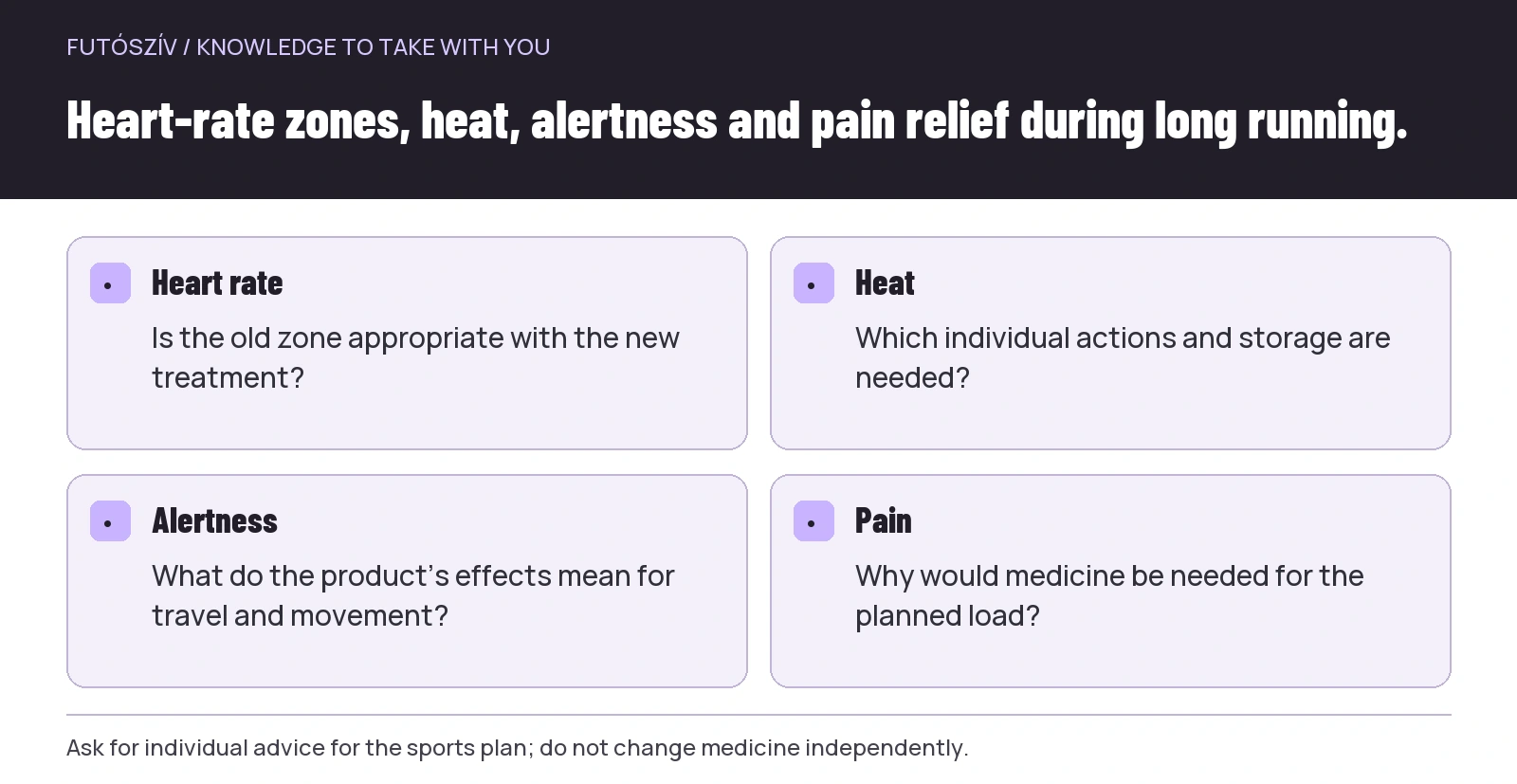
Text version of the diagram
- Heart rate
- Is the old zone appropriate with the new treatment?
- Heat
- Which individual actions and storage are needed?
- Alertness
- What do the product’s effects mean for travel and movement?
- Pain
- Why would medicine be needed for the planned load?
Second situation: a hot day and several regular medicines
According to the CDC, some medicines may increase heat-related risks by influencing temperature regulation, fluid balance or other processes. The heat and medications guide mentions diuretics, anticholinergic medicines and certain psychiatric medicines among others. The document provides expert guidance involving individual assessment of risks and benefits.
The appropriate question is not whether you should stop all medicines in hot weather. Request a plan beforehand: in which conditions should movement change, what should you watch for and are there specific actions defined by your clinician? With fluid restriction or another condition, general advice to “drink more” is not automatically an individual solution either.
Heat can also affect storage and the operation of some devices. Ask about the particular product’s requirements and do not leave it in a hot car simply because you do not need it with you during the run. The individual plan should cover keeping medicine appropriately and accessible help too.
The CDC also warns against abruptly stopping necessary treatment without a plan agreed in advance. Moving or skipping training can be practical decisions, but medication needs discussion with the appropriate professional. Adapting to heat is not an independent medication experiment.
Third situation: allergy medicine and reduced alertness
Some antihistamines more often cause drowsiness, but that effect can occur in the less-sedating group too. The NHS information also warns of changes in reaction time, coordination and judgement. The medicine’s name and your own response matter more than a general belief that an allergy tablet must be irrelevant to sport.
The outward journey is part of the running programme too. If a product causes drowsiness or attention problems, driving is particularly important. According to the FDA guide to driving , some medicines can impair reactions or attention even when a person does not feel particularly sleepy. Follow instructions for that medicine and professional advice.
Do not try to fit the first use of a new product into the day of an important event involving complicated travel without individual discussion. Ask the pharmacist which effects to watch for and when to seek advice. Experience with another tablet in a previous season is not a reliable prediction for the new medicine.
A running companion should not suggest caffeine or another product as a wake-up aid to mask the problem. If how you feel has changed, reconsider the programme and appropriate professional discussion. Route, traffic and getting home are just as real safety considerations as the session itself.
Fourth situation: taking a painkiller preventively for a long run
A painkiller is no guarantee of preparation or freedom from injury. At a long event, medicine effects, environment and underlying condition form a complex question. Neither many others doing it nor certainty that it will prevent pain is an appropriate reason for use. The cause of new pain needs assessing too.
In a double-blind randomised ultrarunning trial, the ibuprofen group had a higher measured proportion of acute kidney injury according to the laboratory definition used than the placebo group. The estimated difference was uncertain: its confidence interval remained compatible with no difference. The ultramarathon study examined a small, specialised race situation rather than every runner’s occasional medicine use.
Uncertainty does not establish the safety of preventive use, nor does the finding mean all painkillers should be treated as identical. Discuss the appropriate medicine, need and contraindications with a pharmacist or doctor based on your own history. This article does not recommend a substitute medicine or race dose.
If masking pain is the only way you could complete the planned run, review the sports plan too. Entry and training already invested do not automatically make starting with symptoms appropriate. Treatment and loading decisions belong together but are not the same question.
Make the medicine list more complete than a list of prescriptions
Include regular and occasional products alike: over-the-counter remedies, nasal spray, inhalers, herbs, supplements and products used for sport should all come up. Exact names and ingredients help. “Sometimes something for a cold” makes it hard to assess duplicate active ingredients or interactions.
Record recent changes and instructions received as well. If several doctors mentioned a product for different reasons, say so. You do not have to reconcile every instruction yourself. A pharmacist and clinician can help clarify, but need to know the complete picture.
Bring the box, patient leaflet or a clearly legible photograph if the name is uncertain. Do not start from an online description of another strength or a product sold in another country. Instructions belonging to your own medicine are the basis, interpreted alongside the individual treatment plan.
 Enlarge diagram
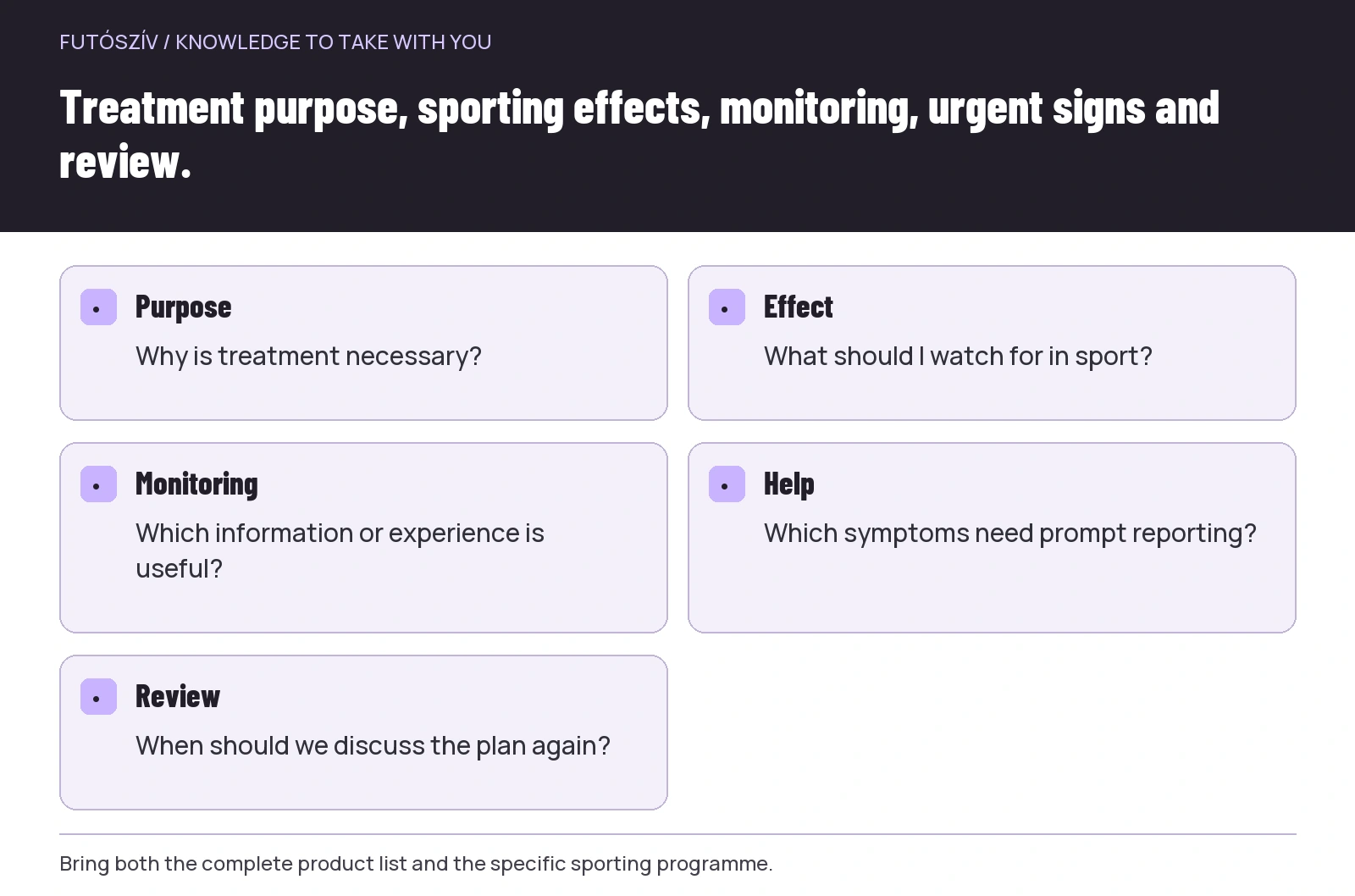
Text version of the diagram
- Purpose
- Why is treatment necessary?
- Effect
- What should I watch for in sport?
- Monitoring
- Which information or experience is useful?
- Help
- Which symptoms need prompt reporting?
- Review
- When should we discuss the plan again?
What sports information should you give the pharmacist or doctor?
Explain which movement you do: occasional walking, regular running, a long race, training in heat or remote trails involve different circumstances. Alongside distance, duration, intensity and access to help matter. You do not need sports-physiology language; a specific programme description is enough.
Organise the experience: when did you start or modify treatment, when did the different sensation appear and what were you doing? Report other changes, such as illness or lack of sleep, too. Close timing alone does not prove a medication side effect, but can be an important question.
Ask which measurement or observation is useful and what action follows its result. Do not leave assessment of a new heart rate, dizziness or fatigue solely to a watch’s automatic message. Your experience can then become a focused discussion rather than a medication test at home.
Missed doses, travel and race timing: do not seek a general recipe
Different medicines can have different missed-dose instructions. Follow your product’s information and professional advice, rather than a running friend’s catch-up rule. This article deliberately gives no general solution for doubling, skipping or moving doses. Those belong to individual treatment.
When travelling, arrange storage conditions, available quantity and necessary documentation too. Before time-zone changes or a long event day, ask how to follow your own prescription. Keep appropriate contact details for your care provider or pharmacy accessible on the phone, but do not wait for a routine message if you are seriously unwell.
If an event’s conditions would be manageable only by arbitrarily changing medicine, question the event plan too. Another date, shorter format or different goal may be possible. Coordinating treatment and sport does not mean stepping beyond your own healthcare boundaries for the calendar.
Leave the discussion with five clear answers
What is treatment for? Which sports-related effect or interaction should you watch for? Which activity information is worth tracking? Which symptoms mean seeking prompt help? When should the next discussion happen? These answers can create a useful individual framework without guessing medication doses online.
Share activity-related conditions with your coach. You do not need to disclose every health detail to the community, but changes important for planning load should be known. Good support accepts when an old zone, time or route is currently inappropriate.
Running data help when interpreted together with your condition and treatment plan. Appropriate activity may still have a place alongside necessary medicine, but its form is not chosen by pressure from an old graph. An accurate list and specific question alone can substantially improve the next decision.
Sources
- AHA: How do beta blocker drugs affect exercise?
- CDC: Heat and medications, guidance for clinicians
- NHS: Antihistamines
- FDA: Some medicines and driving do not mix
- Ibuprofen versus placebo and acute kidney injury in ultramarathons: randomized trial
How Futószív articles are prepared: our editorial guidelines.