
Conversations about exercise after childbirth often reduce the perineum’s condition to a single sentence: there were a few stitches and it will heal. Someone returning to running may need more information. The type of injury, any wound-healing problems and current bladder and bowel control, walking or sitting all matter. Discussing these is as much a part of healthcare as discussing blood pressure.
A perineal injury does not erase the value of your sporting history or by itself mean a permanent ban on sport. Yet the calendar in a running app does not determine your next step. This guide helps you prepare for follow-up, separate the questions that arise and organise a return in which symptoms that feel embarrassing can also be discussed.
First clarify the injury’s name
An episiotomy and perineal tears of different depths are not the same thing. According to RCOG guidance, a first-degree tear involves the skin, while a second-degree tear also involves the perineal muscles. Third- and fourth-degree tears can involve the anal sphincter; they are often referred to as OASI. Healthcare professionals establish the precise classification; you should not have to work it out at home from pain intensity.
Ask your treating professional to show you the relevant part of the discharge summary and explain it in everyday language. It may also matter whether surgical repair was performed, what follow-up was planned and whether there are specific instructions concerning bowel movements, activity or medication. Not remembering something is not a personal failure: much information arrives at once around childbirth.
The injury’s name is not a competition about severity. An injury classified as less extensive can still involve symptoms requiring care. Equally, the name of a severe injury does not mean every later movement will definitely be problematic. Diagnosis and current function together provide a usable picture.
Three separate questions, three kinds of answer
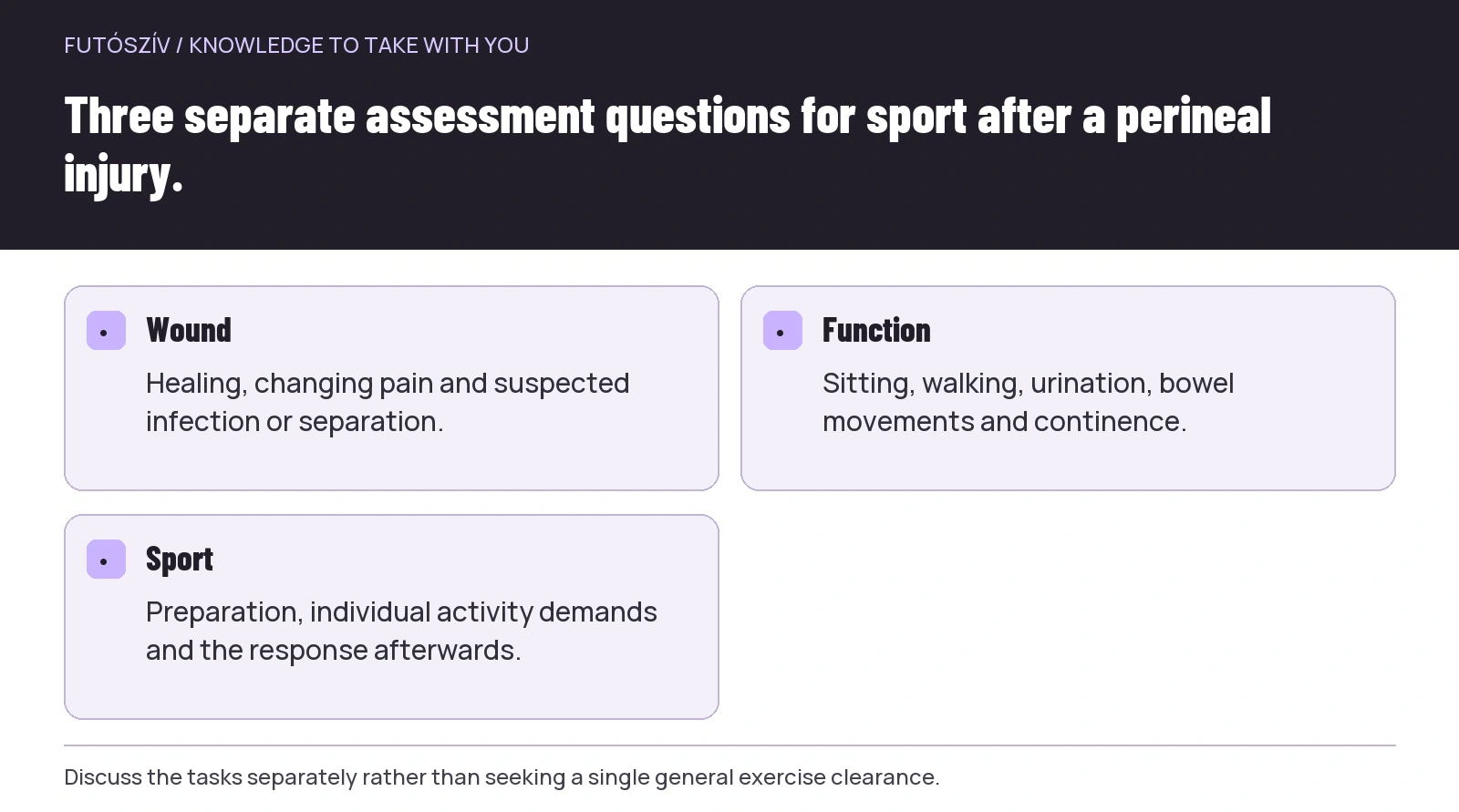
The first question concerns the wound: is it healing appropriately, and is infection or separation suspected? The second concerns function: are walking, sitting, urinating and bowel movements comfortable, and are there continence difficulties? The third concerns sport: what preparation is needed before running again, and how much running can you resume? These should not be compressed into a single yes-or-no exercise clearance.
For example, a short walk may cause no difficulty while standing for longer brings a feeling of pressure. Or the wound may appear fine while controlling wind remains uncertain. Such differences are valuable information rather than inconsistency. Both details belong in your next assessment.
If a follow-up focused mainly on the wound, ask separately about assessment for running. Regaining basic daily function is an important step, but it is not the same demand as many repeated running steps. Make your question about returning specific enough to write down.
Which symptoms should you name explicitly?
Alongside urinary leakage, mention difficulty controlling wind, having to hurry because of an urgent bowel movement or stool leakage. The RCOG information on OASI discusses these among possible symptoms of anal incontinence and emphasises that help is available. You do not have to wait until symptoms occur on every run or during everyday life as well.
A simple sentence is enough: “I used to be able to control this, but now I cannot always manage.” If saying it is difficult, hand over a written note. Frequency, circumstances and changes in the symptom matter more than sophisticated medical wording. You do not need to complete a workout to prove an injury before you are entitled to request assessment.
Stool passing through the vagina, suspected wound separation or signs of infection are not questions of running technique. These require contact with a healthcare professional. Rather than leaving an uncomfortable subject unmentioned, ask for a private opportunity to discuss it at the appointment.
 Enlarge diagram
Text version of the illustration
- Wound
- Healing, changing pain and suspected infection or separation.
- Function
- Sitting, walking, urination, bowel movements and continence.
- Sport
- Preparation, individual activity demands and the response afterwards.
Changing wound pain is not a training challenge
The NHS explains that increasing pain around stitches, unpleasant-smelling discharge, redness or swelling may suggest infection. Discuss these with your maternity provider or doctor. With fever, significant illness or rapid deterioration, do not wait until the next planned sports consultation.
The RCOG wound-healing information discusses perineal wound breakdown and granulation tissue separately. An uncomfortable or easily bleeding area around the wound therefore does not always represent the same problem. Choosing treatment from a home photograph or a description in a running group is not advisable; an examination can clarify the cause.
Do not independently begin forceful scar massage, combinations of antiseptics or intensive exercise to make the area “get used to it”. Follow your own treating professional’s care instructions. If a suggestion is uncomfortable or painful, report that too rather than treating it as a necessary demonstration of cooperation.
What does gradual progression mean after a severe perineal tear?
After third- and fourth-degree tears, RCOG describes avoiding high-impact exercise and heavy lifting in the early weeks, followed by gradually increasing general activity. This patient-education framework does not mean running automatically follows once a specified week has passed. Individual monitoring of wound healing and function still matters.
Observe activity permitted under your own instructions in circumstances where it is easy to stop. A short walk nearby requires different planning from a long outing. More activity does not necessarily provide more useful information. If symptoms worsen afterwards, discuss that before the next plan rather than repeat it unchanged to prove something.
Housework and caring for the baby add to the day’s demands too. Trying activity at the end of an already difficult day is different from trying it when better rested. Reorganising the day is therefore a real way to adjust load, rather than incidental logistics alongside sport.
What can you expect from pelvic-floor assessment?
The NICE NG210 guideline describes care based on assessing symptoms and history. It treats pelvic-floor training as more than a repetition count: technique and individual ability matter too. If you experience pain, continence problems or uncertainty during movement, clarify these before choosing exercises.
At the beginning of the appointment, explain your most important goal. It might be comfortable walking, managing urgency, pain-free everyday function or running later on. The professional can then see the task that matters to you, rather than only a general exercise sequence.
Ask about the purpose and process of the examination, what you are being asked to consent to and what alternatives exist if you do not feel ready for something. You can say that you want to stop or continue later. After childbirth, remaining a participant in decisions about your own body, rather than merely carrying out instructions, is particularly important.
Make the exercise’s purpose understandable
Do not settle for an instruction to squeeze many times a day. Ask what you should feel, how contraction and release differ and which mistakes to avoid. If the task is unclear, ask for a demonstration or feedback instead. Many uncertain repetitions do not automatically create better preparation.
An individual plan should also explain what to do if symptoms occur and how changes will be followed. An everyday task may become more comfortable before greater sporting demands are considered. Progress does not have to be measured only in running kilometres.
A single breathing technique, strengthening exercise or device seen online will not necessarily resolve every perineal problem. You can keep asking questions and making adjustments while rebuilding trust in movement. A plan is usable when it is feasible in daily life and you know the purpose of each part.
 Enlarge diagram
Text version of the illustration
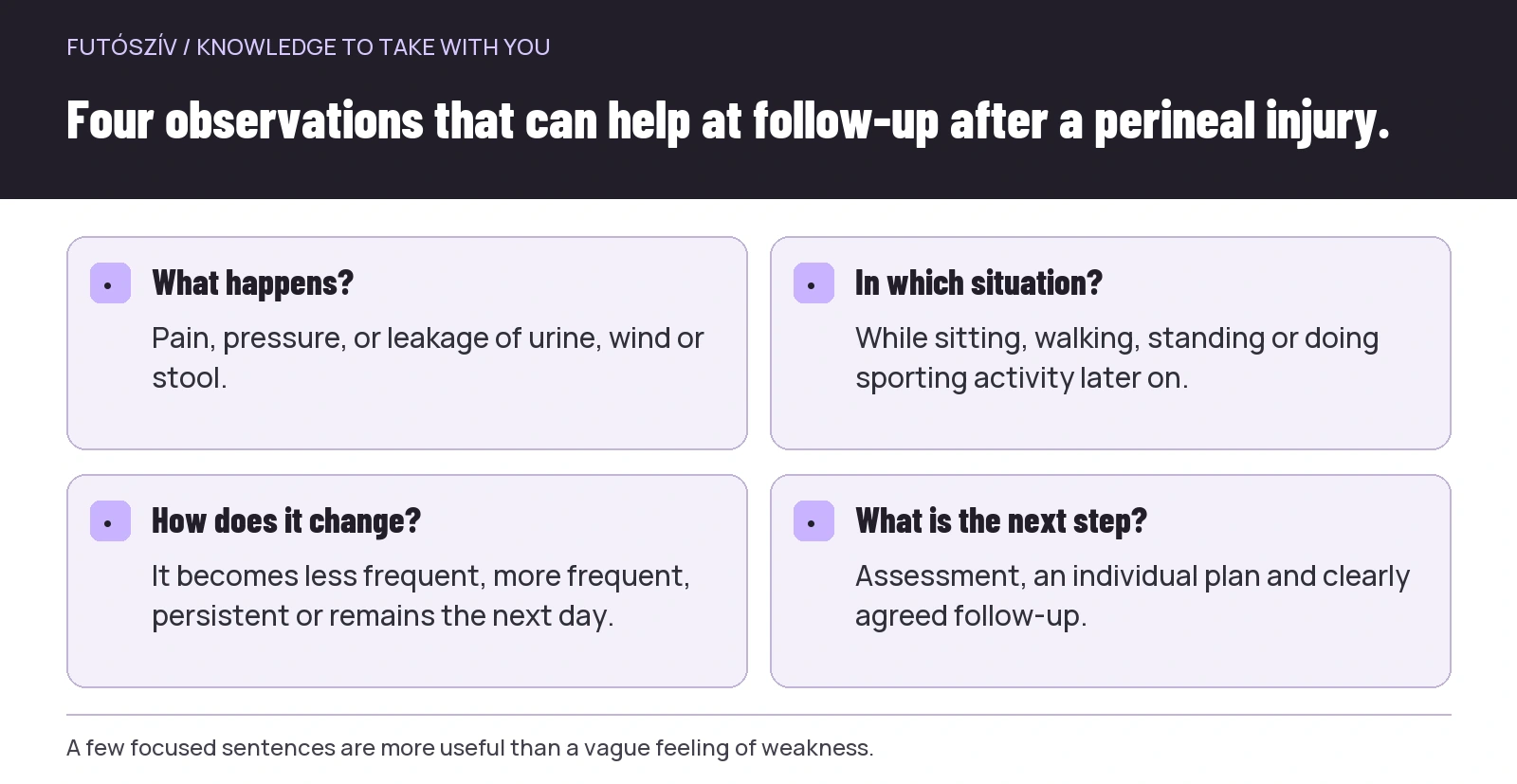
- What happens?
- Pain, pressure, or leakage of urine, wind or stool.
- In which situation?
- While sitting, walking, standing or doing sporting activity later on.
- How does it change?
- It becomes less frequent, more frequent, persistent or remains the next day.
- What is the next step?
- Assessment, an individual plan and clearly agreed follow-up.
A short observation sheet may help more than a ranking
Choose a few situations important to you: getting out of a chair, a short walk, standing for longer, using stairs or caring for the baby. Note when symptoms occur, what they are, how long they last and whether they change the next day. You do not need to monitor your body all day; a few focused sentences may suffice.
The sheet can have separate lines for wound symptoms, pain, pressure and bladder or bowel control. This prevents everything merging into a general “I am still weak” feeling. Together with a professional, it becomes easier to identify which changes matter and what needs to be followed differently.
Use your own starting point as the comparison rather than an internet progression ranked against other people. A harder day after a better week does not prove a permanent setback, but persistent or worsening symptoms deserve clarification. The diary supports discussion rather than replacing examination.
Plan how to stop before you run
When running becomes an option under your individual care plan, agree beforehand what constitutes an appropriate initial demand. A restrained, short trial that is easy to stop is a more sensible starting point than completing your former route. Terrain, distance and timing all form part of the load.
Plan what happens if continence difficulty, pressure or pain appears during the session. Where can you stop, how will you get home and whom will you consult? An easily accessible toilet is practical help, but does not replace care for recurring bowel or bladder-control symptoms.
Even if the first occasion feels good, monitor the later response too. Do not change duration, speed and terrain simultaneously. This also makes any symptoms easier to relate to the actual circumstances. Returning aims to build a form of movement that remains manageable later, rather than achieve a single successful trial.
Emotional concerns belong in the consultation too
Memories of a severe perineal injury, fear of an examination or sadness about losing running may need their own attention. The Australian clinical care standard highlights the importance of information, follow-up and addressing physical and emotional needs. You do not have to seek support only when the wound has a visible problem.
You can explain that movement reminds you of the birth, that you fear follow-up or that discussing continence symptoms is difficult. You can ask for a slower explanation, examination steps described beforehand and a separate opportunity to discuss what happened. Running can restore enjoyment, but is not responsible for resolving every birth-related difficulty on its own.
A concrete request may help your partner or running companion too: ask them to enquire about the support you need rather than your pace. A calmer follow-up, a symptom spoken aloud or a more comfortable day can be an achievement now. These can also rebuild confidence in sport.
Take these questions with you
- Exactly what injury occurred, and what care did I receive?
- Is the wound healing appropriately, or are further checks needed?
- Which assessment is recommended for my continence, pain or pressure symptoms?
- Which daily and sporting tasks can I do now, and what should be the next goal?
- Which changes should not wait until the next follow-up?
- Who will help monitor a gradual return to running and the response afterwards?
Accurate information and open discussion provide useful support when returning to sport after a perineal injury. Symptoms are not something to be ashamed of, and a deadline is not something you have to beat. Build a plan that genuinely makes room for your own function and decisions.
Sources
- RCOG: First- and second-degree tears
- RCOG: Third- and fourth-degree tears (OASI)
- RCOG: Perineal wound breakdown
- NHS: Episiotomy and perineal tears
- NICE NG210: Pelvic floor dysfunction – recommendations
- Australian Commission on Safety and Quality in Health Care: Third and Fourth Degree Perineal Tears Clinical Care Standard
How Futószív articles are prepared: our editorial guidelines.