Planning to run after a caesarean can easily become trapped between two extremes. One story says good fitness means you should return quickly; the other suggests your abdomen can never be a dependable partner after surgery. Neither story replaces following your own recovery. The type of operation, circumstances of the birth, complications, current symptoms and support at home together shape what you can manage now.
This article offers a framework for discussing running with your treating team and reorganising everyday life to support a later return. It does not override the individual instructions in your discharge summary. Getting out of bed in hospital, a short walk, shopping and the first jog are separate tasks: managing one does not automatically make the next one due.
What happened, and what instructions were you given?
When you return home, keep the discharge summary, wound-care instructions, medication details and follow-up contact information together. You do not need to become an expert in surgical techniques. It is useful, however, to know whether any circumstances require a different activity or monitoring plan from the usual one. If memories of your hospital stay blur together, ask for a plain-language summary at your next appointment.
Do not ask only whether you can exercise. Explain that you ran before, what kind of training you did and what your goal is now. Ten minutes of easy alternating walking and jogging is different from a steep trail race. A specific goal allows a more specific answer, including what might prepare you for running over the coming period.
If a restriction is unclear, clarifying it matters more than starting a general internet training plan. Note what it concerns: lifting, intensity, strain around the wound, work or another activity. Until your next follow-up, do not treat a friend’s previous clearance as your own.
The wound’s condition tells you more than the calendar
Follow your own healthcare provider’s wound-care guidance. Cleaning, dressings and checks may depend on the method used. The NHS guidance also emphasises monitoring the wound, comfortable clothing and recognising changes suggesting infection. At this stage, choosing running clothing is primarily about comfort, not reshaping your body.
Distinguish a waistband rubbing the area from a wound becoming increasingly painful, red, swollen or producing discharge. The latter needs healthcare advice, rather than a new item of clothing. Do not try to conceal the change with strong compression or use a training session to test whether you can tolerate it.
The scar’s outward appearance is not a complete assessment of your capacity for activity. A skin surface closing well is encouraging, but does not by itself establish readiness for repeated running steps. How you feel, how you function and your later response to activity also matter. If uncertain, discuss these together with a professional.
Why might different guidance mention different numbers of weeks?
The HSE guidance on exercise after a caesarean discusses high-effort activities, including running, separately from early healing and gives a waiting framework of several months. This is patient-education guidance, not an individual examination. A shorter time on another page often concerns general daily activity rather than the same running demands.
Do not therefore select whichever date you prefer from different guidance. Show your treating team what confused you and ask which conditions apply to progressing in your case. A date can help organise follow-up, but cannot examine your wound and movement for you.
The international expert consensus on return-to-running readiness after childbirth likewise highlights assessing individual circumstances and function; it did not establish performance thresholds applicable to everyone. The consensus is a shared professional position, not evidence for a single starting day that is safe for all.
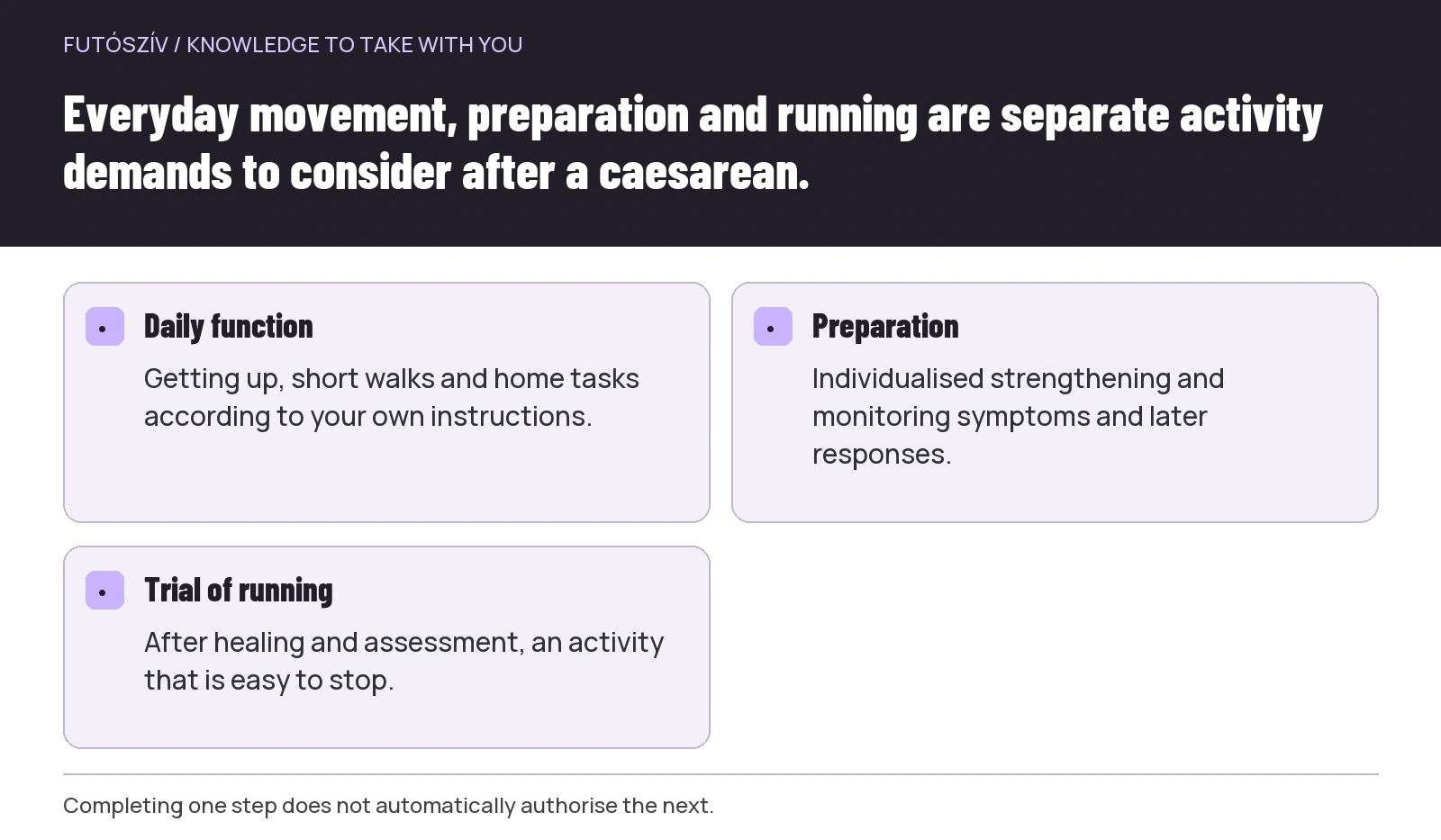 Enlarge diagram
Text version of the illustration
- Daily function
- Getting up, short walks and home tasks according to your own instructions.
- Preparation
- Individualised strengthening and monitoring symptoms and later responses.
- Trial of running
- After healing and assessment, an activity that is easy to stop.
First make the day at home manageable
Recovery after a caesarean does not take place in an empty diary. Caring for the baby, getting up at night, feeding and household tasks already use some of your energy. The HSE’s recovery guidance specifically notes that caring for a newborn can make resting difficult, so help forms part of the recovery plan.
Make a short map of home life. Where do you have to bend down low several times a day? Which object do you lift automatically even though someone else could take over? How many flights of stairs do you climb for a forgotten nappy? Putting frequently used things in suitable places can sometimes help more than buying another rehabilitation device.
Make requests for help concrete: someone could carry the shopping upstairs, collect an older child or prepare a meal. Gentle movement then need not consume the last minutes available for necessary rest. Organising time for running later will be an equally real task; the parent should not have to solve it alone through individual resourcefulness.
A short walk is an observation, not a test of strength
Many steps lie between early mobilisation authorised by the hospital team and running later on. The NHS recommends gentle daily movement during recovery without overexertion. This does not mean meeting a distance target in the first few days.
If your own instructions permit walking, begin with a simple situation: an easy way to turn back, predictable ground and accessible help. Do not try a longer distance, a heavy pushchair and a steep street all at once. It will then be easier to understand which circumstance caused a problem.
After the walk, record more than the time spent. How did your abdomen, wound area and pelvic floor feel during it? Did comfortable movement remain possible for the rest of the day? How did you feel that evening and the next day? If symptoms appear or increase, the next step is to discuss the activity and any assessment needed, rather than practise tolerating them.
The pelvic floor matters after a caesarean too
Not having a vaginal birth is no reason to ignore urinary leakage, a feeling of vaginal pressure or pain. These belong in an assessment before running even if you are mainly focused on the abdominal scar. Do not let the condition of one area obscure feedback from the others.
The HSE’s guidance mentions pelvic-floor exercises alongside gradually increasing activity. Correct technique and assessing individual symptoms matter more than ticking off a large number of repetitions. If you do not know what you should feel, or an exercise causes pain, seek appropriate physiotherapy help.
Give concrete examples at your consultation: urine leaking when coughing, pressure after standing for longer or pain around the perineum during movement. These provide more usable information than saying your core is not strong enough yet. Symptoms do not automatically mean losing running permanently, but they deserve attention.
Assessing the abdomen should not be a mirror test
Abdominal shape, scar colour and the size of your previous trousers are not suitable running-readiness scores. More useful questions concern how you function in everyday situations, what you feel during movements and which activity you want to resume. Assessment with a professional can accordingly involve more than comparing a single measurement or photograph.
Concerns about abdominal separation can also be clarified: are you worried about pain, finding a particular movement difficult or mainly troubled by appearance? These are different questions. Do not independently begin demanding sit-ups to prove your abdomen is good enough, or regard every movement as dangerous because of an image on social media.
Adapt the task, position and difficulty of preparatory strengthening to your condition. The goal is not completing a former workout video as soon as possible, but learning and gradually loading movements to which you respond appropriately. The pace of progression can be discussed too; you do not have to guess.
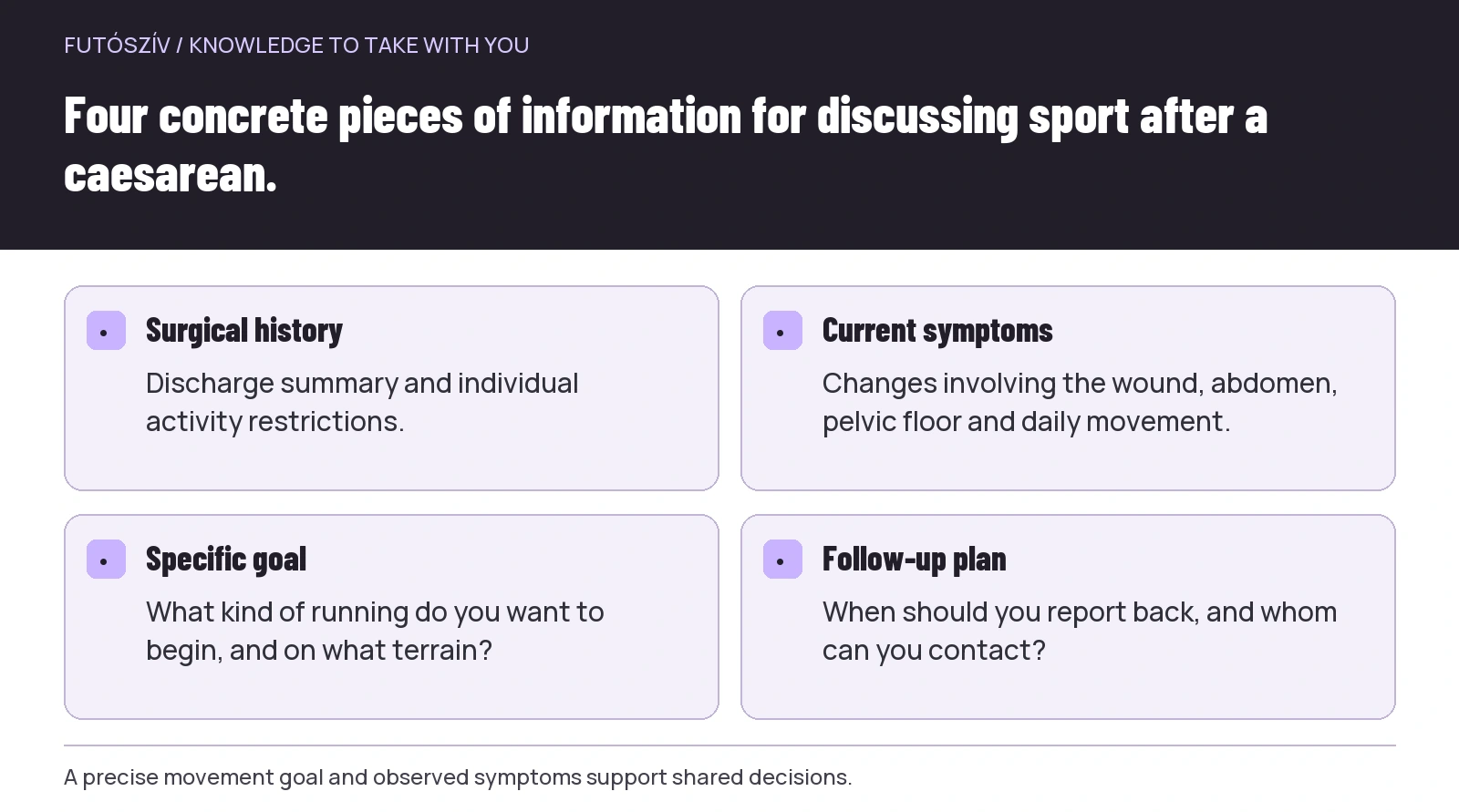 Enlarge diagram
Text version of the illustration
- Surgical history
- Discharge summary and individual activity restrictions.
- Current symptoms
- Changes involving the wound, abdomen, pelvic floor and daily movement.
- Specific goal
- What kind of running do you want to begin, and on what terrain?
- Follow-up plan
- When should you report back, and whom can you contact?
When jogging can begin to be considered
Make a concrete running plan when healing and individual assessment allow it. For the first occasion, choose a route that is easy to stop. Aim to gather information: how does your body handle that particular, restrained activity? Approaching your former pace is a less useful measure now than comfortable movement and the response afterwards.
Individually tailored alternation between walking and jogging can help you try a small amount. This still does not establish a starting ratio for everyone. Write down the treating clinician’s or suitably experienced return-to-running professional’s advice so that duration, terrain and stopping conditions are clear. Hiding pain will not make the next decision more accurate.
Do not test new shoes, a faster downhill section and running with a pushchair on the day of your first run too. Clear circumstances are easier to learn from. If the session goes well, allow the later part of that day and the next day to provide feedback before automatically adding another section.
Medication is not permission to train
Use medication prescribed after surgery as directed, and ask about it if you are breastfeeding or taking other products. Pain relief is not intended to make a painful run possible. If movement seems tolerable only with extra medication, tell your treating clinician before beginning the activity.
A walk also cannot replace treatment prescribed to prevent blood clots. Do not independently change the prescription because you feel more active. For medication questions, prepare a list of what you take, what is unclear and which sport you plan. This provides a better basis than a general running-group response.
At follow-up, clarify which symptoms should prompt contact before the next agreed appointment too. Keep the contact information in your phone rather than on a hard-to-find piece of paper. Reporting changes early is part of monitoring recovery, rather than unnecessary worrying.
Do not wait to collect a training diary’s worth of observations for these symptoms
The HSE recommends urgent advice for symptoms including fever, severe pain, heavy bleeding, unpleasant-smelling discharge or a wound that looks inflamed. Breathlessness, chest pain or painful swelling in a lower limb also require urgent assessment. For severe, sudden illness, calling 112 is appropriate; do not set off walking to prove it is merely poor fitness.
Complications can develop even in a body you know well as an athlete. Previously good endurance is no reason to minimise these symptoms. When receiving care, explain the recent birth and surgery, known complications and medication you take. An urgent warning is not simply a question of adjusting the next running plan.
Five questions to take to your next follow-up
- Which individual surgical or birth-related circumstances currently affect my movement?
- Which symptoms should I report, through which contact and how quickly?
- What can I do to prepare for running, and how will we recognise an appropriate level of activity?
- Do my symptoms require a pelvic-floor or musculoskeletal assessment?
- Under which conditions can we discuss the first jog and follow-up afterwards?
Choose an individual everyday goal alongside these too: for example, more comfortable walking or less demanding daily movement. Returning after a caesarean becomes easier to follow when you consider healing, life circumstances and sporting activity together. From there, you can gradually rebuild running’s place in your life.
Sources
- HSE: Exercise after having a caesarean
- HSE: Recovering after a caesarean
- NHS: Caesarean section – Recovery
- CUH: Your Recovery at Home Following Caesarean Birth
- Christopher and colleagues: Return-to-running readiness after childbirth, Delphi consensus, 2024
How Futószív articles are prepared: our editorial guidelines.