When standard running advice misleads
A common message in running is to start with less and add a little every week. Building load thoughtfully matters in many training situations, but this is not a recipe for every illness. In ME/CFS, or myalgic encephalomyelitis/chronic fatigue syndrome, worsening symptoms after exertion are particularly important. Past running performance, willpower and even a seemingly easy walk do not determine what can safely be managed.
This article does not provide a return-to-running plan. It explains why certain symptoms require setting aside the usual automatic progression and how to support someone without the community creating further pressure to perform. Neither a sports watch nor an online conversation replaces personal assessment and care.
What is post-exertional malaise?
The CDC’s clinical information describes post-exertional malaise, or PEM, as worsening symptoms after physical or mental exertion previously tolerated. The worsening is often delayed, typically appearing 12–48 hours later. This is a characteristic time range, not a home diagnostic cutoff outside which symptoms must have another cause.
PEM does not simply mean tired legs at the end of a workout. The person’s general functioning may decline and several symptoms may intensify. Feeling well during an activity therefore does not establish that the total demand was appropriate. Later effects matter too, not just whether the programme was completed.
The precise symptom pattern may differ between people. Not every symptom needs to appear in the same way, and it is not a running partner’s job to decide whether someone else is ‘ill enough’. Professional assessment that takes symptoms seriously matters more than comparison within a community.
Fatigue alone is not an ME/CFS diagnosis
The CDC’s diagnostic overview describes assessment based on a detailed history, understanding everyday functioning and considering other possible causes. Prolonged fatigue can have various causes; recognising PEM is not a diagnosis that can be made from one online question either.
For a medical discussion, it can help to explain what has changed compared with life before illness, which symptoms follow which activities, when they begin and how they affect self-care or work. Alongside previous weekly mileage, current everyday function matters. For some people, organising a shower, shopping or a longer conversation can already be a substantial task.
Do not automatically attribute new or severe symptoms to an illness already known. Chest pain, severe breathlessness, loss of consciousness or another immediately dangerous situation may require urgent care; call 112 in such a situation. This is separate from how persistent symptoms are investigated.
 Enlarge diagram
Text version of the diagram
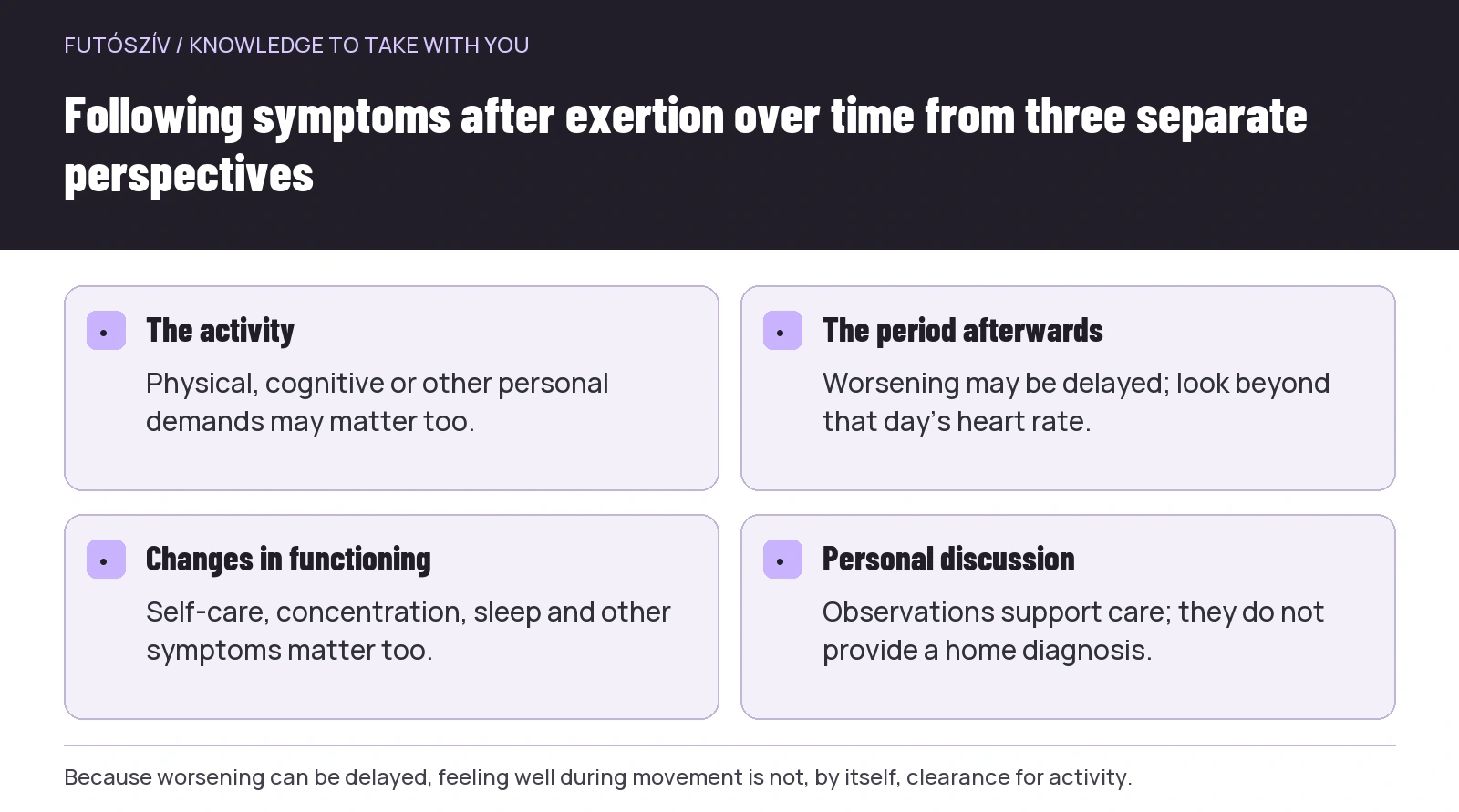
- The activity
- Physical, cognitive or other personal demands may matter too.
- The period afterwards
- Worsening may be delayed; look beyond that day’s heart rate.
- Changes in functioning
- Self-care, concentration, sleep and other symptoms matter too.
- Personal discussion
- Observations support care; they do not provide a home diagnosis.
Why is a mandatory weekly increase inappropriate?
The NICE NG206 guideline does not recommend programmes based on fixed incremental increases in physical activity for treating ME/CFS, such as graded exercise therapy as it defines that approach. The NHS treatment information also states that this method is not recommended. Renaming such a programme while retaining the same automatic increase rule is not enough.
For a runner, this can mean a practical change of direction. The calendar does not dictate that next week must be longer. A better day does not create an obligation to set another goal. Rather than following a number in an earlier plan, adapt to the person’s condition and appropriate professional support.
The aim is not to make someone more willing to ignore worsening symptoms. ‘Push through the barrier’ can be particularly misleading in this situation. Reporting symptoms is not a motivational obstacle for a coach to overcome.
Energy management is not a hidden training competition
The CDC describes individually managing activity, known as pacing, as one approach to reducing PEM. Its aim is to coordinate activity and rest while respecting personal limits. It is not a guarantee of recovery and does not mean completing more tasks every day than the day before.
Reviewing activities can concern the whole day. After a lengthy administrative task, movement called easy contributes to a different total demand than it would on a calmer day. The roles of cognitive, social and sensory demands are also worth discussing with the clinician based on personal experience.
Living circumstances strongly influence how workable activity management is. Not everyone can work less, hand over caring responsibilities or retreat to a quiet room. Theoretical advice may need concrete help alongside it. Do not label difficulty as poor cooperation when the person actually has no accessible choices.
What is worth recording if it is not too demanding?
A short activity and symptom record may help identify personal patterns. There is no need for a medical database precise to the minute. A few easily recorded elements may be enough: the main activity, symptoms appearing later, changes in functioning and help needed.
Let the person choose the format. It could be a few words, a voice note or an observation recorded together with a relative. If documentation is itself a significant burden, simplify it or find another method. A diary is not a test whose absence makes symptoms less real.
Do not turn the record into a homemade activity threshold. One good occasion does not establish that the same thing will be suitable every day. The information may support discussion with the clinician; it does not replace personal assessment or a necessary change.
Why are heart rate and a device score insufficient?
A running watch can easily create the impression that it measures the body’s entire condition. In reality, it records a few signals and makes estimates from them. A green recovery indicator does not rule out delayed symptom worsening, and a seemingly normal heart rate does not, by itself, provide clearance for activity.
Do not choose a universal ‘PEM-free’ heart-rate limit from an online formula. If monitoring has a role in personal care, discuss its purpose and interpretation with the clinician. The device’s cost and the burden of continually watching data matter too.
Switching from exercise to another activity may not reduce demands sufficiently either. ‘Then walk a lot instead of running’ is not a personalised solution. The value of a change depends on how it fits the individual’s overall condition and what later effects it has.
 Enlarge diagram
Text version of the diagram
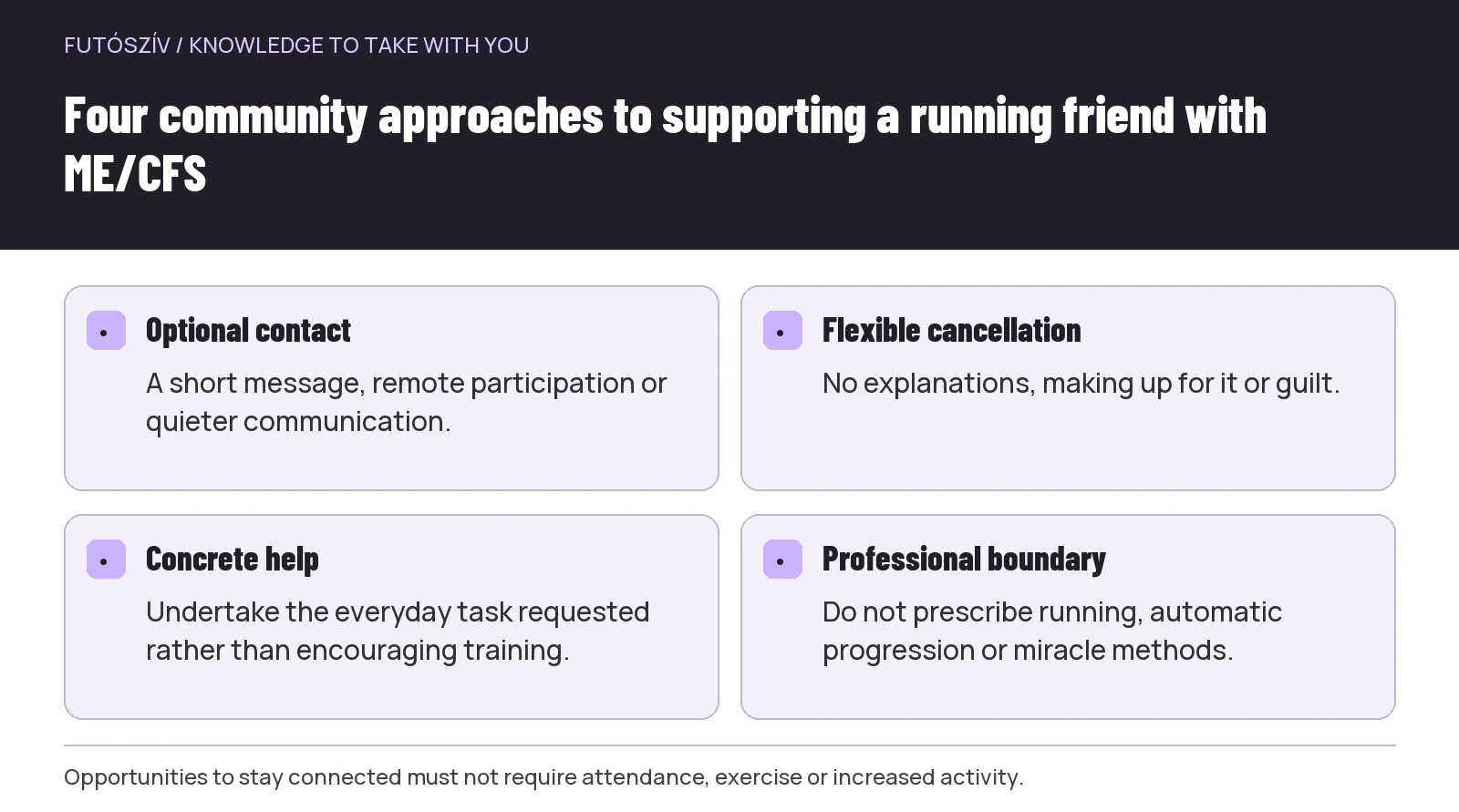
- Optional contact
- A short message, remote participation or quieter communication.
- Flexible cancellation
- No explanations, making up for it or guilt.
- Concrete help
- Undertake the everyday task requested rather than encouraging training.
- Professional boundary
- Do not prescribe running, automatic progression or miracle methods.
What can the running community do?
The first help may be not asking for a return date in every conversation. A former running partner can remain part of the community without training, racing or being able to attend in person. A short message, a chosen way to stay in contact and freedom over responding often offer more than another motivational challenge.
Do not organise compulsory ‘just come and watch’ occasions either. Travel, noise and social presence can also be demanding. Offer opportunities and accept a no or a later cancellation. The value of participation should not depend on the amount of movement involved.
Offer specific support only if you can actually provide it: collecting shopping, making an administrative task easier or a short discussion at the requested time. Ask what is useful rather than trying to cheer someone up with a surprise activity. Help should not require detailed disclosure of symptoms.
The size of a meeting can be a choice too
If the person wants to meet, do not start from the group’s usual schedule. Clarify the expected visit length, number of people, setting and how it can end without a special explanation. Do not turn a cancelled or shortened meeting into a guilt-inducing story.
A short voice message may work better than a phone call, or text may be better than meeting in person. The person need not choose the same format every time. A flexible framework for connection can spare them having to manage other people’s disappointment alongside their symptoms.
Review the help occasionally: is it still useful, is the timing suitable and does a task need adjusting? Support does not need to be spectacular. Reliably completing a requested task is often more valuable than a one-off grand gesture requiring new organisation from the person concerned.
A coach’s professional boundaries
A coach needs to recognise when ordinary sports planning is no longer enough. It is not their role to diagnose ME/CFS, promise recovery or override a treatment plan. If the person wishes, cooperation with the appropriate clinician can clarify whether and how the coach’s support has a role.
Past race results are not proof of suitability. Nor is another athlete with a similar diagnosis having already returned an appropriate argument. Different conditions, levels of severity and living circumstances cannot be compared on the basis of a social-media post.
If movement is considered at all, it should not be derived from a general running programme. NICE’s personalised approach adapted to the person’s condition is not the same as a mandatory return ladder for everyone. Changing or abandoning the next step can also be appropriate.
Staying connected to sport without running
Losing an earlier running identity can be difficult. There is no need to find another sporting goal quickly or rewrite the situation as an ‘everything happens for a reason’ story. The person can decide how much running content they want to see, whom they stay in touch with and when they would rather discuss something else.
In community communications, do not present a good day or brief appearance as proof of recovery. Ask for consent before sharing a photograph or story too. Someone may be present for a moment while the event’s later consequences remain invisible to an observer.
The most important community commitment is not a return deadline. It is maintaining a connection in which someone does not need to prove their place through performance, and seeking necessary medical help is not interpreted as a lack of commitment to sport.
Sources
- NICE NG206: ME/CFS and automatic activity increases that are not recommended.
- CDC: PEM, activity management and symptom worsening.
- NHS: the treatment framework.
- CDC: individual diagnostic assessment.
How Futószív articles are prepared: our editorial guidelines.