
A pulling sensation does not always call for more tension first
Many runners automatically bend down and stretch hard when the back of the thigh feels tight. But if symptoms began during sudden acceleration, a slip or an unusual movement, first understand what happened. Discomfort does not prove that the muscle is simply short. Forcing a painful test does not replace assessment of an injury.
With sudden sharp pain, a popping sensation, substantial swelling or bruising and difficulty walking, stop sport and seek healthcare help promptly. The NHS information on hamstring injury specifically highlights more severe symptoms and a worsening condition. In a serious accident or life-threatening medical emergency in Hungary, you can call 112.
This article does not diagnose a muscle tear or give an individual rehabilitation exercise dose. It helps explain which questions to ask about new symptoms, why the injury’s type and stage matter, and how returning to running can mean more than a pain-free stretch.
What does the back of the thigh include?
The term hamstring refers to a system of several muscles working along the back of the thigh and their associated tendinous parts. The everyday statement “I pulled my thigh” can cover many locations and levels of severity. Symptoms near the sitting bone, in the middle of the thigh or closer to the knee can have different histories.
The AAPM&R professional overview discusses muscle and tendon involvement in proximal and mid-hamstring injuries, alongside particular aspects of assessment and rehabilitation. Not all pain at the back of the thigh is the same injury. If you also have numbness, a radiating sensation or loss of strength, mention this separately to your healthcare provider.
Showing the location matters, but do not choose treatment independently from an anatomical map. The examiner also considers how the event happened, which function changed and what happened afterwards. Pain during stretching alone cannot tell you exactly which tissue is involved or to what extent.
Acceleration, slipping and gradual symptoms are different histories
Start with whether there was one moment you can clearly recall. Did you accelerate suddenly, take a large step, slip or make another movement? Could you keep going afterwards? If symptoms developed over days or weeks instead, report that accurately too. You do not need to fit every condition into a single classic sprinting injury.
What happened over the following hours and days matters in a sports medicine discussion too. When did bruising appear, did your walking change and which everyday task became difficult? Rapid initial improvement does not necessarily mean full function has returned. The early and later history provide information together.
If you cannot reliably remember the timing, say so. A guessed detail does not make the account more accurate. Previous injury, recent illness and changes in load may also come up, but you do not have to nominate a single definite cause yourself. The assessment aims to understand the real situation.
Be specific about the location as well: did it happen on a race course, a slippery trail or indoors? If someone saw the movement, their account may help recall the event. If there is a video, show the examiner the original recording; do not decide the injury type from a single cropped frame.
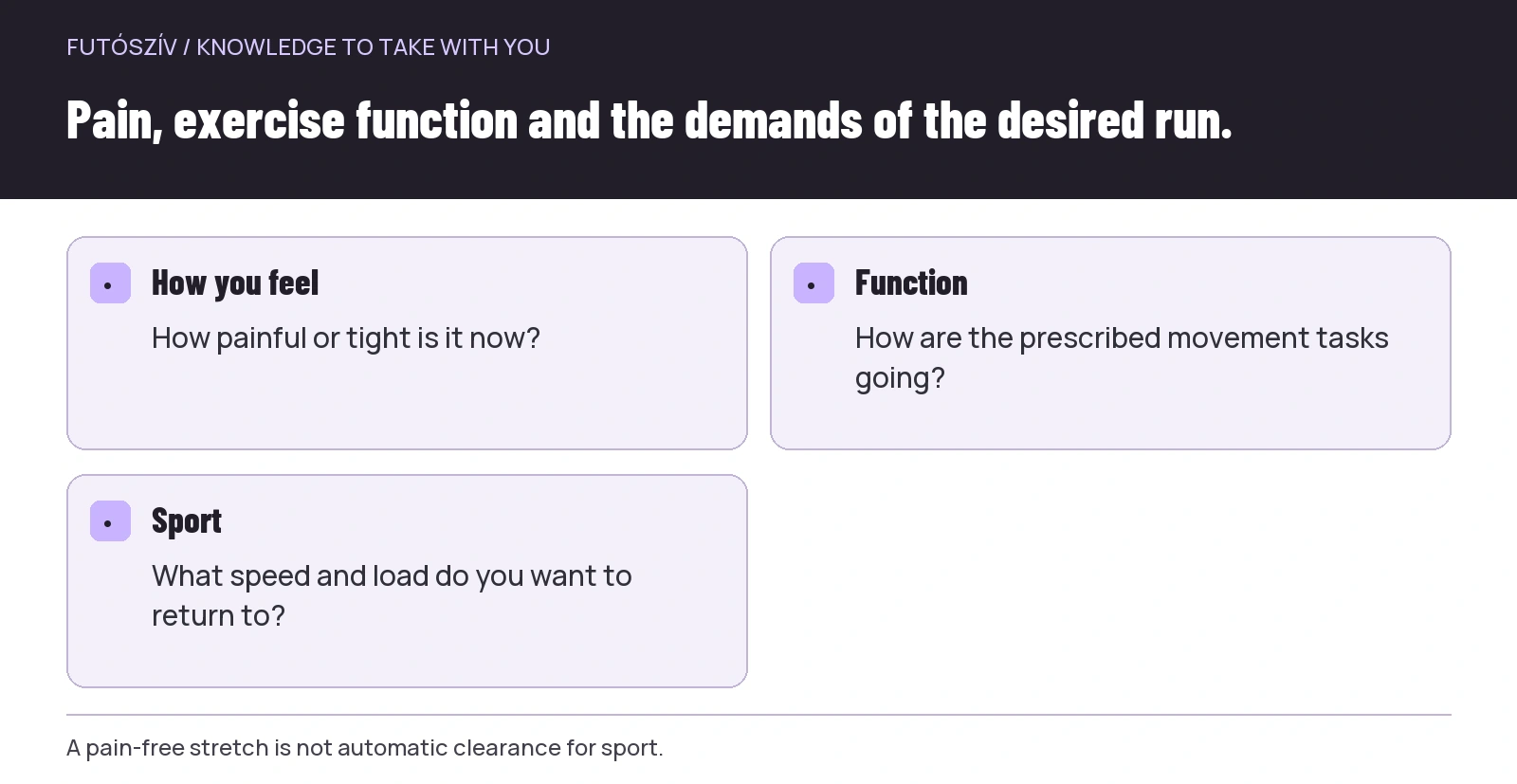 Enlarge diagram
Text version of the diagram
- How you feel
- How painful or tight is it now?
- Function
- How are the prescribed movement tasks going?
- Sport
- What speed and load do you want to return to?
Why does stretching have different roles at different stages?
A recent injury and later, specifically guided rehabilitation are different situations. The clinician chooses tasks according to symptoms, function and stage of healing. Neither “stretch every hamstring symptom hard immediately” nor “stretching never belongs in a programme” is therefore a sound general rule.
The 2022 JOSPT guideline discusses tolerated eccentric loading as part of a comprehensive programme alongside stretching, strengthening, stabilisation and progressive running. The list is not a menu to start at home in any order you like. Selection, timing and dosage require individual decisions.
If you are given a task, ask its purpose and which sensations or responses make it appropriate. Do not automatically seek the movement’s greatest attainable range. Demonstration and showing it back help ensure you are discussing the same thing. Forcing a painful stretch does not prove you are working more thoroughly.
Rehabilitation is more than restoring muscle length
Running also requires strength, coordination and adaptation to different movement speeds. The range achieved in a stretch is therefore not equivalent to readiness for running load. Completing a task successfully is important information, but does not tell the whole story about the next acceleration or longer session.
The London international consensus treats running and movement at the required speed as key elements of later rehabilitation, linking them to the demands of return to sport. This is an expert framework rather than a starting day or pace valid for everyone. A recreational runner’s goal can differ from a sprinter’s too.
Name your own goal with the clinician: comfortable jogging, a longer trail outing, intervals or accelerating at the end of a race? The rehabilitation plan needs to move towards the actual task you want to return to. You do not need to copy another athlete’s complete programme to prepare appropriately for your own goal.
Reduced pain and tissue load capacity are not the same measure
The AAPM&R overview highlights that, in some injuries, pain, strength and flexibility may improve substantially early on while following initial restrictions remains important. Interpret feeling better alongside the plan you have received. Ask not only whether it hurts less today, but also which loading boundaries apply.
The London consensus also discusses differing tissue involvement and particular features of certain tendon injuries. The precise type can influence protection and the return process. You do not need to select an injury category at home, but this helps explain why recovery times differ between runners.
An acquaintance’s quick return is not a good personal deadline. Plan according to your examination findings, function and response to load. Describe daily tasks outside sport as well: prolonged sitting, stairs or physical work, for example, can place different demands on you from a movement tried in the clinic.
What does discussing appropriate strengthening involve?
During eccentric loading, a muscle lengthens while producing force; the term is not the name of one specific exercise. Several variations may be considered in an individual programme. Which task you can perform appropriately and how you respond matter in the choice. An impressive exercise’s popularity on social media does not automatically make it suitable for recent symptoms.
The Nordic exercise often comes up in prevention discussions, and the JOSPT guideline also considers it as part of a comprehensive prevention programme. This does not mean everyone must start with it after an injury, or that more repetitions are always better. Prevention and treatment of the current injury are different questions.
Your physiotherapist and coach should see the same week: strengthening tasks, running and other sports must not add up unnoticed. Report a change in walking or a new symptom after an exercise. Modifying the plan may be a professional decision rather than a judgement on the quality of your work.
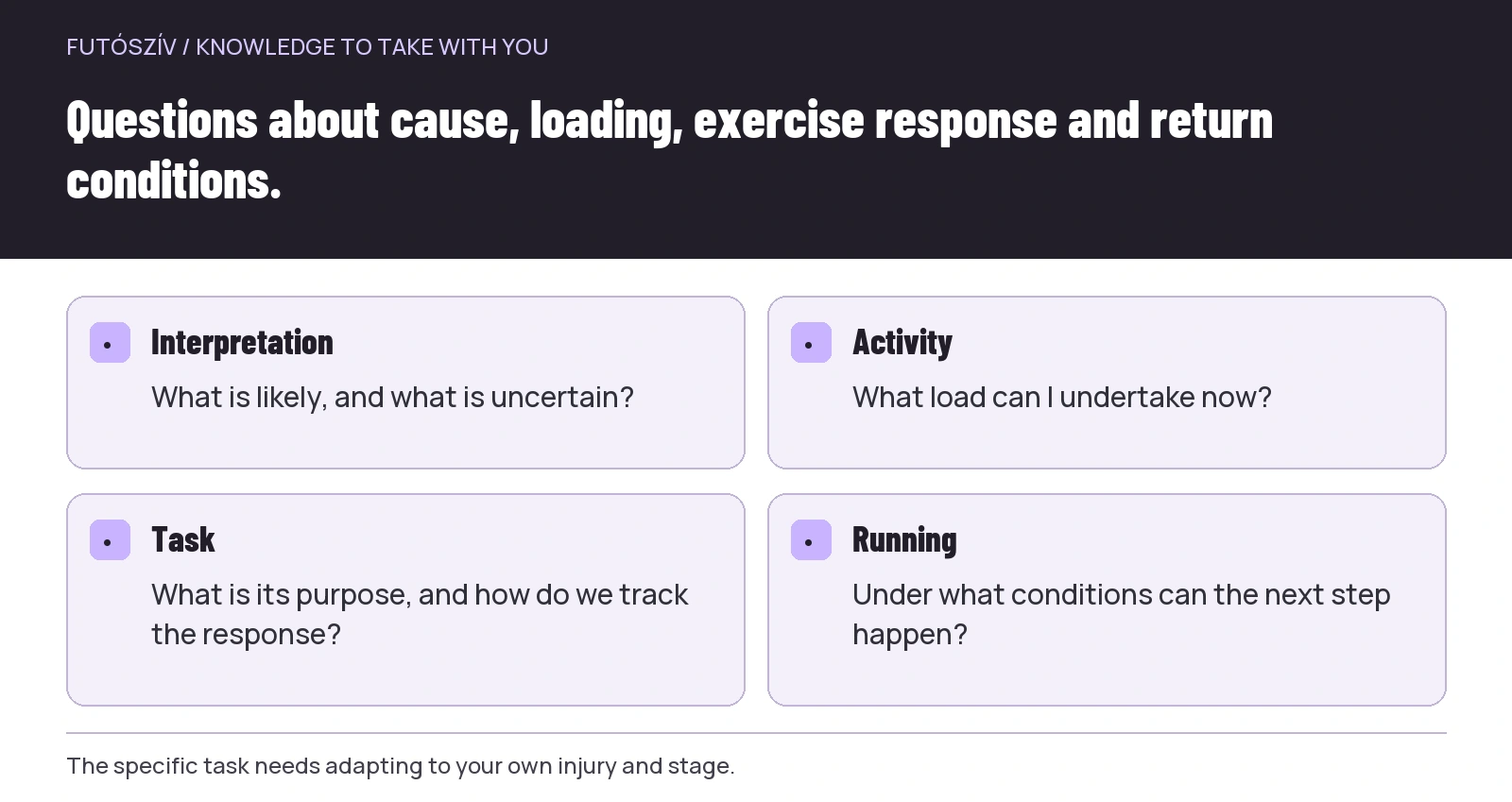 Enlarge diagram
Text version of the diagram
- Interpretation
- What is likely, and what is uncertain?
- Activity
- What load can I undertake now?
- Task
- What is its purpose, and how do we track the response?
- Running
- Under what conditions can the next step happen?
How should you describe the steps back to running?
When restarting movement, record more than distance. Pace, acceleration, uphill sections, surface and the spacing of consecutive sessions matter in describing the task too. If the clinician permits running, ask for an initial version with a clear limit and stopping conditions. Do not use your own maximal test to find your current boundary.
Pain-free easy jogging is not automatic permission to sprint. Equally, a successful short acceleration is not the same as the load of an entire race. The consensus statements emphasise the actual demands of sport and appropriate rehabilitation progression. The steps towards your own goal need individual development.
After the session, also record the later response: how did you feel, how was walking and how was everyday function? You do not need to keep testing with stretches to see how much of the symptom remains. A manageable diary aims to provide useful information for the next decision, rather than another daily performance obligation.
Keep previous injury history visible
The JOSPT guideline discusses previous hamstring injury as a reinjury risk to consider during return. This does not predict that it will definitely happen again. It means taking the earlier history and rehabilitation seriously, rather than remembering them only until current pain disappears.
Explain how far the previous programme progressed and what remained difficult. If you did not finish it, discuss why: lack of time, access, unclear instructions or new symptoms? These become organisational questions you can learn from. The next plan needs to work under conditions genuinely available to you.
After returning, ask what maintenance tasks and review may be appropriate in your circumstances as well. You do not have to spend your whole future anticipating injury. Appropriate information helps turn previous experience into clear, proportionate decisions.
Four questions for the next meeting
What is the likely cause of the symptoms, and what still needs clarifying? What load can I undertake now in sport and everyday life? What is the purpose of each exercise, and which response requires a change? Under what conditions can I return to the running I want? These four questions can lead to a workable plan.
A specific example helps: you want more than for it to “stop being tight”; for instance, you want a defined running format to become manageable again. Bring the history of symptom onset, previous injuries and responses to tasks so far. If you do not understand an instruction, ask for clarification and demonstration.
Symptoms at the back of the thigh do not always call for a stronger stretch. Understand the situation first, then select the appropriate task. The consistency you are used to as a runner can now be most useful in following a clear plan, providing honest feedback and making decisions suited to your condition.
Sources
- NHS: Hamstring injury
- JOSPT: Hamstring strain injury in athletes, clinical practice guideline, 2022
- London International Consensus on hamstring injuries, part 3: rehabilitation, running and return to sport
- AAPM&R: Proximal and mid-hamstring strain or tendon tear
How Futószív articles are prepared: our editorial guidelines.