
The meaning of a bleeding calendar also depends on the method used
If you use hormonal contraception, a bleeding day marked in a cycle app does not necessarily mean the same thing as in a natural menstrual cycle. General phase charts for running training can therefore be particularly misleading. First identify the method and regimen involved; only then can the observation be interpreted.
The CoSRH/FSRH guideline on combined hormonal contraception specifically explains that withdrawal bleeding during a hormone-free interval is not the same as physiological menstruation. This is an important conceptual difference. It does not mean bleeding or associated pain is not a real experience; it means it occurs in a different physiological context.
This guide does not select a contraceptive method or change a dosing regimen. It helps identify questions to clarify in a healthcare consultation, useful observations to record as a runner, and why bleeding alone cannot establish performance, hormonal health or adequate energy availability.
The word hormonal covers several different methods
Combined pills, patches and vaginal rings exist, alongside progestogen-only methods. Administration and the individual usage plan may differ. Another runner’s experience of their pill is not automatically relevant to your own method, and one product’s patient leaflet does not provide general rules for every preparation.
In a training diary, it may therefore be more precise to record starting a new method, a change to clinician-directed use or the appearance of a symptom. Do not copy an ovulation calendar designed for natural cycles into a situation where the method itself influences cycle function.
If you are unsure which category your preparation belongs to, a pharmacist or healthcare provider can clarify it from the name and packaging. You need not know the hormonal composition by heart. What matters is receiving information about the specific method relevant to your question.
Three separate questions: protection, symptoms and sport
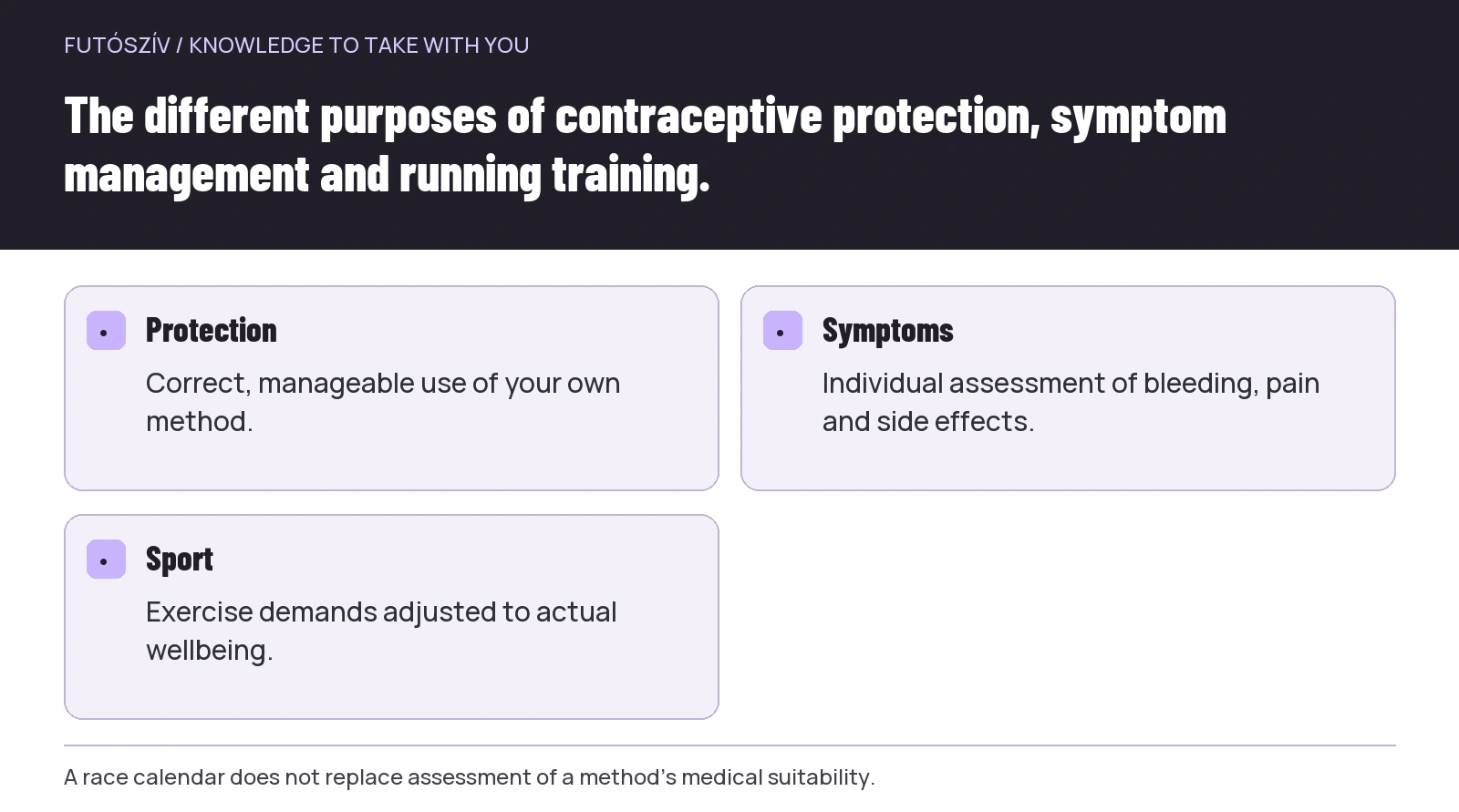
Safely maintaining contraceptive effectiveness is one question. Managing bleeding, pain, headache or another side effect is the second. Planning running training is the third. These may relate, but the first two should not be resolved on the basis of a race calendar or performance promise.
Explain your priorities clearly in the consultation. You want reliable contraception; a recurring symptom troubles you; you travel frequently; a daily routine is difficult to follow; or predictable bleeding matters to you. These are valid considerations. You need not justify your request solely by wanting to run faster.
Health history and personal preferences both matter in choosing an appropriate method. An option convenient for someone else may be unmanageable or unsuitable for you. Your sport-related needs are an important part of the conversation, but do not override medical suitability.
 Enlarge diagram
Text version of the diagram
- Protection
- Correct, manageable use of your own method.
- Symptoms
- Individual assessment of bleeding, pain and side effects.
- Sport
- Exercise demands adjusted to actual wellbeing.
What does a specific endurance study say about performance?
A 2024 study in endurance-trained women assessed participants with natural cycles and users of monophasic oral contraceptives. The final analysis included eleven and thirteen participants respectively. Tests at different times included a cycling time trial, sprinting and strength tests.
Most performance variables did not differ between the phases studied, although some results did show differences. Overall, the authors reported limited effects in this sample. This does not mean every hormonal method affects everyone identically and does not reliably predict a long running race.
The study cannot identify the preparation that makes you fastest. These were tests in small, defined groups, not a direct comparison of every method. If you personally experience symptoms, discussing them remains worthwhile even when a group average shows little performance change.
Bleeding is not a home test of adequate energy availability
The publication presenting the WTA female athlete triad protocol emphasises that with hormonal contraception, bleeding patterns do not directly reflect natural reproductive hormone function and energy status. Regular withdrawal bleeding therefore cannot establish that you are definitely eating adequately for extensive training.
Likewise, reduced or absent bleeding expected with a method does not alone mean REDs. Assessment requires knowing your method, previous patterns and other symptoms. Both simplifications are equally misleading: neither bleeding’s presence nor its absence provides a complete diagnosis.
Seek individual assessment for persistent fatigue, recurring injury, bone symptoms, substantial eating difficulties or another health change. Do not stop contraception on your own merely to check your cycle. Coordinating contraception and investigation is a healthcare task.
What is useful to put in a symptom diary?
Alongside the method and clinician-directed regimen, you can record bleeding days, troublesome symptoms and what changed in your running. If a headache made you shorten a session or your wellbeing worsened, name that directly. Do not automatically add that contraception definitely caused it; this can later be assessed together with your history.
Starting a new method, a new medicine, an illness or a large change in training load are important details. Explain if several things happened simultaneously too. A single bad session rarely identifies a definite cause, and improving performance does not establish a method’s suitability in every respect either.
Focus the diary on functioning: how troublesome a symptom is, how often it recurs and whether it affects work, sleep or sport. You need not upload intimate information to a whole-team platform for a consultation. You can retain details for the healthcare discussion.
Running fitness does not replace a method’s medical suitability
The CDC’s 2024 contraceptive eligibility guidance discusses different health conditions and methods separately. Migraine, blood-pressure problems, a previous blood clot, medicine interactions and other history can affect choice. Clinical categories are not intended for a runner to determine their own eligibility independently.
Good endurance or a low resting heart rate does not erase other risk factors. Share your history even if a sporting lifestyle means you do not think of yourself as ill. With a new health condition or medicine, ask whether the method needs reassessment.
A healthcare choice can have benefits and risks; the aim is not to avoid every hormonal option through fear. It is a decision suited to you and discussed understandably. Assess risk neither through the running group’s most frightening story nor a performance advertisement.
 Enlarge diagram
Text version of the diagram
- Purpose
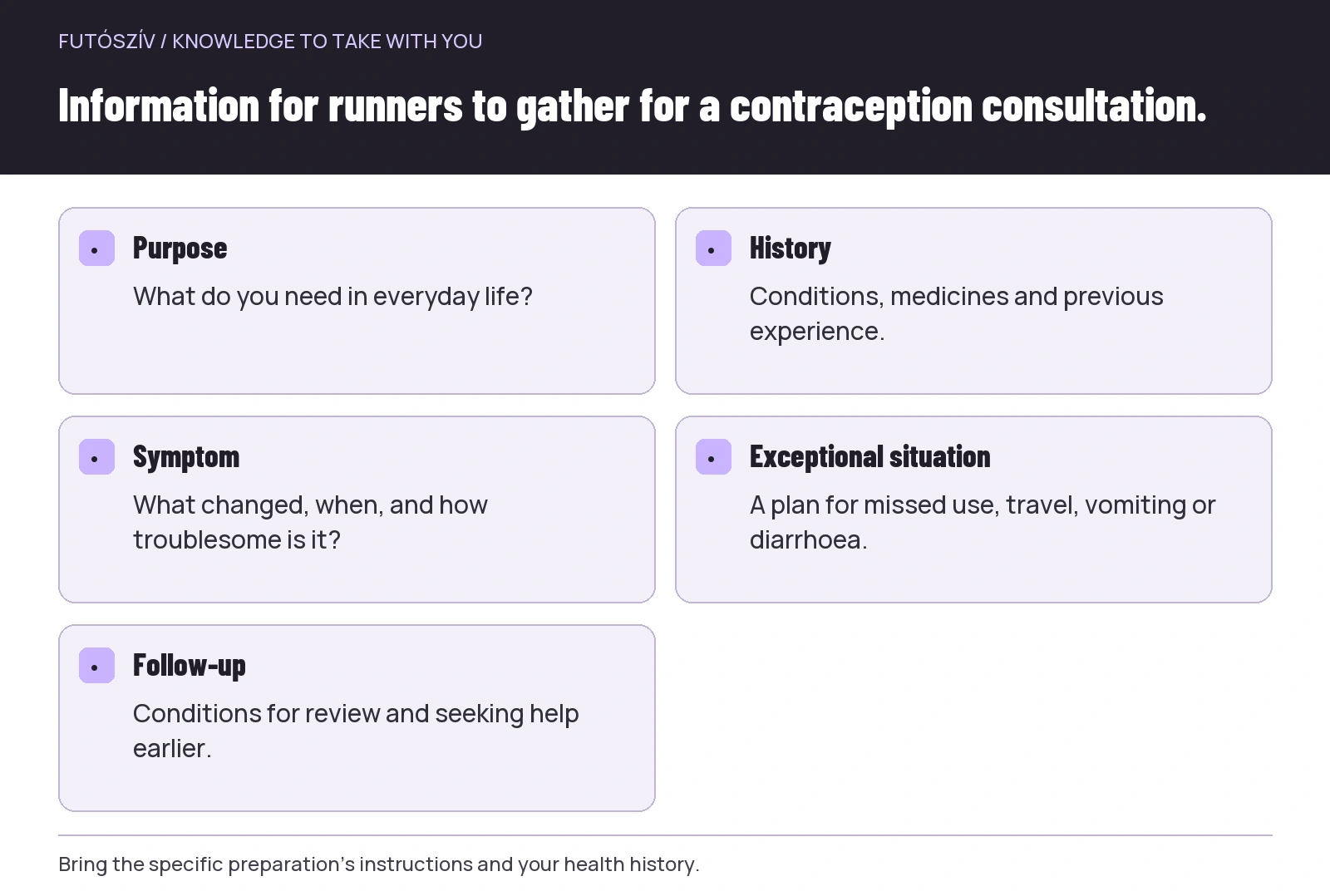
- What do you need in everyday life?
- History
- Conditions, medicines and previous experience.
- Symptom
- What changed, when, and how troublesome is it?
- Exceptional situation
- A plan for missed use, travel, vomiting or diarrhoea.
- Follow-up
- Conditions for review and seeking help earlier.
Races, travel and digestive symptoms: plan use too
For a long journey, carry the specific preparation, its instructions and access to a professional contact for questions. Time zones, delayed luggage or a changed daily schedule make routine mistakes easier. Clarify the solution beforehand according to your method’s rules.
The NHS provides separate information on vomiting and diarrhoea with the combined pill, because these circumstances may affect reliable use. The procedure may depend on the preparation, timing and symptom duration. Do not follow rules for another runner’s pill quoted from memory.
If this happens, read your own patient leaflet and seek pharmacy or medical advice promptly if necessary. Questions about additional protection or urgent action need resolving in time. Post-race vomiting is not solely a recovery problem when use of an oral contraceptive is also affected.
Bleeding and other side effects: when should you discuss them again?
The NHS page on the combined pill explains that breakthrough bleeding and other changes can occur initially. This does not oblige you to wait silently through every strong or worrying symptom. Severity, novelty and individual circumstances determine when discussion is necessary.
If symptoms remain troublesome, discuss options with your provider. Changing the regimen or choosing another method may form part of a medical decision, but do not make changes independently the day before the start. Plans to influence bleeding and maintaining contraceptive effectiveness need handling together.
Seek prompt assessment for unusually heavy bleeding, severe pain or feeling unwell. Sudden chest pain, difficulty breathing, one-sided limb swelling or neurological symptoms may require emergency help. Do not automatically call a new, severe symptom muscle soreness, anxiety or post-training fatigue.
A consultation that leaves you with a followable plan
- Purpose: what protection, symptom support and daily-routine solution do you need?
- History: previous conditions, migraine, medicines and other important health factors.
- Experience: what change have you noticed, since when, and how troublesome is it?
- Use: what should you do for missed use, vomiting, diarrhoea or travel with your own method?
- Follow-up: when should review take place, and which symptoms require earlier contact?
You can ask for the plan in writing or to repeat it in your own words. This is particularly useful if several methods were discussed. Followable instructions reduce the chance of later confusing rules for different preparations.
Share with your coach only what running requires
You can tell your coach you are monitoring wellbeing alongside a new healthcare plan or request more flexible training because of particular symptoms. Their role is not to recommend contraception, plan dosing breaks or diagnose hormonal status from bleeding. Clear professional boundaries protect the athlete.
Adjust the running programme to actual exercise tolerance and symptoms. If you feel well, a general cycle diagram need not automatically make you hold back; if unwell, a favourable app signal does not oblige you to train hard. Contraception is a personal health decision, and running can remain ambitious and enjoyable while respecting it.
Sources and further reading
- CoSRH/FSRH: Combined Hormonal Contraception guideline, amended October 2023
- CDC: U.S. Medical Eligibility Criteria for Contraceptive Use, 2024, appendices
- Oxfeldt and colleagues: Influence of menstrual cycle phase and oral contraceptive phase on exercise performance, 2024
- WTA Multidisciplinary Education and Treatment Protocol for the Female Athlete Triad, 2025
- NHS: Side effects and risks of the combined pill
- NHS: Sickness or diarrhoea when taking the combined pill
How Futószív articles are prepared: our editorial guidelines.