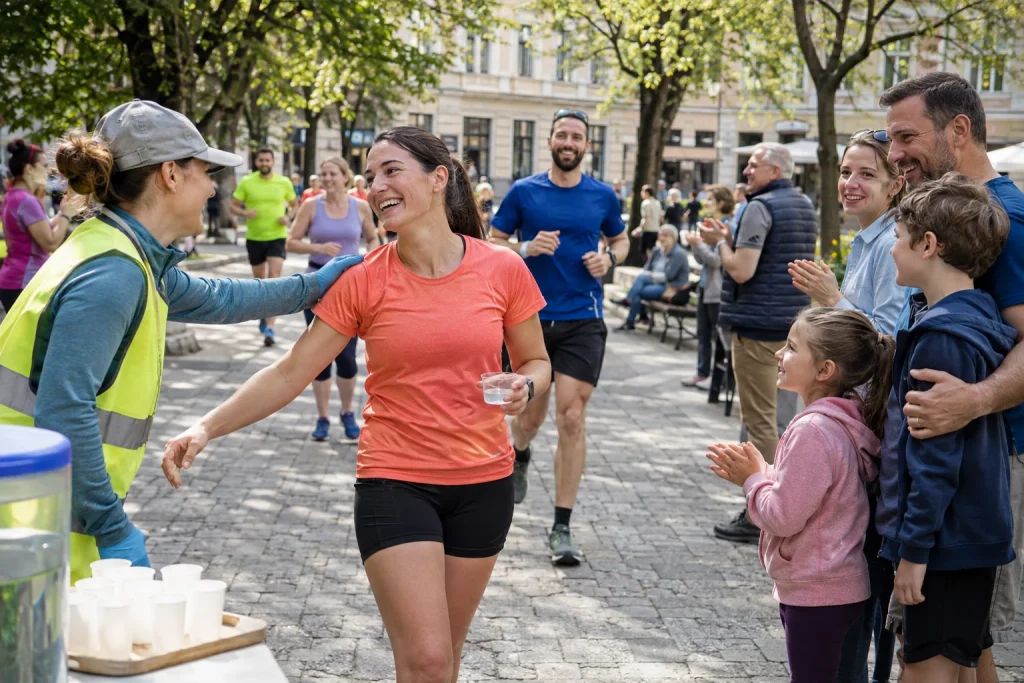
An urban running festival compresses several stories into one day. Leaders race for places, others pursue personal goals, companions support, volunteers work, and residents continue travelling and living in the same space. Community character does not arise simply from large numbers. It also comes from the roles and connections organised around running.
No single origin story applies to every city. Official New York, London and Budapest archives show differing paths. Highlight several well-documented changes: extending urban space, institutional links with charity and varied participation around a marathon. These examples are historical information, not next-year promises about old programmes.
In New York, the city became part of the course’s story
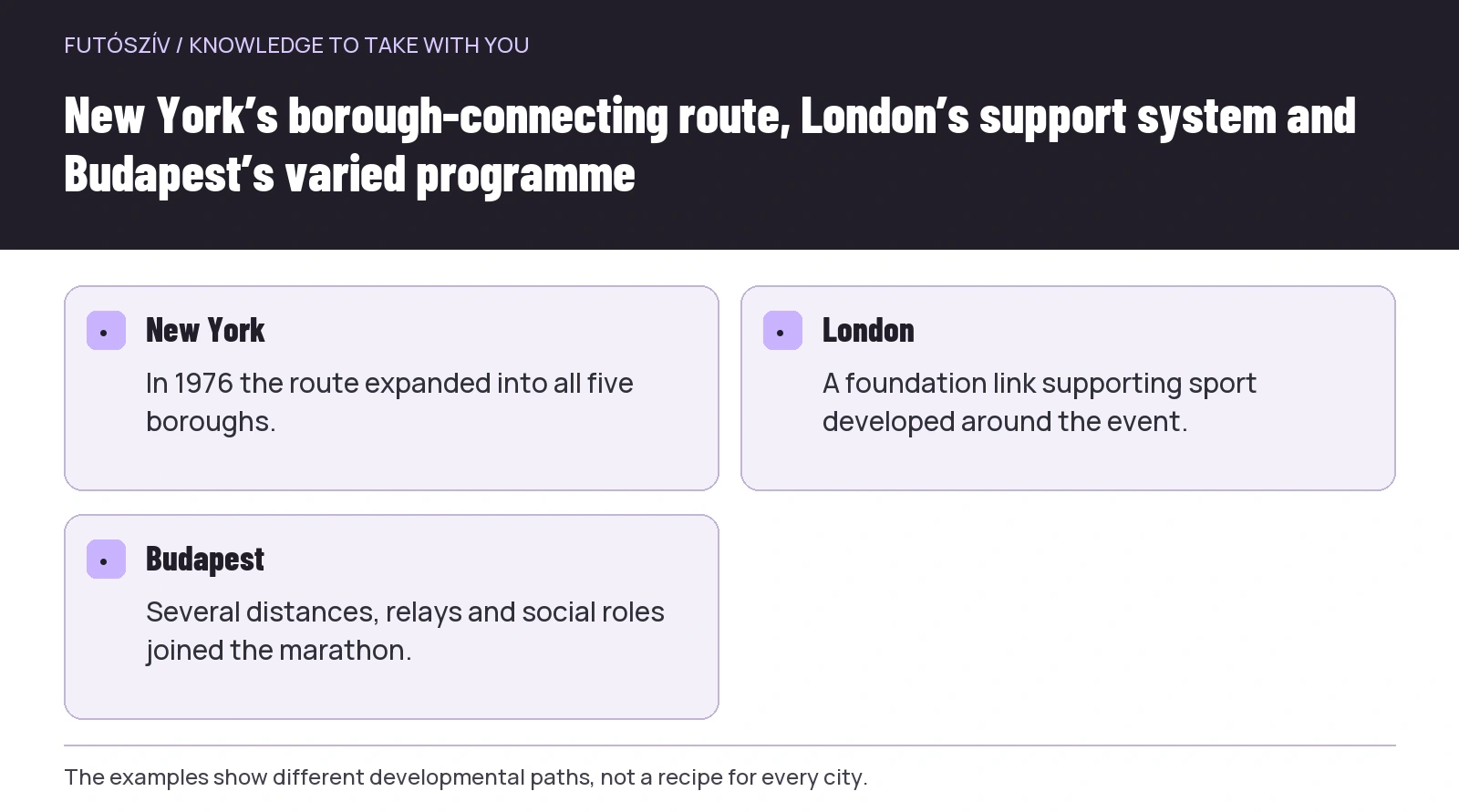
The New York Road Runners historical overview states that the first New York City Marathon in 1970 took place in Central Park. Of 127 entrants,55 finished. By 1976 the race covered all five boroughs, with the historical page describing a field of 2090 participants. This is more than additional runners: it visibly changes the event’s relationship to the city.
A repeating route inside a park and a race connecting boroughs bring the event to residents differently. New streets, support locations and local viewpoints can become involved. This does not establish equal enthusiasm among all residents or automatic economic benefit. Spatial change does allow running to be understood as a shared story connected to different city parts.
Read development through several questions. Who encounters runners who previously never saw them in their neighbourhood? What organisational tasks come with larger space? How does the city appear in event images? These are not splits in one individual performance, yet belong to why a race becomes an urban event.
The audience is more than a finish-photo background
A runner follows the designated route; spectators may connect to a place, person or community. One attends for family, another encounters the field in their street and another supports a club. These roles can coexist in a community event. Everyone need not pursue the same athletics aim.
This changes how a race should be described too. The winner’s result matters but does not alone describe the entire day. A support point, volunteer task or first shorter race is another kind of participation. Understand a festival accurately by making these visible alongside sporting results, rather than placing everyone in one ranking.
Spectator presence also needs organisation. People need to know where they can move, how to reach a point and where to meet a runner. Supporting’s community role is not helped by giving companions only an uncertain time estimate. Understandable activity beside the course belongs to urban running experience too.
 Enlarge diagram
Text version of the diagram
- New York
- In 1976 the route expanded into all five boroughs.
- London
- A foundation link supporting sport developed around the event.
- Budapest
- Several distances, relays and social roles joined the marathon.
In London, community funding aims connected to the event
The official London Marathon history dates the first race to 29 March 1981, with 6255 finishers recorded. The organiser’s account names New York’s inspiration too. This is a specific historical link between two events, not a requirement for every later city to build an identical event.
The London Marathon Group historical page also describes a foundation purpose supporting sports and recreational activities connected to event organisation. Using race-generated resources thus became more than a question belonging to the next start day. This particular British organisational system is a documented example, not a general rule to copy onto Hungarian events.
Separate runners’ individual fundraising from an organisation’s own grant-making. Both may surround a large event, but involve different financial flows and commitments. One participant running for charity does not describe the entire event’s financing. Precise information shows who raises or distributes resources, for what purpose and how.
Charity offers connection but does not replace sporting rules
Running for a personal cause can give participation meaning for people not following leaders’ results. Friends, colleagues or local communities can support a named aim. This connects individual completion with the social setting in another way. Every runner nevertheless need not fundraise for their participation to be valuable.
A charitable role requires precise information. The supported organisation, commitment and participation conditions should be understandable. Sporting rules still need learning. Membership of a fundraising team does not automatically exempt someone from entry, relay or course-use requirements.
As a reader, examine which information the source supplies. Planned fundraising and support actually delivered are different claims. Total money raised by runners and grants from organisational surplus are not interchangeable either. Precise wording lets a community story be presented with its actual meaning.
Several roles connected to Budapest’s marathon early too
The Hungarian Olympic Committee’s 2013 report based on organiser information gives 650 marathon finishers and 2400 starters across distances at the first Budapest Marathon in 1984. These figures do not compete: they describe different participation groups. That distinction alone helps show why the entire event and main marathon should be treated separately.
The same 2013 account discusses varied distances, relays, spectators, charitable initiatives and music points. These are historical elements of the 2013 programme, not automatically included services today. At one moment, the source shows sporting competition alongside cultural and social participation organised around the route.
The Budapest example is interesting because people could join event day in ways beyond the marathon distance. Shorter distances should not simply be interpreted as a marathon waiting room. They can represent distinct aims, programmes and participant circumstances. Festival community space broadens through room for different commitments.
The history of participation numbers needs the correct denominator
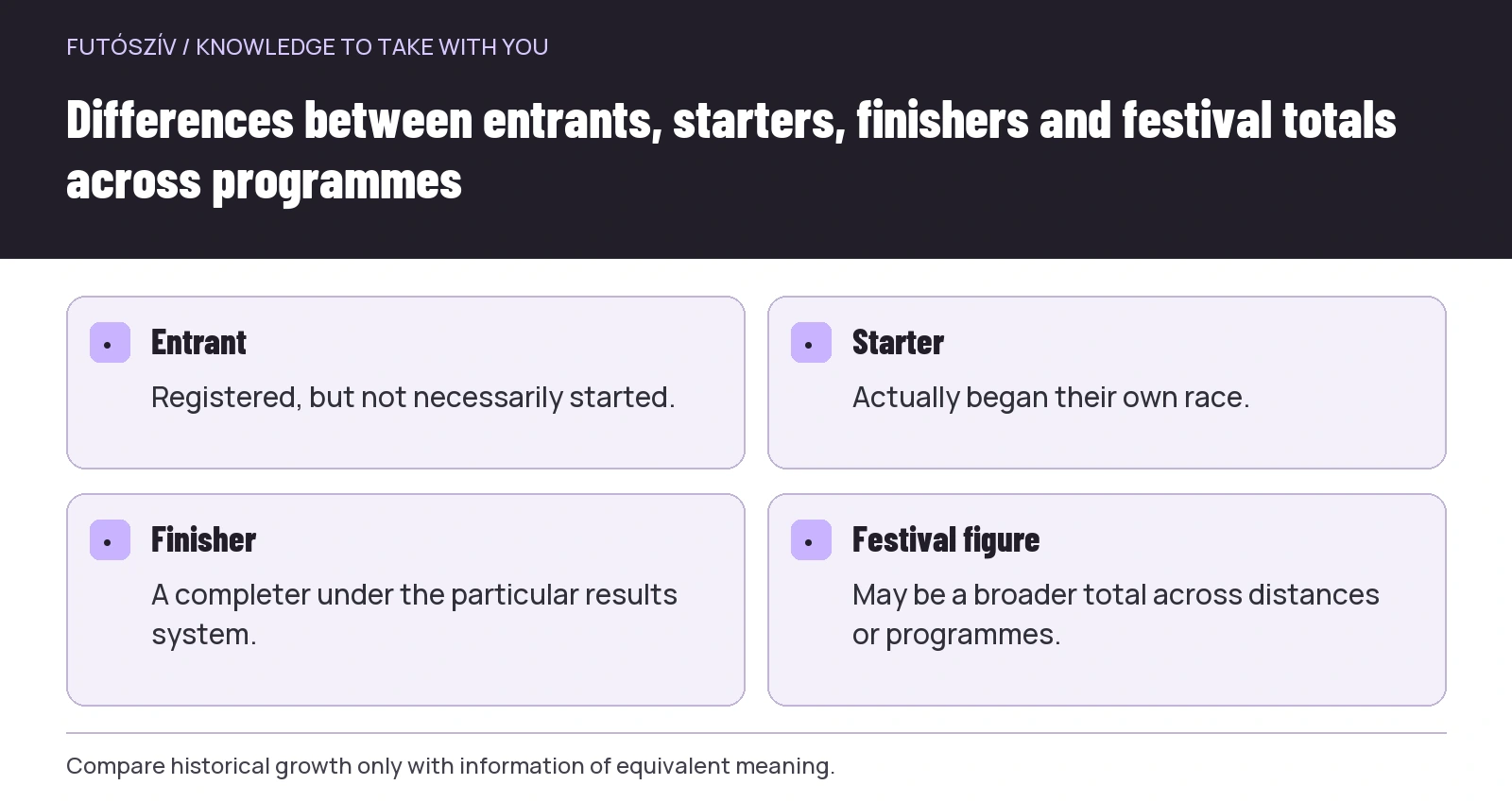
When reading about growth, check what was counted. Entrants, starters, finishers, relay teams or participants across all distances? In a multiday event, separate participations versus unique people may matter too. Similar-sounding large figures can have different definitions.
Comparing historical data requires aligning concepts. Early marathon finishers should not be compared with a later entire festival’s entries as though one indicator had grown. The difference can remain interesting if explained precisely: one describes main-event finishers, the other a broader programme’s participants.
| Historical figure | What does it describe? | Why does it differ from the others? |
|---|---|---|
| Entrants | Registered intent to participate. | Not every entrant necessarily starts. |
| Starters | The field actually beginning the race. | Not the same group as finishers. |
| Finishers | Completers according to the stated results system. | Interpret separately by distance and category. |
| Festival participants | The combined group across several events or activities. | Not automatically the individual marathon field. |
This precision does not reduce a large event’s significance. It preserves what the information actually establishes. Community development is also more than one number: expanding roles and connections can be examined where suitable sources exist.
 Enlarge diagram
Text version of the diagram
- Entrant
- Registered, but not necessarily started.
- Starter
- Actually began their own race.
- Finisher
- A completer under the particular results system.
- Festival figure
- May be a broader total across distances or programmes.
What makes a festival more than a large start?
As an original interpretive framework, examine four layers. The sports programme shows distances and participation conditions. The urban connection shows relationships to streets and residents. The social layer reveals companions, clubs and volunteers. The cultural layer connects locations, stories and accompanying activities. This is a reading aid, not an official grading system.
An event may be strong in one layer and restrained in another. Every small race need not have bands and citywide activities. The word festival alone does not establish answers to every participant need. Learn the specific programme and access conditions.
A quieter local event can have a community as strong as a major international weekend. Community character lies more in relationship quality and understandable participation. Large historical examples are not compulsory size models, but opportunities to recognise tasks individual organisers undertook.
Residents belong to the situation too
A street event temporarily changes traffic and space use. For runners, a road normally used by cars may become a special course. For residents or local workers, the same change may mean diversions and replanning. Both can be true together.
Understanding a community event therefore includes clear information and local perspectives. Sporting enthusiasm does not replace traffic information. If someone asks you as a participant, do not assume you know every route and closure; direct them to current official information or the appropriate on-site person.
Historical accounts often preserve celebratory images. These matter as documents but are not complete assessments of city functioning. A photograph full of spectators cannot establish every resident’s opinion, just as one traffic complaint cannot describe every participant’s experience. Build a many-sided view of a many-role event.
A fictional situation: one weekend from four viewpoints
At an urban running weekend, one person enters the main distance, a friend chooses a shorter event, another volunteers and a family member supports. This invented example is not a specific event programme. The four people create four schedules for the same day because their fixed tasks occur in different places and times.
The shared experience can arise from recognising these differences. A volunteer cannot leave a commitment at any moment; the shorter-distance runner has personal collection and start arrangements too; the spectator cannot necessarily reach every viewing point. They tie their meeting to a shared section genuinely workable in all schedules.
This everyday example returns to the historical question. An urban running festival can become a community event when different roles complement each other without requiring everyone to do the same thing. Race results and the day’s social meaning can remain important together.
How can historical examples inform your own priorities?
When considering a current event, ask about more than numbers or a famous name. Find the participation fitting your aim, how companions can connect and what is explained about the urban setting. Charitable or cultural elements can be assessed when their content and conditions are described specifically.
New York’s spatial opening, London’s community-support system and Budapest’s varied programme offer three viewpoints. None establishes one universal recipe. Their shared lesson is that the history of an event built around running is shaped by changes in places, institutions and participant roles alongside individual sporting results.
How Futószív articles are prepared: our editorial guidelines.