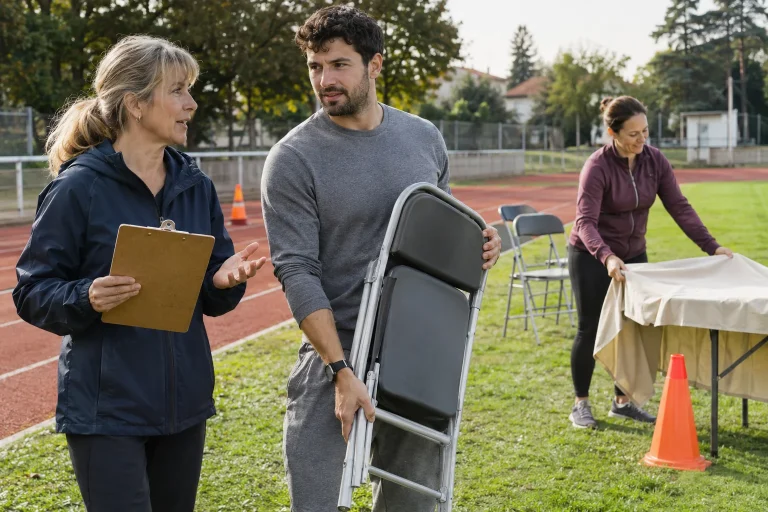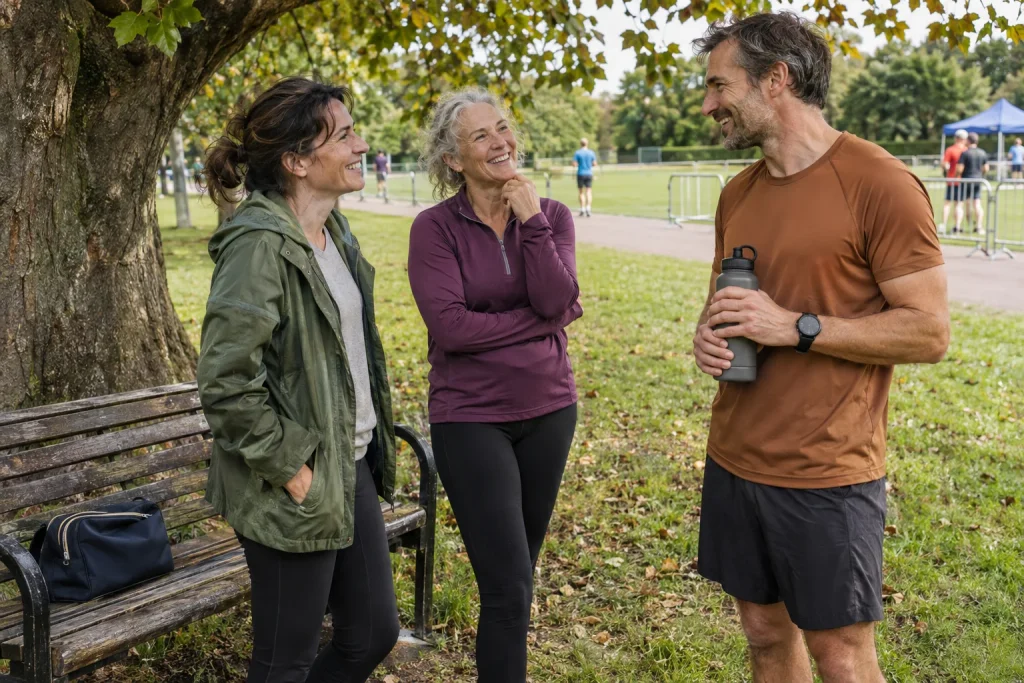
At the end of a small community running event, everyone often wants to head to the same place: the finish, their friends, their belongings and the group photo. Participants knowing each other does not make the site usable by itself. A post-finish gathering needs its own location, information and time frame. Completing the sporting activity and socialising can then support each other.
This article describes details of organising a community meet-up through our own fictional examples. It is not a complete crowd-management, medical or site-safety plan. The organiser must clarify suitability, access and necessary professional conditions with the appropriate people. Here we examine how ‘we will meet at the finish’ becomes an understandable part of the programme.
The finish line and meeting point serve different purposes
At the finish, an event may have timing, onward participant movement or other organisational procedures. A group wants to stop, talk and wait for one another. Do not automatically put both functions in the same place. A meeting needs a point actually reachable by participants and those waiting for them under the site’s arrangements.
Britain’s HSE distinguishes arrival, movement on site and departure within an event’s movement flows. We use this as an organisational perspective: people’s route after finishing needs planning just as their arrival at the start does. We are not applying British legal requirements to a Hungarian event, but recognising different purposes of movement. HSE: Put crowd controls in place
On your site plan, begin with routes rather than another decorative feature: where finishers go next, where waiting people approach from and how they later reach exits or other services. Detailed safety design is professional work. The first community-organising question is whether you are trying to use the same place simultaneously as a passage and a social space occupied for a long time.
Give it a precise name and recognisable location
‘Under the big tree’ is precise only while everyone means the same tree. A meeting point needs a description understandable to a first-time visitor. It may be a marked point on the site plan, an unmistakable building section or an information location designated by the organiser. Approach direction may matter too, particularly when access differs from another side of the site.
Use the name consistently in invitations, on-site signs and spoken information. If it is ‘community corner’ once, ‘club point’ another time and ‘photo wall’ later, people may not know these mean the same thing. Keep a simple location description beside a creative name. Participants should not have to decode a marketing idea just to find their way.
Check access from both the waiting person’s and runner’s side. A sign clearly visible beyond a barrier does not mean both can reach it. Use organiser information as the basis for precise access. Correct discrepancies found during checks before publication, rather than making an on-site volunteer invent an extra explanation.
 Enlarge diagram
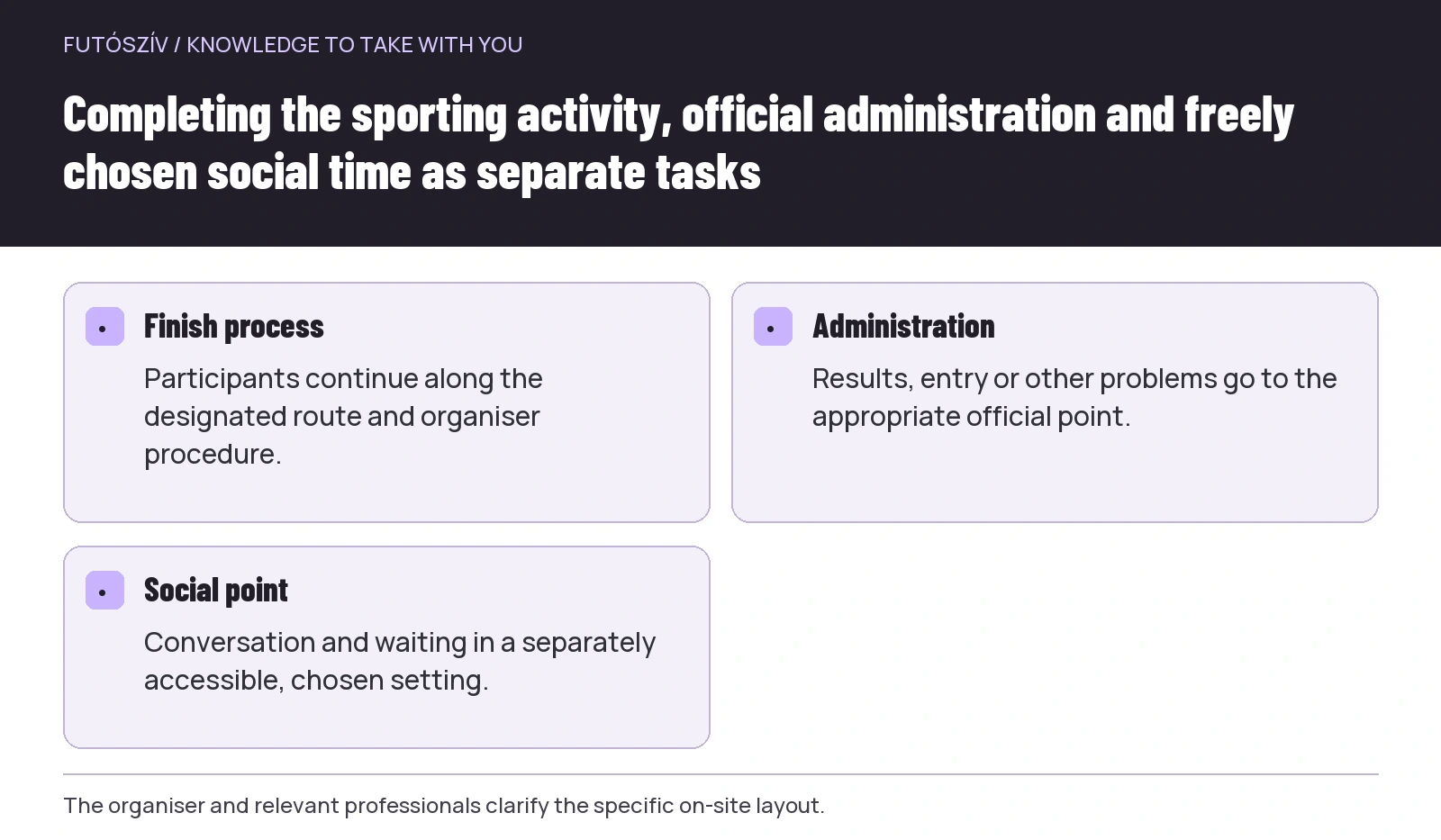
Text version of the illustration
- Finish process
- Participants continue along the designated route and organiser procedure.
- Administration
- Results, entry or other problems go to the appropriate official point.
- Social point
- Conversation and waiting in a separately accessible, chosen setting.
Give the programme opening and closing arrangements
A meeting point is not necessarily an all-day service. State when it operates, whether a contact person will be there and what closing means. Participants then know what to expect if arriving earlier or later. If finishes are spread over time, adapt the social programme to that rather than the first group’s clock.
Do not schedule a group photo or short welcome at a time requiring someone to hurry their own running programme to reach it. Not everyone starts together or chooses the same distance. You can offer several smaller meeting windows or a more flexible part people can join continuously. Explain the chosen format precisely and do not promise someone’s presence without agreement.
| Planning detail | What should participants know from it? |
|---|---|
| Opening | From when can they actually rely on the community point? |
| Contact person | Who helps them find the location and answers programme questions? |
| Shared element | When will an optional activity happen, and what will it be? |
| Ending | Until when does the point operate, and what happens afterwards? |
| Change | Where can updated information be found? |
Times should appear beyond participants’ invitations. The helper at the point, site manager and relevant provider also need to know the agreed framework. If one party expects a different time, the gathering can become uncertain on site. A short discussion behind the scenes can prevent much searching.
Keep meeting up separate from administration
A community point is not automatically a results-problem desk, lost-property office or medical station. One may be nearby, but keep roles understandable. The contact person should know which official place handles which question. They should not independently take on every matter arising after the run.
One sentence can help: ‘The community gathering is here; entry and results matters are handled at the designated organiser point.’ Fill in specific place names for the event. A participant then need not experience referral elsewhere as personal rejection. Separate functions also make the helper’s role more manageable.
When someone asks for help, first listen to the actual request. They may merely be looking for a friend, or may need appropriate professional assistance. Follow the organiser’s reporting arrangements. The social programme must not come before necessary help, and ‘come and join the photo first’ cannot replace it.
Do not make public participation the price of meeting up
A group photo, short introduction or account of the experience can be enjoyable, but should not be a condition of joining. Someone who does not want to appear in pictures or speak publicly may still enjoy meeting others. Make participation formats clear beforehand. Arrange use of images and recordings through the appropriate organisational process.
Conversation need not automatically begin by ranking finishing times. Some want to discuss results, others a section of the route, and others simply want to say hello and go home. An open question leaves different ways in: ‘What stayed with you most from today?’ If someone does not answer, do not immediately demand more stories.
Treat brief participation naturally too. Someone may need a train, have another family activity or simply a different time window. A community point works when leaving is also an understandable choice. Belonging to the group need not be proven by attending the whole closing programme.
Plan the day for those waiting too
Someone waiting for a runner may begin earlier and finish later than the shared meeting window. Clarify which site information they receive, where they may go and when to head to the meeting point. Do not simply tell them ‘you will see when they arrive’. A tracking app or brief phone call is not always a sufficient organising basis.
The official Bath Half spectator guide recommends a meeting point agreed beforehand and a backup alongside mobile contact. We use this as an example of coordinating a meet-up; we do not promise that overseas event’s locations or current services for your own occasion. Clarify specific Hungarian access separately. London Marathon Events: Bath Half Spectator Guide
Your own agreement might be that the waiting person stays at the known community point during a designated period, and the runner goes there after completing official procedures. If plans change, they use the same agreed channel. Both need not start searching for the other at once and miss one another again. Keep the backup simple and known beforehand.
 Enlarge diagram
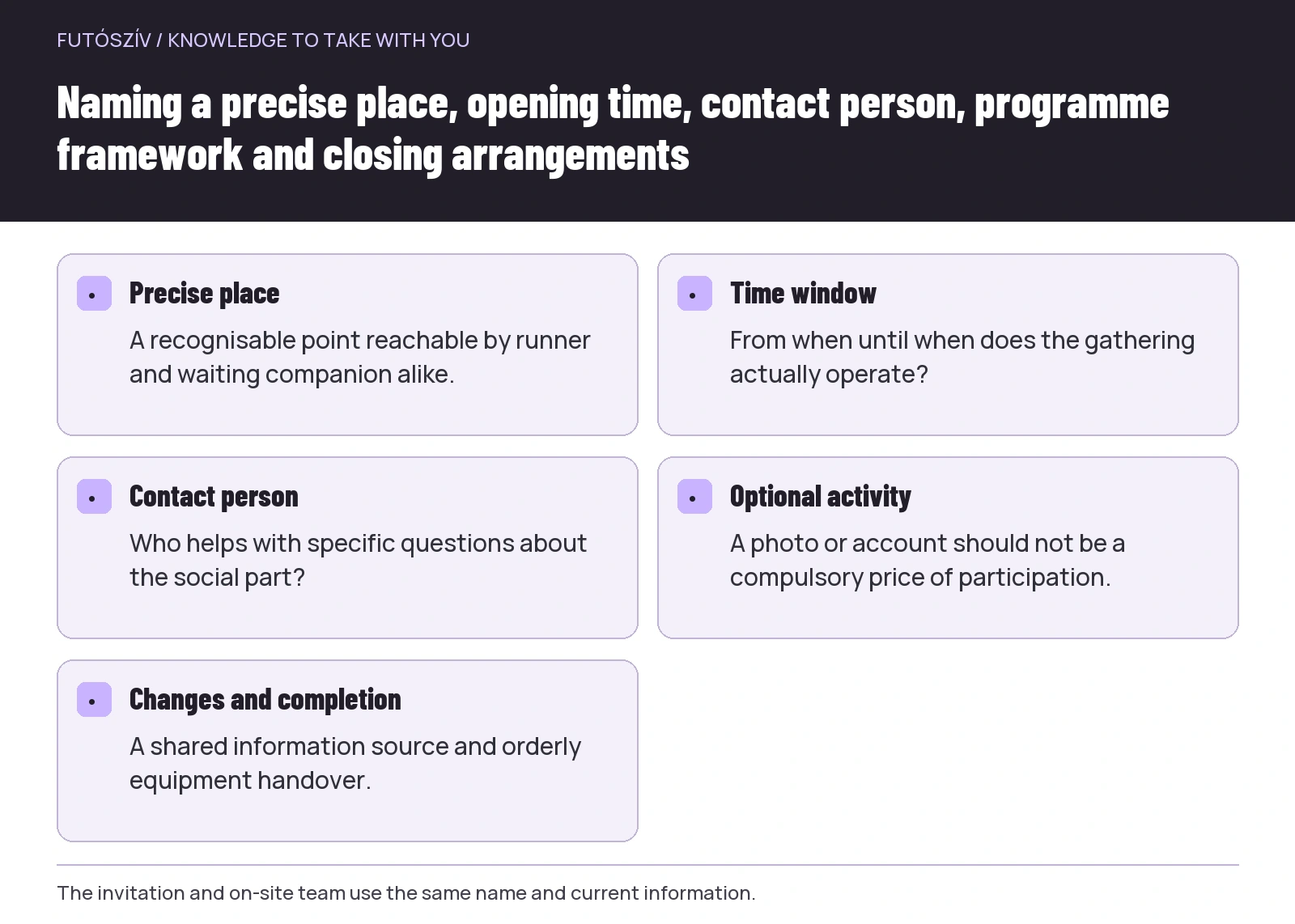
Text version of the illustration
- Precise place
- A recognisable point reachable by runner and waiting companion alike.
- Time window
- From when until when does the gathering actually operate?
- Contact person
- Who helps with specific questions about the social part?
- Optional activity
- A photo or account should not be a compulsory price of participation.
- Changes and completion
- A shared information source and orderly equipment handover.
Baggage and shared equipment are separate tasks
If bags, flags or other equipment are brought to the meeting point, organise storage and removal separately. A community point is not automatically supervised baggage storage. Participants need to know which service actually exists and what they must arrange themselves. Do not silently make a helper responsible for guarding every valuable.
Belongings should not occupy passage or waiting space. Arrange their exact position according to the approved site plan. Photo props, sound equipment and decorations are equipment too, with an owner and later return route. By the gathering’s end, there should be no uncertainty about who takes shared items home.
Offering refreshments or other provision requires separate appropriate conditions. Do not add catering afterwards while organising a conversation point. Arrange actual products, handling and information with the responsible person. The programme name should not promise a service whose operation is unresolved.
Do not send location changes separately to everyone
Rain, changed access or another reason may require a different meeting place. An alternative works only when its organiser and venue conditions are genuinely arranged. Do not vaguely point to a nearby covered space without knowing whether you may enter and hold the activity there. The updated information should include an approach understandable to spectators too.
Have a designated person approve the change and provide a shared information source. Helpers should say the same thing, while people reaching the old point receive directions under the agreed procedure. A private message to one participant may not reach everyone waiting. Familiarity within the group does not replace clear change notifications.
Dropping the activity may also be appropriate when necessary conditions are absent. You need not hold the group photo or conversation at any cost. Make clear that the point is no longer operating and where further official information is available. Uncertain improvisation can cause more difficulty than a clearly communicated simplification.
A fictional example: three groups, one meeting point
An imagined small event includes short and longer running programmes and a group of supporters. The original plan has everyone waiting beside the finish line. Review shows that participant onward movement and service routes also pass there. Organisers therefore agree a separate community point with the venue that all three groups can reach.
Those finishing the shorter programme join freely, while longer-distance participants do not have to hurry for one early photo time. Supporters receive the point’s name and waiting arrangements beforehand. A contact helps with social questions and refers results matters to the designated organiser colleague. This example, without numerical or site-specific details, illustrates separating roles and routes.
At closing, the responsible person checks shared equipment and hands the meeting point back under agreed arrangements. Open matters do not remain buried in a private conversation. They note which approach description repeatedly needed explaining for next time. Social time thus also produces a usable organising lesson.
Make leaving as clear as arriving
At the end, be able to say where shared items went, when the programme closed and whether a designated contact remains. Someone leaving early should not take equipment others still expect to use. Anyone staying for a friendly conversation should know it may be a different arrangement from the organised programme. Respect the venue’s permitted time and procedures throughout.
When seeking feedback, ask about how the gathering actually worked. Did people find the point? Were opening and closing clear? Did social activity become confused with administration? One detail that can be improved may be more valuable than a general ‘the atmosphere was good’. Include the chosen change in the next plan.
A considerate post-finish gathering makes understandable space for different arrival times and participation preferences. Runners can complete their own programmes, waiting companions know where to find them and social space does not obstruct the operating event. The shared experience then comes from a freely chosen, clear opportunity to spend time together rather than a scramble beside the finish line.
How Futószív articles are prepared: our editorial guidelines.