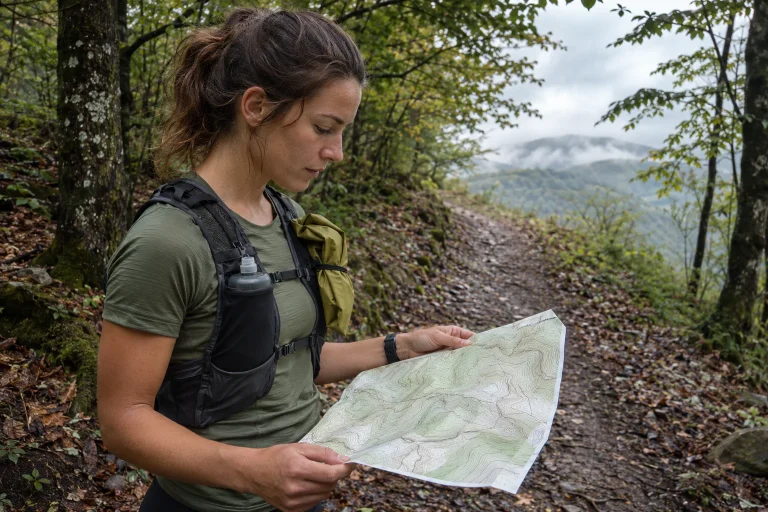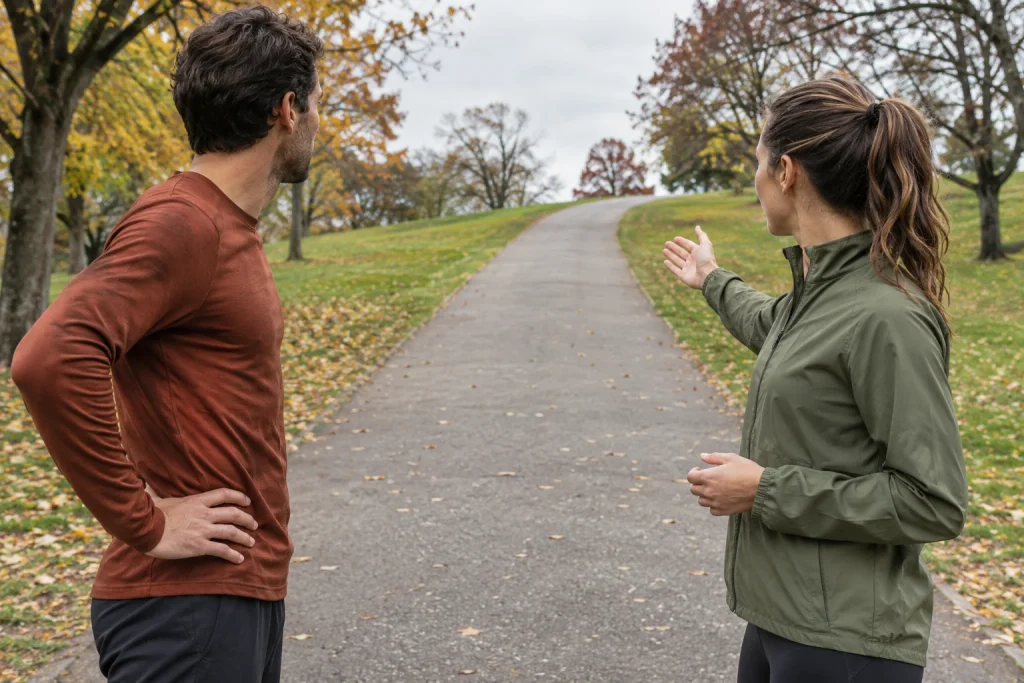
At the start of a hill, running may feel the same, but seconds later breathing reorganises. It may not simply be faster: the point within the step at which inhalation starts can change too. This timing question is less apparent in ‘two in, two out’ counting, yet may be part of movement–breathing coordination.
Phase describes when an event happens within another cycle. For runners it is an interesting observation, not another compulsory inhalation rule. We begin with original uphill–downhill research, then use timelines to separate phase, breath duration and changing exertion. This is not a ready-made hill-breathing programme.
Inhalation onset is a time point, not the whole breath
Imagine movement footage identifying foot contact and a breathing measurement identifying inhalation onset. The first can be time zero and the second happens later. Their difference is timing data. Alone it does not reveal air volume, inhalation duration or how demanding the whole run was.
In our illustration, inhalation starts 0.08 seconds after a right-foot contact. On another section, the delay is 0.20 seconds. We can say the event occurred at another time relative to the reference, without calling either favourable or unfavourable. That would require the whole stride and breathing conditions.
Defining onset matters in measurement too. Inhalation does not begin with an audible click; airflow or another signal identifies it. Foot-contact detection can also depend on equipment. Comparison requires a synchronised time base. A side-view phone video alone does not provide precise, complete breathing measurements.
What did the original nine-runner uphill–downhill study find?
Takano’s 1995 study recorded foot contacts and inhalation and exhalation onsets in nine experienced runners at comfortably selected steady speeds. In the coupled-rhythm conditions studied, inhalation began in the first half of the step interval uphill in seven participants and in the second half downhill in all. Exhalation onset showed no equally consistent relationship.
The work also described stride-to-breath ratios of 1:1, 2:1 and 2.5:1. Inhalation’s share of the whole breathing cycle did not simply follow the uphill–downhill condition. Onset phase and inhalation’s proportional duration are distinct data. This small observation does not prove that timing inhalation to a designated foot improves everyone’s performance.
The practical conclusion is modest but useful: adapting to terrain may appear in breathing timing as well as breaths per minute. Read this as observation. Turning it into coaching advice would require a separate intervention study and appropriate outcome. An observed pattern cannot become compulsory technique in one step.
Mechanical effects on the body can connect with airflow
Foot contact during running involves body acceleration and mechanical changes around the trunk. Daley and colleagues’ 2013 human study examined the relationship between steps and brief airflow changes in fourteen people. They observed different respiratory transitions at preferred and less-frequently selected timings at defined self-selected speeds.
This helps explain why phase matters. A mechanical effect occurs in a different respiratory state if inhalation starts elsewhere. The original work suggests movement and breathing are not wholly independent. General prescriptions for improved breathing-muscle work or long-term performance would nevertheless exceed what this short study directly established.
An original timing analogy: two people push a swing the same number of times but at different points. Counts do not describe the interaction; timing matters too. This is only a conceptual analogy, not a lung-mechanics model. It shows how two rhythms’ relationship can change at the same frequency.
 Enlarge image
An incline is not merely a tilted picture of flat ground
Moving uphill also increases gravitational potential energy. In our simple example, raising seventy kilograms by ten metres changes it by approximately 6,867 joules, using gravitational acceleration of 9.81 metres per second squared. This is not food energy consumed or total muscle work, but a distinct, clearly defined mechanical task.
Minetti and colleagues’ 2002 study measured metabolic cost across a wide range of uphill and downhill treadmill gradients in ten runners. Cost changed with gradient, and downhill was not simply uphill copied with a negative sign. This was an energetics study, not a breathing-phase experiment; we use it here to interpret the changed task.
Runners may adjust speed and movement on hills, while surroundings add differences. An uneven trail and a steady treadmill are not identical tasks. If breathing changes, first ask what else changed. Gradient can matter, but is rarely the only factor on an everyday route.
The same pace and similar effort are different comparisons
In the first version of our imagined trial, a runner maintains identical speed on flat and uphill ground. The hill changes demands, and breathing differences may reflect several adaptations. In the second, the runner slows uphill to maintain similar perceived effort. Speed and movement timing then differ too.
The trials answer different questions. One observes a new terrain condition at a given speed; the other examines reorganisation when the participant adapts by feel. Neither is a perfect independent laboratory test, but naming the question avoids attributing all change to one cause.
Record how pace was selected alongside breathing. ‘I held the same speed’ and ‘I followed a comfortable feeling’ are different statements. If confused, changing phase or frequency cannot later be interpreted clearly. Useful observation need not be elaborate, but preserves its conditions honestly.
The same milliseconds mean a different phase in a different cycle
Phase is often expressed relative to cycle duration. In our example, the selected step interval is 0.30 seconds and inhalation starts 0.06 seconds after contact: twenty per cent of the interval. If another situation has a 0.24-second interval, the same delay represents twenty-five per cent. Absolute delay stays unchanged while relative position changes.
Conversely, an event remaining at twenty per cent occurs at 0.06 seconds in the longer interval and 0.048 in the shorter. Phase stays constant while delay changes. This shows why reference cycle must accompany phase data. Milliseconds and percentages offer different views of one temporal relationship.
Inhalation duration is separate again. In an imaginary 1.5-second breath cycle, a 0.6-second inhalation is forty per cent. That does not locate its onset relative to foot contact. Proportion within the breath cycle and phase relative to movement use different denominators. This is a key detail to check in research diagrams.
Why does a phase change not prescribe an inhalation foot?
A pattern associated with a condition and an improving intervention are different things. Claiming benefit from inhalation timed to a particular contact would call for comparison with another timing under appropriate control. The endpoint also needs naming: comfort, lower breathing-muscle work or better overall running performance? One does not automatically establish another.
In our imaginary group, eight show one pattern and two another. Majority occurrence would be descriptive, not proof that the two should be retrained. Individuals may solve the task differently. Observation describes what happened; a teaching decision needs a separate aim and justification.
You do not need to decide which foot to inhale on before every hill. If natural timing changes while running remains comfortable, that may simply be part of the task. Understand surroundings and effort rather than forcing rhythm. The phase figures here are not inhalation targets.
 Enlarge image
Three situations worth recording separately
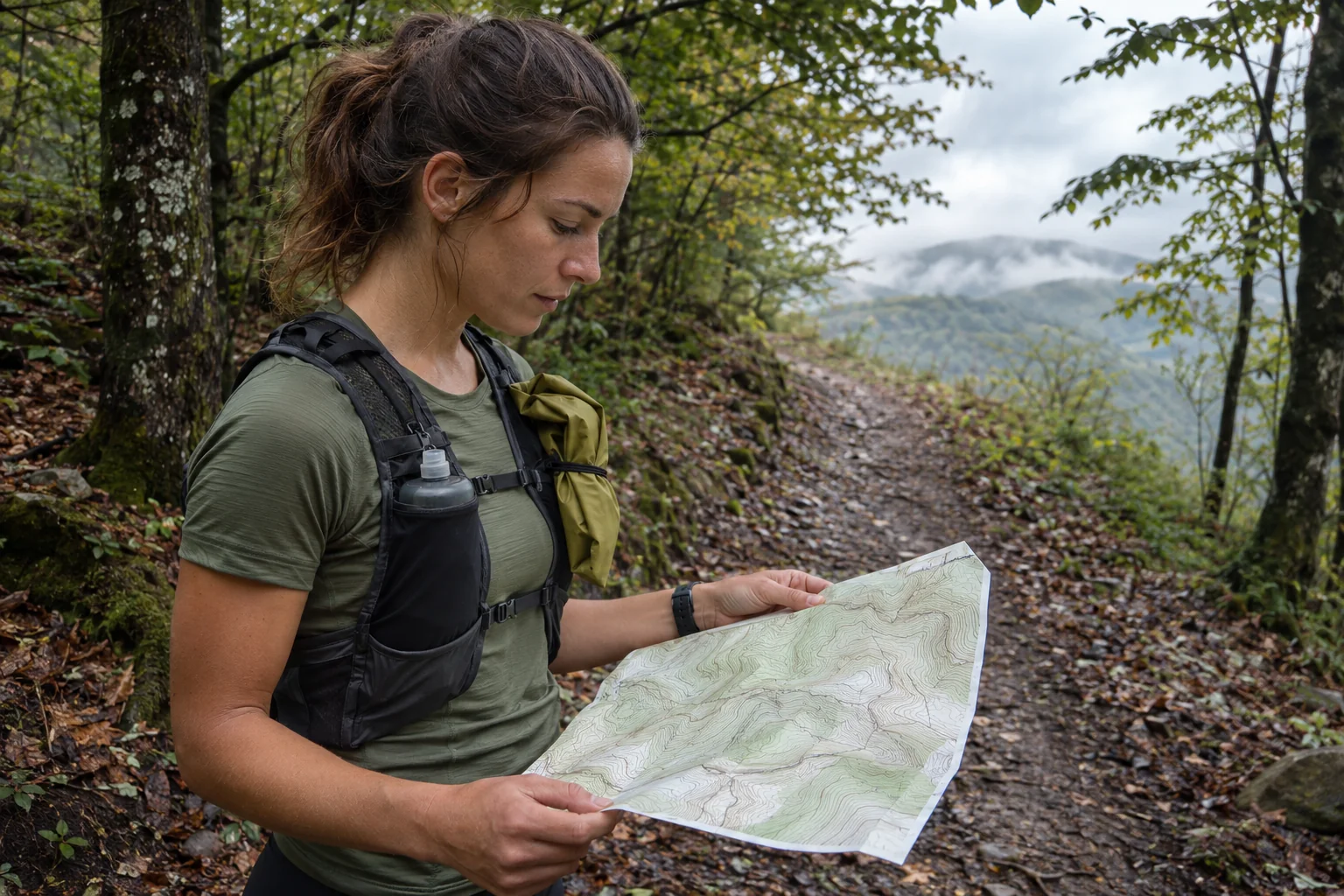
First is the familiar flat section: how was running before the hill? Second is transition: did you slow, shorten steps or stop talking? Third is the steadier uphill part. Three short descriptions distinguish the environmental transition from the sustained pattern. Every breath need not be recorded.
A useful diary sentence might be: ‘I held pace at the hill’s start, then slowed; breathing initially felt hurried and later settled.’ This observes feelings and movement without claiming precise laboratory phase or diagnosing disease. Applying the research concept would require suitably timed breathing and contact data. Everyday description still has value.
Self-observation must not distract from terrain. Especially downhill, do not search for inhalation times instead of the next secure step. Discussing experience after exercise may be a better starting point. Technical understanding helps when it clarifies a task, not when it adds ever more compulsory checks.
A symptom is not a phase error; observation is not diagnosis
New, apparently disproportionate or recurring difficulty breathing is different from timing relative to steps. The official NHS symptom information treats severe breathing difficulty and chest-tightness-associated symptoms as potentially needing urgent care. Stop running and get appropriate help; do not try to resolve the situation by continuing with a new breathing rhythm.
Forced uncomfortable inhalation timing is not a training goal to complete. We recommend no breath-holding, mouth taping or deliberate airflow restriction for hills. If observation causes dizziness, discomfort or lost attention to surroundings, release the task. This is not failure, but recognition that observation is not serving running.
Hills can therefore change more than breath counts: inhalation timing relative to a step may reorganise. Phase, duration and exertion are different concepts. Research clarifies their relationships rather than issuing a universal foot-linked breathing command. Personal experience becomes meaningful when it preserves route, pace choice and perceived task together.
Sources
- Takano, 1995: breathing phase on uphill and downhill gradients.
- Daley and colleagues, 2013: timing relationships between steps and airflow.
- Minetti and colleagues, 2002: terrain and metabolic cost.
- NHS: breathlessness and urgent symptoms.
How Futószív articles are prepared: our editorial guidelines.